wayground logo

Free Printable Worksheets

NEW

Font size

S
M
L
XL
Worksheets

2023 EOC Review

Total questions: 65

Worksheet time: 2hrs 0mins
Name
Class
Date
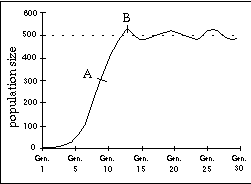
1.
What is the carrying capacity of the graph?
a)
around 500
b)
more than 500
c)
less than 500
d)
around 600
2.
A plant growing towards the light is an example of 
a)
reproduction.
b)
responding to a stimuli.
c)
metabolism.
d)
homeostasis.
3.
Where is the DNA found in a prokaryotic cell? 
a)
floating around in the cytoplasm 
b)
in the nucleus 
4.

Which cell does NOT have a nucleus?

a)

Prokaryote

b)

Eukaryotes

5.
Which of the following is found inside a prokaryote?
a)
cytoplasm
b)
DNA
c)
ribosomes
d)
all of these
6.
A population of peppered moths with a dark grey variation and a light grey variation lives in light colored birch forest. It is hunted by sight. Which statement is most likely true?
a)
there are equal number of light and dark grey peppered moths in the population
b)
more light grey moths survive than dark grey moths
c)
more dark grey moths survive than light grey moths
d)
all peppered moths will be eaten before they can reproduce
7.

Which statement BEST describes how limiting factors affect the organisms in an ecosystem?

a)

They destroy resources organisms need to survive.

b)

They provide what an organism needs to survive.

c)

They keep a population from getting too large.

d)

They have no effect on the organisms in an ecosystem.

8.
The graph shows how a finch population changed during the past 50 years. What can you infer based on the graph? 
a)
Thin-beaked finches prey on wide-beaked finches.
b)
Wide-beaked finches are better suited for life in an ocean environment.
c)
Thin-beaked finches are better suited to the environment in Burke Lake.
d)
Wide-beaked finches are better suited to the environment in Burke Lake. 
9.
Which part of the Cell Cycle takes the longest?
a)
Interphase
b)
Mitosis
c)
Prophase
d)
Cytokinesis
10.
What is the cell cycle?
a)
The gradual development of something, especially from a simple to a more complex form.
b)
The study of heredity and the variation of inherited characteristics.
c)
The branch of biology that deals with the relations of organisms to one another and to their physical surroundings.
d)
The series of events that take place in a cell leading to its division and duplication of its DNA to produce two daughter cells.
11.
What does DNA Replication mean?
a)
DNA is made.
b)
DNA makes new cells. 
c)
DNA copies itself.
d)
DNA starts the cell cycle.
12.
Which enzyme has the job of unzipping the double helix?
a)
Helicase
b)
Polymerase
c)
Ligase
d)
Primerase
13.
If a strand reads:
3' A A A T T T C 5'
The matching strand would read...
a)
5' T T T A A A G 3'
b)
3' T T T A A A G 5'
c)
5' A A A T T T C 3'
d)
3' U U U A A A G 5'
14.
This picture is illustrating the ____ nature of DNA.
a)
anti-parallel
b)
deoxyribosic
c)
helical
d)
radioactive
15.
The enzyme that splits open the DNA creates what's called a fork - where the DNA separates into the lagging strand and the ______ strand.
a)
leading
b)
leveraging
c)
Okazaki
d)
ligase
16.
A DNA nucleotide contains all of the following, except...
a)
Deoxyribose
b)
Phosphate group
c)
Nitrogenous base
d)
Cholesterol
17.
Sometimes, DNA is called "semi-conservative." Why might this be?
a)
The old strand is "conserved" and used to make the new strands
b)
Uracil is "conserved" in that it is only used to make the new strands
c)
ATP is "conserved" via the usage of facilitated diffusion
d)
Ligase is "conserved" in that it is denatured by the process
18.
Cancer creates abnormal cells by disrupting
a)
the cell cycle
b)
red blood cell formation
c)
DNA replication
d)
ATP synthesis
19.
Where the better adapted organisms survive to pass traits along to offspring.
a)
Evolution
b)
Natural Selection
c)
Extinction
d)
Artifical Selection
20.
Why are advantageous traits more likely to be passed onto offspring?
a)
Because they are more likely to survive and reproduce.
b)
Because they come from dominant alleles.
c)
Because they come from recessive alleles.
d)
Because the trait is an acquired phenotype.
21.

Mechanism of evolution responsible for a random change in a population is known as:

a)

Speciation

b)

Selection

c)

Genetic Drift

d)

Variation

22.

Temporal isolation occurs when two different populations:

a)

develop different mating behavior

b)

become geographically separated

c)

reproduce at a different times

d)

interbreed

23.

When two populations no longer interbreed, what is the result?

a)

genetic equilibrium

b)

stabilizing selection

c)

genetic drift

d)

reproductive isolation

24.

Which of the following contiditions is MOST likely to result in changes in allele frequencies in a population?

a)

no migration

b)

small population size

c)

absence of natural selection

d)

random mating

25.

Situation in which allele frequencies change as aresult of the migration of small subgroup of a population is known as:

a)

founder effect

b)

genetic bottleneck

c)

random mating

d)

natural selection

26.

Genetic drift is driven by chance, not Natural Selection.

a)

true

b)

false

27.
A sugar, a phosphate group, and a nitrogen base form the building blocks of which organic compound?
a)
carbohydrates
b)
nucleic acids
c)
lipids
d)
proteins
28.
Which of the following is the template for the production of RNA within a cell?
a)
DNA
b)
protein
c)
ATO
d)
carbohydrate
29.
which process is shown?
a)
diffusion
b)
repiration
c)
recombination
d)
translation
30.
When an extra base is inserted into the DNA sequence of a gene, the protein doesn't work. Which explains why?
a)
the base increases rate of translation
b)
the base causes DNA to be transcribed in opposite direction
c)
the inserted base causes the codons in the sequence to be incorrect for the desired protein
d)
the base signals enzymes to translate DNA rather than RNA
31.
The genetic material of an organism is composed of
a)
lipids
b)
proteins
c)
deoxyribonucleic acids
d)
complex carbohydrates
32.
The genetic material of an organism is composed of
a)
lipids
b)
proteins
c)
deoxyribonucleic acids
d)
complex carbohydrates
33.
DNA sequence is ACAGTGC. How would this be coded on mRNA?
a)
TGTCACG
b)
UGUCACG
c)
GUGACAU
d)
CACUGUA
34.
Which process?
a)
mutation
b)
transcription
c)
respiration
d)
translation
35.

What is the name of the stretch of DNA where RNA polymerase binds?

a)

operator

b)

promoter

c)

enhancer

d)

regulatory gene

36.

What is a gene?

a)

A segment of RNA that encodes for a protein

b)

The portion of the chromosome that does not get transcribed

c)

A segment of DNA that encodes for a protein

d)

The collection of your chromosomes

37.
Enzymes are...
a)
nucleic acids
b)
proteins
c)
lipids
d)
carbohydrates
38.
What happens when enzymes are heated to a high temperature?
a)
The enzymes die.
b)
The shapes of the enzyme are altered denature
c)
The enzymes' amino acid sequence changes.
d)
The enzymes remain the same
39.

Can a change in pH alter the active site of an enzyme

a)

yes

b)

no

40.
What is another name for enzymes?
a)
chemical catalysts
b)
microorganisms
c)
biological catalysts
d)
inorganic catalysts
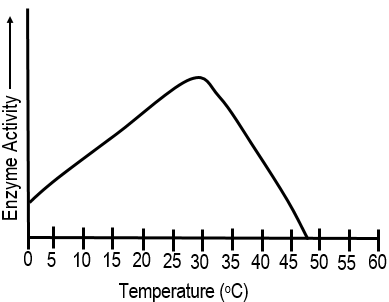
41.
Based on the graph, what is the optimal temperature for this enzyme? 
a)
15oC
b)
40oC
c)
30oC
d)
35oC
42.
Which of the following conclusions can be drawn from this graph?
a)
The optimum pH of the enzyme is 6.6.
b)
The optimum pH of the enzyme is 5.8
c)
The enzyme’s activity increases as pH increases 5.0 to 9.0
d)
The enzyme’s activity is greater around pH of 8.0 .
43.
What happens to an enzyme when it is denatured?
a)
Activation energy is lowered.
b)
It becomes stronger.
c)
It loses its shape.
d)
Activation energy is raised.
44.
Enzymes are composed of which of the following monomers? 
a)
amino acids
b)
carbohydrates
c)
nucleotides
d)
monosaccharides
45.

Which organelle is DNA usually found in?

a)

cell membrane

b)

vacuole

c)

chloroplast

d)

nucleus

46.
Any change in the sequence of DNA is...
a)
transgenic shift
b)
Single Genotype
c)
Monohybrid Trait
d)
Mutation
47.

ATT-TGA-GCC- Original

ATT-GAG-CC - Mutated

The example above is an example of a

a)

Insertion- Frameshift

b)

Deletion- Substitution

c)

Deletion -Frameshift

d)

All of the above

48.

Original DNA: CAT GAT CCA

New DNA: CAT TGA TCC A

What mutation occurred?

a)

deletion

b)

substitution

c)

tranverse

d)

insertion

49.
Are all mutations bad?
a)
Yes
b)
No
50.
Why are insertion and deletion (frameshift) mutations so harmful?
a)
They change all of the codons from the mutation on down the line, which changes the amino acid sequence
b)
They insert things that an organism doesn't need.
c)
They often delete things that organisms need.
d)
Insertion and deletions are not any more harmful than substitution mutations.
51.
Which RNA bases would pair with TACGAA in transcription
a)
AUGCUU
b)
ATGCTT
c)
GCATCC
d)
GCAUCC
52.
A frameshift mutation would result from...
a)
a base deletion only
b)
a base substitution only
c)
either an insertion or deletion of a base
d)
a base insertion only
53.
What type of population change does this graph represent
a)
Exponential Growth
b)
Massive Die-off
c)
Linear Growth
d)
Decrease in Birth-Rate
54.
From 1901-1981 how would you describe the Raven Population
a)
Below Carrying Capacity
b)
Above Carrying Capacity
c)
At Carrying Capacity
d)
Bird-Like
55.
Angel was trying to explain carrying capacity to her mother.  Which of the following descriptions is accurate? Carrying capacity is :
a)
the maximum number of individuals that an ecosystem can sustain. 
b)
 the ability of an environment to accommodate a growing population. 
c)
the greatest number of individuals that an area can sustain over the long term. 
d)
the maximum number of species that can co-exist in an area. 
56.

What is the definition of OSMOSIS?

a)

Diffusion of water through a selectively permeable membrane

b)

Molecular structure that surrounds the cell and controls what enters and leaves the cell

c)

Movement of molecules across the cell membrane against the concentration gradient

d)

Movement of molecules across the cell membrane from an area of high concentration to low concentration

57.

What is the definition of ACTIVE TRANSPORT?

a)

Movement of molecules across the cell membrane against the concentration gradient

b)

Diffusion of water through a selectively permeable membrane

c)

Molecular structure that surrounds the cell and controls what enters and leaves the cell

d)

Movement of molecules across the cell membrane from an area of high concentration to low concentration

58.

What is the definition of LIPID BILAYER?

a)

Molecular structure that surrounds the cell and controls what enters and leaves the cell

b)

Movement of molecules across the cell membrane against the concentration gradient

c)

Diffusion of water through a selectively permeable membrane

d)

Movement of molecules across the cell membrane from an area of high concentration to low concentration

59.

The solution surrounding the cell in Diagram B, would be defined as:

a)

hypertonic

b)

hypotonic

c)

isotonic

60.

The solution surrounding the cell in Diagram C, would be defined as

a)

hypertonic

b)

isotonic

c)

hypotonic

61.
The cell below is in a _________ solution.
a)
Hypotonic
b)
Hypertonic
c)
Isotonic
62.
The cell below is in a _____________ solution.
a)
Hypertonic
b)
Hypotonic
c)
Isotonic
63.
What type of solution is this cell in?
a)
Isotonic
b)
Hypertonic
c)
Hypotonic
d)
diffused
64.

What will happen to the cell in the given solution?

a)

Swell up

b)

Shrink

c)

Stay the same

65.
In this picture, how do you classify the solution?
a)
The solution is hypotonic
b)
The solution is hypertonic
c)
The solution is isotonic
d)
The solution is my tonic