
 Worksheets
XII_QUIZ_CH1 and 2
Total questions: 100
Worksheet time: 3hrs 20mins
1. Insect pollinated flowers usually posses____________
a. Sticky pollens with rough surface
b. Large quantities of pollens
c. Dry pollens with smooth surface
d. Light coloured pollens
WHICH OF THESE IS A DISADVANTAGE OF ASEXUAL REPRODUCTION?
Results in too much genetic variation in a population
Requires less time
Enables organisms to produce large amounts of offspring
Results in little genetic variation within a population
A form of asexual reproduction in which offspring grow from a part of a parent plant.
BINARY FISSION
BUDDING
REGENERATION
VEGETATIVE PROPOGATION
Occurs when an animal offspring grows from a piece of its parent.
FISSION
BUDDING
REGENERATION
VEGETATIVE PROPOGATION
Which types of organisms typically reproduce by BINARY FISSION?
HYDRA
BACTERIA
PLANARIA
PLANTS
Cell division in prokaryotes that forms two genetically identical cells.
CLONING
BUDDING
BINARY FISSION
REGENERATION
In asexual reproduction, all of the offspring are:
PHYSICALLY IDENTICAL
GENETICALLY IDENTICAL
PHYSICALLY AND GENETICALLY IDENTICAL
NOT IDENTICAL

What type of Asexual Reproduction is shown in the image?
budding
sporulation
vegetative propagation
binary fission
Sexual reproduction requires _____ parents and asexual reproduction requires ___ parents
1,1
2,2
2,1
1,2
One key advantage of Asexual reproduction is:
Offspring complete for food and space
It allows organisms to reproduce quickly
Extreme temperatures can wipe out entire populations
Offspring are different than parent organism
One disadvantage of asexual reproduction is:
Extreme temperatures can wipe out entire colonies
Large colonies can out compete other organisms for nutrients and water
Large numbers of offspring reproduce slowly
How does the DNA of the offspring formed from asexual reproduction compare to the parent?
none of the DNA is transferred to the offspring
half of the DNA is transferred to the offspring
the DNA of the offspring is identical to the DNA of the parent
none of these are correct
A form of asexual reproduction in which offspring grow from a part of a parent plant.
fission
budding
regeneration
vegetative reproduction
cloning
Geitonogamy is genetically similar to self-pollination but functionally similar to crosss-pollination because
Geitonogamy involves flowers of the same plant so it is similar to self-pollination and it also requires pollinating agent so it is similar to cross-pollination.
Geitonogamy involves two different flowers of the same plant and does not result in genetic variation in the progeny.
Both 1 and 2.
None of the above
Mechanisms that ensure self-pollination include:
Chasmogamy
Cleistogamy
Both 1 and 2
None of the above

What helps pollen move form one plant to another?
hummingbirds
bees
butterflies
all of the above

Pollination happens when pollen from another flower touches the _______.
petal
sepal
pistil
Check ALL of the animals that are pollinators.
moths
butterflies
worms
bats
eagles
Pollination is __________________________.
A)Insects carry pollen from plant to plant.
B)Birds take seeds.
C)Pollen is carried by the wind and animals.
D) Both A and C.
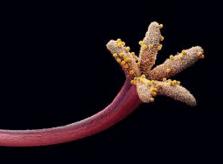

Fertilization is the process by which an
egg and pollen combine
embryo grows into a plant
animal carries pollen between plants
Which of the following statements best describes double fertilisation?
A male gametes fertilises an egg cell while another male gametes fertilises a polar nucleus
A male gametes fertilises an egg cell and two fused polar nuclei
A male gametes fertilises two fused polar nuclei
A male gametes fertilises an egg while another male gametes fertilises two polar nuclei
Why do flowering plants show double fertilisation?
To produce the endosperm which contains food and ensures the seed can germinate succesfully
To protect the seeds
The diploid zygote can survive
The ovary will not develop if double fertilisation does not take place
which of the following is true about double fertilization in flowering plants?
two sperm nuclei fuse with one egg cell
two sperm nuclei fuse with two egg cell
two sperm nuclei fuse with an egg cell and polar nuclei respectively
one sperm nucleus fuse with an egg cell and a polar nucleus
What is endosperm ?
Nutritive tissue
Fruit
Seed
Perisperm
Example.of Helobial endosperm
Arachis
Adoxa
Helianthus
Hydrilla
Seed structure that stores nutrients
radicle
plumule
testa
endosperm
Which is NOT part of a seed?
seed coat
embryo
pollen
food store
In which type of germination the plant grows above ground
Hypocotyl
Epicotyl
Viviparous
No type

Flowering plants that have only one seed cotyledon, produce one seed leaf, have parallel leaf venation, and have flower petals in multiples of 3
Monocot
Gymnosperms
Dicot
Bryophyte

Incorrect statement about Apomixis -
it is a form of asexual reproduction
it mimics sexual reproduction
fusion of gamete will not occur
it involve process of fertilization
In ovule, meiosis occurs in______________
a. Integument
b. Nucellus
c. Megaspore
d. Megaspore mother cell
The ploidy level is NOT the same in____________
a. Integuments and nucellus
b. Root tip and shoot tip
c. Secondary nucleus and endosperm
d. Antipodals and synergids
Which of the following types require pollinator but result is genetically similar to autogamy?
a. Geitonogamy
b. Xenogamy
c. Apogamy
d. Cleistogamy
If diploid chromosome number in a flowering plant is 12, then which one of the following will have 6 chromosomes?
a. Endosperm
b. Leaf cells
c. Cotyledons
d. Synergids
In angiosperms, endosperm is formed by/ due to___________
a. Free nuclear divisions of megaspore
b. polar nuclei
c. polar nuclei and male gamete
d. synergids and male gamete
Point out the odd one____________
a. Nucellus
b. Embryo sac
c. Micropyle
d. Pollen grain
Central body of ovule is called_______
a) hilum
b)nucellus
c) funicle
d) chalaza
Movement of non motile male gamete upto the female gamete is known as__________
a) siphonogamy
b) triple fusion
c) syngamy
d) porogamy
Embryo sac is_____________
a) megasporangium
b) megaspore
c) female gamete
d) female gametophyte
Most common type of ovule in angiosperms is________
a) orthotropous
b) anatropous
c) campylotropous
d) amphitropous
For formation of 50 seeds, how many minimum meiotic divisions are necessary ?
a) 50
b) 63
c) 25
d) 75
In bisexual flowers, maturation of gynoecium before androecium is known as__________
a) protandry
b)gynandry
c) protogyny
d) dicliny
If the number of chromosomes in an endosperm cell is 27, what will be the chromo- some number in the definitive nucleus?
a) 9
b) 18
c) 27
d) 36
Lever mechanisim of pollination is observed in_________
a) Salvia
b) Jasmine
c) Bougainvillea
d) Butea
Identify the wrong one from the following : In an orthotropous ovule_________
a) the micropyle and chalaza are in one
straight line
b) the micropyle and funicle are in one
straight line
c) the funicle, embryo sac, micropyle and
style are all in one straight line
d) the funicle, chalaza, embryo sac, micropyleare not in one straight line
Type of pollination in Vallisneria is_________
a) anemophily
b) hydrophily
c) omithophily
d) entomophily
The product of syngamy leads to the
formation of_________
a) endosperm
b) embryo
c) perisperm
d) cotyledon
In angiosperms, fertilization occurs________
a) in the stamen
b) when the male gamete fuses with an egg cell
c) on the outer surface of the ovary
d) some time after pollination
In Helobial type of endosperm development__________
a) first only nuclei divides
b) only first division is followed by cytokinesis
c) every nuclei division accompained by
cytokinesis
d) only second division is followed by auxin
Entomophilous flowers usually shows
modified structures like________
a) tiny flowers with white colour
b) dry pollens with smooth surface
c) light weight, bright coloured pollen
d) sticky pollen with rough surface
The number of nuclei present in a zygote is________
a. two
b. one
c. four
d. eight
Which of these is the male reproductive organ in human?
a. sperm
b. seminal fluid
c. testes
d. ovary
Attachment of embryo to the wall of the uterus is known as_____________
a. fertilization
b. gestation
c. cleavage
d. implantation
Rupturing of follicles and discharge of ova is known as___________
a. capacitation
b. gestation
c. ovulation
d. copulation
In human female, the fertilized egg gets implanted in uterus____________
a. After about 7 days of fertilization
b. After about 30 days of fertilization
c. After about two months of fertilization
d. After about 3 weeks of fertilization.
Test tube baby technique is called_________
a. In vivo fertilization
b. In situ fertilization
c. In vitro fertilization
d. Artificial insemination

The given figure shows a human sperm. Various parts of it are labelled as A, B, C, and D .Which labelled part represents acrosome ?
B
C
D
A
Presence of beard in boys is a____________
a. primary sex organ
b. secondary sexual character
c. secondary sex organ
d. primary sexual character.
Which of the following layers in an antral follicle is acellular?
(a) Granulomas
(b) Theca interna
(c) Stroma
(d) Zona pellucida
What is the correct sequence of sperm formation?
(a) Spermatogonia, spermatozoa, spermatocyte, Spermatid
(b) Spermatogonia, spermatocyte, spermatid, spermatozoa
(c) Spermatid, spermatocyte,
spermatozoa, spermatogonia,
(d) Spermatogonia, spermatocyte, spermatozoa, spermatid
The shared terminal duct of the reproductive and urinary system in the human male is__________
(a) Ureter
(b) Urethra
(c) Vas deferens
(d) Vasa efferentia
A temporary endocrine gland in the human body is________
(a) Pineal gland
(b) Corpus luteum
(c) Corpus cardiacum
(d) Corpus allatum
Capacitation occurs in________
(a) Rete testis
(b) Epididymis
(c) Vas deferens
(d) Female reproductive tract
Several hormones like hCG, hPL, oestrogen,cprogesterone are produced by____________
(a) Ovary
(b) Placenta
(c) Fallopian tube
(d) Pituitary
Fertilization in humans is practically feasible only with__________
(a) The Ovum and sperms are transporte
Simultaneously to ampullary - isthmic junction of the fallopian tube
(b) The ovum and sperms are transported Smultaneously to ampullary - isthimic junction of the cervix.
(c) The sperms are transported into cervix within 48 hours of release to ovum in uterus.
(d) The sperms are transported into vagina just after the release of ovum in fallopian tube.
Which of these is not an important componernt or initiation of parturition in humans?
(a) Increase in estrogen and progesterone ratio
(b) Synthesis of prostaglandins
(c) Release of oxytocin
(d) Release of Prolactin
Which of the following events is not associated with ovulation in human female?
(a) Decrease in oestradiol
(b) Full development of Graafian follicle
(c) Release of secondary oocyte
(d) LH surge
An advantage of sexual reproduction is that
many offspring are produced in a short time
it increases genetic diversity
production of gametes requires energy
organisms remain stable in a changing environment
A major male sex organ that produces and stores sperm.
Prostate Gland
Testicle
Ovary
Vas deferens

Using the diagram, which letter is the Vas Deferens?
H
I
J
K

Which letter corresponds to Testis?
D
E
F
J
When semen is pushed through and out of a males body through the urethra is a process called_______.
Ejaculation
Erection
Menstruation
Transportation
Which statement is true about epididymis?
A set of oily openings that release sperm
A set of coiled tubes which transport and stores sperm cells.
Producer of male sex hormones.
Transport mature sperm to the urethra.
What is the function of vas deferens?
A muscular tube that passes upward alongside the testes and transports mature sperm to the urethra.
Sperm storage organ.
Feces holding area.
It produces sugar- rich fluid that provides sperm with a source of energy to help them move.


I - Stimulate the completion of Meiosis I of Primary oocyte.
II - Stimulate the growing of Primary follicle.
III - Stimulate transformation of Graafian follicle become corpus luteum.
IV - Stimulate the maturation of the growing follicle.
Which answers are the functions of FSH hormone?
I and III only
II and III only
I and IV only
II and IV only
Name the process which a mature ovum is released from the ovary which occur around 13th to 16th day of menstrual cycle.
Ovulation
Fertilisation
Menstruation
Pregnancy

Menstrual cycle lasts for ____
28 days
24 days
30 days
The egg cell develops in the
vagina
ovary
oviduct
uterus

Perhatikan gambar berikut. Spermatogenesis terjadi pada bagian....
1
2
3
4
5

Perhatikan gambar berikut. Bagian yang ditunjuk oleh X adalah....
Oosit primer pada oogenesis
Oosit sekunder pada oogenesis
Oogonium pada oogenesis
Spermatozoa primer pada spermatogenesis
Spermatozoa pada spermatogenesis

Merupakan proses dari..
Spermatogenesis
Oogenesis
Meiosis
Mitosis
Pada proses Spermatogenesis, tahapan yang dapat mengalami pembelahan mitosis adalah....
A. Spermatogonium
B. Spermatosit Primer
C. Spermatosit Sekunder
D. Spermatid
E. Spermatozoa
Where does fertilization take place?
Ovary
uterine linning
Vagina
Fallopian tube
During fertilization, nucleus in the head of sperm fuses with the ovum nucleus to form a ___________________
embryo
zygote
foetus
baby
After the sperm has fused with the egg and entered, what events take place?
The pronuleus of the male and female fuse completing the process of fertilization
The pronuleus of the male and female separate completing the process of fertilization
Cilia pull zygote towards infundibulum
Cilia pull sperm towards infundibulum
Single layer of cells surrounding a fluid-filled space that forms during early development
morula
gastrula
blastocyst
blastula
Embryonic structure of an animal that consists of TWO cell layers
blastula
gastrula
morula
blastocyst
Abbreviate HPV -
Human Papillo Virus.
Human Papilloma Virus
Herpes Papillo Virus
Herpes Papilloma Virus
Find the odd one
Gonorrhoea, Hepatitis B, Genital Herpes, AIDS.
Gonorrhoea
Hepatitis B
Genital Herpes
AIDS

