
 Worksheets
OCN: MID-TERM Exam
Total questions: 100
Worksheet time: 2hrs 31mins
Who were the first sailors to reach and settle in Iceland, Greenland, and North America?
Vikings
Phoenecians
Polynesians
Greeks
The captain of the first voyages made purely for the scientific study of the oceans was
Cook
Harrison
Behaim
Toricelli
This explorer was also the inventor of the chronometer that allowed navigators to know exactly where they were
Captain James Cook
Ferdinand Magellan
Charles Darwin
John Harrison
The largest ocean on Earth is the....
Pacific
Arctic
Atlantic
Antarctic
The submersible that discovered the wreckage of the Titanic was called
The Trieste
HMS Beagle
Alvin
The JOIDES Resolution
A person who studies and observes wave dynamics, currents, and ocean-atmosphere interactions is called
Marine Engineer
Marine Biologist
Physical Oceanographer
Marine Geologist
How did the Polynesians navigate their voyages on the ocean?
Using a compass
Using song and dance
Using celestial navigation
Using cartography
Biological Oceanography is the study of....
marine life and their ecosystems.
the composition of seawater, including the amount of salt dissolved.
plate tectonics, underwater volcanoes and mountains.
ocean currents and motions of the ocean.
Geological Oceanography is the study of....
marine life and their ecosystems.
the composition of seawater, including the amount of salt dissolved.
plate tectonics, underwater volcanoes and mountains.
ocean currents and motions of the ocean.
Enviornmental Oceanography is the study of....
marine pollution and human effects on the ocean.
instruments and technology used to explore the ocean.
plate tectonics, underwater volcanoes and mountains.
ocean currents and motions of the ocean.
Ocean Engineering is the study of....
marine pollution and human effects on the ocean.
instruments and technology used to explore the ocean.
plate tectonics, underwater volcanoes and mountains.
ocean currents and motions of the ocean.
Chemical Oceanography is the study of....
marine life and their ecosystems.
the composition of seawater, including the amount of salt dissolved.
plate tectonics, underwater volcanoes and mountains.
ocean currents and motions of the ocean.
Which ocean is between North America and Europe?
Pacific Ocean
Atlantic Ocean
Indian Ocean
Southern Ocean
Oceans cover about ______ of the surface of the earth.
60%
70%
80%
90%
The following are the oceans according to size
Pacific, Atlantic, Indian, Arctic, Antarctic
Pacific, Indian, Atlantic, Arctic, Antarctic
Atlantic, Pacific, Indian, Antarctic, Arctic
Pacific, Atlantic, Indian, Antarctic, Arctic
Smaller bodies of salt water are called
seas
lakes
oceans
rivers

What is the correct order (starting from the surface) of Earth’s layers?
crust, outer core, inner core, mantle
mantle, outer core, inner core, crust
crust, mantle, outer core, inner core
outer core, inner core, crust, mantle
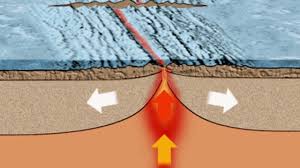
In sea-floor spreading, molten material rises from the mantle and erupts
along the edges of all the continents.
along mid-ocean ridges.
in deep-ocean trenches.
at the north and south poles.

The process by which the ocean floor sinks beneath a deep-ocean trench and back into the mantle is known as _______
convection.
continental drift.
subduction.
conduction.

Most geologists think that the movement of Earth’s plates is caused by _______
convection.
continental drift.
subduction.
conduction.
The geological theory of _______ states that pieces of Earth’s lithosphere are in constant, slow motion.
subduction
plate tectonics
deep-ocean trenches
sea-floor spreading
Scientists think that convection currents flow in Earth’s
continents.
mantle.
lithosphere.
inner core.

The place where two plates come together is known as a _______
transform boundary.
divergent boundary.
convergent boundary.
rift valley.

Below is a picture of sea-floor spreading. How are the ocean crusts moving?
Converging
Diverging
Sliding
No movement
The San Andreas Fault in California is known as an active earthquake area. What type of
boundary is it?
Converging
Diverging
Transform
Sea Floor Spreading
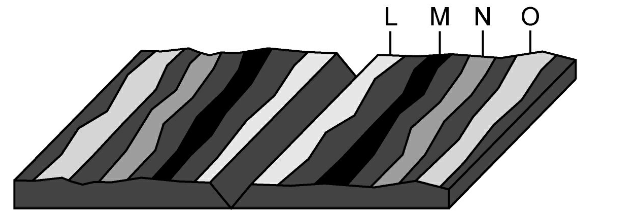

Where does sedimentation (depositing of sediment) occur most often?
Closer to continents
Near Seamounts
In the deep ocean
None of the above
Avalanches of turbid water (water carrying sediment) are called?
Thermohaline currents
Waves
Turbidity currents
Longshore Currents


Which feature includes the deepest parts of the ocean
deep sea trench
contintental margin
atoll
rift valley
A characteristic of hydrothermal vents is that
there isn't any sunlight there
no life exists there
it is made up of only salt water
it is hydrogenous

Which of the following is NOT a reason the ocean has salt in it?
Dissolved organisms.
Rainwater runoff
Volcanism
comet impact
The combination of cohesion and adhesion allows water to "crawl" in this property of water?
cohesion
adhesion
capillary action
surface tension
Water can dissolve anything that is polar.
True
False

Which layer is the least dense?
Teal (top)
Blue (middle)
Red (bottom)

What type of bond is shown by the dashed lines?
Covalent
Ionic
Polar
Hydrogen
Water forms droplets due to this property of water?
Cohesion
Adhesion
Capillary Action
Surface Tension
This zone of the ocean compromises the least amount of volume?
Surface
Pycnocline
Deep
What amount of the ocean is salt?
97.5%
3.5%
89%

______ causes deep ocean currents
The Coriolis Effect
gravity
wind
density differences
______ causes surface currents.
The Coriolis Effect
gravity
density differences
wind
As plants and animals in the ocean die, the nutrients produced from their decay _____.
are recycled by the Global Conveyor Belt
sink to the bottom
are destroyed by sunlight
become coral reefs
Nutrients are brought to the surface for phytoplankton to use at _______.
gyres
eddies
upwellings
the equator
_______ causes the Coriolis Effect
Earth's rotation
gravity
wind
density
The __________ is a surface current that flows along the eastern US and brings warm water to Europe.
California Current
Gulf Current
North American Gyre
Arctic Current
There are (is) _______ major gyres in each ocean.
1
2
3
4
Gyres in the southern hemisphere are surface currents that turn _________ due to the Coriolis Effect.
clockwise
counterclockwise
toward the right
toward the bottom of the ocean
________ and _______ affect the ocean's density and cause the Global Conveyor Belt to travel
gravity and the Coriolis Effect
temperature and salinity
wind and climate
temperature and the Coriolis Effect
The more scientific name of the Global Conveyor Belt is _____.
halinethermal circulation
thermohaline circulation
thermodensity circulation

