Wayground logo

Free Printable Worksheets

Font size

S
M
L
XL
Worksheets

Tutoring End of Term Review

Total questions: 46

Worksheet time: 40mins

Name
Class
Date
1.
The amount of water vapor present in the air is called ________________.
a)
weather
b)
humidity
c)
air mass
d)
dew point
2.
Rain, snow, sleet, and hail are all forms of _____.
a)
precipitation
b)
condensation
c)
evaporation
d)
climate
3.
What is the condition of the Earth's atmosphere at a certain time and place?
a)
climate
b)
temperature
c)
weather
d)
air pressure
4.
Warm air rises because it is __________ dense then cold air.
a)
More
b)
Less
5.
The layer of the atmosphere where weather occurs is the _.
a)
thermosphere
b)
stratosphere
c)
mesosphere
d)
troposphere
6.
Before condensation can occur, the air must  be ____________________________.
a)
Humid
b)
Cold
c)
Hot
d)
Saturated
7.

What is the correct order (starting from the surface) of Earth’s layers?

a)

crust, outer core, inner core, mantle

b)

mantle, outer core, inner core, crust

c)

crust, mantle, outer core, inner core

d)

outer core, inner core, crust, mantle

8.

A place where two plates slip past each other, moving in opposite directions, is known as a _______

a)

transform boundary

b)

divergent boundary.

c)

convergent boundary.

d)

rift valley.

9.

The place where two plates come together is known as a _______

a)

transform boundary.

b)

divergent boundary.

c)

convergent boundary.

d)

rift valley.

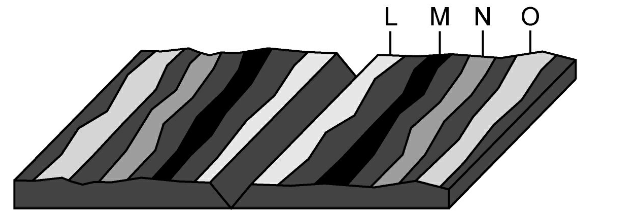
10.
Where would the oldest rock be found?
a)
L
b)
M
c)
N
d)
O
11.
What are the two types of crust
a)
continental and oceanic
b)
ocean and upper
c)
lower and upper
d)
pizza and subway
12.
What is Pangaea?
a)
the name of a German scientist
b)
the name of the super-continent that existed millions of years ago
c)
another name for continental drift
d)
the name of an ancient fossil
13.
A divergent boundary occurs when plates ....
a)
Pull apart
b)
Come together
c)
Slide past each other
d)
subducting
14.
What geologic feature/event you be most likely to find at a transform boundary?
a)
Earthquakes
b)
Volcanoes
c)
Mountains
d)
Rift Valleys
15.
The core is mostly made up mostly of which elements?
a)
Oxygen and Silicon
b)
Silicon and Magnesium
c)
Nickel and Iron
d)
Iron and Magnesium
16.
Identify the Major Plate labeled B
a)
African Plate
b)
Antarctic Plate
c)
Pacific Plate
d)
Eurasian Plate 
17.
Identify the Major Plate labeled I
a)
African Plate
b)
Antarctic Plate
c)
Pacific Plate
d)
Eurasian Plate 
18.
Identify the Major Plate labeled N
a)
African Plate
b)
Antarctic Plate
c)
Pacific Plate
d)
Eurasian Plate 
19.
How does freezing water cause the weathering of rocks?  The freezing water—
a)
keeps the rocks in place
b)
makes the rocks last longer
c)
expands cracks and breaks rocks
d)
causes rocks to fall in landslides
20.
The process that breaks down rocks and other materials on Earth's surface is called
a)
weathering
b)
erosion
c)
soil conservation
d)
decomposition
21.
What is mechanical weathering?
a)
Process through which rocks are physically broken into smaller pieces.
b)
Rocks are broken down through chemical changes.
c)
Rocks are worn away from acid in plant roots.
d)
Rocks broken down by machinery.
22.
What are the two factors that affect the rate at which weathering occurs?
a)
climate and mass of rock
b)
climate and size of rock
c)
type of rock and size of rock
d)
type of rock and climate
23.
Which type of climate will have faster chemical weathering?
a)
Hot and Wet
b)
Cold and Dry
c)
Hot and Cold
d)
Cold and Wet
24.
How do plants weather rocks?
a)
during photosynthesis
b)
when roots grow into cracks of rocks and expand the rock
c)
when the plant moves water from the roots to the leaves
25.
These rocks were made smooth by wind blowing smaller rock particles across their surface.  This is an example of:
a)
ice wedging
b)
chemical weathering
c)
acid rain
d)
abrasion
26.

Which is an example of oxidation?

a)

Rust decomposes rocks completely with the passage of time.

b)

Some of the minerals get dissolved in water.

c)

The joints enlarge in size and lime is removed in the solution.

d)

Due to the absorption of water by rocks, its volume increases.

27.

Which among the triggers contributes greatly to the occurrence of mass wasting?

a)

gravity

b)

water

c)

ground vibration

d)

human activity

28.

What is not a stage in the water cycle?

a)

Evaporation

b)

Precipitation

c)

Drizzle

d)

Runoff

29.
What part of the water cycle does this picture show?
a)
condensation
b)
precipitation
c)
evaporation
30.
Which of these is an example of precipitation?
a)
snow
b)
air
c)
clouds
d)
vapor
31.
What is is called when water turns into a vapor?
a)
EVAPORATION
b)
PRECIPITATION
c)
TRANSPIRATION
32.
What is it called when plants give off water vapor as a waste product?
a)
condensation
b)
evaporation
c)
sublimation
d)
transpiration
33.
The start of a river is called the what?
a)
River summit
b)
River source
c)
River start
d)
River mouth
34.
A waterfall is most likely to be found closer to what part of the river?
a)
River mouth
b)
River source
35.
The area that contains a river system is called a what?
a)
Drain Bassoon
b)
Drainage Basinet
c)
Drainage Basin
d)
Drain Basalt
36.
There are four main types of erosion for rivers. Which answer is correct.
a)
Hydraulic Action, Attrition, Rubbing, Silting
b)
Hydraulic Action, Abrasion, Deposition, Solution
c)
Hydraulic Action, Abrasion, Silting, Solution
d)
Hydraulic Action, Solution, Abrasion, Attrition
37.
Deposition is when ...
a)
Objects are moved along the river.
b)
Objects are dropped along the river.
c)
Objects are suspended in the water.
d)
Objects are move into the ocean.
38.
Transportation in river systems has four main categories. These are ...
a)
Suspension, Solution, Attrition, Abrasion.
b)
Suspension, Solution, Saltation, Abrasion.
c)
Suspension, Solution, Saltation, Attrition.
d)
Suspension, Solution, Saltation, traction.
39.
What river features and landforms are associated with  a cross section or profile of a river valley in its upper course.
a)
A. river source, V-shape, interlocking spurs, narrow and shallow river channel
b)
B. delta, flood plain, river mouth, levees, wide and deep river channel
c)
C. sheep farming, wind turbines, HEP (hydro-electric power) stations and dams and reservoirs
40.
Which of the following features are not formed by river deposition
a)
A. levee
b)
B. gorge
c)
C. delta
41.

What is the name given to material deposited in a flood plain?

a)

Aluminium

b)

Boulders

c)

Alluvium

d)

Gorge

42.
Magma that reaches the surface is called:
a)
Vent
b)
Hot spot
c)
Lava
d)
Cinders
43.
The more silica that magma contains...
a)
the thicker the magma
b)
the thinner the magma
c)
the higher the viscosity
d)
the runnier the magma
44.
The belt of volcanoes around the rim of the Pacific Ocean is called:
a)
Island arc
b)
Ring of Fire
c)
Lava plateau
d)
Hawaii
45.
A chain of volcanic islands formed where two oceanic plates collide is called:
a)
island arc
b)
hot spot
c)
Hawaii
d)
geyser
46.
An opening through which the lava flows is called:
a)
crater
b)
caldera
c)
vent
d)
pipe