wayground logo

Free Printable Worksheets

Font size

S
M
L
XL
Worksheets

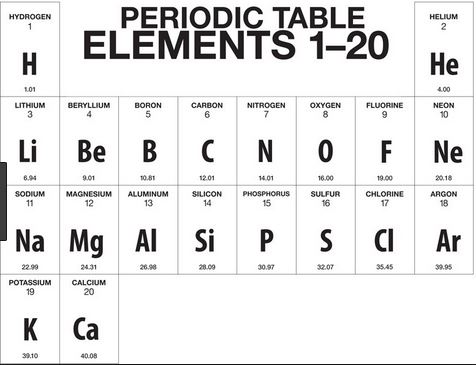
QM and Periodic Table

Total questions: 62

Worksheet time: 1hrs 18mins

Name
Class
Date
1.

What is the full electron-configuration notation for a Bromine atom? *

a)

A

b)

B

c)

C

d)

D

2.

What are the three main groups of the periodic table?

a)

groups

b)

metal

c)

nonmetals

d)

metalloids

e)

periods

3.

What are the vertical columns on the periodic called?

a)

groups

b)

periods

c)

nonmetals

d)

metals

e)

metalloids

4.

What do the vertical columns on the periodic table tell us?

a)

The number of orbitals

b)

The number of valence electrons (electrons on the outer most shell)

5.

What are the horizontal rows on the periodic table called?

a)

periods

b)

groups

c)

metals

d)

nonmetals

e)

metalloids

6.

What group and period does this element belong in? *

a)

period 1 and group 3

b)

period 3 and group 1

c)

period 2 and group 3

d)

period 3 and group 2

7.

How many valence electrons and energy levels does (Pb) lead have?

a)

4 valence electrons and 6 energy levels (orbitals)

b)

6 valence electrons and 4 energy levels (orbitals)

c)

5 valence electrons and 5 energy levels (orbitals)

d)

5 valence electrons and 10 energy levels (orbitals)

8.
Looking at atoms in the same group/family, what factor affects Coulombic attraction?
a)
number of protons
b)
distance from the nucleus
9.

Looking at atoms in the same period (energy level), what factor affects Coulombic attraction?

a)

number of protons

b)

distance from the nucleus

10.
Ionization energy is the...
a)
energy needed to remove the outermost electron.
b)
ability of an atom to attract electrons from another atom.
11.
Electronegativity is the...
a)
energy needed to remove the outermost electron.
b)
ability of an atom to attract electrons from another atom.
12.
As the Coulombic attraction increases the atomic radius: increases or decreases?
a)
increases
b)
decreases
13.
Which element has the smaller atomic radius: potassium (K) or bromine (Br)?
a)
potassium (K)
b)
bromine (Br)
14.
As the Coulombic attraction in an atom increases, the energy needed to remove an electron: increases or decreases?
a)
increases
b)
decreases
15.
Which element has the greatest electronegativity: Nitrogen (N) or Arsenic (As)?
a)
Nitrogen (N)
b)
Arsenic (As)
16.
As the Coulombic attraction of an atom increases, the electronegativity of the atom: increases or decreases?
a)
increases 
b)
decreases
17.
What atom matches this electron configuration?
1s2s2p3s2
a)
Neon
b)
Magnesium
c)
Aluminum
d)
Potassium
18.
Which is the electron configuration for an oxygen atom?
a)
1s22s22p63s23p64s2
b)
1s22s22p4
c)
1s22s22p6
d)
1s22s22p63s23p6
19.
How many electrons can the first energy level hold?
a)
1
b)
2
c)
8
d)
0
20.
Which element is pictured?
a)
neon
b)
fluorine
c)
magnesium
d)
argon
21.
What do you start electron configuration with?
a)
1s2
b)
1d10
c)
1f14
d)
1p6
22.
There are 4 different types of subshells s,p,d,f
a)
true
b)
false
23.
Electrons occupy orbitals of lowest energy first is part of what electron configuration rule?
a)
Hund’s Rule
b)
Aufbau Principle
c)
Pauli Exclusion Principle
24.
What does Pauli exclusion principle state ?
a)
states that each electron occupies the lowest energy orbital available
b)
states that a maximum of two electrons can occupy a single atomic orbital, but if only if the electros have opposite spins
c)
states that single electrons electrons with the same spin must occupy each-energy orbital before additional electrons with opposite spins can occupy the same orbitals
25.
The electron configuration of an atom is 1s22s22p6.  The number of electrons in the atom is 
a)
3
b)
6
c)
8
d)
10
26.
Which electron configuration belongs to Chlorine (Cl)?
a)
1s2s2p3s3p5
b)
1s2s2p3s3p6
c)
1s2s2p3s3p7
27.
How many valence electrons are represented here?
a)
7
b)
5
c)
2
d)
8
28.

What is the maximum number of electrons that an S orbital can have?

a)

1 electron

b)

2 electrons

c)

3 electrons

d)

4 electrons

29.

How many electrons can the d sublevel(orbital) hold?

a)

8

b)

10

c)

2

d)

4

30.
How many valence electrons does Chlorine have?
a)
5
b)
2
c)
7
d)
5
31.
Which of the following is a p block element?
a)
Ca
b)
Ar
c)
Re
d)
Au
32.

Which area on the periodic table represents the electrons in the "d" sublevel?

a)

representative elements

b)

columns 3-8

c)

rare earth elements

d)

transition elements

33.

Which alkali metal is most reactive out of the following

a)

rubidium

b)

potassium

c)

sodium

d)

lithium

34.

How many electrons do the alkali metals have in their outer shell?

a)

1

b)

2

c)

8

d)

7

35.

How does a group 1 metal atom form an ion?

a)

lose 1 electron

b)

lose 2 electrons

c)

gain 1 electron

d)

gain 2 electrons

36.

Where are valence electrons found?

a)

In the first energy level of the electron cloud

b)

In the nucleus

c)

In the outermost energy level in the electron cloud

37.

How many valence electrons do Alkaline Earth Metals have?

a)

1

b)

2

c)

3

d)

7

38.

Which metal is NOT an Alkaline Earth Metal?

a)

Calcium

b)

Radon

c)

Strontium

d)

Radium

39.

Are Halogens metallic?

a)

True

b)

False

40.

Which of these elements are Halogens?

a)

Fluorine

b)

Helium

c)

Zinc

d)

Bromine

41.

What group are the Halogens?

a)

6.9

b)

7

c)

8

d)

3

42.

What is the Valency of a Halogen?

a)

1

b)

2

c)

-2

d)

-1

43.

How many electrons do Halogens have in their outer shell?

a)

0

b)

1

c)

6

d)

7

44.
Which of these is not a noble gas?
a)
Helium
b)
Argon
c)
Nitrogen
d)
Krypton
45.

The reason that Noble Gases do not react is because

a)

Their outer electron shell is filled

b)

Their inner electron shell is filled

c)

They are able to bond to fill their outer shell

d)

None of the above, Noble Gases are highly reactive

46.
Another term for being chemically inactive is...
a)
Inert
b)
Inbert
c)
Insert
d)
Inmert
47.
What particles make up light?
a)
Photons
b)
Neutrons
c)
Protons
48.
Light behaves like both a particle and a ______.
a)
Mass
b)
Wave
c)
Current
49.
What color has the shortest wavelength, or the highest frequency?
a)
yellow
b)
blue
c)
red
d)
violet
50.
The full spectrum of light energy is called the__________
a)
broad spectrum
b)
electromagnetic spectrum
c)
helium spectrum 
d)
natural light spectrum
51.
EM waves have the same speed but different:
a)
frequency & medium 
b)
wavelength & frequency
c)
medium & wavelength
d)
color & medium
52.
Which of the following types of radiation has the shortest wavelength and the highest frequency?
a)
Radio Waves
b)
Infrared
c)
Visible
d)
X-Rays
53.

How many electrons can a d sublevel hold?

a)

14

b)

10

c)

2

d)

6

54.

What are the shapes of p orbitals ?

a)

cloverleaf

b)

spherical

c)

dumbbell

55.

How many valence electrons does Hydrogen Have?

a)

1 Valence electron

b)

2 Valence electron

c)

3 Valence electron

d)

4 Valence electron

e)

5 Valence electron

56.

How many valence electrons does Nitrogen Have?

a)

1 Valence electron

b)

2 Valence electron

c)

3 Valence electron

d)

4 Valence electron

e)

5 Valence electron

57.

What is the correct Lewis Dot Structure for ammonia NH3

a)
b)
c)
d)
58.
How many electrons should Lithium have around its Lewis dot model?
a)
1
b)
2
c)
3
d)
4
59.
How many electrons should Beryllium have around its Lewis dot model?
a)
1
b)
2
c)
3
d)
4
60.
How many electrons should Flourine have around its Lewis dot model?
a)
5
b)
6
c)
7
d)
8
61.
How many electrons should Sodium have around its Lewis dot model?
a)
1
b)
2
c)
3
d)
4
62.
How many electrons should Aluminium have around its Lewis dot model?
a)
1
b)
2
c)
3
d)
4