
 Worksheets
semester 1 review part 2: units 4-5
Total questions: 107
Worksheet time: 1hrs 19mins


Which of the following defines Yellow Journalism?
Writing about bad stuff to cause change
Exaggerating events to sell newspapers
Investigative journalism
Reporting only the truth
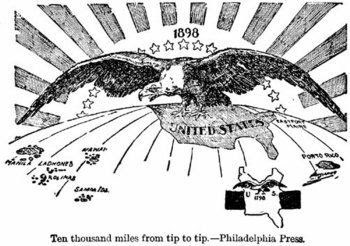
This political cartoon best supports the idea that, after the Spanish American War, the United States became a...
World Power
"Woke" Power
Head of the United Nations
Conquered Nation
This type of foreign policy encourages stronger nations to extend their influence over weaker ones.
Imperialism
Isolationism
Globalism
Communism
"Be it enacted by... Congress... That no producer, manufacturer, or dealer shall ship or deliver for shipment in interstate or foreign commerce, any article or... product of any mine or quarry situated in the United States, in which... children under the age of sixteen years have been employed or permitted to work..."
This quote reflects the public's support for the -
control of the mining industry
abolition of child labor
regulation of product transportation
limitation of foreign trade
~Upton Sinclair exposed the unhealthy practices of Chicago's meat-packing plants
~Ida Tarbell revealed the dishonest business tactics of Rockefeller's Standard Oil
Company
~Jacob Riis wrote How the Other Half Lives, showing the conditions of the residents of
New York City tenements
What was the impact of these muckraking activities during the early 1900s?
Society changed in response to their promotion of Social Darwinism
Voters agreed to let big business owner create more profitable monopolies
Reports of their works in publications abroad caused a decline in immigration
Public reaction to their books led to new laws addressing the abuses of industrialization
In annexing Hawaii, the United States benefitted from...
allowing natives to manage Hawaiian shipyards
imposing high taxes on Hawaiian imports
avoiding import tariffs on sugar
sending American entrepreneurs to manage the plantations.
These reforms made the government directly accountable to the citizens.
Referendum, recall, initiative, and 17th amendment
19th and 22nd Amendments
Pendleton Act & Homestead Act
16th and 18th Amendments

As a result of the suffrage movement
slavery was abolished.
the 19th Amendment was passed
women achieved equal pay
women were allowed to drive.
As a result of the suffrage movement
slavery was abolished.
the 19th Amendment was passed
women achieved equal pay
women were allowed to drive.
Workers moved from farms to factories because...
They liked city life better
Country life was a little too boring
Advances in farm technology eliminated jobs
People were simply trying to feed their families
Which of the following would be a correct description of what life was like in urban areas during the height of immigration in New York?
majority of the people were wealthy
most people in urban areas lived in nice houses
most people lived in poverty, and cities were overcrowded & dirty
city streets were well maintained, and the unemployment rate was low
In tenements, many apartments were spacious with a lot natural light coming in through windows.
True
False
_________are small areas of cities that are inhabited by a minority cultural group.
Ethnic island
Host society
Ethnic enclaves
Ethnic group

What part of the country did political machines control?
Urban (city) governments
Rural (country) governments
The U.S. federal government

The most famous political machine was Tammany Hall in New York lead by-
Bill the Butcher
Andrew Carnegie
William "Boss" Tweed
John D Rockefeller

Which of the following would be a correct description of what life was like in urban areas during the Gilded Age?
majority of the people were wealthy
most people in urban areas lived in nice houses
most people lived in poverty, and cities were overcrowded & dirty
city streets were well maintained, and the unemployment rate was low
Which of the options below would correctly describe the working conditions during the Gilded Age? (choose all that apply)
long hours & low wages
child labor
Plenty of vacation & sick days
often unsafe working conditions
Which of the following was a direct result of immigration during the Gilded Age?
Overcrowded Rural areas
Overcrowded Cities
Decreased Nativism
Improved working conditions
In tenements, many apartments were spacious with a lot natural light coming in through windows.
True
False
You and your child have to work long hours doing dangerous jobs. Your child gets beaten to him/her work harder. If you complain you may both lose your jobs. Who is this?
Overseer
Child Worker
Adult Spinner
Parent of Child Worker

Why would factory owners what to hire kids to work?
Can easily get to places that adults cant when fixing a machine?
Kids work harder
Kids will have more energy
Can pay the kids less thus saving money.
All the following were reasons for US imperialism except:
to develop closer relations with European nations
need for more natural resources
need for new markets to sell goods
fear of running out of land to settle
Which of the following supported imperialism as a means of protecting the country?
Alfred Thayer Mahan
Teddy Roosevelt
Josiah Strong
Henry Cabot Lodge
To avoid further conflict in China, the US instituted what policy?
Open Door Policy
Meat Inspection Act
Federal Reserve Act
Island Hopping
Why did the United States "need" territories like the Philippines and Hawaii?
they acted as refueling stations for ships
they had once belonged to the United States
to rid the Americas of European powers
so that those countries did not imperialize the US
What often happens to areas that are colonized?
the economy suffers and are the people are not treated as equals
they become wealthy with the abundance of new opportunities that are presented
they are often deported to another country
they are executed
This is the belief in regards to imperialism that it must be done so as to lead "backwards" people towards the light of democracy...
White Man's Burden
Open Door Policy
Self-determination
Sphere of Influence
Which of the following was the primary reason William Seward wanted to purchase Alaska?
territorial expansion of the US
gold had been discovered
to assimilate the indigenous people
oil had been found
Which territory's annexation by the US happened through a lot of controversy that went all the way to the presidency?
Hawaii
Alaska
Puerto Rico
Cuba
Discovery of which natural resources helped to spark change in how the purchase of Alaska was viewed?
gold
iron
timber
fish
Why was the US initially interested in Hawaii?
sugar plantations were very valuable
an abundance of oil was discovered
to develop a military base
to learn the culture of the natives
Which of the following presidents did not approve of the means in which Sanford B. Dole had become the leader of the Republic of Hawaii?
Clevland
T. Roosevelt
Taft
Hoover
Fake news is the modern term for what during the 1890s?
yellow journalism
red journalism
false advertising
negative journalism
What event led to the start of the Spanish-American War?
sinking of the USS Maine
sinking of the USS Lusitania
attack on southern Florida by Cuba
the coronation of Liliuokalani
Which of the following is not a territory that the US acquired through war?
Alaska
Puerto Rico
Guam
Philippines
What role did the media(yellow journalism) play in the Spanish American War?
shaped public opinion to go to war
only covered facts of the events of the war
play no role in the war whatsoever
shaped public opinion to give the president war powers to declare war on Cuba
As a result of helping Cuba win independence from Spain, the US gained Guantanamo Bay and...
the ability to intervene in Cuba whenever the US saw fit to do so
the ability to have US representatives in the Cuban government
the ability to control the Cuban economy
the ability to annex Cuba
Which of the following foreign policies was used to acquire the land necessary to build a canal in Panama?
Big Stick Policy
Dollar Diplomacy
Moral Diplomacy
Treaty of Paris
Which president built on the Monroe Doctrine's limitations on colonization in the Western Hemisphere?
T. Roosevelt
Taft
Wilson
Seward
How did the US gain the rights to build the Panama Canal?
the US helped Panama achieve independence from Colombia
a treaty with Colombia whom controlled Panama
the US purchased the land from Panama for 7.2 million dollars
the US helped Colombia put down a rebellion in Panama
What was the name given to Taft's foreign policy?
Dollar Diplomacy
Big Stick
Moral Diplomacy
Taft Corollary

The event which probably angered Americans the most and stirred up anti-German sentiment in the United States was
the sinking of the ocean liner the Lusitania.
the assassination of the Archduke of Austria-Hungary.
the overthrow of the Russian Tsar.
Germany’s invasion of Belgium.

What happened to the United States after the Spanish-American War?
The United States joined forces with Cuba and controlled all of the island countries in the Caribbean.
The United States began a war with Mexico.
The United States became a world power.
The United States began a war with Canada.
How did the Treaty of Versailles severely punish Germany?
It forced Germany to accept blame for the war and to pay reparations.
It supported economic help given to Germany by the U.S.
It divided Germany into four separate, occupied zones.
It took away German territory in Spain and Russia.
How did the new technology of the tank solve the issue of the deadly killing force of machine guns and barbed wire?
It could fire it's guns at vast distances
Protected the soldiers as they crossed no man's land
It was so fast that it overwhelmed the enemy's defense
The main causes of World War 1:
Militarism, Alliances, Imperialism, Nationalism
Money, Alliances, Imperialism, Nativism
Militarism, Alliances, Imperialism, Nativism
Mobilization, Annexation, Imperialism, Neo-Confucianism
During World War I, the western front in Europe was characterized by
destroyed villages and cities
trenches
submarines
cargo ships
Which of the following was NOT a reason the U.S. entered World War One?
Unrestricted Submarine Warfare
The Sinking of the Luisitania
The Zimmerman Telegram
The Bombing of Pearl Harbor

An artificial waterway built to provide a shortcut between the Atlantic and Pacific Oceans, opened in in 1914
Roosevelt Corollary
Panama Canal
Yellow Journalism
Open Door Policy
Which of these territories were NOT acquired from the United States' victory in the Spanish-American War
Guam
The Philippines
Alaska
Puerto Rico
How is the the American takeover of the Panama Canal an example of Big Stick Policy of Teddy Roosevelt?
It established the concept that European nations could no longer colonize the Americas
It protected the idea of open trade in China among all major powers
Roosevelt negotiated a peaceful deal with the Panamanian government, while American warships waited in the harbor
Roosevelt was able to influence the Panamian government through the use of investment and US capital
How did the United States contribute to ending World War 1
American bombers dropped two nuclear bombs on Berlin, forcing them to surrender
American troops helped stop a German counterattack and supplied fresh troops/supplies
The Americans actually arrived too late to contribute anything meaningful to the war effort
They were able to reestablish a new front in the East
Why were trenches used extensively during WW1?
They provided a very strong defensive position that was almost impossible to take from a frontal attack
They allowed armies to move stealthily underground and flank their enemies
They were the only safe place from nuclear attacks
They were the perfect tool to launch massive and successful offensive charges from
This new weapon introduced by the Germans caused soldiers to have to wear masks to protect themselves.
Machine guns
Tanks
Planes
Poison Gas

_____ took control of the Hawaiian government after the queen was overthrown in a rebellion.
Theodore Roosevelt
Alfred Thayer Mahan
Sanford Dole
Henry Cabot Lodge
True or False? The passing of the Selective Service Act allowed congress to draft men from 18-30 into the armed forces.
True
False
What is the first thing you should do when breaking down a political cartoon
Read the title
Identify major symbols
Research the context of the illustration
Make an assertion on the message
On a scale of 1-5, how do you feel about the test tomorrow?
(1 being I don't feel ready, 5 being I got this)
1
2
3
4
5

Which major era in U.S. history is described by the information in the box?
Progressive Era
Twenties
Great Depression
Sixties

What historical era is identified by the items in the graphic above?
The Roaring Twenties
The Progressive Era
The Gilded Age
The Red Scare
The Roaring Twenties were characterized by-
internment camps, the rationing of goods, and the first use of an atomic bomb
bank failures, the New Deal, and bread lines
installment plans, Prohibition, and flappers
brinkmanship, McCarthyism, and a policy of containment
One characteristic of the U.S. economy in the 1920s was-
greater financial dependency on credit cards
increasing government regulations on businesses
all-time high production levels of consumer goods
repeated labor uprisings that limited industrial output
The establishment of speakeasies in the 1920s was an unintended consequence of which federal government action?
The taxation of imported luxury goods
The deportation of suspected communist sympathizers
The prohibition of the sale of alcoholic beverages
The implementation of immigration restrictions
The ratification of the 19th Amendment in 1920 was a victory in the long struggle for women's equality because the amendment-
gave women the right to vote
allowed women to hold political office
guaranteed women the right to attend state universities
made it illegal to discriminate against female job applicants
The Eighteenth Amendment prohibited the manufacture, sale and transportation of intoxicating beverages, but Prohibition's unintended consequences were-
a decrease in the production of alcohol
an increase in organized crime and mob related violence
a decrease in organized crime and mob related violence
an increased participation in Progressive Era reform movements

Which inference about the 1920s is supported by this illustration?
Women confronted discrimination in employment and education
Women challenged traditional attitudes and social norms
Reform organizations targeted women's issues
Mass media reflected trends popular in rural communities

What was a result of the social problems presented in this 1917 political cartoon?
Government leaders introduced health-care reforms
Lobbyists focused attention on the power of corporate monopolies
Women worked to improve conditions in tenement houses
Progressives worked to ratify a prohibition amendment
The debate between Clarence Darrow and William Jennings Bryan in the Scopes Trial illustrated how society in the 1920s was characterized by-
clashes between ethnic minority groups
changing attitudes about the role of women
demands to reform the public education system
tension between traditional values and modern views

The events of the 1920s listed in the box reflect the influence of-
prohibition
organized crime
growing nativism
civil rights leaders

How did the person depicted in the image above most influence American culture immediately after his historic flight in 1927?
He helped negotiate the Treaty of Versailles and end German militarism
He promoted military spending during World War II
He was treated as a hero and inspired a sense of hope
He helped end nativism by spreading European traditions
Henry Ford is credited with revolutionizing industrial manufacturing with the introduction of-
automobiles with a single-frame chassis
assembly lines in the automobile industry
internal combustion engines in automobiles
healthcare benefits for auto industry workers
One factor that contributed to the Great Migration of the 1920s was-
discrimination in the South
demand for agricultural workers
immigration of southern Europeans
development of interstate highways
Which economic condition contributed to support for the passage of immigration quotas at the beginning of the 1920s?
Elevated tax rates to pay war debts
Increasing mechanization in factories
Unemployed soldiers returning from war
Excessive tariffs placed on exported goods
Why did the "Return to Normalcy" agenda of U.S. presidential candidate Warren G. Harding appeal to many voters in the 1920 election?
The public wanted to help rebuild war-torn countries
There were significant shortages of military supplies
There was a decrease in demand for consumer goods
The public wanted to concentrate on domestic economic issues
Improved mass-production techniques affected the American economy of the 1920s by-
decreasing the need for workers
lowering the quality of most products
reducing the prices of consumer goods
raising the costs for agricultural production
The Teapot Dome Scandal tarnished the Harding administration and resulted in-
the conviction of a cabinet member
the impeachment of a U.S. President
the passage of the Eighteenth Amendment
the limitation on number of presidential terms

This 1924 cartoon satirizes a scandal that led to-
public disappointment over revelations of government corruption
widespread dissatisfaction with a lack of economic development
public frustration with government neglect of the working class
widespread anger over excessive partisan politics

Based on the information in the excerpt, jazz music was popular in the 1920s because it-
spread from cities like New Orleans
emphasized traditional American culture
appealed to a broad section of Americans
reflected the changes in American society
The works of Harlem Renaissance artists such as Langston Hughes focused on issues related to-
discrimination suffered by women
class conflict caused by economic prosperity
shifting demographics in New England states
racial pride in the African American community
Which of the following identifies two effects of the Harlem Renaissance?



