wayground logo

Free Printable Worksheets

NEW

Font size

S
M
L
XL
Worksheets

Semester 1 Review

Total questions: 80

Worksheet time: 6hrs 14mins

Name
Class
Date
1.

If the atomic mass is 55.85, what is the name of this element?

a)

Iron

b)

Fe

c)

Manganese

d)

Mn

2.

If the atomic mass is 55.85, what is the atomic number?

a)

56

b)

26

c)

30

d)

25

3.

If the atomic mass is 55.85, what is the number of electrons

a)

25

b)

30

c)

26

d)

59

4.
What is an ion?
a)
A Charged Atom
b)
A Large Atom
c)
A Small Atom
d)
A Cute Atom
5.
Why are ions formed?
a)
To make our lives difficult
b)
Because atoms want 8 valence electrons
c)
Because atoms have the same number of protons and electrons
d)
Because atoms gained neutrons
6.
Cations are...
a)
Positive
b)
Negative
c)
Neutral
d)
Purring
7.
Anions are...
a)
Positive
b)
Negative
c)
Neutral
d)
Crying
8.
An atom becomes _________ when it gains electrons.
a)
Positive
b)
Negative
c)
Neutral
d)
Invinsible
9.
An atom becomes _______ when it loses electrons.
a)
Positive
b)
Negative
c)
Neutral
d)
Invinsible
10.

How many protons are in Sodium?

a)

11

b)

22

c)

12

d)

33

11.

How many electrons are in Aluminium?

a)

40

b)

27

c)

13

d)

14

12.

How many neutrons are in Phosphorus?

a)

16

b)

15

c)

31

d)

46

13.

How many electrons are in Potassium?

a)

19

b)

20

c)

58

d)

39

14.
What is an isotope? 
a)
A charged atom
b)
An atom with different amounts of neutrons
c)
An atom with different amounts of protons
d)
A neutral atom
15.
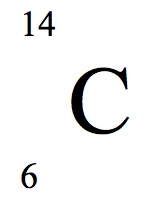
The photo above shows the isotopic notation for which isotope?
a)
Carbon 12
b)
Carbon 13
c)
Carbon 14
d)
Carbon 15
16.
Different isotopes have...
a)
different masses
b)
different atomic numbers
c)
different electrons
d)
different protons
17.
How many neutrons does a Calcium 48 isotope have?
a)
16
b)
20
c)
28
d)
12
18.
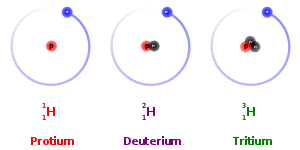
What is the atomic mass of the pictured isotope?
a)
2
b)
4
c)
6
d)
Hehehehe
19.
What is the name of the pictured isotope?
a)
Copper-29
b)
Copper-63
c)
Copper-34
d)
CopperWopperHopperBopper
20.
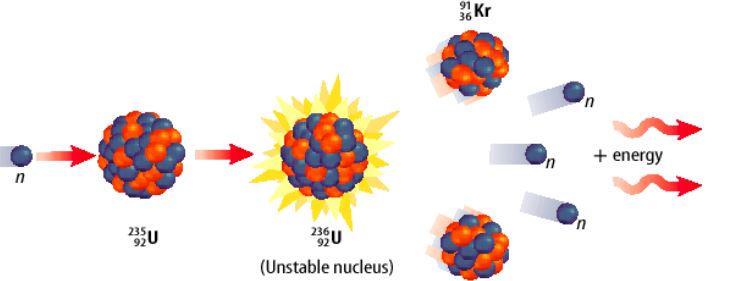
How many neutrons does the isotope below have?     89 36Kr
a)
53
b)
36
c)
89
d)
125
21.

Oxygen has six valence electrons. When forming an ion, oxygen will

a)

lose six electrons and have a charge of +6.

b)

lose six electrons and have a charge of -6.

c)

gain two electrons and have a charge is +2.

d)

gain two electrons and have a charge of -2.

22.

How is the alpha particle written in a nuclear equation?

a)

42He

b)

24He

c)

0-1e

d)

00γ

23.
A helium nucleus with two protons and two neutrons is called a(n) ____.  
a)
alpha particle
b)
electroscope
c)
beta particle
d)
gamma ray
24.
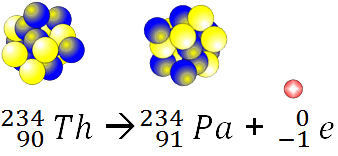
Which type of nuclear radiation is being emitted here?
a)
Alpha
b)
beta
c)
gamma 
d)
none
25.
Solve this equation for alpha decay.
85209At = ___ + 24He
a)
83205Bi
b)
86209Rn
c)
81207Tl
d)
85208At
26.

Gamma rays have

a)

no mass

b)

a huge mass

c)

a small mass

d)

an average mass

27.
Solve this equation for beta decay.
614C = ___ + -10e
a)
410Be
b)
714N
c)
210He
d)
613C
28.
Solve this equation for beta decay.
614C = ___ + -10e
a)
410Be
b)
714N
c)
210He
d)
613C
29.
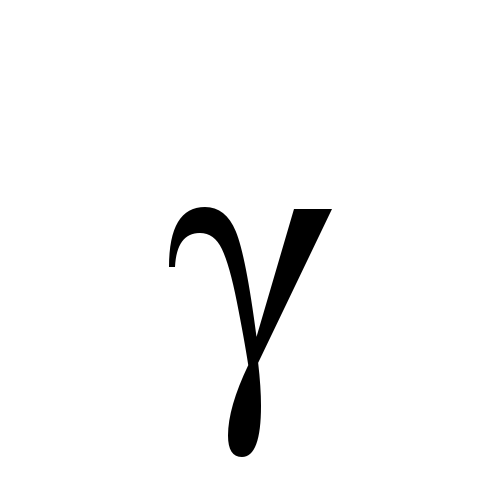
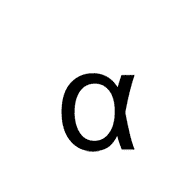
Has the symbol
a)
Alpha
b)
Beta 
c)
Gamma
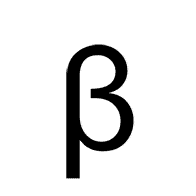
30.
Has the symbol
a)
Alpha
b)
Beta
c)
Gamma
31.
Has the symbol
a)
Alpha
b)
Beta
c)
Gamma
32.
Has the highest penetrating power.  Can penetrate our body.  Even several cm thick of lead or several meters thick of concrete cannot stop all of it.
a)
Alpha
b)
Beta
c)
Gamma
33.
Has the lowest penetrating power.  Can only penetrate 0.05 mm into the body and can be stopped by a piece of paper or clothing.
a)
Alpha
b)
Beta
c)
Gamma
34.
Uranium-238  decays into  Thorium-234  by emitting .........
a)
an alpha particle
b)
a beta particle
c)
gamma rays
d)
visible light
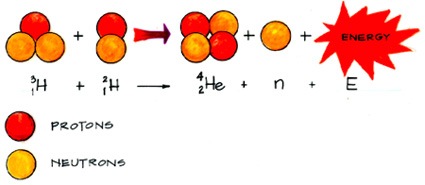
35.
This is an example of...
a)
Fission  reaction
b)
Fusion reaction
c)
Decomposition reaction
d)
Decay
36.
Which process involves the joining of small nuclei?
a)
Beta decay
b)
Alpha decay
c)
Nuclear fission
d)
Nuclear fusion
37.

In a correctly written symbol what would be located in the "Z" position?

a)

number of neutrons

b)

atomic number

c)

number of electrons

d)

mass number

38.
In a correctly written symbol what would be located in the "A" position?
a)
number of neutrons
b)
atomic number
c)
number of electrons 
d)
mass number
39.
Ionization energy is the...
a)
energy needed to remove the outermost electron.
b)
ability of an atom to attract electrons from another atom.
40.
Electronegativity is the...
a)
energy needed to remove the outermost electron.
b)
ability of an atom to attract electrons from another atom.
41.
Which element has the smaller atomic radius: potassium (K) or bromine (Br)?
a)
potassium (K)
b)
bromine (Br)
42.
Which element has the greatest ionization energy: Aluminum (Al)    or    Chlorine (Cl)?
a)
Aluminum (Al)
b)
Chlorine (Cl)
43.
As the Coulombic attraction of an atom increases, the electronegativity of the atom: increases or decreases?
a)
increases 
b)
decreases
44.
Which element has the greatest electronegativity: Nitrogen (N) or Arsenic (As)?
a)
Nitrogen (N)
b)
Arsenic (As)
45.

Which of these has the smallest atomic radius?

a)

K

b)

Rb

c)

Fr

d)

Cs

46.

Which has the highest ionization energy?

a)

Ca

b)

As

c)

Br

47.

Which would be the easiest to take an electron from?

a)

He

b)

F

c)

Ba

d)

Fr

48.

Which element would want to keep its electrons the most?

a)

O

b)

S

c)

Al

d)

Rb

49.
The energy required to remove electrons is the definition of: 
a)
Electronegativity
b)
Atomic Number
c)
Atomic Radius
d)
Ionization
50.
Families all have similar 
a)
Names
b)
atomic numbers
c)
atomic masses
d)
properties
51.
Electronegativity is...
a)
the ability of an atom to attract/ accept electrons
b)
the ability of an atom to lose electrons
c)
the energy required to remove an electron from a specific atom
d)
how easy it is to make friends. 
52.
Electronegativity __________ from left to right within a period and __________ from top to bottom within a group.
a)
decreases, increases 
b)
increases, increases
c)
increases, decreases 
d)
stays the same, increases
53.
Which statement correctly and completely identifies a trend?
a)
Atomic radius decreases across a period and increases down a group.
b)
Electronegativity decreases across a period and decreases down a group.
c)
Ionization energy increases across a period and increases down a group.
d)
Ionic radius increases across a period and increases down a group.
54.

What is the atomic radius?

a)

The distance from the nucleus to the outer boundary of an atom

b)

The distance from one side of an atom to the other side

c)

The distance around the atom

d)

The distance between atoms in the gas phase

e)

The distance between atoms in the solid phase

55.

Which of the following elements would be the largest: copper, zinc, silver or cadmium?

a)

copper

b)

zinc

c)

silver

d)

cadmium

e)

cannot be determined

56.

A Beryllium atom that has lost 2 electrons would look like

a)

Be2+

b)

B2-

c)

B2+

d)

Be2-

57.

The cation Rb+ has

a)

Had nothing happen to it

b)

Gained 1 electron

c)

Lost 1 electron

d)

Become negative

58.

Describe the anion S2-

a)

Silicon that gained 2 electrons

b)

Sulfide that gained 2 electrons

c)

Sulfur that gained 2 electrons

d)

Strontium that gained 2 electrons

59.
If an atom of nickel has a charge of +3, how many electrons does the atom have?
a)
28
b)
25
c)
26
d)
31
60.
If an atom of oxygen has a charge of -2, how many electrons does the atom have?
a)
18
b)
6
c)
8
d)
10
61.
Which of the following could have 14 neutrons?
a)
Al-27
b)
Si-29
c)
Mg-25
d)
Na-22
62.
What is the mass number of an atom of gold with 117 neutrons?
a)
117
b)
196
c)
196.97
d)
197
63.

12 protons, 10 electrons, 12 neutrons

a)

24Mg2^{24}Mg^{-2}

b)

24Cr+2^{24}Cr^{+2}

c)

24Cr2^{24}Cr^{-2}

d)

24Mg+2^{24}Mg^{+2}

64.

 26Al3^{26}Al^{-3}  

a)

13 protons, 16 electrons, 13 neutrons

b)

12 protons, 15 electrons, 14 neutrons

c)

16 protons, 13 electrons, 13 neutrons

65.

What does it happen to this atom?

a)

It LOSES electrons

b)

It GAINS electrons

c)

It GAINS protons

d)

It LOSES protons

66.

Which group does Hydrogen belong to?

a)

Group 1

b)

Group 2

c)

Group 3

d)

Group 4

67.

Which group does Aluminum belong to?

a)

Group 3

b)

Group 13

c)

Group 6

d)

Group 26

68.

Which period is Oxygen found in?

a)

Period 1

b)

Period 2

c)

Period 3

d)

Group 16

69.

Which Period is Gold (Au) found in?

a)

Group 11

b)

Group 6

c)

Period 11

d)

Period 6

70.

Which element is in the SAME GROUP as Oxygen?

a)

Hydrogen

b)

Helium

c)

Sulfur

d)

Carbon

71.

Which element is found in Group 2, Period 3?

a)

Sc

b)

Cu

c)

Na

d)

Mg

72.

Which element is in the SAME GROUP as Oxygen?

a)

Hydrogen

b)

Helium

c)

Sulfur

d)

Carbon

73.

Which element is in the SAME PERIOD as Helium?

a)

Hydrogen

b)

Neon

c)

Nitrogen

d)

Potassium

74.

What is the ATOMIC NUMBER of the element found in Period 4, Group 1?

a)

41

b)

4

c)

1

d)

19

75.

The law of conservation of mass says substances can neither be _______ nor ___________.

a)

Built; torn down

b)

Blended together; separated

c)

Created; destroyed

d)

Condensed; extracted

76.

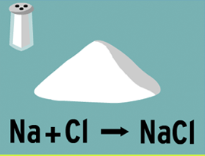
Sodium and chlorine combine to form sodium chloride, or table salt. Sodium and chlorine are:

a)

Producers

b)

Products

c)

Reactionaries

d)

Reactants

77.

When sodium and chlorine combine to form sodium chloride, sodium chloride is the:

a)

Originator

b)

Reactant

c)

Product

d)

Produce

78.
A 500-gram block of solid cheese is melted in a pot. Which is most likely the mass of the cheese after it is melted?
a)
500 grams, because the cheese does not gain or lose mass just because it was melted
b)
499 grams, because some of the cheese evaporates as it melts
c)
502 grams, because the cheese absorbs heat as it melts
79.

In a reaction A + B ----> C, reactant A has 5g and product C has 9g. How many grams does reactant B have?

a)

4g

b)

5g

c)

9g

d)

14g

80.
If reaction starts with 20g of reactants it should produce 
a)
a total of 40g of products
b)
a total of 10g of products
c)
a total of 80 g of products
d)
a total of 20g of products