wayground logo

Free Printable Worksheets

NEW

Font size

S
M
L
XL
Worksheets

Midterm Review

Total questions: 80

Worksheet time: 1hrs 12mins

Name
Class
Date
1.

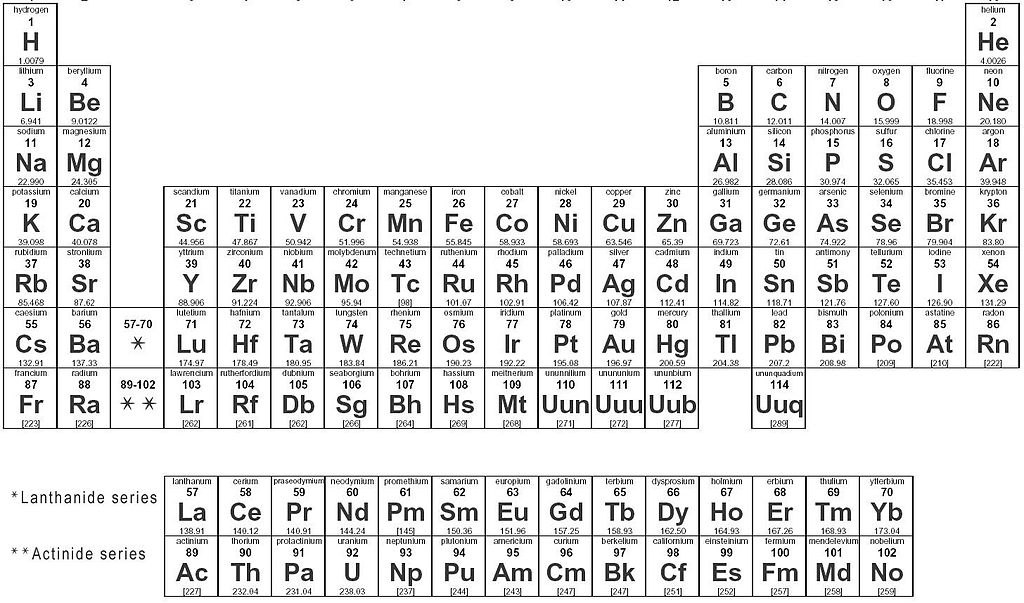
Which of the following will have a larger radius than Zinc?

a)

Gallium

b)

Aluminum

c)

Magnesium

d)

Strontium

2.
Which of the following will have a higher electronegativity than arsenic (As)?
a)
Carbon (C)
b)
Neon (Ne)
c)
Antimony (Sb)
d)
Germanium (Ge)
3.
Which of the following will have a lower ionization energy than Scandium (Sc)?
a)
Helium (He)
b)
Titanium (Ti)
c)
Calcium (Ca)
d)
Magnesium (Mg)
4.
As atoms of elements in group 16 are considered in order from top to bottom, the electronegativity of each successive element....
a)
decreases
b)
increases
c)
remains the same
d)
none of the above
5.
As you move down the periodic table atoms get bigger.  This is because ____________.
a)
The atoms have more mass.
b)
The atoms have more protons.
c)
The atoms have more energy levels
d)
The atoms have more neutrons
6.
As you move across the periodic table atoms tend to get smaller because, ______________.
a)
the atoms have more mass.
b)
the atoms have less mass
c)
the atoms have more protons.
d)
the atoms have less electrons.
7.
Ionization energy is...
a)
the energy required to add an electron to a specific atom
b)
how much energy it takes to remove an electron from an atom
c)
the energy required to shield the outer electrons from the nucleus
d)
a measure of the ability of an atom to attract electrons
8.
The atom with the largest atomic radius in Group 18 is - 
a)
Ar
b)
He
c)
Kr
d)
Rn
9.
Electronegativity __________ from left to right within a period and __________ from top to bottom within a group.
a)
decreases, increases 
b)
increases, increases
c)
increases, decreases 
d)
stays the same, increases
10.

Atomic radius generally increases as we move __________.

a)

down a group and from right to left across a period

b)

up a group and from left to right across a period

c)

down a group and from left to right across a period

d)

up a group and from right to left across a period
11.
Vertical columns of elements (families) on the periodic table with similar  properties
a)
groups
b)
periods
c)
quadrants
d)
rows
12.
What side of the periodic table are metals on?
a)
left
b)
right
c)
top
d)
bottom
13.
What does malleable mean?
a)
able to bend
b)
will break easily
c)
can be used for wire
d)
is shiny
14.
What does ductile mean?
a)
electricity flows easily
b)
quacks like a duck
c)
can be drawn into a wire
d)
able to bend
15.
What side of the periodic table are nonmetals on?
a)
left
b)
right 
c)
top
d)
bottom
16.
Is oxygen metal or nonmetal?
a)
metal
b)
nonmetal
17.
Is gold metal or nonmetal?
a)
metal
b)
nonmetal
18.
Metalloids _____________
a)
have no properties of metals.
b)
have no properties of nonmetals.
c)
have some properties of both metals and nonmetals.
d)
none of the above
19.
Which of the following properties refers to the ability of metals to be drawn into wires?
a)
A. malleability 
b)
B. compressibility
c)
C. ductility
d)
D. luster
20.
What element in Group 1 is not a metal but a nonmetal?
a)
Helium
b)
Lithium
c)
Hydrogen
d)
Oxygen
21.
How would this element be classified?
a)
Metal
b)
Nonmetal
c)
Metalloid
d)
Metamorphic
22.
Silicon is a semiconductor and has properties of both metals and nonmetals. What type of element is Silicon? 
a)
Metal
b)
Nonmetal
c)
Metalloid
d)
Pretty
23.

A cation is

a)

larger than its corresponding atom.

b)

smaller than its corresponding atom.

c)

the same size as its corresponding atom.

24.
Which of these is not a noble gas?
a)
Helium
b)
Argon
c)
Nitrogen
d)
Krypton
25.
Name group 18 on the periodic table.
a)
alkali metals
b)
alkaline earth metals
c)
transition metals
d)
noble gases
26.
Which of the following is NOT an alkali metal
a)
Li
b)
Cl
c)
K
d)
Cs
27.

What is another name for the elements in group 7A?

a)

The Halogens

b)

The Noble gases

c)

The Oxides

d)

The Alkali Metals

28.
Alkali metals are found in which group of the periodic table?
a)
Group 1
b)
Group 2
c)
Group 7
d)
group 8 
29.
Gold is what kind of metal?
a)
alkaline earth
b)
alkali
c)
transition
d)
lanthanide
30.
The family with the most reactive metals is the
a)
transition metals
b)
alkaline earth metals
c)
alkali metals
d)
lanthanide metals
31.
Group 18 elements are known as the _____ _____ and have full valence shells.
a)
royal gases.
b)
supreme solids.
c)
noble gases.
d)
legit liquids.
32.
Which elements have the most similar chemical properties?
a)
K and Na
b)
K and Ca
c)
K and Cl
d)
K and S
33.

How did Mendeleev organize the elements in his periodic table?

a)

increasing mass only

b)

increasing atomic number only

c)

increasing atomic mass with periods and groups

34.

The modern-day periodic table is organized by increasing

a)

atomic mass.

b)

atomic number.

c)

mass number.

d)

number of isotopes.

35.
Which of the following is the smallest in size?
a)
N3-
b)
O2-
c)
F-
d)
Na+
36.
Which of the following is the smallest in size?
a)
K
b)
Na
c)
Li
d)
Cs
37.
How many electrons does Si contain? (click to see image)
a)
14
b)
28
c)
2
d)
4
38.
How many valence electrons does Si contain? (click to see image)
a)
14
b)
28
c)
2
d)
4
39.
How many electrons can the first energy level hold?
a)
1
b)
2
c)
8
d)
0
40.
An orbital can at most hold how many electrons?
a)
1 electron
b)
2 electrons
c)
3 electrons
d)
4 electrons
41.
What is the highest occupied energy level?
a)
1
b)
2
c)
3
d)
4
42.
Cations are _______ that form ____________ ions and __________ electrons.
a)
nonmetals, positive, lose
b)
nonmetals, negative, gain
c)
metals, positive, gain
d)
metals, positive, lose
43.
Anions are _______ that form ____________ ions and __________ electrons.
a)
nonmetals, positive, lose
b)
nonmetals, negative, gain
c)
metals, positive, gain
d)
metals, positive, lose
44.

What is the configuration of the valence electrons in a sulfur atom?

a)

p4

b)

s2p4

c)

s4p2

d)

p6

45.
Steve wanted to see if the type of fertilizer made sunflowers grow larger. What is the independent variable 
a)
Type of fertilizer
b)
Size of sunflower
c)
type of sun flower
46.
Steve wanted to see if the type of fertilizer made sunflowers grow larger. What is the dependent variable 
a)
Type of fertilizer
b)
Size of sunflower
c)
Type of sunflower
47.
Molly investigated if the age of students caused them to be better drivers. What is the independent variable?
a)
Type of car
b)
Skill of driving
c)
Age of student
48.
Molly investigated if the age of students caused them to be better drivers. What is the dependent variable?
a)
Type of car
b)
Skill of driving
c)
Age of student
49.
Robert wanted to know if the type of phone you used gave you better or worse service. What is the dependent variable. 
a)
Location of phone call
b)
Type of phone
c)
How good or bad the service was
50.
Robert wanted to know if the type of phone you used gave you better or worse service. What is the independent variable. 
a)
Location of phone call
b)
Type of phone
c)
How good the service was
51.
a)
The dependent variable is total cost
b)
The dependent variable is weight
c)
The independent variable is total cost
d)
The independent variable is cost of a package
52.
On a graph, which axis shows the independent variable?
a)
x-axis
b)
y-axis
c)
neither
d)
it changes
53.

How many sig figs are there 100.00?

a)

1

b)

3

c)

4

d)

5

54.

How many sig figs are there in 100000000?

a)

1

b)

9

c)

10

55.

How many sig figs are there in 4004?

a)

1

b)

2

c)

3

d)

4

56.

How many sig figs are there in 0.000008?

a)

1

b)

2

c)

6

d)

7

57.

How many sig figs are there in 0.00400?

a)

1

b)

3

c)

5

d)

6

58.
Round 0.010229 to four sig figs
a)
1022
b)
1023
c)
0.01023
d)
0.01022
59.
Round 1047.78 to three sig figs
a)
104
b)
105
c)
1050
d)
1050.00
60.

How many significant figures are in 4.56 x 10³?

a)

5

b)

4

c)

6

d)

3

61.
What is measured with a graduated cylinder?
a)
Passage of time
b)
Distance from one thing to another
c)
Weight of an object
d)
Volume of liquid
62.
Identify the equipment shown here:
a)
graduated cylinder
b)
Erlenmeyer flask
c)
beaker
d)
volumetric flask
63.
Identify the equipment shown here:
a)
concave glass
b)
convex glass
c)
watch glass
d)
glass plate
64.
Identify the equipment shown here:
a)
beaker
b)
Erlenmeyer flask
c)
Florence flask
d)
volumetric flask
65.
Identify the equipment shown here:
a)
striker
b)
test tube holder
c)
flame snuffer
d)
utility clamp
66.
Which of these could be a correct measurement for the volume shown?  Click on this image for a better look.
a)
40 mL
b)
43 mL
c)
43.0 mL
d)
43.00 mL
67.

What is the volume of water in this graduated cylinder?

a)

47 mL

b)

47.0 mL

c)

45 mL

d)

45.4 mL

68.
Which has the LONGEST wavelength and, therefore, the lowest frequency/energy
a)
Gamma Rays
b)
Radio Waves
c)
Visible Light
d)
Infrared rays
69.
Put the visible light colors in order from longest wavelength to shortest wavelength
a)
Violet, Indigo, Blue, Green, Orange, Yellow, Red
b)
Red, Yellow, Green, Orange, Violet, Blue, Indigo
c)
Red, Orange, Yellow, Green, Blue, Indigo, Violet
70.

Calculate the wavelength of light that has a frequency of 5.2 x 10¹² Hz. The speed of of light is 3.0x 10⁸ m/s.

a)

5.8 x 10 -5 m

b)

5.8 x 10 -7 m

c)

5.19 x 10 14 m

d)

1.56 x 10 23 m

71.
The half life of iodine-131 is 8.040 days. What percentage of an iodine-131 sample will remain after 40.20 days?
a)
312.5%
b)
31.25%
c)
.3125%
d)
3.125%
72.
This type of reaction occurs when light nuclei combine to form a larger, single nucleus.
a)
Fission
b)
Fusion
c)
single displacement
d)
double displacement
73.
What is the most penetrating radiation?
a)
gamma
b)
alpha
c)
beta
d)
positron
74.
What is the product of the alpha decay of Gold-175?
a)
Ir-171
b)
Tl-179
c)
Au179
d)
Au171
75.
If the half-life of uranium-232 is 70 years, how many half-lives will it take for 10 g of it to be reduced to 1.25 g?
a)
1 half-life
b)
2 half-lives
c)
3 half-lives
d)
4 half-lives
76.
How many neutrons does the isotope of lithium have?
a)
8
b)
3
c)
4
d)
5
77.

What is the atomic number?

a)

the number of protons

b)

the number of protons and neutrons

c)

the number of neutrons

d)

the number of protons and electrons

78.

What is the mass number?

a)

the number of protons

b)

the number of protons and neutrons

c)

the number of neutrons

d)

the number of protons and electrons

79.
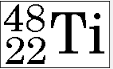
How many protons does this isotope of titanium have?
a)
48
b)
22
c)
26
d)
70
80.
What do these isotopes of carbon all have in common?
a)
neutrons & mass number
b)
atomic number and neutrons
c)
atomic number and electrons
d)
protons, atomic number, and mass number