
 Worksheets
Unit 3 Review - Nuclear Chemistry
Total questions: 75
Worksheet time: 2hrs 58mins
In which type of reaction do two lighter nuclei combine to form one heavier nucleus?
combustion
ionization
nuclear fission
nuclear fusion
____ is the process by which an unstable nucleus emits a particle or energy.
Radiation
Radioactivity
Decay series
Chain reaction
A stable nucleus will have a ratio of ____ (n0:p+) if it is a low atomic number, or a ratio of ____ (n0:p+) if it is a high atomic number.
1.5:1, 1:1
1:1, 1:2
1:1, 2:1
1:1, 1.5:1
1.1, 1:1.5
Which of the following is an example of alpha decay?
C-14 emits an electron and N-14
U-238 emits He-4 and Th-234
Lu-175 emits Lu-175 and a photon
Beta decay occurs when ___.
a nucleus spits out a helium nucleus plus a daughter nucleus
a neutron is converted into a proton + electron, and the electron is emitted from the nucleus at a very high speed
energy in the form of a photon is released from the nucleus
radon gas decays into polonium
The minimum amount of matter necessary to sustain a runaway chain reaction is known as ___.
molar mass
critical mass
nuclear mass
required mass
Successive decays that eventually result in the production of a stable nucleus is known as a ___.
Reaction series
Radiation series
Nuclear series
Decay series
What occurs in BOTH fusion and fission reactions?
Small amounts of energy are converted into large amounts of matter.
Small amounts of matter are converted into large amounts of energy.
Heavy nuclei are split into lighter nuclei.
Light nuclei are combined into heavier nuclei.
The purpose of "enriching uranium" was to:
obtain a higher percentage of fissionable U-235
make uranium atoms more stable
capture neutrons before they collide with more uranium atoms
increase the amount of ionizing radiation produced during fission reactions
What is emitted during Beta Decay?
A high-energy Electron
A helium nucleus
A proton
A high energy wave


Consists of 2 neutrons and 2 protons
Alpha
Beta
Gamma

Which type of nuclear radiation is being emitted here?
Alpha
Beta
Gamma
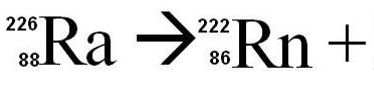
What is emitted during Alpha Decay?
A high-energy Electron
A helium nucleus
A proton
A high energy wave

Which type of nuclear radiation is being emitted here?
Alpha
Beta
Gamma

Which type of nuclear radiation is being emitted here?
Alpha
Beta
Gamma
Which can be stopped by your skin?
alpha particles
beta particles
gamma radiation
Which might you breathe in if you spend time in a basement that has high levels of Radon?
alpha particles
beta particles
gamma radiation

Arrange in order of INCREASING ability to penetrate matter.
Beta, gamma, alpha
Alpha, gamma, beta
Gamma, beta, alpha
Alpha, beta, gamma
What is the product of the ALPHA decay of Gold-175? (the atomic # of gold is 79)
Ir-171
Tl-179
Au179
Au171
Which of the following completes the following equation:
146C --> ________ + 0-1e
145B
146C
147N
42He

Which of the following remains once Cobalt-60 undergoes GAMMA decay?
Cobalt-60
Copper-62
Manganese-56
Nickel-60

Which of the following remains once Bismuth-214 undergoes ALPHA decay?
Bismuth-210
Bismuth-214
Thallium-210
Polonium-210

Which of the following remains once Copper-66 undergoes BETA decay?
Copper-30
Cobalt-62
Copper-66
Zinc-66
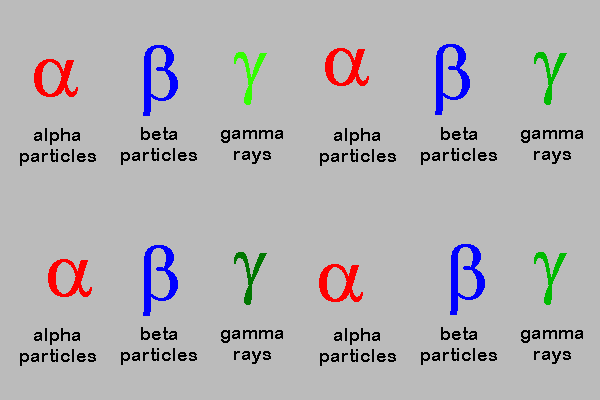
Using the decay of an isotope to find the age of a once-living object [fossil].
carbon dating
alpha particle
gamma ray
half-life
Time necessary for 50% of a radioactive sample to decay.
carbon dating
half-life
alpha particle
gamma ray
Who was the first woman to win a Nobel Prize for her work with radioactivity?
Lise Meitner
Marie Curie
Jane Goodall
Judy Blume
One type of radioactive device that indicates the intensity of radiation with a clicking sound that increases in frequency as more radiation is present is a(n) ____.
bubble chamber
cloud chamber
electroscope
Geiger counter
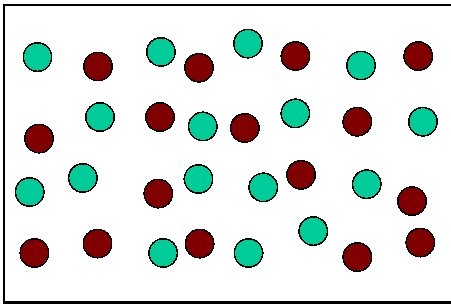
The diagram shows 32 atoms.
16 of the Red are parent isotopes
16 of the Green are daughter isotopes
How many half-lives have occurred?
0
1
2
3
How many grams are left after 1 half life?
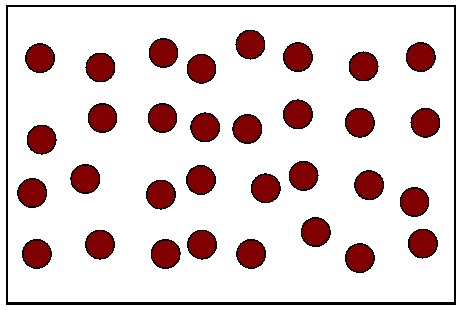
The diagram shows 32 atoms
32 of the Red are the parent isotope
0 of the atoms are daughter isotopes
How many half-lives have occurred?
0
1
2
3
Uranium was first discovered when people were mining ___.
gold
silver
copper
lead
The rock containing uranium was called:
pitchrock
pitchblende
uraniumblende
radiorock
Henri Becquerel wrapped ___ in dark paper and putting a chunk of rock containing uranium on top of it.
photographic film
a digital camera
a thin piece of silver
a window
Henri Becquerel then placed everything in sunlight. After unwrapping it, he noticed that the photographic film was "exposed". It was as if sunlight shined directly on it. This was ___ since the photographic film was COVERED with dark paper.
impossible
a reasonable explanation
So Becquerel concluded that ____ must be absorbing the sunlight and transferring this energy to the photographic film through the paper!
the paper
the rock containing uranium
To test this, Becquerel wrapped a new piece of film in paper and put the uranium containing rock on top once again. He was going to put it on the window ledge but noticed that it was…
cloudy out, so he left it on the ledge anyway
cloudy out, so he put it in a dark drawer
sunny out, so he put it on the ledge in the sunlight
Becquerel took the film wrapped in paper with the rock on top out of the drawer, unwrapped it, and noticed that it had been exposed once again, despite being in a dark drawer! He realized the energy required to expose the film:
definitely came from sunlight and had nothing to do with the rock
came from the rock itself and had nothing to do with sunlight
Becquerel's FINAL conclusion was that:
the rock released its own energy that exposed the film, even when it was in the dark
the rock absorbed the sun's energy and then transferred it to the photographic film days later
the rock had nothing to do with the change on the photographic film
Years later, scientists finally understood what caused the rock containing uranium to expose the film. They realized that it contained atoms of ____.
Uranium-238
Thorium-234
Helium-4
Lead-207
The nucleus of these U-238 atoms were ____ and underwent radioactive decay.
stable
unstable
These unstable atoms of Uranium-238 can be represented with the following analogy:


These unstable atoms of Uranium-238 underwent radioactive decay and changed into a more stable atom which can be represented by:
The U-238 atoms changed into ___ during the decay process.
more stable atoms of Thorium
more stable atoms of Uranium
more UNstable atoms of Thorium
As the unstable atoms of Uranium-238 decayed, they released radiation which can be represented by:

