Wayground logo

Free Printable Worksheets

Font size

S
M
L
XL
Worksheets

Quiz 4 Review - Enzymes, Cell Respiration and Photosynthesis

Total questions: 40

Worksheet time: 1hrs 20mins

Name
Class
Date
1.

The purpose of cellular respiration is to:

a)

synthesize carbohydrates from CO2

b)

break down carbohydrates to provide energy for the cell

c)

provide oxygen for the cell

d)

break down proteins into amino acids

2.
What is the ultimate ORIGINAL source of energy for living things
a)
Sugar
b)
Sun
c)
Moon
d)
Carbon Dioxide
3.
Which gas is removed from the atmosphere during photosynthesis?
a)
hydrogen
b)
oxygen
c)
nitrogen
d)
carbon dioxide
4.

Which of these processes requires oxygen?

a)

aerobic processes

b)

anaerobic processes

c)

electron transport

d)

glycolysis

5.

Which of the following processes produces the most ATP molecules per glucose molecule consumed?

a)

Krebs Cycleb

b)

Electron Transport Chain

c)

Glycolysis

d)

Calvin cycle

6.
What is produced as a result of photosynthesis?
a)
Glucose and Chlorophyll
b)
Glucose and Oxygen
c)
Water and Light energy
d)
Carbon dioxide and Water
7.

The reactants or raw materials needed for cell respiration are

a)

water and carbon dioxide

b)

sunlight and water

c)

sugar (glucose) and oxygen

d)

oxygen and ATP

8.

Muscle fatigue is caused when the process of fermentation produces:

a)

ethanol

b)

lactic acid

c)

ATP

d)

H2O

9.

Which organelle does cell respiration take place in?

a)

Chloroplast

b)

Cytoplasm

c)

Mitochondria

d)

Ribosome

10.

Which is the correct formula for cellular respiration?

a)

H2O + CO2 --> O2 + C6H12O6 (sugar) + Energy

b)

Energy + O2 + C6H12O6 (sugar) --> CO2 + H2O

c)

C6H12O6 (sugar) + O2--> H2O + CO2 + Energy

11.

Alcoholic fermentation and lactic acid fermentation are processes that don't require oxygen, so they are

a)

Aerobic

b)

Anaerobic

12.

What is the relationship between photosynthesis and cell respiration ?

a)

The products of photosynthesis are the reactants of cell respiration.

b)

They are not related at all.

c)

Only animals can do cell respiration and only plants can do photosynthesis.
13.
What is a substance called if it speeds up a chemical reaction?
a)
reusable
b)
catalyst
c)
specific
d)
fragile
14.
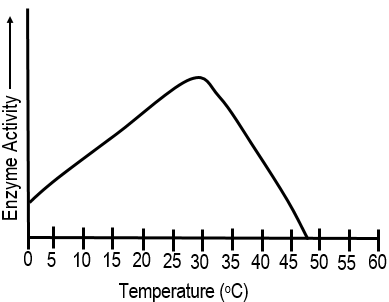
Based on the graph, what is the optimal temperature for this enzyme? 
a)
15oC
b)
40oC
c)
30oC
d)
35oC
15.
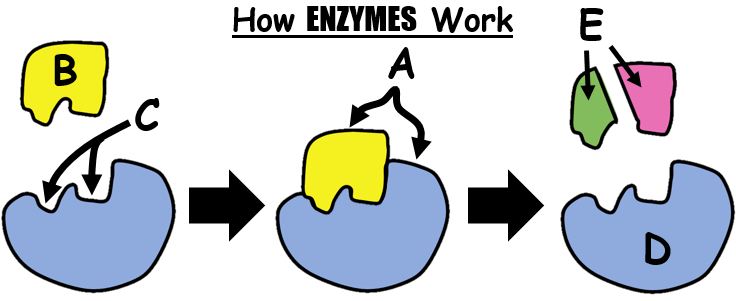
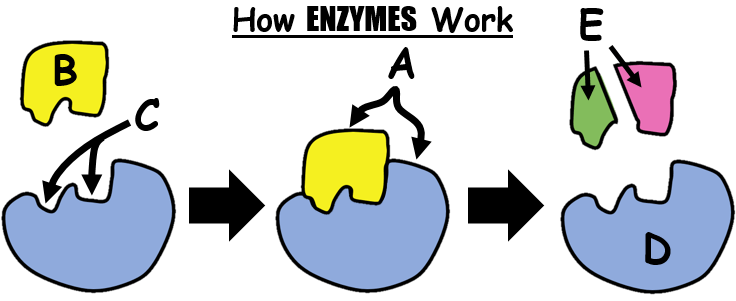
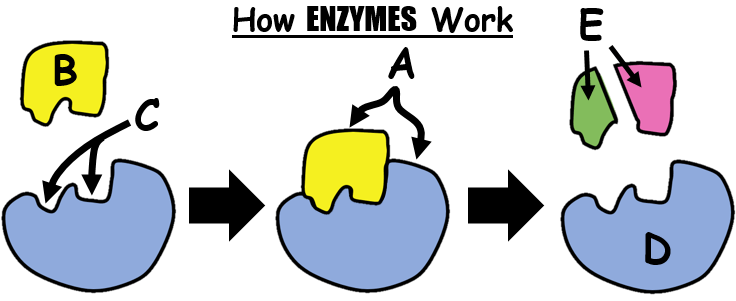
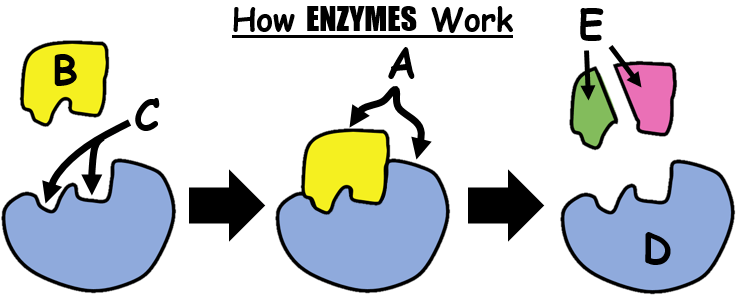
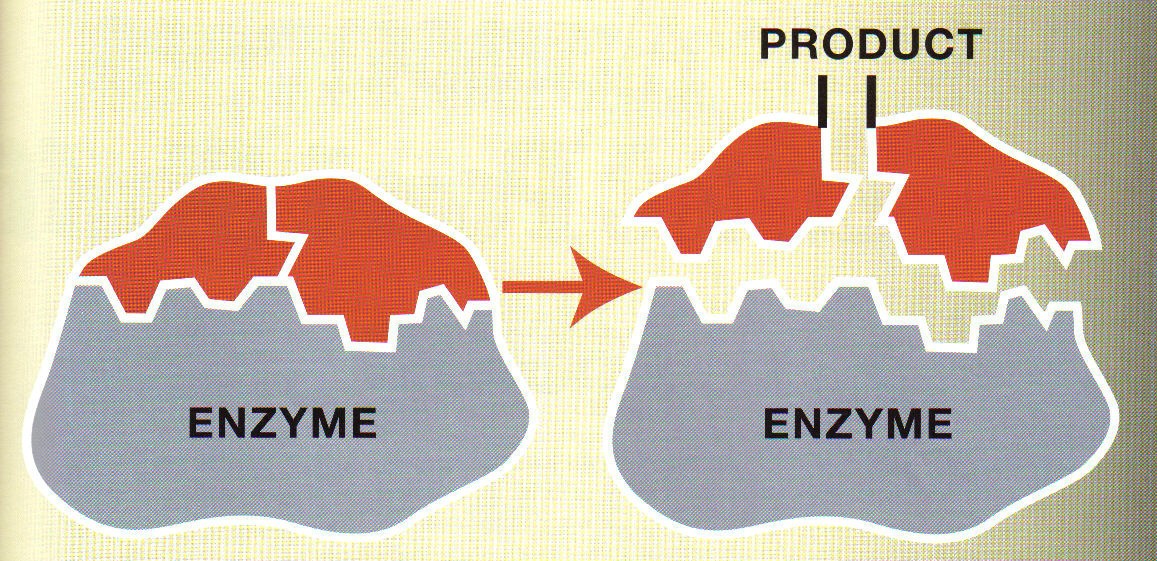
In the diagram, what is letter A? 
a)
product
b)
substrate
c)
enzyme-substrate complex
d)
active site
16.
Letter B...
a)
active site
b)
enzyme
c)
substrate
d)
products
17.
Letter C...
a)
active site
b)
enzymes
c)
substrate
d)
products
18.
Letter D...
a)
active site
b)
enzyme
c)
substrate
d)
products
19.
What is the function of an enzyme?
a)
enzymes break themselves into small pieces
b)
enzymes slow down chemical reactions
c)
enzymes speed up chemical reactions
d)
enzymes combine products to form reactants 
20.
Enzymes speed up reaction rates by changing...
a)
Activation Energy
b)
pH
c)
Hydrogen Bonds
d)
Kinetic Energy
21.
Which statement about photosynthesis is correct?
a)
Plants get the energy they need for photosynthesis from water.
b)
Plants get the energy they need for photosynthesis from soil.
c)
Plants get the energy they need for photosynthesis from sunlight.
d)
Plants do not require energy to perform photosynthesis.
22.
Why do we eat food?
a)
to provide energy/fuel
b)
to eliminate waste products
c)
to prevent diseases
d)
to kill pathogens
23.
What is the purpose of cellular respiration?
a)
to break down food
b)
to create energy in the body
c)
to release energy from food
d)
there is none; it's a waste of time
24.
Which gas is removed from the atmosphere during photosynthesis?
a)
hydrogen
b)
oxygen
c)
nitrogen
d)
carbon dioxide
25.
What gas is released by plants during photosynthesis?
a)
sulfur
b)
carbon dioxide
c)
oxygen
d)
hydrogen
26.
What type of respiration requires oxygen?
a)
Aerobic
b)
Anaerobic
27.
Which organism pictured must absorb carbon dioxide to survive?
a)
bird
b)
rabbit
c)
insect
d)
tree
28.

True or False: plant cells use both photosynthesis and cell respiration whereas animal cells only use cell respiration.

a)

True

b)

False

29.

What are the substances before the arrow in a chemical equation called?

a)

products

b)

reactants

30.

What is ATP?

a)

a plant

b)

an animal

c)

a form of energy

d)

a cell

31.
How are cellular respiration and photosynthesis related, in terms of energy?
a)
The energy captured in photosynthesis is used to power cellular respiration.
b)
The energy transformed in cellular respiration is used to power photosynthesis.
c)
Photosynthesis and respiration perform the same task in terms of energy transformation.
d)
Energy is not involved in either photosynthesis or cellular respiration.
32.

What happens when cell respiration is interrupted or stopped?

a)

cells die from lack of energy

b)

they begin photosynthesis

c)

cells power through anyways

33.

What is glucose converted into during glycolysis?

a)

Pyruvic acid

b)

Acetyl CoA

c)

NADH

d)

FADH2

34.
What 3 letters do enzymes typically end in?
a)
-ose
b)
-ase
c)
-ese
d)
-tic
35.
What is the name for the mechanism of enzyme activity?
a)
Lock and key
b)
jigsaw puzzle
c)
hammer and nail
d)
two hands pattern
36.
The graph shows how enzymes affect reactions in cells. Which statement best summarizes the information shown in the graph?
a)
Enzymes increase the energy of the reactants.
b)
Enzymes decrease the energy level of the products.
c)
Enzyme decrease the activation energy of the reaction.
d)
Enzymes reverse the direction of the reaction.
37.
What factors affect an enzyme's reaction rate?
a)
temperature 
b)
pH
c)
substrate concentration
d)
all of these
38.
What is a substance called if it speeds up a chemical reaction?
a)
reusable
b)
catalyst
c)
specific
d)
fragile
39.
Venus flytraps produce chemicals that break down insects into usable compounds. These chemicals are most likely:
a)
Hormones
b)
Lipids
c)
Enzymes
d)
Carbohydrates
40.
Which suggests that the shape of an enzyme determines the enzyme's function?
a)
Enzymes are specific to a substrate
b)
Enzymes can operate in a wide range of conditions
c)
Enzymes are activated by neighboring molecules
d)
Enzymes can be found in all life-forms