Wayground logo

Free Printable Worksheets

Font size

S
M
L
XL
Worksheets

EB Chem PTable Quiz

Total questions: 58

Worksheet time: 43mins

Name
Class
Date
1.
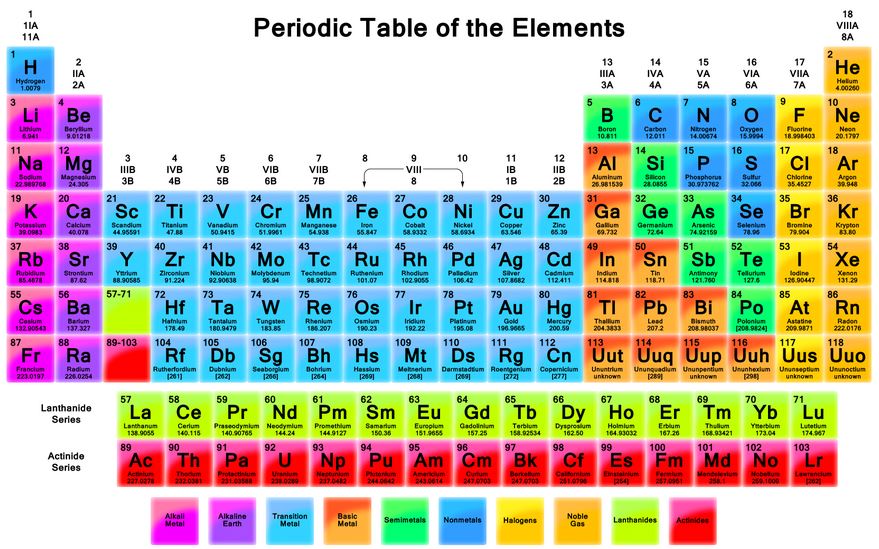
Which group of the periodic table is composed of inert (not reactive)  gases?
a)
alkali metals
b)
alkaline earth metals
c)
halogens
d)
noble gases
2.
Which is a halogen?
a)
Helium
b)
Chlorine
c)
Oxygen
d)
Neptune
3.

True or False: The reactivity of metals tends to decrease as you move from left to right across the periodic table.

a)

True

b)

False

4.

Which of the following are physical properties of metal?

a)

Luster

b)

Conductivity

c)

Malleability

d)

Ductility

5.

Name this group: These metals are the most reactive.

a)
b)
c)
d)
6.

Find an element with similar chemical properties to Barium (Ba).

a)

Ca an Ra, because they are in the same group and have similar chemical properties.

b)

Cs and La, b/c they are in the same period number.

c)

Ca and Y, b/c they are 90 degree angle and have similiar properties.

7.

Which element has similar chemical properties as sodium but has 7 energy levels?

a)

Francium (Fr)

b)

Cesium (Cs)

c)

Rubidium (Rb)

d)

Potassium (K)

8.
Elements which are shiny, conduct electricity and heat are called
a)
metal
b)
nonmetal
c)
metalloid
d)
nonexistent
9.
Group Name and Number for Neon
a)
Alkaline Earth Metals 2 or 2A
b)
Noble Gases 18 or 8A
c)
Halogens 17 or 7A
d)
Alkali Metals 1 or 1A
10.
Group Name and Number for Flourine
a)
Transition Metals 3-12
b)
Noble Gases 18 or 8A
c)
Halogens 17 or 7A
d)
Alkali Metals 1 or 1A
11.
Looking at atoms in the same group/family, what factor affects Coulombic attraction?
a)
number of protons
b)
distance from the nucleus
12.
Looking at atoms in the same valence energy level, what factor affects Coulombic attraction?
a)
number of protons
b)
distance from the nucleus
13.
Ionization energy is the...
a)
energy needed to remove the outermost electron.
b)
ability of an atom to attract electrons from another atom.
14.
As the Coulombic attraction increases the atomic radius: increases or decreases?
a)
increases
b)
decreases
15.
Which element has the smaller atomic radius: potassium (K) or bromine (Br)?
a)
potassium (K)
b)
bromine (Br)
16.
As the Coulombic attraction in an atom increases, the energy needed to remove an electron: increases or decreases?
a)
increases
b)
decreases
17.
Which element has the greatest ionization energy: Aluminum (Al)    or    Chlorine (Cl)?
a)
Aluminum (Al)
b)
Chlorine (Cl)
18.
As you move down a group, atomic radius increases because - 
a)
you add more and more neutrons
b)
you add more and more protons
c)
you add more and more shells (energy levels)
d)
you add more atomic mass
19.
The atom with the largest atomic radius in Group 18 is - 
a)
Ar
b)
He
c)
Kr
d)
Rn
20.
As you move across the periodic table from left to right, the atomic radius decreases.  This is because - 
a)
the number of protons increases, so attraction to electrons increases
b)
the number of energy levels increases
c)
the number of electrons increases
d)
the atomic mass increases
21.
The atom with the largest atomic radius in Period 4 (row 4) is - 
a)
K
b)
Kr
c)
Fe
d)
Fe
22.

Put these in order of INCREASING First Ionization Energy (low to high) : Ga, Ne, Rf

(a)  

23.

When nonmetals react, they gain electrons. 

a)

True

b)

False

24.
Which of the following has a full valence shell?
a)
Oxygen
b)
Neon
c)
Barium
d)
Carbon
25.
Elements on the LEFT side of the periodic table will most likely form:
a)
Positive ions
b)
Negative ions
c)
Neutral Ions
d)
None of these
26.
An ionic bond forms when atoms ___________ electrons.
a)
gain
b)
share
c)
increase
d)
transfer
27.
Which type of bond has an equal sharing of electrons?
a)
Polar Covalent 
b)
Non Polar Covalent
c)
Ionic
d)
Metallic
28.
Which type of bond has an unequal sharing of electrons?
a)
Polar Covalent 
b)
Non Polar Covalent
c)
Ionic
d)
Metallic
29.
Which type of bond has a transfer of an electron from on atom to another?
a)
Polar Covalent 
b)
Non Polar Covalent
c)
Ionic
d)
Metallic
30.
All chemical bonds involve two atoms sharing electrons.
a)
True
b)
False
31.
Chemical bonds form when atoms
a)
combined nuclei
b)
give up neutrons
c)
gain protons
d)
share or transfer electrons
32.
Bonds that form between two metals are called ______________ bonds.
a)
ionic 
b)
covalent
c)
metallic
d)
pervasive
33.
If an atom loses two electrons what charge will it have?
a)
+ 2
b)
 - 2
c)
+1
d)
-1
34.
If an atom gains one electron what charge will it have?
a)
-2
b)
-1
c)
+1
35.
Covalent compounds
a)
Share electrons
b)
transfer electrons
c)
contain a sea of electrons
d)
conduct electricity
36.
What is the number of valence electrons for Oxygen?
a)
8
b)
6
c)
2
d)
1
37.
How many valence electrons in this structure?
a)
6
b)
5
c)
4
d)
7
38.
Which type of bond creates a "pool" of electrons between atoms?
a)
Ionic Bonds
b)
Covalent Bonds
c)
Metallic Bonds
d)
Saving Bonds
39.

What is a valence electron?

a)

an electron that is found in the outermost shell of an atom.

b)

an electron found in the innermost shell of an atom.

c)

an electron found in the middle shell.

40.

What is the number of valence electrons for Neon and the other Noble Gases?

a)

5

b)

6

c)

7

d)

8

41.

Predict the bond between Mg and Cl

a)

covalent

b)

ionic

c)

metallic

d)

none of the above

42.
What is the name for CaS?
a)
calcium sulfate
b)
calcium sulfide
c)
calcium monosulfide
d)
monocalcium monosulfide
43.
Which of the following is ionic?
a)
NO2
b)
MgO
c)
CO
d)
CH4
44.

What charge would a potassium (K) ion have?

a)

+1

b)

-1

c)

+2

d)

-2

45.
The bond between N & H.   Ionic or covalent?
a)
Ionic
b)
Covalent
46.
The bond between Na & F.   Ionic or covalent?
a)
Ionic
b)
Covalent
47.

Which of the following would be held together by the metallic bond?

a)

Atoms of iron (Fe)

b)

Molecules of CH4

c)

Atoms of sulfur (S)

d)

Units of NaCl

48.
At room temperature, most metals are
a)
liquid
b)
solid
c)
gas
d)
an alloy
49.

______ molecules are found in nature as pairs of two atoms of the same type covalently bonded together.

a)

Diatomic

b)

Monatomic

c)

Polyatomic

d)

Network

50.
Why do bonds form?
a)
To fill the valence shell of electrons for the elements involved
b)
to release energy stored in the bonds
c)
because whenever you mix two chemicals, there will be a reaction
d)
because of attraction
51.
What type of bond is illustrated above?
a)
Metallic
b)
Ionic
c)
Covalent
d)
Wiggly
52.
A substance which has a high melting point, conducts electricity when dissolved in water, and has a crystalline structure probably has what type of bond?
a)
Ionic
b)
Metallic
c)
Covalent
d)
Crystalline
53.
A solid substance is an excellent conductor of electricity. The chemical bonds in this substance are most likely?
a)
ionic, because the valence electrons are shared between atoms
b)
covalent, because the valence electrons are mobile
c)
metallic, because the valence electrons are stationary
d)
metallic, because the valence electrons are mobile
54.

A mixture of two or elements at least one of which is a metal is called

a)

an ion

b)

an alloy

c)

steel

d)

a crystal

55.

A compound forms between a metal and a nonmetal. It is

a)

ionic

b)

metallic

c)

covalent

56.

Ionic compounds are held together by

a)

intermolecular forces

b)

electrostatic forces

c)

magnetic forces

d)

nuclear forces

57.

Which solid would be a good conductor?

a)

sodium chloride

b)

copper (II) sulfate

c)

glucose

d)

aluminum

58.

Which compound would be a good conductor when in solution?

a)

aluminum

b)

sulfur dioxide

c)

ammonia

d)

sodium nitrate