
 Worksheets
7th First Semester Challenge
Total questions: 119
Worksheet time: 1hrs 9mins
The goals of the Age of Exploration were...
To expand world ideas
To acquire goods
To spread Christianity
All of the above
What was the Treaty of Tordesillas?
The treaty to help end the 100 Years' War
The name given for the route to North America
Treaty between Spain and Portugal, giving Spain all land to the West, and Portugal all discovered land to the East
The name of Christopher Columbus' ship at the time of his Atlantic crossing

Which route on the map represents VAsco da Gama's voyage most accurately?
A
B
C
D
Native American population of Mexico in 1492 has been estimated at 25 million; the population in 1608 has been estimated at 1.7 million. This decrease in population was mainly a result of
crop failure brought on by poor weather conditions
emigration of Native Americans to Europe and Africa
wars between various native groups
diseases introduced by the Spanish
Was given credit as the first explorer to circumnavigate the world.
Vasco Da Gama
Ferdinand Magellan
Christopher Columbus
Prince Henry
Spanish explorer who conquered the Aztec Empire in Mexico.
Vaco Da Gama
Christopher Columbus
Prince Henry
Hernan Cortes
First explorer to find a sea route to Asia by traveling around the coastline of Africa.
Vasco Da Gama
Ferdinand Magellan
Christopher Columbus
Prince Henry
How did the plague enter into Europe?
From birds
From tainted food
From poisoned water
By flea-bearing rats on ships
Which of the following was the leader of the Aztecs at the time of Cortes' arrival?
Atahualpa
Pizarro
Hiawatha
Moctezuma
Sailors could calculate their location on teh position of the Sun and stars in relation to the horizon with the
compass
astrolabe
caravel
nautical map
How did the Renaissance contribute to the Age of Exploration?
by emphasizing the importance of converting people to Buddism
by awakening a spirit of discovery and innovation in Europe
by fostering a belief in the importance of working as a group
by persuading Europeans that hte pursuid of wealth was all-important
Which European country was the first to send out Explorers?
Spain
France
England
Portugal
The expeditions of Conquistadors Hernan Cortes and Franciscco Pizarro resulted in the...
Destruction of the Aztec and Inca empires
Capture of Brazil by Portugal
Colonization of North America by Portugal
Exploration of the East Indies

Which route on the map above represents Christopher Columbus's first voyage mos accurately?
A
B
C
D
Portuguese explorer Ferdinand Magellan is credited with...
First person to Circumnavigate the world
Being the fist European to see the Pacific Ocean
Fidning a Northwest Passage
Rounding the tip of Africa and making it to India
Does the plague still exist today?
Yes
No
In popular culture which children's rhyme is said to be about the plague?
"London Bridges is Falling Down
Three Blind Mice
Baa Baa Black Sheep
Ring Around the Rosie
Which of the following best describes the motivation that caused European exploreres to find a way to sail to Asia, otherwise known as the "three G's)
Gifts, Gold, and Glory
God, Gold, and Greed
God, Glory, and Silver
God, Glory, and Gold
What were the symptoms of the Black Death?
Fever, headaches, and vomiting
Black swellings the size of eggs onthe armpits or groin
Dark spots on the skin
All of these
The ultimate goal of early Portuguese exploreres was to...
find a water route around Africa to India
discover new lands
exploere the coast of Africa
spread Christianity
Which of the following were obstacles face by the explorers?
Fear of the unknown
Disease and starvation
Poor maps and navigational tools
All of the above
The type of ship used during the AGe of Exploration was the
Caravel
Titanic
Astrolabe
Silk Road
News of the invention of gunpowder traveled from China westward by way of the
Columbian Exchange
Venetian Trading Ships
Portuguese trading post
Silk Road

WHich route on the map above represents Magellan's voyage most accurately?
A
B
C
D
Who was Marco Polo?
a religious leader
a pirate
a Philosopher
an explorer and author
The historical period of intellectual and artistic creativity is knwon as the
Age of Enlightenment
Age of reason
Middle Ages
Renaissance
Which Portugueses prince laid the groundwork for a new era of exploration
Bartholameu Dias
Henry the Navigator
John II
Vasco da Gama
In 1492 Christopher Columbus sailed to America with the Nina, Pinta, and
Cortez
Isabella
Santa Maria
Tordesillias
Who was the first Spaniard to land on the mainland of North America
Juan Ponce de Leon
Hernan Cortez
Christopher Columbus
Francisco Pizarro
THe Explorer who first sailed around the southern tip of Africa was
Robert de La SAlle
Ferdinand Magellan
Vasco da Gama
Bartholomeu Dias
Many Native Americans died after the Spanish invation because of
loss of homes
loss of pride
starvation
disease
The voyages of Christopher Columbus led ot contact and an exchange between Europe, Asia, AFrica, and the Americas called?
the Continental Exchange
mercantilism
the Columbian Exchange
the Treaty of Tordesillas
Made the first blue prints for the tank and helicoptor. Also painted the Mona Lisa.
Michelangelo
Dias
Leonardo
Donatello

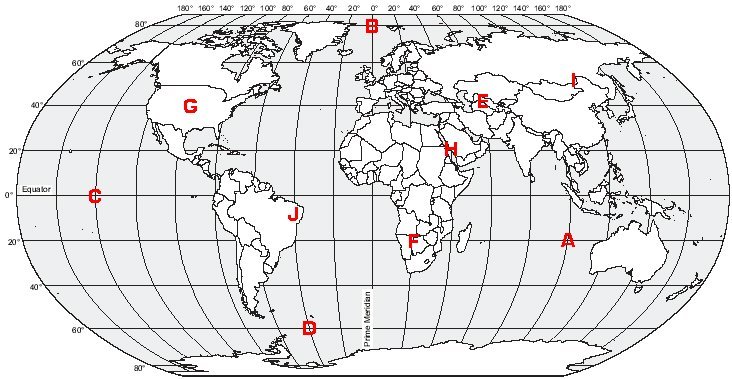
Location D is located at which coordinates?
30oN, 90oW
90oN, 30oW
10oN, 40oW
30oN, 90oE
Location H is located at which coordinates?
60oN, 120oE
90oN, 30oE
10oS, 40oW
30oN, 90oE
Location E is located at which coordinates?
30oS, 30oE
30oS, 30oW
10oS, 40oW
30oN, 90oE
Location L is located at which coordinates?
15oS, 60oW
45oS, 60oW
15oS, 60oE
45oS, 60oE
Which point is located at 30oS, 30oE?
K
D
E
G
Which point is located at 30oS, 150oE?
K
D
E
G
Which point is located at 30oN, 90oW?
K
D
E
G
Which point is located at 45oN, 30oE?
K
D
E
G


120°W, 45°N

105°W, 47°N
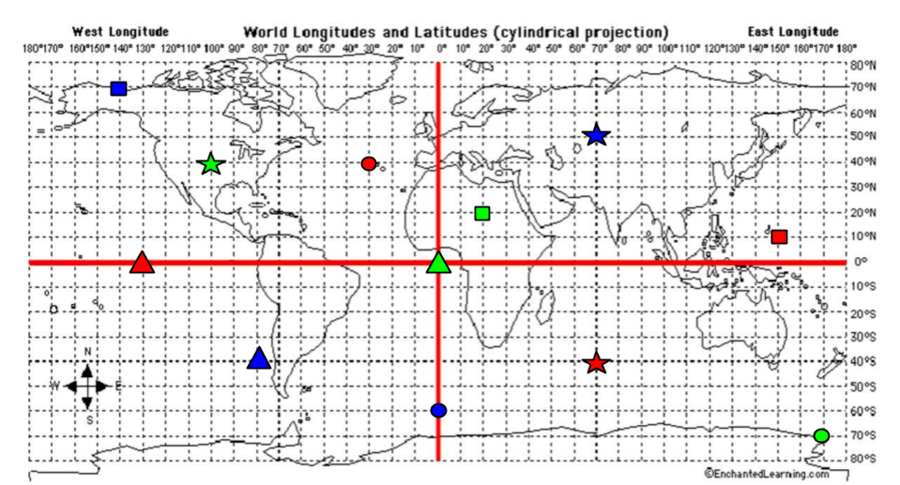
What are the coordinates for the RED Square?
40*S, 70*E
40*N, 30*W
0*, 130*W
10*N, 150*E
What are the coordinates for the RED Triangle?
40*S, 70*E
40*N, 30*W
0*, 130*W
10*N, 150*E
What are the coordinates for the RED Circle?
40*S, 70*E
40*N, 30*W
0*, 130*W
10*N, 150*E
What are the coordinates for the BLUE Star?
40*S, 80*W
60*S, 0*
70*N, 140*W
50*N, 70*E
What are the coordinates for the BLUE Star?
40*S, 80*W
60*S, 0*
70*N, 140*W
50*N, 70*E
What are the coordinates for the BLUE Circle?
40*S, 80*W
60*S, 0*
70*N, 140*W
50*N, 70*E
What are the coordinates for the BLUE Square?
40*S, 80*W
60*S, 0*
70*N, 140*W
50*N, 70*E
What are the coordinates for the GREEN Star?
40*N, 100*W
70*S, 170*E
20*N, 20*E
0*, 0*
_____ location is the exact spot on earth a place is found.
absolute
exact
pinpoint
accurate
The Mayans did not use money in the modern sense. Instead they traded.
Los mayas no usaban el dinero en el sentido moderno. En cambio, comerciaron
True
False
Early nomads crossed the land bridge from Siberia to Alaska called
Los primeros nómadas cruzaron el puente terrestre de Siberia a Alaska llamado
Pacific Ocean
Berengia
Asia
Ice Land
Movement of a group of people
Movimiento de un grupo de personas
migration
artifacts
nomads
carbon dating
During the Explorers Club dinner of 1951 mammoth was on the menu. What was it really?
Durante la cena del Club de Exploradores de 1951, el mamut estaba en el menú. ¿Qué fue realmente?
Sloth
Chicken
Mammoth
Sea Turtle
Things left behind by early people
Cosas dejada por las primeras personas
carbon dating
artifacts
maize
migration
What plant turned early people from hunters into farmers?
¿Qué planta convirtió a las primeras personas de cazadores en granjeros?
Carrots/ zanahorias
Apples/ manzanas
Maize
Potato/ papa
Because of farming, people were able to settle down and form communities
Debido a la agricultura, las personas pudieron establecerse y formar comunidades
True
False
Scientist use carbon dating to
find out how old an artifact is
preserve ancient artifacts
create better tasting corn
make things explode
What part of the body did the Aztecs need for a sacrifice
¿Qué parte del cuerpo necesitaban los aztecas para un sacrificio?
head/ cabeza
leg/ pierna
lung/pulmón
heart/corazón
The Inca produced a steady food supply using
El Inca produjo un suministro constante de alimentos utilizando
terraces/ las gradas
hieroglyphics
floating gardens/ jardines flotante
copper rope/cuerda de cobre
This was the largest of the empires, containing over 9 million people, and over 10,000 miles of roads.
Este era el imperio más grande, con más de 9 millones de personas y más de 10,000 millas de caminos.
Aztec
Maya
Inca
Apache
One of the games that the Mayans liked to play and watch was the ball game. In the ball game the players could not hit the ball with their what?
Uno de los juegos que a los mayas les gustaba jugar y mirar era el juego de pelota. En el juego de pelota, ¿los jugadores no podían golpear la pelota con su qué?
Head/ cabeza
Hip/ cadera
Hands/ manos
Which civilization had free education for everyone?
¿Qué civilización tenía educación gratuita para todos?
Aztec
Mayans
Incas
Mexico City, Mexico was built on the ruins of this Aztec Capital City
Ciudad de México, México fue construido sobre las ruinas de esta capital azteca
Machu Picchu
Tenochtitlan
Tikal
Cuzco
Which one of the below choices is an Incan myth
Which one of the below choices is an Incan myth
This tribe was wandering around the countryside when they spotted an island. On that island was an eagle sitting on top of a cactus with a snake in its mouth. This tribe believed that this was a sign from the gods to make this their new home.
Esta tribu deambulaba por el campo cuando vieron una isla. En esa isla había un águila sentada sobre un cactus con una serpiente en la boca. Esta tribu creía que esta era una señal de los dioses para hacer de este su nuevo hogar.
Believe that their ancestors are people made from white corn.
Cree que sus antepasados son personas hechas de maíz blanco.
The god Viracocha came out of the Pacific Ocean, and created the sun and all people. He buried the people in springs and rocks, but they eventually came back into the world. This tribe's name means "Children of the Sun."
El dios Viracocha salió del Océano Pacífico y creó el sol y todas las personas. Enterró a la gente en manantiales y rocas, pero eventualmente regresaron al mundo. El nombre de esta tribu significa "Hijos del Sol".
Which one of the below choices is a Myan myth
¿Cuál de las siguientes opciones es un mito maya?
This tribe was wandering around the countryside when they spotted an island. On that island was an eagle sitting on top of a cactus with a snake in its mouth. This tribe believed that this was a sign from the gods to make this their new home.
Esta tribu deambulaba por el campo cuando vieron una isla. En esa isla había un águila sentada sobre un cactus con una serpiente en la boca. Esta tribu creía que esta era una señal de los dioses para hacer de este su nuevo hogar.
Believe that their ancestors are people made from white corn.
Cree que sus antepasados son personas hechas de maíz blanco.
The god Viracocha came out of the Pacific Ocean, and created the sun and all people. He buried the people in springs and rocks, but they eventually came back into the world. This tribe's name means "Children of the Sun."
El dios Viracocha salió del Océano Pacífico y creó el sol y todas las personas. Enterró a la gente en manantiales y rocas, pero finalmente regresaron al mundo. El nombre de esta tribu significa "Hijos del Sol".
Which one of the below choices is an Aztec myth
¿Cuál de las siguientes opciones es un mito azteca?
This tribe was wandering around the countryside when they spotted an island. On that island was an eagle sitting on top of a cactus with a snake in its mouth. This tribe believed that this was a sign from the gods to make this their new home.
Esta tribu deambulaba por el campo cuando vieron una isla. En esa isla había un águila sentada sobre un cactus con una serpiente en la boca. Esta tribu creía que esta era una señal de los dioses para hacer de este su nuevo hogar.
Believe that their ancestors are people made from white corn.
Cree que sus antepasados son personas hechas de maíz blanco.
The god Viracocha came out of the Pacific Ocean, and created the sun and all people. He buried the people in springs and rocks, but they eventually came back into the world. This tribe's name means "Children of the Sun."
El dios Viracocha salió del Océano Pacífico y creó el sol y todas las personas. Enterró a la gente en manantiales y rocas, pero finalmente regresaron al mundo. El nombre de esta tribu significa "Hijos del Sol".
What date did the Mayan calendar end?
¿En qué fecha terminó el calendario maya?
January 1, 2000
December 21, 2012
June 26, 1982
January 1, 2012
Agriculture allowed the early Americans to
La agricultura permitió a los primeros estadounidenses
Form communities
Formar comunidades
Hunt more efficiently
Caza más eficientemente
Have better birthday parties
Travel farther
Viajar más lejos
Were the Mayans Monotheistic or Polytheistic
¿Los mayas eran monoteístas o politeístas?
Monotheistic
Polytheistic

Which bodies of water surround the area in which the Maya settled?
¿Qué cuerpos de agua rodean el área donde se asentaron los mayas?
Atlantic Ocean, Caribbean Sea, Pacific Ocean
Atlantic Ocean, Gulf of Mexico, Pacific Ocean
Caribbean Sea, Gulf of Mexico, Atlantic Ocean
Caribbean Sea, Gulf of Mexico, Pacific Ocean
A ________ and ________ agriculture is a method of agriculture in which vegetation is cut down and burned off before new seeds are sown.
Una agricultura ________ y ________ es un método de agricultura en el que la vegetación se corta y se quema antes de sembrar nuevas semillas.
Whip, Lash
Latigazo
Slash, Burn
cortar, quemare
Temple, Pyramid

Where did the Incas live?
¿Dónde vivieron los incas?
Western South America
Eastern North America
Eastern South America
Western North America
Read the following excerpt and answer the question based on the reading.
"The Aztec civilization grew into a military empire. In the 1400s the Aztec army marched through central and southern Mexico, conquering nearly all rival communities. Aztec warriors took everything they could carry from their victims, including maize, cotton cloth, copper, and weapons. Conquered people were forced to work as slaves in Aztec cities and villages. Like the Maya, the Aztec organized their society around their religion. The Aztec believed that human sacrifices were necessary to keep the gods pleased and to ensure abundant harvests. Thousands of prisoners of war were sacrificed."
What might happen to an Aztec war prisoner?
Lea el siguiente extracto y responda la pregunta según la lectura.
"La civilización azteca se convirtió en un imperio militar. En la década de 1400, el ejército azteca marchó por el centro y el sur de México, conquistando casi todas las comunidades rivales. Los guerreros aztecas tomaron todo lo que podían llevar de sus víctimas, incluido maíz, tela de algodón, cobre y armas. Las personas conquistadas se vieron obligadas a trabajar como esclavos en ciudades y pueblos aztecas. Al igual que los mayas, los aztecas organizaron su sociedad en torno a su religión. Los aztecas creían que los sacrificios humanos eran necesarios para mantener satisfechos a los dioses y asegurar abundantes cosechas. Miles de prisioneros de la guerra fueron sacrificados ".
¿Qué le puede pasar a un prisionero de guerra azteca?
He might be part of a human sacrifice
Él podría ser parte de un sacrificio humano
He might be given a house in which to live
Se le podría dar una casa en la que vivir
He might be set free
Él podría ser puesto en libertad
All of the above
Todas las anteriores
A highly developed society
Una sociedad altamente desarrollada
civilization
terrace
migration
theocracy
A society ruled by religious leaders.
Una sociedad gobernada por líderes religiosos.
Democracy
Theocracy
Dictator
Civilization

Which civilization is in red?
¿Qué civilización está en rojo?
Inca
Mayan
Aztec
British
Inglaterra
Which civilization is in green?
¿Qué civilización está en verde?
Inca
Mayan
Aztec
British
Which civilization is in yellow?
¿Qué civilización está en amarillo?
Inca
Mayan
Aztec
British

