
 Worksheets
Spring Benchmark Review
Total questions: 114
Worksheet time: 1hrs 9mins
Why was Constantinople such a prosperous city?
located at the crossroads of trade
Great architecture
Strong autocratic rulers
The pope lives there


Who was the leader of the church in the Byzantine empire, Eastern Orthodox Church?
The pope
The patriarch
The emperor
The people

What emperor had the law code re-written and organized?
Charlemagne
Justinian
Theodora
Constantine
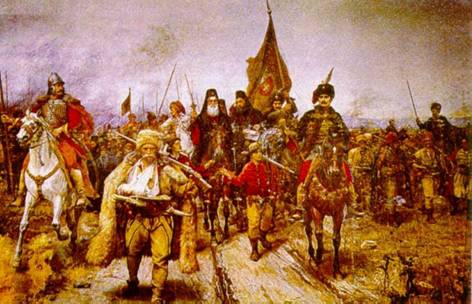
Who conquered the Byzantines in 1453?
The Franks
The Ottoman Turks
The Holy Roman Empire
The Mongols
Which Byzantine emperor rebuilt the Hagia Sophia, a masterpiece of Byzantine architecture?
Justinian
Constantine
Zeno
Irene
How did the Roman pope and the Byzantine patriarch deal with their religious differences?
Made a compromise
excommunicated each other
sent troops in to attack
rewrote the laws to include freedom of religion
What is the title of the head of the Roman Catholic Church?
King
Pope
Tsar
Emperor

What was Constantinople the original capital of?
Rome
Byzantine Empire
Ottoman Empire
Ancient Greece
The Byzantine Empire was originally the
western Roman empire
eastern Turkish empire
western Greek empire
eastern Roman Empire
Who did the Roman Catholic Church say was head of the church?
pope
emperor
people
clergy
What is the Justinian Code?
books of laws
writings of Emperor Justin
religious document
books of hieroglyphs
Why is the Justinian Code important?
It tells about everyday life in ancient Rome.
It influenced many future cultures and civilizations.
It tells about everyday life in Byzantine.
It laid the foundation of western medicine.
What is the Quran?
Christian holy book
Justinian holy book
Islamic holy book
Hebrew holy book
Where do Muslims make their pilgrimage?
Istanbul
Arabia
Constantinople
Mecca
The Roman Emperor Constantine called his new capital city.....
Rome II
Little Italy
Constantinople
istanbul
Constantinople
Byzantine emperor; reconquered parts of Western Roman Empire; building projects like Hagia Sophia; established a new legal code
Justinian's wife; encouraged laws to protect women
Capital city of the Byzantine empire; located between the Black Sea and Mediterranean Sea
Christian followers in the Byzantine Empire; split from Roman Catholic Church
Theodora
Byzantine emperor; reconquered parts of Western Roman Empire; building projects like Hagia Sophia; established a new legal code
Justinian's wife; encouraged laws to protect women
Capital city of the Byzantine empire; located between the Black Sea and Mediterranean Sea
Christian followers in the Byzantine Empire; split from Roman Catholic Church
Justinian
Byzantine emperor; reconquered parts of Western Roman Empire; building projects like Hagia Sophia; established a new legal code
Justinian's wife; encouraged laws to protect women
Capital city of the Byzantine empire; located between the Black Sea and Mediterranean Sea
Christian followers in the Byzantine Empire; split from Roman Catholic Church
Code of Justinian
at the end of the Roman Empire, the Romans bought more than they produced, which added another reason for their collapse
Byzantine legal code; foundation for justice systems around the world today
series of trade routes between Asia and Europe and run through Constantinople; allowed for political, cultural, religious and economic interactions
mostly Greek (some Latin)
Silk Road
at the end of the Roman Empire, the Romans bought more than they produced, which added another reason for their collapse
Byzantine legal code; foundation for justice systems around the world today
series of trade routes between Asia and Europe and run through Constantinople; allowed for political, cultural, religious and economic interactions
mostly Greek (some Latin)
Language spoken in Byzantine Empire
at the end of the Roman Empire, the Romans bought more than they produced, which added another reason for their collapse
Byzantine legal code; foundation for justice systems around the world today
series of trade routes between Asia and Europe and run through Constantinople; allowed for political, cultural, religious and economic interactions
mostly Greek (some Latin)
Which of the following East Asian countries is an example of a peninsula?
Japan
China
The Koreas
Taiwan
In their early history, Japan and Korea were both strongly influenced by...
The United States
Russia
China
India
Japanese land owning warriors who supported the Shogun were known as...
Tsunami
Samurai
Loess
Communists
Besides merchant goods, what else traveled along the Silk Road?
Ideas
Technology
Religions
All of the above
Which of the following was NOT invented by the Chinese?
The wheel
Magnetic Compass
Paper
Gunpowder
What East Asia Country is an archipelago?
China
Japan
South Korea
Mongolia


The Himalayas are located ________.
northwest of China
west of Pakistan
northeast of India
east of Myanmar

Largest continent in the world
Asia
China
Japan
Europe

Which region stretches from China to Mongolia and is the largest desert in Asia?
Sahara
Gobi
Atacama
Nile Basin

Which mountain is part of the Himalayas and the tallest mountain in the world?
Mount Everest
Mount McKinley
Mount Fuji
Mount Ranier

What country is this?
China
Japan
North Korea
Mongolia

What physical feature is this?
Himalayas
Ural Mountains
Gobi Desert
Korean Peninsula

What physical feature is this?
Gobi Desert
Tibetan Plateau
Huang He (Yellow) River
Mount Fuji

What body of water is this?
Mississippi River
Nile River
Ganges River
Huang He (Yellow) River

What body of water is this?
Pacific Ocean
Arctic Ocean
Atlantic Ocean
Indian Ocean

What body of water is between mainland Asia and Japan?
Black Sea
Philippian Sea
Sea of Japan
Caspian Sea

What physical feature are North and South Korea located on?
archipelago
isthmus
volcano
peninsula

Japan is an example of....
a peninsula
an archipelago
an isthmus
a desert
Genghis Khan used foreigners to create a written language, bombs and catapults, and learn medicine because he:
was respectful of foreigners
short-tempered with foreigners
concerned about foreigners
Hurricane in the Pacific Ocean is called a:
flood
typhoon
cyclone
In 1206, one man _________ the Mongol people.
annihilated
separated
united
Which dynasty did Kublai Khan conquer to become the ruler of all of China?
Ming Dynasty
Qing Dynasty
Song Dynasty
Tang Dynasty
How did Kublai Khan treat the conquered people's traditional beliefs?
He forced them to convert to Mongol beliefs
He completely banned all traditional beliefs
He allowed them to practice their traditional beliefs
He only allowed certain traditional beliefs
Who advised Kublai Khan on governing the people?
Confucian scholars
Mongol warriors
Foreign diplomats
Religious leaders
How did Kublai Khan maintain control of his empire?
With fear
With a strong central government
By promoting cultural assimilation
By establishing democratic institutions

Tribute is
a payment made for protection or as a sign of submission
a payment made for groceries
a payment made for home-building

A caravan is
a group of people or animals traveling together on a long journey especially through the desert
a car that is large and shaped like a van
giving money or goods to a ruler or country for protection

A pilgrimage is a
a journey to a holy place
person who attended the first Thanksgiving
a group of people or animals traveling on a long journey

A griot is a
holy journey
group of people on a long trip through the desert
storyteller and entertainer in Ancient Africa

To "barter" means to
buying or selling stories
buying or selling only good things
to exchange things for other things instead of for money

Islam refers to
a religion that started in the Middle East
a religion that started in Europe

A follower of Islam is called a
Christian
Muslim
Jew

The Sahara Desert is
the largest desert in the world
the smallest desert in the world

The word "Arabic" refers to
a language spoken mostly in the Middle East and North Africa
a type of desert plant found in the Sahara Desert
a type of food carried in caravans

A sultan is
a king or ruler of a Muslim state or country
a king or ruler of a Christian state or country
a king or ruler of a Jewish state or country
Monotheism is the belief in
one god
many gods
all gods
all of the above
Allah is the word "god" in which language?
Hebrew
English
Greek
Arabic
All of these are monotheistic religions EXCEPT...
Islam
Hinduism
Christianity
Judaism
This is the most valuable natural resource in Saudi Arabia.
Oil
Lumber
Gold
Coffee
Which region in the world contains almost half of the world's oil?
East Asia
North America
Middle East
Southern Europe
Select all religious groups
Judaism
Persian
Christianity
Islam
Kurd
Which of the following best matches the definition of "Secular"?
Arabic for "the one at the front," he leads Muslim worship services
A nomad of the Sahara or Rub-al-Khali Deserts
A rigid form of government in which the monarch has absolute power among his or her people
Non-religious, or the separation of Church and State

What domesticated animal is used in the Middle East/North Africa for wrestling, racing, and eating (As sausages, when they get too old)?
Sheep
Camel
Badger
Dog
What connects the Mediterranean Sea and the Red Sea?
The Strait of Hormuz
The Strait of Gibraltar
The Bosporus and Dardanelles Straits
The Suez Canal
Where can all swimmers easily float?
The Red Sea
The Dead Sea
The Black Sea
The Persian Gulf

This is a ____, or Islamic house of worship, in Richardson, TX.
Caliph
Mosque
Bedouin
Wadi
A nobleman who was trained as a warrior and lived their live according to a code of chivalry
Samurai
Navy
Vassal
Knight
Code of conduct which a knight swore to uphold
Ethics
Semper Fi
Chivalry
Tithe
Event where knights would ride towards each other with blunted lances (long poles) in attempt to knock each other off of their horse
Joust
Chivalry
Squire
Page

What’s a castle?
It is the large, splendid home of a rich, important person.
It is a strengthened military stronghold. (redoubt)
It is a large, fortified building that is also the home of a king, lord, or other important person.
An extreme shortage of food is called a ___________________.
drought
plague
famine
natural disaster


What did the Magna Carta do?
extended property rights to serfs and peasants
made the king subject to the rule of law
organized barons into a parliament
restored and organized English common law
What killed a third of the population of Europe in the 1300s?
bubonic plague
invasion of the Turks
religious persecution
wars among kingdoms
Against what group of people did Pope Urban II declare the Crusades?
heretics
Jews
Muslims
renegades
Which choice correctly shows the social order under feudalism?
king, clergy, peasants & serfs, knights
king, knights, clergy, serfs
king, nobles, knights, peasants & serfs
king, knights, nobles, peasants & serfs
What was a series of wars by Christian armies to reclaim the Holy Land?
Reconquista
Inquisition
Hundred Years' War
Crusades
Whose selfless actions helped bring about an end to the Hundred Years' War?
King John
Robin Hood
Julius Caesar
Joan of Arc

