
 Worksheets
ว21102 วิทย์ ม1 สสารและพลังงาน
Total questions: 40
Worksheet time: 3hrs 20mins
เพราะเหตุใดประเทศไทยหรือประเทศที่อยู่ในสภาพอากาศร้อนจึงเหมาะสำหรับการสร้างบ้านที่มีใต้ถุนสูง หลังคาทรงสูง และมีช่องระบายอากาศ
อากาศช่วยพาความร้อนออกไป
อากาศช่วยนำความร้อนออกไป
อากาศช่วยนำและพาความร้อนออกไป
อากาศช่วยนำความร้อนเข้ามาและพาความร้อนออกไป
การถ่ายโอนพลังงานความร้อนแบบใดที่ไม่อาศัยตัวกลาง
การนำความร้อน
การพาความร้อน
การแผ่รังสีความร้อน
การคายความร้อน
การได้รับรังสีอินฟาเรดซึ่งเป็นรังสีความร้อนจากดวงอาทิตย์เป็นการถ่ายโอนความร้อนด้วยวิธีการใด
การนำความร้อน
การพาความร้อน
การแผ่รังสีความร้อน
การนำความร้อน และ การแผ่รังสีความร้อน
การที่ก้อนดินน้ำมันหลอมเหลวตกจากแท่งวัตถุเพราะดินน้ำมันได้รับความร้อนจากน้ำเดือดโดยผ่านวัตถุมาสู่ก้อนดินน้ำมันวิธีการนี้เรียกว่าอะไร
การพาความร้อน
การนำความร้อน
การแผ่รังสีความร้อน
การขยายตัว
ข้อใดไม่ใช่วิธีการถ่ายโอนพลังงานความร้อน
การนำความร้อน
การพาความร้อน
การคายความร้อน
การแผ่รังสีความร้อน

ด้ามจับกระทะ อาศัยหลักการ...
นำความร้อน
พาความร้อน
แผ่รังสี

การย่างปลาจนสุก เป็นการถ่ายโอนความร้อนแบบใด
นำความร้อน
พาความร้อน
แผ่รังสีความร้อน
การคายความร้อน

เอามือจับแก้วกาแฟแล้วรู้สึกร้อน เป็นการถ่ายโอนความร้อนแบบใด
นำความร้อน
พาความร้อน
แผ่รังสีความร้อน
คายความร้อน
What are the three methods of heat transfer?
conduction
convection
friction
radiation
Process of changing a liquid to a solid
boiling
freezing
condensation
melting
Heat energy from the Sun is transferred by
Conduction
Convection
Radiation
Friction
Hot air rising is an example of
Conduction
Convection
Radiation
Friction
State of matter where particles are tightly packed and move very little.
Solid
Liquid
Gas
Plasma
The process of changing a gas to a liquid
Freezing
Boiling
Condensation
Melting


Which will heat up faster?
copper
granite
iron
basalt

Which will heat up slower?
water
lead
granite
iron
Which of the following best explains why the sand at the beach is hotter than the water?
Sand has a higher specific heat than water.
Sand has a lower specific heat than water.
There is more water than sand at the beach.
There is more sand than water at the beach.
The amount of energy required to raise the temperature 1ºC for every gram is called____?
Thermal Energy
Specific Heat
Temperature
Kinetic Energy

What letter is used to represent specific heat capacity?
H
P
C
T
The specific heat of platinum is 0.133 J/g°C. How much heat(Q) is released when a 10 g piece of platinum cools from 100°C to 50°C?
66.5 J
665 J
0.0266 J
0.665 J
Determine the heat energy needed to heat the water in the pot to boiling.
The specific heat(c) of copper is 0.39 J/g °C. What is the temperature change(∆t) when 100 Joules of heat(Q) is added to 20 grams?
12.82 °C
24.12°C
1.95 °C
5128 °C
20 g of water. specific heat of water is 4.18 J/g°C. temperature changes from 25° C to 20° C, how much heat energy (Q) moves from the water to the surroundings?
418 J
209 J
83 J
4.18 J
Water molecules have the greatest kinetic energy in
Ice at 0 ⁰C
Water at 90 ⁰C
Water at 373 K
Steam at 150 ⁰C
How much energy is needed to raise the temperature of 5.0 grams of lead from 25°C to 35°C? [specific heat (c) = 0.129 J/(g•°C)]
6.45 J/(g•°C)
6.45 J
16.1 J/(g•°C)
d.16.1 J
The heat absorbed by melting a solid is known as
latent heat of fusion
latent heat of solid
latent heat of liquid
latent heat of vaporisation
What is the formula to calculate specific latent heat of vaporisation?
L = Q/m
c = Q/(mΔƟ)
Q = mcΔƟ
Q = mL
The quantity of heat, Q that is absorbed or released during a change of phase of 1 kg of the substance without any change in its temperature.
This is the definition of
Specific latent heat
Latent heat
Specific heat capacity
Heat capacity
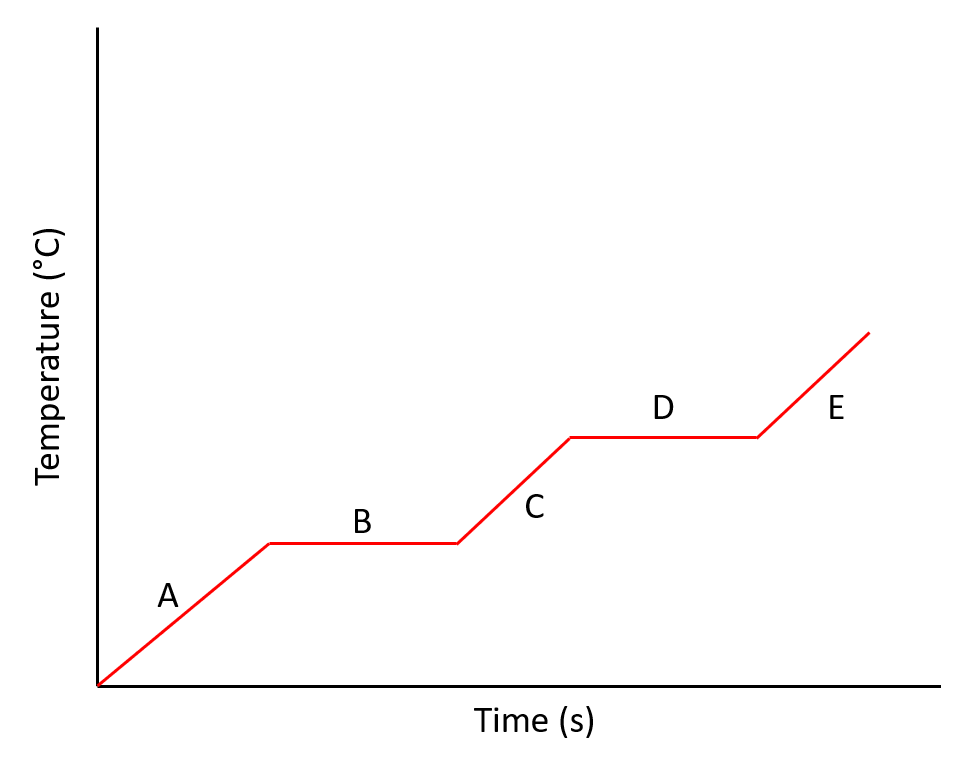
The diagram shows a heating curve for ice. Which line represents the ice in a liquid state (water)?
A
B
C
D
E

