
 Worksheets
Physics Practice test for Long Test 1
Total questions: 40
Worksheet time: 3570secs
What is the definition of displacement?
An object that is lost without any scientifically explained reason
.
A vector that points from an object's initial position to its funal position and has a magnitude that equals the shortest distance between two points
A vector that points from an object's initial position to its funal position and has a magnitude that equals the greatest distance between two points
None of the above
What is the definition of average velocity?
Average Velocity= displacement ------------------ elapsed time
Elapsed time= Distance ------------- speed
Velocity= Elapsed time ----------------- acceleration
None of the above
______________ does not reveal about the direction of the motion. To describe how fast an object moves and the direction of its motion, we need the vector concept of _____________
speed , velocity
distance , time
speed , time
displacement, velocity
When an object is in free fall,
its speed stays the same.
it decelerates
it accelerates.
none of the above.
The word rate is a clue that something is being time.
divide by
multiply by
added to
subtract from
The students are arguing over the differences between speed and velocity. One student says, “Speed is a vector because it describes how fast an object traveling. Velocity is a scalar because it tells how fast and what direction an object is traveling.” Which of the following statements is correct?
The students' understanding of all four terms (speed, velocity, scalar, and vector) is correct.
The students' understanding of all four terms (speed, velocity, scalar, and vector) is incorrect.
The students' understanding of speed and velocity is incorrect but their
understanding of scalar and vector is correct.
The students’ understanding of speed and velocity is correct but their understanding of scalar and vector is incorrect.

which of the following is a vector?
velocity
discance
position
speed

Solve the sum:


Solve the sum:



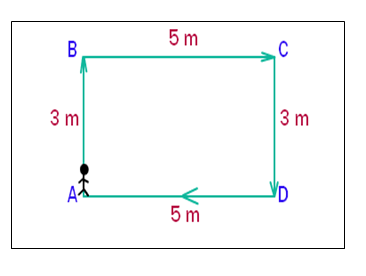
Fred walks in the following order: from Point A-B-C-D. The DISTANCE Fred walked is ____ meters and his Net DISPLACEMENT is ____ meters.
11 m; 16 m
16 m; 0 m
0 m; 16 m
16 m; 8 m

How was the graph created?
Keeping the car steady, moving it away from the sensor at a constant speed, holding it still for a little while, then moving it back toward the sensor
Keeping the car steady, moving it away from the sensor slowly after first and then faster, holding it still for a little while, then moving it back toward the sensor
Keeping the car steady, moving it away from the sensor quickly at first then slowly, holding it still for a little while, then moving it back toward the sensor
Computers hooked up to a science machine

What is the total displacement of the car?
60 m
20 m
0 m
80 m
What is the total distance traveled by the car?
60 m
20 m
0 m
80 m

According to the vector diagram which is correct?
F2 + F 3 = F1
F1 + F2 = F 3
F1 + F3 = F 2
F1 + F2 + F 3 = 0
A man, who has walked a certain distance, but not in a straight line, can …
have a zero displacement
not have a negative displacement
have a displacement higher in magnitude to the distance
have a displacement equal in magnitude to the distance

In which of the following vector diagrams is the resultant of the three vectors zero?
A
B
C
D
E

-9.8 m/s2


A projectile is fired with initial velocity vo at an angle θ0 with the horizontal and follows the trajectory shown above. Which of the following pairs of graphs best represents the vertical components of the velocity and acceleration, v and a, respectively, of the projectile as functions of time t?


A ball is thrown and follows the parabolic path shown above. Air friction is negligible. Point Q is the highest point on the path. Points P and R are the same height above the ground. Which of the following diagrams best shows the direction of the acceleration of the ball at point P?


Two projectiles are fired horizontally from the same height but with different velocities as shown in the picture. Which one will hit the ground first?
The one on the left.
The one on the right
They will hit at the same time.

Two projectiles are fired horizontally with the same velocity but from different heights as shown in the picture. Which one will hit the ground first?
The one on the left.
The one on the right
They will hit at the same time.

If this velocity graph is from projectile, what does the area of the shaded region represent.
The maximum height
The maximum velocity
Vertical acceleration
How long it was in the air

If this velocity graph is from a projectile, what does the area of the shaded region represent?
Initial velocity
How high it got
The range
The acceleration

