
 Worksheets
A/P: Chapter 7: Nervous System Part II
Total questions: 49
Worksheet time: 2hrs 38mins
When a nerve fiber is polarized, the concentration of
sodium and potassium ions is higher on the outside of its membrane
sodium and potassium ions is higher on the inside of its membrane
sodium ions is higher on the inside of its membrane and potassium ions is higher on the outside of its membrane
sodium ions is higher on the outside of its membrane and potassium ions is higher on the inside of its membrane
The minimal stimulus needed to elicit an action potential in a neuron is called the ___ potential
resting
action
threshold
refractory


What number(s) on the graph represents the THRESHOLD level of stimulus?
1 and 5
2
3
6
These respond to excessive chemical, mechanical or thermal pain; found in every tissue of the body and adapt slowly
mechanoreceptor
nociceptor
photoreceptor
thermoreceptor
These are found in the retina, detects light.
mechanoreceptor
nociceptor
photoreceptor
thermoreceptor
Most important and common inhibitory neurotransmitter
Acetylcholine
Dopamine
Epinephrine
Gama-Aminobutyric Acid (GABA)
Neurotransmitter produced when "feeling good," causes addictions
Serotonin
Dopamine
Epinephrine
Gama-Aminobutyric Acid (GABA)
Most common neurotransmitter found in both the CNS and PNS
Acetylcholine
Dopamine
Epinephrine
Gama-Aminobutyric Acid (GABA)
Also known as adrenaline, causes the feeling of being “revved up” or on edge
and activates a “fight or flight” reaction in the autonomic nervous system
Acetylcholine
Dopamine
Epinephrine
Gama-Aminobutyric Acid (GABA)
Neurotransmitter used for attention and other complex cognitive functions (drives), such as sleep (dreaming), eating, mood, pain regulation
Serotonin
Dopamine
Epinephrine
Gama-Aminobutyric Acid (GABA)
Releases neurotransmitters
axon terminal
myelin sheath
neurolemma
neuron cell body
Nissl bodies
Clustered ribosomes and rough ER
axon terminal
myelin sheath
neurolemma
neuron cell body
Nissl bodies
Increases the speed of impulse transmission
axon terminal
myelin sheath
neurolemma
neuron cell body
Nissl bodies
The cytoplasmic extensions that provide the main receptive surface for neurons are called...
dendrites


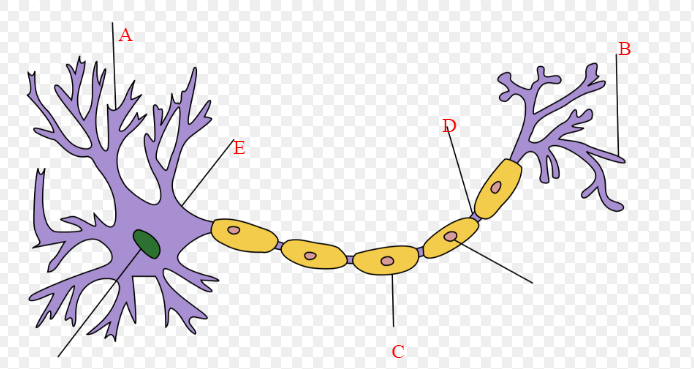

E
Synapse
Cell Body (Soma)
Axon
Dendrite

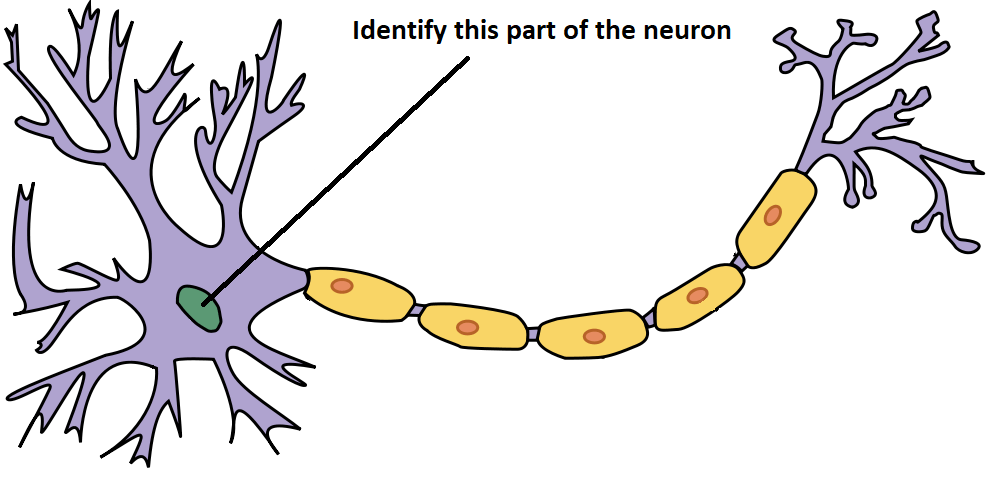
Nucleus
Cell Body
Axon
Node of Ranvier
Neurons that carry information from the sensory receptors to the CNS:
Sensory, afferent
Sensory, efferent
Moror, afferent
Motor, efferent
Type of neuron that perceive information about your environment.
Motor Neuron
Interneuron
Sensory Neuron
Type of neuron located only in the brain and spinal cord that pass impulses from one neuron to another.
Motor Neuron
Interneuron
Sensory Neuron
Masses of myelinated nerve fibers would appear...
white
grey
brown
transparent
Which of the following shows the correct path of travel?
sensory neuron to interneuron to motor neuron
sensory neuron to motor neuron to interneuron
interneuron to motor neuron to sensory neuron
It's a two way street
Most of the neurons in the brain and spinal cord are...
unipolar
bipolar
multipolar
anaxonic
An afferent neuron would...
deliver an AP to the CNS
interpret an AP being sensed
deliver an AP to a gland from the CNS
communicate with a motor neuron
D
Node of Ranvier
This neuroglia is star-shaped and are the most abundantly found in the body. Braces and anchors neurons to blood capillaries and help form scar tissue.
Astrocytes
Microglia
Ependymal Cells
Oligodendrocytes
This neuroglia acts as a phagocyte that helps monitor the health of nearby neurons.
Astrocytes
Microglia
Ependymal Cells
Oligodendrocytes
This neuroglia are ciliated and forms an epithelial-like membrane that cover parts of brain and forms inner lining that encloses spaces within brain and spinal cord
Astrocytes
Microglia
Ependymal Cells
Oligodendrocytes
This neuroglia has processes that wrap around nerve fibers and produce myelin sheaths around them in the brain and spinal cord.
Astrocytes
Microglia
Ependymal Cells
Oligodendrocytes
This neuroglia acts as protective and cushioning cells around the PNS
Astrocytes
Schwann Cells
Satellite Cells
Oligodendrocytes
These are specialized nerve cells that receive and transmit information to other cells, (sensory, integrative, motor)
Neurons
Dendrites
Myelin Sheaths
Nodes of Ranvier
These increase transmission rate of nerve impulses. Made of a white, fatty material
Neurons
Dendrites
Myelin Sheaths
Nodes of Ranvier
These are the spaces between myelin sheaths, give astrocytes something to hold on to and provides easier transfer of nutrients and materials.
Neurons
Dendrites
Myelin Sheaths
Nodes of Ranvier

