wayground logo

Free Printable Worksheets

Font size

S
M
L
XL
Worksheets

Algebra basics

Total questions: 96

Worksheet time: 5hrs 48mins

Name
Class
Date
1.

What is at point (6, 8)

a)
b)
c)
d)
2.

What is at point (2, 2)?

a)
b)
c)
d)
3.

What is at point (9,5)?

a)
b)
c)
d)
4.

What is at point (5,6)?

a)
b)
c)
d)
5.

What is at point (2, 7)?

a)
b)
c)
d)
6.

What is at the point (5, 2)?

a)
b)
c)
d)
7.

What is at the point (4,9)?

a)
b)
c)
d)
8.

Where is the pineapple?

a)

(3,6)

b)

(5,2)

c)

(7,8)

9.

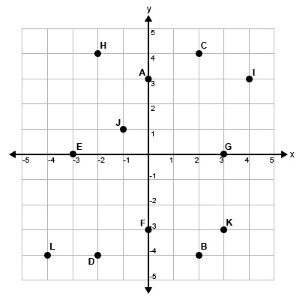
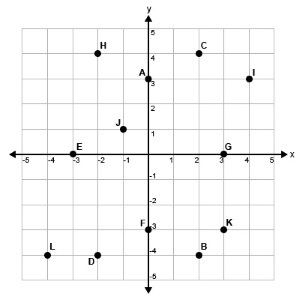
What point is this?

a)

(-3, -3)

b)

(2,3)

c)

(3,3)

10.

What point is this?

a)

(-4, 1)

b)

(1, 4)

c)

(-1, -4)

11.

What point is this?

a)

(2, 3)

b)

(1, 4)

c)

(3, -2)

12.

What point is this?

a)

(-2, 4)

b)

(-2,-3)

c)

(3, 2)

13.

Where is the tomato?

a)

(2,2)

b)

(9,6)

c)

(4,7)

14.

Where is the onion?

a)

(3,4)

b)

(4,5)

c)

(8,1)

15.

Where is the apple?

a)

(3, 5)

b)

(4,9)

c)

(6, 6)

16.

The vertical number line is called the __________?

a)

x-coordinate

b)

x-axis

c)

y-axis

d)

y-coordinate

17.

The horizontal number line is called the _____________?

a)

y-axis

b)

y-coordinate

c)

x-axis

d)

x-coordinate

18.

In an ordered pair ( __ , __) which axis comes first?

a)

y

b)

x

19.
What is the Domain?
a)
{-3, -1, 1, 3, 5, 7, 9}
b)
{-3, -2, -1, 0, 1, 2, 3}
c)
-3 ≤ x ≤ 3
d)
-3 ≤ x ≤ 9
20.
What is the domain?
a)
{-4, -1, 0, 2, 7}
b)
{-5, -4, -1, 0, 1, 2, 4, 7}
c)
{-5, 0, 1, 2, 4}
d)
{5}
21.
What is the Domain?
a)
-3 ≤ x < 5
b)
-3 ≤ y < 5
c)
-8 ≤ x < 5
d)
-8 ≤ y < 5
22.
The student council set its members on four field trips during the school year.  The number of buses needed to transport the members on each trip is a function of the number of members who went on the trip.  This function consists of only the ordered pairs (52, 3), (72, 4), (86, 5), and (105, 6).  What is the domain for this situation?
a)
{52, 105}
b)
{3, 4, 5, 6}
c)
{52, 72, 86, 105}
d)
{3, 4, 5, 52, 72, 86, 105}
23.
Find the Domain.
a)
All real numbers
b)
x > 3
c)
x > 0
d)
x ≥ 0
24.
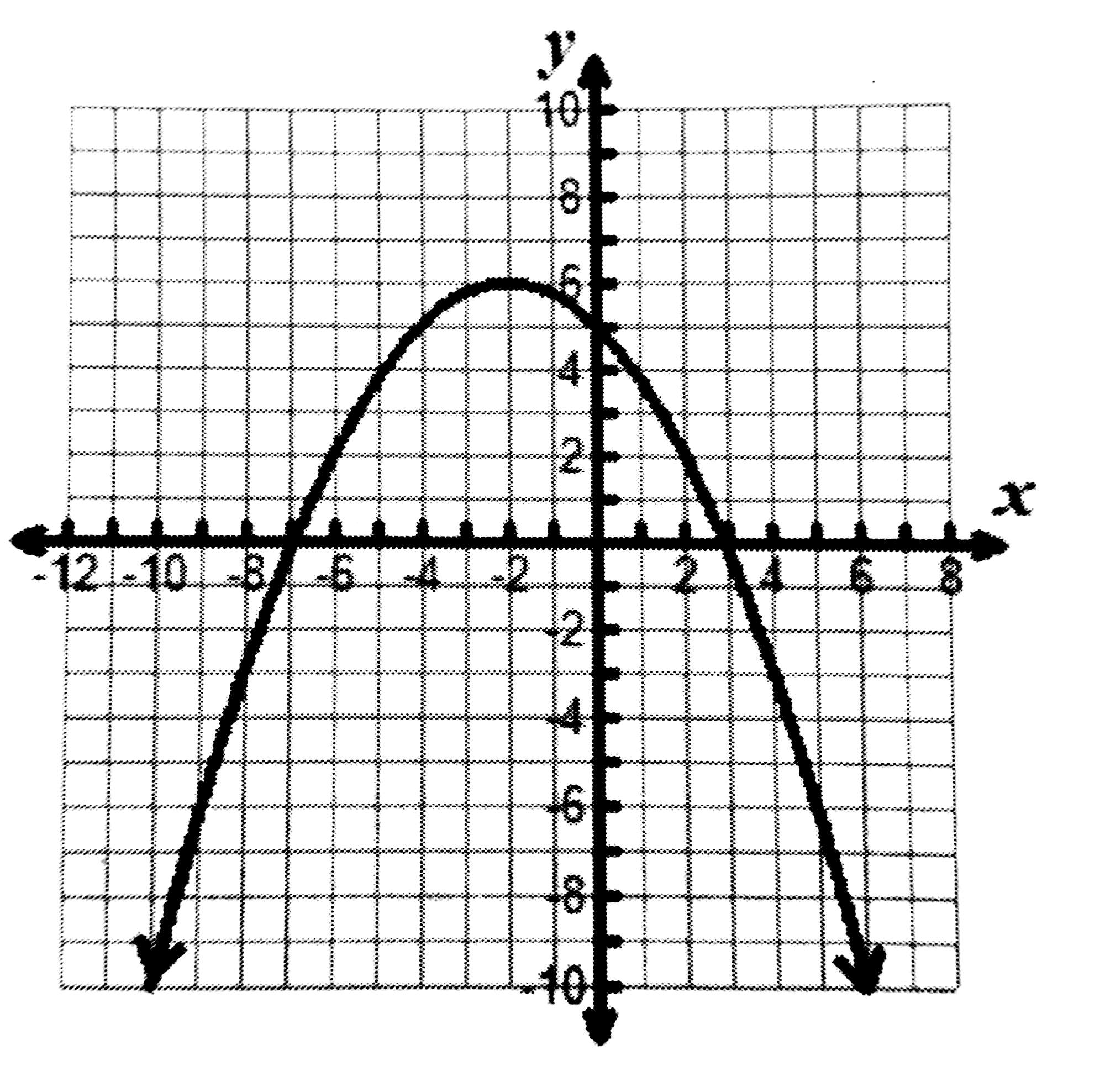
What is the Domain?
a)
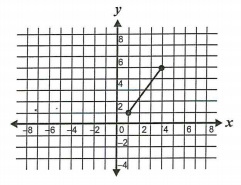
-10 ≤ y ≤ 6
b)
y ≤ 6
c)
-10 ≤ x ≤ 6
d)
All Real Numbers
25.
What is the Domain?
a)
All real numbers
b)
x > 3
c)
x = 4
d)
x ≥ 3
26.
What is the domain of the graph?
a)
-3 ≤ x ≤ 3
b)
3 ≤ x ≤ -3
c)
-2 ≤ x ≤ 10
d)
-3 ≤ x ≤ 10
27.

What is the input?

a)

0, 4, 10, 12

b)

1, 2, 4, 5, 10, 12

c)

0, 4, 10, 4, 12

d)

1, 2, 5

28.

What is the range?

a)

-4 < x ≤ 5

b)

-4 ≤ x < 5

c)

-3 < y < 3

d)

-3 ≤ y ≤ 3

29.

What is the RANGE of this graph?

a)

-7<x<5

b)

-7≤y<5

c)

-3<x<1

d)

-3≤y<1

30.

What is the Range?

a)

y ≥ 6

b)

<y6-\infty<y\le6  

c)

-10 ≤ y ≤ 6

d)

-10 ≤ x ≤ 6

31.
For the function {(0,1), (1,-3), (2,-4), (-4,1)}, write the domain and range.
a)
D: {1, -3, -4,}
R: {0, 1, 2, -4}
b)
D: {-4, 0, 1, 2}
R:{-4, -3, 1}
c)
D: {0, 1, 2, 3, 4}
R:{1, -3, -4}
d)
D: {0, 1, 2, -4}
R: {1, -3, -4, 1}
32.
What is the range of the following relation:
(9, -2) (4, 3)  ( 8, 10) ( -4, 8)
a)
{-4, 4, 8, 9}
b)
{-2, 3, 8, 10}
c)
{(9, -2) ( 4, 3)}
d)
{(8, 10) (-4, 8)}
33.
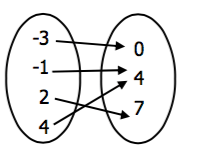
What is the range?
a)
{-3, -1, 2, 4}
b)
{0, 4, 7} 
c)
{0, 4, 4, 7}
d)
{7, 4, 0}
34.
a)
Function
b)
Not a Function
35.
What is the range of the graph?
a)
1 ≤ x ≤ 5
b)
1 < x < 5
c)
1 ≤ y ≤ 5
d)
1 < y < 5
36.
Does the graph represent a function?
a)
Yes, because the vertical line test shows there are no repeating input values
b)
No, because the vertical line test shows there are repeating input values
37.
What is the range of the graph?
a)
-7 ≤ x < 5
b)
-3 ≤ x < 1
c)
-3 ≤ y < 1
d)
-7 ≤ y < 5
38.
Is the relation a function? Why.
a)
Yes, because the x-value 11 has two y-values pair with it.
b)
Yes, because each x-value has only one y-value paired with it.
c)
No, because the x-value 11 has two y-values pair with it.
d)
No, because each x-value has only one y-value paired with it.
39.
a)
Function
b)
Not a Function
40.
Identify the domain of the following relation:
a)
{-6, 14, 2, 28}
b)
{(-6,14), (0,32), (2,38), (4,44)}
c)
{-6, 0, 2, 4}
d)
{14, 32, 38, 44}
41.
Does this mapping diagram represent a function?
a)
No, because there are repeating input values
b)
Yes, because there are no repeating input values
42.
Is this a function? Explain.
a)
Yes; it passes the horizontal line test.
b)
No; it is not a straight line.
c)
Yes; it passes the vertical line test.
d)
No; there is a line connecting the dots.
43.
a)
Function
b)
Not a Function
44.
a)
Function
b)
Not a Function
45.
Which of the following guarantees a table will not be a function?
a)
A x value repeats
b)
An y value repeats
c)
An x value repeats and has different y values
d)
A y value repeats and has different x values
46.
a)
greater than
b)
less than
c)
less than or equal to
d)
greater than or equal to
47.
a)
greater than
b)
less than
c)
less than or equal to
d)
greater than or equal to
48.
a)
greater than
b)
less than
c)
less than or equal to
d)
greater than or equal to
49.
a)
greater than
b)
less than
c)
less than or equal to
d)
greater than or equal to
50.
 Which inequality can be represented by the graph?
a)
x < 5
b)
x > 5
c)
x ≤  5
d)
x ≥ 5
51.
 Which inequality can be represented by the graph?
a)
x < 5
b)
x > 5
c)
x ≤  5
d)
x ≥ 5
52.
a)

x ≤ -2

b)

x < -2

c)

x > -2

d)

x ≥ -2

53.

Which inequality matches the graph?

a)

x<3

b)

x>3

c)

x<3

d)

x>3

54.

When the following inequality is graphed, what will it look like?


2 > f

a)

open circle

b)

closed circle

55.

Which inequality represents the graph?

a)

X > 3

b)

X \ge 3

c)

X < 3

d)

X \le 3

56.

Which inequality represents the graph?

a)

X > - 1

b)

X \ge -1

c)

X < -1

d)

X \le -1

57.
What inequality does the number line graph represent?
a)
x > 5
b)
x < −5
c)
x ≥ 5
d)
x ≥ −5
58.
Match the graph with its inequality.
a)
a > 11
b)
a < 11
c)
a ≥ 11
d)
a ≤ 11
59.

When the following inequality is graphed, what will it look like?


r < -12.97

a)

open circle

b)

closed circle

60.

When the following inequality is graphed, what will it look like?


y<5

a)

open circle

b)

closed circle

61.
x is less than or equal to 24
a)
x > 24
b)
x < 24
c)
x ≤ 24
d)
x ≥ 24
62.
x>5
a)
x is greater than 5
b)
x is less than 5
c)
x is zero
63.

You use an open dot when you have:

a)

<, >

b)

≤, ≥

64.

You used a closed dot when you have:

a)

≤, ≥

b)

<, >

65.

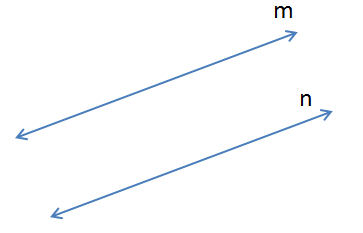
The slopes of parallel lines are...

a)

the same

b)

opposite

c)

always different

66.
Find the slope of the line that passes through:
(6,7) and (4,2)
a)
2/5
b)
-5/2
c)
5/2
d)
-1/2
67.
Find the slope of the line that passes through: 
(2, 4) and (6, 12)
a)
1/2
b)
-1/2
c)
2
d)
-2
68.
Find the slope of the line that passes through:
(10, 1) and (5, 2)
a)
1/5
b)
-1/5
c)
5
d)
-5
69.

What is the slope represented in the table?

a)

slope: 12\frac{1}{2}

b)

slope: 22

c)

slope: 12-\frac{1}{2}

d)

slope: 2-2

70.

What is the Slope represented in this table?

a)

slope: 14-\frac{1}{4}

b)

slope: 4-4

c)

slope: 14\frac{1}{4}

d)

slope: 44

71.
Are these two lines parallel, perpendicular or neither?
y = -1/3x - 5
y = 1/3x + 2
a)
Parallel
b)
Perpendicular
c)
Neither
72.

Are these two lines parallel, perpendicular or neither?

y = -1/4 x - 5

y = 4x + 2

a)

Parallel

b)

Perpendicular

c)

Neither

73.

Write a linear equation in slope intercept form of a line with a slope of 12 and y intercept of 10

a)

y=12x-10

b)

y=10x+12

c)

y=12x+10

d)

x=10x-12

74.
Write a linear equation in slope intercept form of a line with a slope of -3 and y intercept of 0
a)
y=-3
b)
y=3x
c)
y=-3x
d)
x=-3
75.
What is the slope in the equation y=2x + 3?
a)
2
b)
3
c)
5
d)
Cannot be Determined 
76.
If m=3 and b=6, what is the correct slope intercept equation?
a)
y=3-6
b)
y=3x-6
c)
y=3x+6
d)
y=6x+3
77.

What is the y-intercept of the line with the equation
y = 2x + 4y\ =\ -2x\ +\ 4  

a)

2-2  

b)

22  

c)

44  

d)

4-4  

78.

What is the slope of the line with the equation
y = 32x + 4y\ =\ -\frac{3}{2}x\ +\ 4  

a)

32-\frac{3}{2}  

b)

32\frac{3}{2}  

c)

44  

d)

4-4  

79.
What is the x-intercept shown on the graph?
a)
(2, 0)
b)
(-2, 0)
c)
(0, 3)
d)
(3, 0)
80.
What is the y-intercept shown on the graph?
a)
(0, -2)
b)
(3, 0)
c)
(0, 3)
d)
None of these.
81.
What is the x-intercept of the equation?
y = 3x - 12
a)
x = 3 or (3, 0)
b)
x = 4 or (4, 0)
c)
x = 1 or (1, 0)
d)
x = -12 or (-12, 0)
82.
What is the y-intercept of the equation?
y = 3x - 12
a)
y = 1 or (0, 1)
b)
y = 12 or (0, 12)
c)
y = -1 or (0, -1)
d)
y = -12 or (0, -12)
83.
What is the y-intercept of the line?
a)
y = 1/2
b)
y = 1
c)
y = -1/2
d)
y = -1
84.
What is the x-intercept shown on the graph?
a)
(4, -2)
b)
(0, -2)
c)
(4, 0)
d)
(0, 4)
85.
What is the y-intercept shown on the graph?
a)
(0, -2)
b)
(4, -2)
c)
(4, 0)
d)
(0, 4)
86.
What is the y-intercept of the equation?
y = 3x - 12
a)
y = 1 or (0, 1)
b)
y = 12 or (0, 12)
c)
y = -1 or (0, -1)
d)
y = -12 or (0, -12)
87.
Given the list of ordered pairs, what is the x-intercept?
(8,10),  (3, -4),  (0, 8), (4, -3), (9, 0)
a)
(8,10)
b)
8, 3, 0, 4, 9
c)
(0,8)
d)
(9,0)
88.
From the equation y = 3x + 18,  what is the value of the x-intercept?
a)
-6
b)
6
c)
18
d)
3
89.
True or false:
The y-intercept of a function ALWAYS occurs where y is equal to zero.
a)
True
b)
False
90.
True or false:
The x-intercept of a function ALWAYS occurs where y is equal to zero.
a)
True
b)
False
91.
What is the x-intercept?
a)
12
b)
-3
c)
8
d)
0
92.

What is the y-intercept?

a)

12

b)

-3

c)

8

d)

0

93.
Given the list of ordered pairs, what is the x-intercept?
(8,10),  (3, -4),  (0, 8), (4, -3), (9, 0)
a)
(8,10)
b)
8, 3, 0, 4, 9
c)
(0,8)
d)
(9,0)
94.

Given the list of ordered pairs, what is the y-intercept?

(8,10), (3, -4), (0, 8), (4, -3), (9, 0)

a)

(8,10)

b)

10, -4, 8, -3, 0

c)

(0,8)

d)

(9,0)

95.
What is the y-intercept?
a)
7
b)
0
c)
1
d)
2
96.
What is the x-intercept?
a)
12
b)
-3
c)
8
d)
0