wayground logo

Free Printable Worksheets

NEW

Font size

S
M
L
XL
Worksheets

Solutions Test

Total questions: 39

Worksheet time: 28mins

Name
Class
Date
1.
What is a substance that is dissolved in another substance? 
a)
solution
b)
solute
c)
solvent
d)
compound
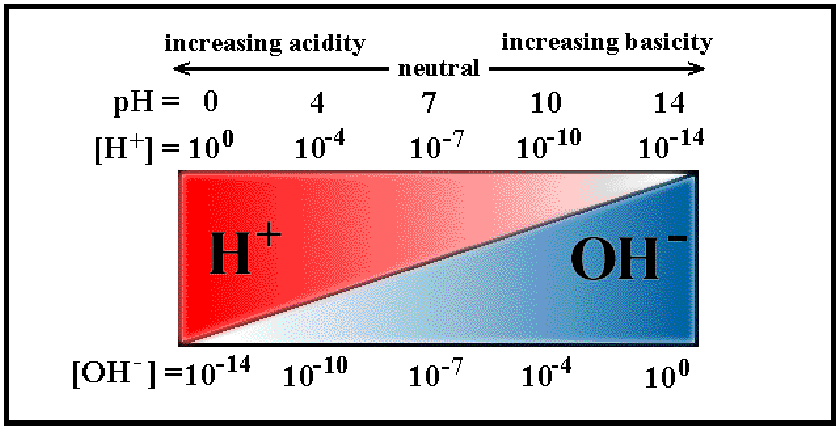
2.
What is a solvent?
a)
The substance that does the dissolving in a solution.
b)
The substance that is being dissolved in a solution.
c)
The mixing of different substances.
d)
The process in which neutral molecules lose or gain electrons
3.
In the above picture, a powder is about to be poured into the liquid. Which of the following should be done to make this powder dissolve faster?

a)
stir the powder in the liquid
b)
freeze the mixture
c)
add more powder to the liquid
d)
store the mixture in a dark place
4.
air is a 
a)
compound
b)
element
c)
heterogeneous mixture
d)
solution
5.
Another name for a homogeneous mixture is 
a)
an element.
b)
a solution.
c)
a compound.
6.
Kool-Aid - Powder, sugar, and water
Identify the solvent 
a)
water
b)
powder
c)
sugar
d)
powder and sugar
7.
When Koolaid mix is light colored and tastes watery it is a _______ solution.
a)
saturated 
b)
diluted
8.
When a Koolaid mix in water is dark in color and very sweet it is a __________ solution.
a)
concentrated 
b)
Diluted
9.
To make a solute dissolve more quickly i n a solvent which would you do?
a)
Put it in cold water and stir it
b)
Put it in warm water and stir it
10.
The concentration of a mixture can be increased in which of the following ways?
a)
Heating the mixture
b)
Adding more water “solvent”
c)
Adding more powder “solute”
d)
Stirring the mixture
11.
When a certain amount of solvent cannot hold any more solute it is called a ________ solution.
a)
Diluted
b)
Saturated
12.
How many grams of K2Cr2O7, are soluble in 100 g of water at 95 ºC?
a)
83 grams
b)
75 grams
c)
40 grams
d)
12 grams
13.
Which solute is the most soluble at 10 ⁰C?
a)
KI
b)
KClO3
c)
NH4Cl
d)
NH3
14.
How does a solution become supersaturated?
a)
dissolve lots of solvent in it.
b)
dissolve a little solute in it. 
c)
dissolve more solute than you should be able to. 
d)
dissolve a super amount of solvent in it. 
15.

Which of the following actions will NOT

increase the rate of dissolution

(dissolving)?

a)

Stirring the solution

b)

Decreasing the temperature

c)

Increasing the surface area of the

solute

d)

Increasing the temperature

16.

You are given a small beaker of solution at room temp. You add a bit of solute to the solution and it dissolves. The solution was:

a)

saturated

b)

unsaturated

c)

concentrated

d)

warm

17.

Which statement is true about compounds?

a)

a pure substance where two or more elements are chemically combined

b)

a homogenous mixture of 2 or more elements

c)

a pure substance containing only one type of atom

d)

a heterogeneous mixture of 2 or more elements chemically combined

18.

What does this pic illustrate?

a)

Element

b)

Mixture of Compunds

c)

Mixture of elemets

d)

Compounds

19.

What type of mixture has a positive tyndall effect?

a)

Solution

b)

Suspension

c)

Pure Substance

d)

Colloid

20.

How are Mixtures made?

a)

Chemically

b)

Physically

c)

Physically and Chemically

d)

Found in Nature

21.

What is considered the simplest form of matter?

a)

Compounds

b)

Colloids

c)

Solutions

d)

Elements

22.
What type of mixture is this?
a)
heterogeneous 
b)
homogeneous
23.
Sand floating in water, but most of the sand is settled at the bottom this an example of which type of mixture?
a)
A solution
b)
A colloid
c)
A suspension
d)
A compound
24.

How are suspensions and colloids different?

a)

Suspensions settle out and colloids do not settle.

b)

Colloids settle out and suspensions do not settle.

c)

Suspensions dissolve and colloids do not.

d)

Colloids dissolve and suspensions do not.

25.

A sour taste is a characteristic of:

a)

acids

b)

bases

c)

neutral

d)

pH scale

26.

Which is a characteristic of a base?

a)

tastes sour

b)

found mostly in foods

c)

feels slippery

d)

turn litmus paper red

27.

pH is the measure of the concentration of ______.

a)

Acids

b)

H+ ion

c)

OH- ion

d)

Bases

28.

According to Bronsted-Lowry, what is the definition of an BASE?

a)

a substance that donates a hydrogen (H+) ion

b)

a substance that donates a hydroxide (OH-) ion

c)

a substance that accepts a hydrogen (H+) ion

d)

a substance that accepts a hydroxide (OH-) ion

29.
If a solution is basic which ion will be more present?
a)
H+
b)
K+
c)
OH-
d)
H-
30.

NaOH is:

a)

an Arrhenius base

b)

an Arrhenius acid

c)

neither an acid nor a base

d)

both an acid and a base

31.

A substance that is 3 on the pH scale would be a(n):

a)

acid

b)

base

c)

neutral

d)

solute

32.
What color does litmus paper turn in the presence of an acid?
a)
blue
b)
black
c)
green
d)
red
33.
Bases are located where on the pH scale?
a)
any number can be a base
b)
below 7
c)
above 7
d)
number 7 is a base
34.

Neutral solutions have a pH of:

a)

0

b)

1

c)

7

d)

14

35.

True or false: a neutral solution has equal amounts of H+ and OH-.

a)

True

b)

False

36.

Particles of a homogeneous mixture is smaller than ______.

a)

1nm

b)

0.5nm

c)

2nm

d)

1.5nm

37.

What is it called when light passes through a colloid and scatters/spreads out

a)

tyndall effect

b)

fog effect

c)

spreading out effect

d)

substance effect

38.

The Tyndall Effect is not visible in which of the following?

a)

Solution

b)

Suspension

c)

Colloid

d)

Heterogeneous Mixture

39.

A substance that conducts an electrical current when dissolved in water is called

a)

catalyst

b)

metalloid

c)

electrolyte

d)

nonelectrolyte