wayground logo

Free Printable Worksheets

NEW

Font size

S
M
L
XL
Worksheets

Convection and Weather

Total questions: 35

Worksheet time: 35mins

Name
Class
Date
1.

When air is heated, its density ___________.

a)

increases

b)

decreases

c)

remains the same

2.

Some dye in a beaker of water is gently heated. Why are the streaks of dye seen in the water?

a)

The hot dye is a better conductor than the cool water.

b)

The hot dye is a better convector than the cool water.

c)

The hot water is less dense than the cool water.

d)

The hot water is denser than the cool water.

3.

What causes convection current in the Earth?

a)

The uneven heating on each layer inside the Earth.

b)

The crusts outer layer.

c)

The temperatures we feel outside.

4.
If differences in air pressure produce winds, what can you conclude about temperature and air pressure based on the figure?
a)
As warm air rises, it creates an area of lower pressure, and cooler air flows in as wind
b)
Warm air is denser than cold air is, creating an area of high pressure the produces wind.
c)
Winds flow from areas of low pressure to areas high pressure when temperature is warmer
d)
Air pressure decreases at night because temperature is lower, producing land and sea breezes
5.
At the seashore late in the afternoon on a hot day, a person often feels a strong breeze coming from the ocean because...
a)
the pounding waves generate air currents
b)
warm air over the ocean rushes in to replace the cool air that rises over the land
c)
the heavy, cool air over the ocean rushes in to replace the warm air that rises over the land
d)
there are no clouds to block the wind coming in from the ocean
6.
Which one heats and cools fastest?
a)
land
b)
sea
c)
both are the same rate
d)
air
7.
The cycle that powers the ocean currents, weather, and tectonic plates it called
a)
conduction current
b)
radiation
c)
condition current
d)
convection current
8.
The main reason that we have currents in the ocean and air is
a)
the sun heats the air and ocean evenly everywhere
b)
the heat inside the earth heats the ocean and the ocean heats the air
c)
the sun cannot heat both the air and water, so one must heat the other
d)
the sun heats air and water more at the equator because it receives more direct sunlight
9.
a)
Warm Front
b)
High Air Pressure
c)
Cold Front
d)
High Temperatures
10.
a)
Low Clouds
b)
Low Temperatures
c)
Light Wind
d)
Low Air Pressure
11.
a)
High Air Pressure
b)
High Temperatures
c)
Heavy Rain
d)
Hail
12.
a)
High Pressure
b)
Warm Front
c)
Cold Front
d)
Mountains
13.
The picture represents the symbol for a _______________________Front.
a)
Cold
b)
Warm
c)
Occluded
d)
Stationary
14.
Low Pressure is associated with this type of weather...
a)
Cloudy/Overcast Weather
b)
Cold Weather
c)
Warm Weather
d)
Fair Weather
15.
High Pressure is associated with this type of weather...
a)
Cloudy/Overcast Weather
b)
Cold Weather
c)
Warm Weather
d)

Sunny/Fair Weather

16.

A cold front is approaching Minneapolis. What will happen to the air temperature AFTER the front passes through?

a)
stay the same
b)
increase
c)
decrease
17.
A warm front moving into an area can bring this type of weather...
a)
Warmer Temperatures, Clear Skies
b)
Colder Temperatures, Clear Skies
c)
Warmer Temperatures, Clouds, and steady precipitation
d)
Colder Temperatures, Clouds, and Precipitation
18.
Air behind a cold front is ___________than the air in front of it.
a)
Hotter
b)
Colder
c)
Warm
d)
Freezing
19.

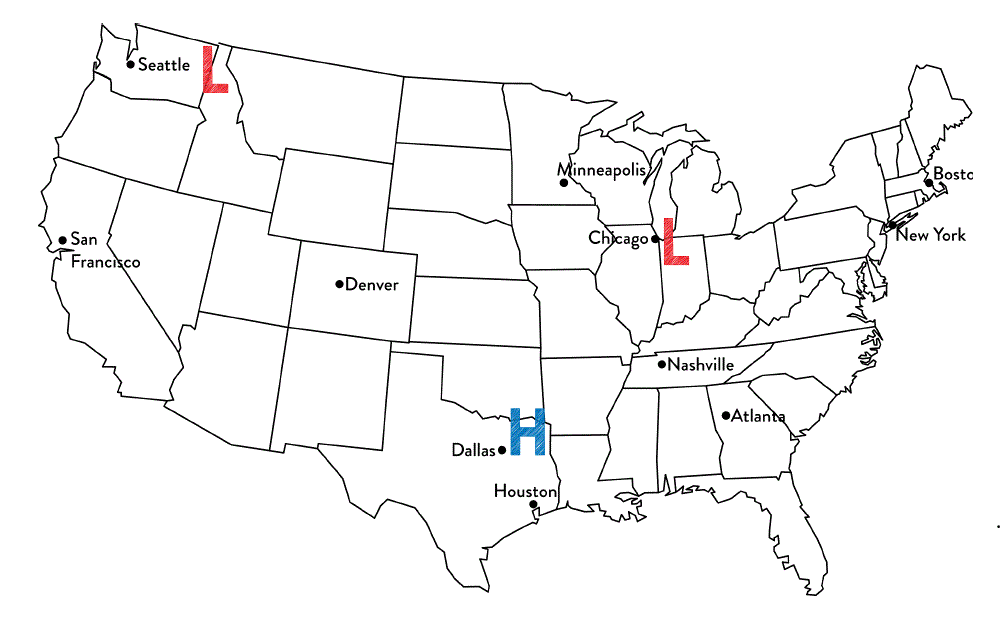
Near which two cities are the low pressure systems located?

a)

Seattle & San Francisco

b)

Chicago & Seattle

c)

Dallas & Houston

d)

Chicago & Nashville

20.

Near which city is the high pressure system located?

a)

Seattle

b)

Minneapolis

c)

Dallas

d)

Chicago

21.

Which two cities are most likely to experience clear, dry weather?

a)

Seattle & San Francisco

b)

Chicago & Minneapolis

c)

Chicago & Nashville

d)

Dallas & Houston

22.

Tim said that Chicago is most likely to experience rainy weather. Jennifer thinks that Dallas is most likely to experience rainy weather.

Which student is correct?

a)

Tim because Chicago is the closest to a low pressure system and they produce precipitation.

b)

Jennifer because high pressure systems produce precipitation

c)

Both students are correct because all systems produce precipitation

d)

Neither of the students are correct because the cities are not close enough to the system.

23.

What type of weather is Minneapolis most likely experiencing?

a)

light/drizzly rain

b)

severe thunderstorms

c)

sunny skies

d)

cloudy skies, light precipitation

24.

What type of weather is Denver most likely experiencing? Notice the type of front that has just passed through.

a)

High humidity, cooler temperatures

b)

Low humidity, cooler temperatures

c)

Rainy, cold weather

d)

Rainy, humid weather

25.

Why does city "B" have clear skies?

a)

It is in North America

b)

There is not a front moving through city "B"

c)

Clouds do not form in the West

d)

It is located near a high pressure system

26.

Which location is most likely experiencing warmer temperatures and higher humidity?

a)

Location A

b)

Location B

c)

Location C

d)

Location D

27.

The cold front is moving

a)

east and southeast

b)

west and northwest

c)

north

d)

south

28.

Does 1 or 2 show high pressure?

a)

1

b)

2

29.

Does 1 or 2 show low pressure?

a)

1

b)

2

30.

Scientists say that conditions must be "just right" for a hurricane to start up. Which is the first step of "just right" in the development of a hurricane?

a)

Cool ocean water replaces warmer surface water

b)

Very warm ocean water evaporates into the atmosphere

c)

Hot dry wind blows from land across the ocean surface

d)

Humid ocean air cools and condenses to form precipitation

31.

Thunderstorms are the result of which type of pressure system?

a)

Low

b)

High

32.

Why do hurricanes form more often at the end of summer?

a)

The ocean water is cooling off and creating more moisture in the air.

b)

The ocean water is cooling off and creating less water vapor in the ocean.

c)

The ocean water is much warmer which fuels the water cycle and creates lower air pressure.

d)

The ocean water is much warmer which fuels an increase in water vapor on the ocean's surface.
33.
What two factors determine the density of water in deep currents? 
a)
Salinity and temperature
b)
Coriolis Effect and wind
c)
Upwelling and dissolved solids
d)
Continental deflection and convection
34.
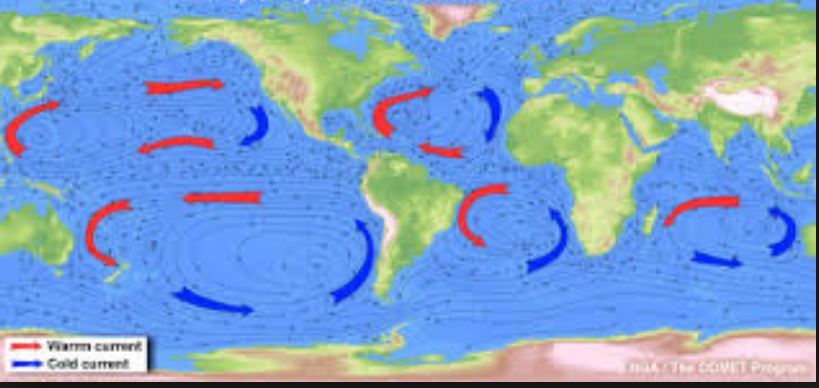
Analyze the image. What could explain why certain parts of the ocean have warmer temperatures?
a)
the uneven heating of the Earth's surface
b)
the rising of cold air and the sinking of warm air
c)
hurricanes
35.

Where do Hurricanes form?

a)

NEAR the Equator

b)

Away from the Equator

c)

NEAR the North/South Poles