
 Worksheets
AM 3 Review
Total questions: 60
Worksheet time: 47mins
The unit m3 is used to express
length
mass
volume
density
SI base units for length and mass are
centimeter
meter and gram
centimeter and kilogram
meter and kilogram
The abbreviations for units of length in order from smallest to largest are
m, cm, mm, km
mm, m, cm, km
km, mm, cm, m
mm, cm, m, km
A measure of the quantity of matter is
density.
weight.
volume.
mass.
The relationship between the mass m of a material, its volume V, and its density D is
V = mD.
Vm = D.
m = DV.
D + V = m
1. The mass of a paperclip is about 1 ..........
ton
kg
g
mg
1. One teaspoon of cough syrup has a volume of 5 .........
ml
L
kg
g

If this bottle of water holds 30 Litres, how many milliters is that?
3000000mL
300mL
300000mL
30000mL
The best units to measure the weights of a single tiny earring, a single apple, a person, and 50 elephants are _____, ______, _______ and ______.
Grams, Milligrams, Tonnes and Kilograms.
Milligrams, Grams, Kilograms and Tonnes .
Milligrams, Tonnes, Kilograms and grams.
Grams, Milligrams, Kilograms and Tonnes.
As a pendulum gets longer, what happens to the period?
doesn't change
decreases
increases
Which of these does not affect the period of a pendulum?
length
gravity
mass
A pair of trapeze performers at the circus is swinging from ropes attached to a large elevated platform. Suppose that the performers can be treated as a simple pendulum with a length of 16 m. Determine the period for one complete back and forth cycle.
2 sec
12 sec
8 sec
10 sec
Your Mom wishes to make a simple pendulum that serves as a timing device. She plans to make it such that its period is 1.00 second. What length must the pendulum have?
1 m
.5 m
.25 m
More than 1 meter
Which of the following affects the period of a pendulum?
What planet you're on
What material is used to make the pendulum
Which direction the pendulum starts swinging
The frequency of the mass weight force grams

On the pendulum shown, where is the speed the greatest?
A
B
C
The speed is the same at all positions
On the pendulum shown, where is the potential energy the greatest?
A and D (highest positions)
B
C (lowest position)
The potential energy is the same at all positions
If the angle of incidence is 25 degrees, the angle of reflection is
20 degrees
25 degrees
50 degrees
90 degrees
In a specular or regular reflection, parallel rays are reflected in
no direction
one direction
different direction
all directions
As indicated by the hands of the clock without numbers, the real time is 9:30. What is the time indicated inits image if the clock is placed in front of a plane mirror?
10:30
9:30
3:30
2:30
What is the distance of your image from you if you stand 1.5 m in front of a plane mirror?
1.5 m
2.0 m
3.0 m
4.5 m

In the diagram, which letter represents the angle of incidence?
A
B
C
D

Given that the angle of incidence = 30 degrees
a. Draw a ray diagram, labelling clearly the normal, incident ray, angle of incidence, reflected ray and angle of reflection accurately.
Which is the correct diagam?
WHICH OF THE FOLLOWING DEPICTS THE LEFT-RIGHT REVERSAL DESCRIPTION IN PLANE MIRROR


When the image of an object is seen in a plane mirror, the image is _____.
real and upright.
real and inverted.
virtual and upright.
virtual and inverted.

If a mirror is 10 cm tall, how much of yourself can you see in the mirror?
5 cm
10 cm
15 cm
20 cm
Suppose the angle of incidence of a light ray is 42°.What is the angle between the incident ray and the reflected ray?
42
48
84
90

Suppose the angle of incidence of a light ray is 42°.
.What is the angle the incident ray makes with the mirror?
42
48
84
90
Which optical instrument can be best used to show multiple reflection?
mirror
periscope
eye glasses
kaleidoscope
If you stand in front of two adjacent large mirrors at 90˚ angle, how many images will you see?
1
2
3
4
Which of the following angles between two
mounted plane mirrors will give more images?
30˚
60˚
90˚
180˚
Spherical mirrors are part of a
Rectangle
Cube
Sphere
Cone
The side view mirrors on your car help shrink the image on both sides of the car, allowing you to see a larger field of view. What type of mirror is this?
a convex mirror
a concave mirror
a convex lens
a concave lens

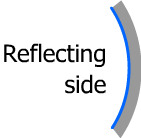
A focal point is
The point where light rays parallel to the optical axis converge after being reflected by a concave mirror.
The point where light rays parallel to the optical axis diverge after being reflected by a concave mirror.
The point where light rays parallel to the optical axis converge after being reflected by a convex mirror.
The point where light rays parallel to the optical axis converge after being reflected by a optical illusion.
A focal point is
The point where light rays parallel to the optical axis converge after being reflected by a concave mirror.
The point where light rays parallel to the optical axis diverge after being reflected by a concave mirror.
The point where light rays parallel to the optical axis converge after being reflected by a convex mirror.
The point where light rays parallel to the optical axis converge after being reflected by a optical illusion.
A diffuse reflection is:
Reflection of light from a smooth, shiny surface.
Reflection of light from a rough surface.
Reflection of dust particles.
Reflection of heat from a rough surface.

Where is the focal point of mirror A?
in front of the mirror
on the side of the mirror
behind the mirror
there isn't a focal point
A _____ mirror can produce both a virtual and a real image.
plane
concave
convex
regular
A shopkeeper wants to keep an eye on his store in order to prevent shoplifting. What could the shopkeeper hang on the wall in order to see a wider image of his store and his customers?
a convex mirror
a concave mirror
a convex lens
a concave lens
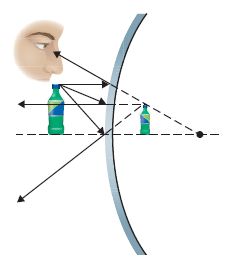

A student is conducting an experiment with four different types of mirrors. Which mirror in the experiment is a convex mirror?
mirror 1
mirror 2
mirror 3
mirror 4
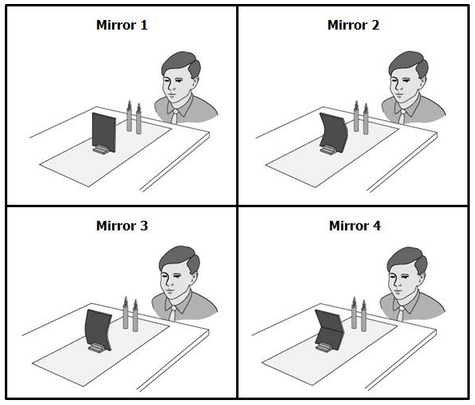
A student is conducting an experiment with four different types of mirrors. Which mirror in the experiment converges light and UP CLOSE, produces an upright, magnified image of the candles? (hint: no two mirrors are the same)
mirror 1
mirror 2
mirror 3
mirror 4

An object placed at the center of curvature will form an image that is .............. the size of the object.
larger than
the same as
smaller than

