Wayground logo

Free Printable Worksheets

Font size

S
M
L
XL
Worksheets

American Revolution Review

Total questions: 79

Worksheet time: 3hrs 38mins

Name
Class
Date
1.
Who was the main author of the Declaration of Independence?
a)
Thomas Jefferson
b)
Ben Franklin
c)
George Washington
d)
John Adams
2.
The British called the Intolerable Acts, the _______ Acts
a)
Coercive
b)
Townshend
c)
Harboring
d)
Punishment
3.
A popular method of protesting British laws was to ______________, or refuse to buy British goods.
a)
riot
b)
vandalize
c)
tar and feather
d)
boycott
4.
This act required colonists to pay for an official seal whenever they bought paper products.
a)
Townshend Acts
b)
Intolerable Acts
c)
Stamp Act
d)
Quartering Act
5.
These acts were meant as punishment for the Boston Tea Party
a)
Intolerable Acts
b)
Stamp Act
c)
Townshend Acts
d)
Quartering Act
6.
This secret group often used violence, threats and intimidation to frighten tax collectors
a)
Secret Society of LIberators
b)
Liberty Makers
c)
Sons of Patriots
d)
Sons of Liberty
7.
In response to the Tea Act, colonists dressed as Mohawk Indians and dumped 340 tea chests into the Boston Harbor in what is known as the 
a)
Drink Coffee Movement
b)
Boston Swim in Tea
c)
Boston Tea Party
d)
Boston Night Out
8.
This slogan was used to protest the lack of colonial representation in parliament
a)
Sam says "No" 
b)
Say no to taxation
c)
No taxation without representation
d)
No taxation without Sam Adams
9.
After the British repealed the Townshend Acts, they left a tax on 
a)
tea
b)
glass
c)
coffee
d)
lead
10.
These Acts included closing Boston Harbor, housing British soldiers, losing land to Quebec, and losing the Massachusetts charter.
a)
Absurd Acts
b)
Townshend Acts
c)
Intolerable Acts
d)
Stamp Act
11.
Colonists reacted to the Proclamation Line of 1763 by
a)
moving west anyway
b)
staying home
c)
killing British and Native Americans
d)
boycotting all Lines
12.
New York refused to raise money to feed and shelter troops after this act was passed
a)
Stamp Act
b)
Townshend Acts
c)
Intolerable Acts
d)
Quartering Act
13.
Colonists boycotted paper products, protests increased, Sons of Liberty formed as a result of 
a)
Sugar Act
b)
Declaratory Act
c)
Stamp Act
d)
Quartering Act
14.
As a result of the Townshend Acts, tensions rose and this tragedy occurred
a)
Boston Tea Party
b)
Boston Massacre
c)
Bullets at Breed's Hill
d)
Battle of Bunker Hill
15.
As a result of the oppressive Intolerable Acts, this meeting takes place in Philadelphia
a)
First Continental Congress
b)
Second Continental Congress
c)
Continental Congressional Hearings
d)
Philadelphia Convention
16.
This man created a famous, and highly bias, engraving of the Boston Massacre
a)
Sam Adams
b)
John Hancock
c)
Joseph Warren
d)
Paul Revere
17.
Which statement best summarizes King George's view after the French & Indian War
a)
"Let's attack Spain next!"
b)
"We are in great debt - we must avoid another war"
c)
"Now it's time to ask for peace"
d)
"Maybe we should ask the French for forgiveness"
18.
A small army made up of ordinary citizens who are available to fight in an emergency
a)
military 
b)
army 
c)
Continental army
d)
militia
19.
British response to colonial protests to the Stamp Act was to _____________ the law
a)
redo
b)
restate
c)
repeal
d)
reimagine
20.
Patriots accused Britain of _____________, or unjust use of government power.
a)
Feudalism
b)
Communism
c)
Totalitarianism
d)
Tyranny
21.
The Intolerable Acts had a significant impact on business due to 
a)
the closing of Walmart
b)
the closing of the Boston Harbor
c)
stationing troops in front of businesses
d)
giving land to Quebec
22.
What war preceded the British taxing the colonists
a)
Mexican American War 
b)
French and Indian War
c)
French Revolution
d)
Civil War
23.
Members of the First Continental Congress sent a list of 10 resolutions, known as the Declaration of Rights, to King George demanding rights but they did not seek to 
a)
have representation in parliament
b)
have the right to liberty
c)
separate from Britain
d)
have the right to property
24.
Which concern of the colonists led to the American Revolution?
a)
opposition to British tax policies
b)
Desire for greater religious freedom
c)
Fear of attacks by American Indians
d)
Increasing immigration from countries other than Britain
25.
Colonists protested the Stamp Act because they believed in what phrase?
a)
Live free or die
b)
All men are created equal
c)
Life, liberty, and pursuit of happiness
d)
No taxation with representation
26.
Sons of Liberty were a group of American colonists who worked to repeal the Stamp Act by doing what?
a)
Taking military action against the British
b)
Forming alliances with the enemies of Britain
c)
Meeting with Parliament in England 
d)
Publicly protesting and organizing boycotts
27.
In response to the Tea Act, the colonists threw tea from the British ships into the Boston Harbor.  This event is known as:
a)
Boston Tea Party
b)
Boston Riots
c)
Boston Massacre
d)
Boston Market
28.
Who was the King of Britain at the time of the Revolutionary War?
a)
King George III
b)
King George I
c)
King Henry IV
d)
King Henry VIII
29.
Why did the king begin to tax the colonists?
a)
He wanted more money to make England look better
b)
He needed money to pay off war debts from the French and Indian War
c)
He needed money to pay for Boston soldiers
d)
He hated the colonists' guts
30.
An angry crowd of workers surrounded a small group of British soldiers and were fired upon
a)
Boston Massacre
b)
Boston Rebellion
c)
Boston Treaty 
d)
Boston Tea Party
31.
What was the name of the meeting of colonial leaders where all the colonies agreed to boycott British goods and wrote a letter to the King voicing their complaints?
a)
Committees of Correspondence
b)
The Declaration of Independence
c)
The Revolutionary War
d)
First Continental Congress
32.
Why could the colonists not move West of the Appalachian mountains after the French and Indian war?
a)
To avoid conflicts with the French 
b)
To avoid conflicts with the British
c)
To avoid conflicts with the Natives
d)
To avoid conflicts with the British
33.
First person killed in the Boston Massacre.
a)
Samuel Adams
b)
Crispus Attucks
c)
Benjamin Franklin
d)
General Wolfe
34.
In 1764, the ________ Act required colonies to house and feed British troops in barracks or homes.
a)
Stamp 
b)
Townshend
c)
Quartering
d)
Intolerable 
35.
Who wrote Common Sense?
a)
Thomas Jefferson
b)
Thomas Paine
c)
George Washington
d)
Abraham Lincoln
36.
What did King George reject, and not even read, that the colonists sent to him?
a)
Declaration of Independence
b)
Olive Branch Petition
c)
Common Sense
d)
Uncle Toms Cabin
37.
What was one purpose of the Declaration of Independence?
a)
to establish a framework for government
b)
to state the reasons for the colonies to separate from England
c)
to express reasons for limiting immigration
d)
to list arguments for women’s suffrage
38.
Who commanded the Continental Army?
a)
Henry Knox
b)
John Hancock
c)
Benedict Arnold
d)
George Washington
39.
What does the Declaration of Independence state people have a right to do if a government violates their personal rights?
a)
Replace the President with a king
b)
Re-write the Constitution
c)
Change the government
d)
Hold a new election
40.
What is the importance of the first section of the Declaration of Independence?
a)
States that people have rights that cannot be taken away and the purpose of a government
b)
It's the longest section that states the grievances the colonists had.
c)
It's where members of Congress signed & pledged their loyalty to one another & declared independence
d)
States why it is being written, which was to break away from Britain. 
41.
What is the importance of the second section of the Declaration of Independence?
a)
States that people have rights that cannot be taken away and the purpose of a government
b)
It's the longest section that states the grievances the colonists had.
c)
It's where members of Congress signed & pledged their loyalty to one another & declared independence
d)
States why it is being written, which was to break away from Britain. 
42.
What is the importance of the 3rd Section, Grievances, within the Declaration of Independence?
a)
States that people have rights that cannot be taken away and the purpose of a government
b)
To list the complaints against the king
c)
It's where members of Congress signed & pledged their loyalty to one another & formally declared independence
d)
States why it is being written, which was to break away from Britain. 
43.
According to the Declaration of Independence, what truths were "self-evident"?
a)
All men are created equal
b)
Rights are bestowed by good kings
c)
Government exists to protect us from ourselves
d)
Only a democracy can protect our rights
44.
We hold these truths to be self-evident, that all men are created equal, that they are endowed by their Creator with certain _______, that among these are Life, Liberty and the pursuit of Happiness. — The Declaration of Independence, July 4, 1776
Which of the following best completes this excerpt?
a)
unalienable rights
b)
equalities of opportunity
c)
duties and responsibilities
d)
repeated injuries and abuses
45.
 The declaration was published in this year
a)
1775
b)
1776
c)
1777
d)
1778
46.
________ took place during the winter of 1777 to 1778 and more than ⅕ of the soldiers died of disease and/or malnutrition.
a)
Saratoga
b)
Yorktown
c)
Valley Forge
d)
Trenton
47.
George Washington was appointed as the ____________ during the American Revolution.
a)
Father of the US Navy
b)
British General
c)
Colonial Spy
d)
Commander of the Continental Army
48.
First Battle of the American Revolution 
a)
Saratoga 
b)
Valley Forge 
c)
Lexington and Concord 
d)
Yorktown
49.
The French began to support the Americans after this battle
a)
Lexington and Concord
b)
Yorktown
c)
Saratoga
d)
Treaty of French 
50.
Soldiers froze here because of the harsh winter
a)
Paris
b)
Valley Forge
c)
Rio Grande Valley 
d)
Yorktown 
51.
Who was the opponent at Valley Forge?
a)
Winter, starvation, disease
b)
British
c)
French
d)
Indians
52.
In what chronological order did the battles occur?
a)
Valley Forge, French & Indian War, Battle of Saratoga, Battle of York Town
b)
Lexington & Concord, Battle of Bunker Hill, Battle of Trenton, Battle of Yorktown
c)
Battle of Saratoga, Valley Forge, French & Indian War, Lexington & Concord
d)
Yorktown, French & Indian War, Saratoga, Valley Forge
53.
The "shot heard 'round the world" was which battle?
a)
Battle of Bunker Hill
b)
Battle of Saratoga
c)
Battle of Trenton
d)
Battle of Lexington & Concord
54.
Which battle is considered the Turning Point of the American Revolution?
a)
Battle of Trenton
b)
Battle of Saratoga
c)
Lexington & Concord
d)
Battle of Bunker Hill
55.
Who wrote Common Sense and The Crisis during the American Revolution?
a)
John Paul Jones
b)
Abigail Adams
c)
Thomas Paine
d)
Benjamin Franklin
56.
When was America declared independent?
a)
October 26th, 2014
b)
July 31st, 1842
c)
July 4th, 1776
d)
January 7th,1777
57.
What river did Washington and his men cross for the battle of Trenton?
a)
Susquehanna river
b)
Trenton river
c)
Delaware river
d)
Mississippi river
58.
Which fundamental political idea is expressed in the Declaration of Independence?
a)
The government should guarantee every citizen economic security. 
b)
The central government and state governments should have equal power. 
c)
If the government denies its people certain basic rights, that government can be overthrown. 
d)
Rulers derive their right to govern from God and are therefore bound to govern in the nation’s best interest. 
59.
Who was the volunteer from France who became Washington’s trusted aide?
a)
Benjamin Franklin
b)
Francis Marion
c)
Marquis de Lafeyette
d)
Thomas Pain
60.
What 2 major battles did the Americans win?
a)
Trenton and Saratoga
b)
Philadelphia and New York
c)
New York and Saratoga
d)
Trenton and New York
61.
Who did General Washington & the Continental Army attack at Trenton, N.J.?
a)
British mercenaries
b)
German mercenaries
c)
French mercenaries
62.
Which battle ended the American revolution?
a)
Battle of Lexington and Concord
b)
Battle of Saratoga
c)
Battle of Yorktown
d)
Battle of Trenton
63.
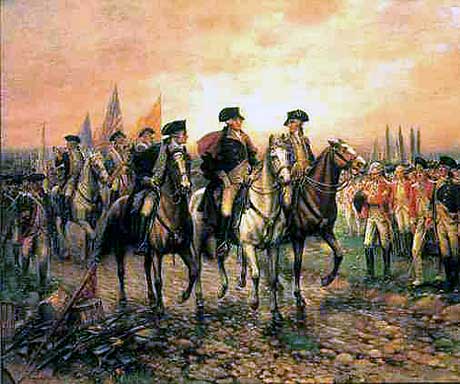
General Cornwallis surrenders to General Washington during this battle 
a)
Yorktown
b)
Lexington and Concord
c)
Saratoga
d)
Bunker Hill
64.

Located close to Boston, there were heavy English losses as a result of the battle

a)

Battle of Bunker Hill

b)

Battle of New Jersey

c)

Battle of Yorktown

d)

Battle of Trenton & Princeton

65.

Who were the Hessians?

a)

Women who disguised themselves as men to fight in the war

b)

The cooks in the Military

c)

Paid German soldiers who fought for the British

d)

Another name for American soldiers

66.

professional soldiers

a)

British strength

b)

American strength

c)

British weakness

d)

American weakness

67.

more soldiers

a)

British weakness

b)

American weakness

c)

British strength

d)

American strength

68.

little money for the war

a)

American strength

b)

American weakness

c)

British strength

d)

British weakness

69.

inexperienced soldiers

a)

British strength

b)

British weakness

c)

American strength

d)

American weakness

70.

used hit and run tactics

a)

British strength

b)

American strength

c)

British weakness

d)

American weakness

71.

3,000 miles away from home

a)

British strength

b)

British weakness

c)

American weakness

d)

American strength

72.

George Washington

a)

British strength

b)

British weakness

c)

American strength

d)

American weakness

73.

allied with France

a)

British strength

b)

American strength

c)

American weakness

d)

British weakness

74.

familiar with the land

a)

British strength

b)

British weakness

c)

American weakness

d)

American strength

75.

plenty of supplies, guns, and clothing

a)

British strength

b)

British weakness

c)

American strength

d)

American weakness

76.
True or False. The colonists had well-trained soldiers.
a)
True
b)
False
77.
They fought to defend their homes, land, and principles
a)
American Strength
b)
British Strength
c)
American Weakness
d)
British Weakness
78.
What event is depicted in this image?
a)
Boston Massacre
b)
Boston Tea Party
c)
Battle of Bunker Hill
d)
Lexington and Concord
79.
What was this poster's meaning?
a)
The Colonies needed to be united
b)
Serpents can grow back together
c)
Colonies need to be independent
d)
Ben Franklin didn't know why he made this