wayground logo

Free Printable Worksheets

Font size

S
M
L
XL
Worksheets

Chem Practice Exam

Total questions: 67

Worksheet time: 2hrs 57mins

Name
Class
Date
1.
A certain photon of light has a wavelength of 4.22x10⁻⁷nm. What is the frequency? (v=c/λ)
a)
7.11x10¹⁴ Hz
b)
7.11Hz
c)
1.41x10⁻¹⁵
d)
-1.41x10¹⁵
2.
A wave with a large wavelength will have a ______ frequency and _____ energy
a)
high, low
b)
high, high
c)
low, high
d)
low, low
3.
Which has the LONGEST wavelength and, therefore, the lowest frequency/energy
a)
Gamma Rays
b)
Radio Waves
c)
Visible Light
d)
Infrared rays
4.
As the frequency of an electromagnetic wave increases, the amount of energy in that wave...
a)
increases.
b)
decreases.
c)
stays the same.
5.
The height of the wave is known as the _____________.
a)
amplitude
b)
crest
c)
trough
d)
wavelength
6.
What is the energy of a quantum of light with a frequency of 7.39x10¹⁴Hz.(E=Hv)
a)
4.88x10¹⁹
b)
4.88x10⁻¹⁹
c)
2.22x10²³
d)
2.22x10⁻²³
7.
Certain blue lights have a frequencey of 6.91x10¹⁴Hz. What is the wavelength? (λ=c/v)
a)
4.34x10²¹
b)
4.34x10⁻²¹
c)
4.34x10⁻⁷
d)
2.07x10²³
8.
What is the wavelength for a quantum of light with energy of 7.56x10⁻¹⁹J? (λ=hc/E) 
a)
2.62x10⁻⁷m
b)
2.62x10⁷m
c)
2.64x10-45m
d)
2.64x1045m
9.
On a graph, which axis shows the independent variable?
a)
x-axis
b)
y-axis
c)
neither
d)
it changes
10.
When experimenting with the growth of a plant, a scientist uses three (of the same type of) plants, two different fertilizers, equal light, and equal water. What type of variable is the fertilizer?
a)
Dependent
b)
Independent
c)
Control
d)
Compound
11.
Research Question: Does the type of gasoline put in a car effect how fast the car can drive. What is the independent variable?
a)
Type of gasoline
b)
which car the gas is put into
c)
how fast the car can drive
d)
how much gas is put into the car
12.
What would the INDEPENDENT variable be in an experiment testing which types of paper airplane goes furthest?
a)
the paper used
b)
the type of paper airplane
c)
the distance of each plane's flight
d)
how hard the plane is thrown
13.
Ionization energy is the...
a)
energy needed to remove the outermost electron.
b)
ability of an atom to attract electrons from another atom.
14.
Electronegativity is the...
a)
energy needed to remove the outermost electron.
b)
ability of an atom to attract electrons from another atom.
15.
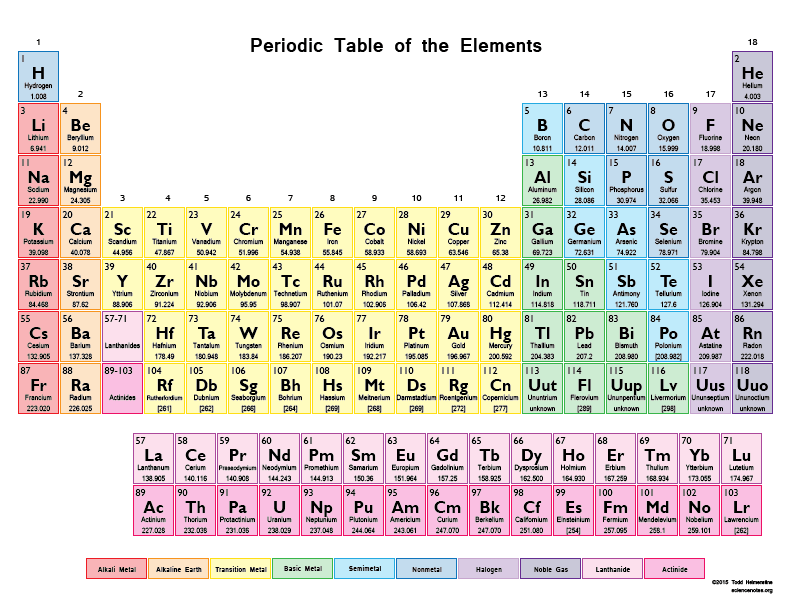
Which element has the greatest ionization energy: Aluminum (Al)    or    Chlorine (Cl)?
a)
Aluminum (Al)
b)
Chlorine (Cl)
16.
The first person to propose a theory about an atom was
a)
Democritus
b)
Rutherford
c)
Dalton
d)
Aristotle
17.
What contribution did John Dalton make to atomic theory? 
a)
He discovered that every atom was positively charged. 
b)
He discovered that every element consisted of one type of atom.  
c)
He discovered that atoms had nuclei. 
d)
He discovered that atoms could be divided into smaller parts. 
18.
What scientist first developed 4 rules for atomic theory, and helped kick start modern chemistry?
a)
J.J. Thomson
b)
Ernest Rutherford
c)
John Dalton
d)
Democritus
19.
How did Rutherford discover the proton?
a)
Cathode tube ray experiment
b)
Gold Foil Experiment
c)
Planetary Model
d)
Plum Pudding Model
20.
His atomic model was depicted similar to a planetary/solar system
a)
Bohr
b)
Thomson
c)
Rutherford
d)
Dalton
21.
As you move down a group, atomic radius increases because - 
a)
you add more and more neutrons
b)
you add more and more protons
c)
you add more and more shells (energy levels)
d)
you add more atomic mass
22.
As you move across the periodic table from left to right, the atomic radius decreases.  This is because - 
a)
the number of protons increases, so attraction to electrons increases
b)
the number of energy levels increases
c)
the number of electrons increases
d)
the atomic mass increases
23.
Francium (Fr) has the lowest ionization energy in Group 1 because - 
a)
it has the smallest number of valence electrons
b)
it has the greatest atomic mass
c)
it has the greatest number of protons, so it attracts its electrons the strongest
d)
its 1 valence electron is very far from the nucleus, so little energy is needed to remove it
24.
The energy required to remove electrons is the definition of: 
a)
Electronegativity
b)
Atomic Number
c)
Atomic Radius
d)
Ionization
25.
Families all have similar 
a)
Names
b)
atomic numbers
c)
atomic masses
d)
properties
26.
Electronegativity is...
a)
the ability of an atom to attract/ accept electrons
b)
the ability of an atom to lose electrons
c)
the energy required to remove an electron from a specific atom
d)
how easy it is to make friends. 
27.
What is the atomic number?
a)
the number of protons
b)
the number of protons and neutrons
c)
the number of neutrons
d)
the number of protons and electrons
28.
What is the mass number defined as?
a)
the number of protons
b)
the number of protons and neutrons
c)
the number of neutrons
d)
the number of protons and electrons
29.
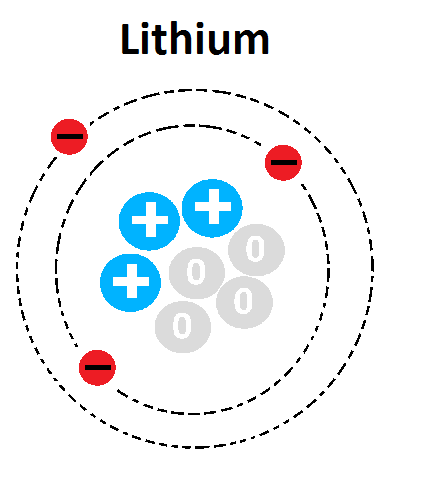
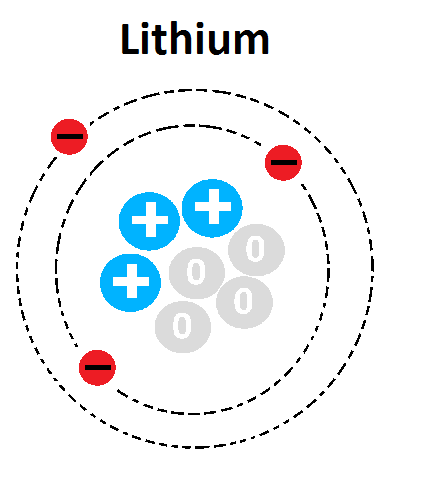
What is the atomic number of this atom?
a)
1
b)
3
c)
4
d)
7
30.

What is the mass number of this atom?

a)

1

b)

3

c)

4

d)

7

31.

Atoms of the same element which have a different number of neutrons are called _________________.

a)

ions

b)

isotopes

c)

quarks

d)

molecules

32.

How many neutrons does C-14 contain? (tap to enlarge the image)

a)

6

b)

7

c)

14

d)

8

33.

ALL atoms of the same element have:

a)

same number of proton

b)

same number of nucleon

c)

different number of neutron

d)

different number of electron

34.
How many neutrons in C-14?
a)
6
b)
7
c)
14
d)
8
35.
If X is the symbol for an element, which of the following two symbols represent    isotopes of the same element?     I. 7735X  II. 7733X  III. 8137X  IV. 8135 X
a)
I and II
b)
III and IV
c)
I and IV
d)
I and III
36.
What atom matches this electron configuration?
1s2s2p3s2
a)
Neon
b)
Magnesium
c)
Aluminum
d)
Potassium
37.
Which is the electron configuration for an oxygen atom?
a)
1s22s22p63s23p64s2
b)
1s22s22p4
c)
1s22s22p6
d)
1s22s22p63s23p6
38.
Which element is pictured?
a)
neon
b)
fluorine
c)
magnesium
d)
argon
39.
There are 4 different types of subshells s,p,d,f
a)
true
b)
false
40.

What is the electron configuration of Iodine?

a)

[Kr]5s24d105p6

b)

[Kr]5s24d106p6

c)

[Kr]5s25d106p6

d)

None of the above

41.
The electron configuration of an atom is 1s22s22p6.  The number of electrons in the atom is 
a)
3
b)
6
c)
8
d)
10
42.
What atom matches this electron configuration?
1s2s2p3s2
a)
Neon
b)
Magnesium
c)
Aluminum
d)
Potassium
43.
If you spill or break something during an experiment, what is the FIRST thing you should do?
a)
Tell the teacher.
b)
Clean it up. 
c)
Cover it with a paper towel.
d)
Leave it for someone else.
44.
The lab equipment seen in the image should be worn during a lab investigation when...
a)
using glassware.
b)
using chemicals.
c)
using heat/fire.
d)
using any of the above.
45.
Identify the piece of lab equipment seen in the image.
a)
Erlenmeyer Flask
b)
Graduated Cylinder
c)
Beaker
d)
Test Tube
46.
Identify the primary function of the lab equipment seen in the image.
a)
Mixing liquids
b)
Measuring liquid volume
c)
Mixing solids
d)
Measuring mass
47.
Identify the primary function of the lab equipment seen in the image.
a)
Transfer small amounts of liquid
b)
Transfer large amounts of liquid
c)
Measure liquid volume
d)
Mixing liquid chemicals
48.
Identify the piece of lab equipment seen in the image.
a)
Pipets
b)
Test Tubes
c)
Forceps
d)
Scoopulas
49.

During lab, what do you do first?

a)

read all directions

b)

wash your hands

c)

gather your materials

d)

get the fire extinguisher

50.

Emergency equipment in our classroom includes:

a)

eyewash fountain

b)

safety shower

c)

fire extinguisher

d)

fire blanket

51.

A covalent bond forms when atoms ___________ electrons.

a)

gain

b)

share

c)

increase

d)

transfer

52.
Which type of bond has a transfer of an electron from on atom to another?
a)
Polar Covalent 
b)
Non Polar Covalent
c)
Ionic
d)
Metallic
53.
Covalent compounds
a)
Share electrons
b)
transfer electrons
c)
contain a sea of electrons
d)
conduct electricity
54.

Why do atoms bond?

a)

They typically don't bond

b)

To add or take away energy levels

c)

To have a full valence shell.

d)

To have a full inner shell

55.

Ionic bonding is between a

a)

nonmetal and nonmetal

b)

metal and nonmetal

c)

metal and metal

d)

Depends on the situation

56.

CaCl2 is an example of what type of bond?

a)

Covalent

b)

Metallic

c)

Ionic

57.

Which category of elements usually form negative ions?

a)

metals

b)

nonmetals

c)

metalloids

d)

noble gases

58.

Predict the bond between Mg and Cl

a)

covalent

b)

ionic

c)

metallic

d)

none of the above

59.
What type of bond forms when atoms share electrons?
a)
Ionic Bond
b)
Covalent Bond
c)
Metallic Bond
d)
Gold Bond Medicated Powder
60.
What type of bond is this? Lithium with Fluorine?
a)
ionic
b)
covalent
61.

What charge would a potassium (K) ion have?

a)

+1

b)

-1

c)

+2

d)

-2

62.

Name the ionic compound, LiCl

a)

lithium chlorine

b)

lithium chloride

c)

lithium chlorate

d)

lithium monochloride

63.

Name the ionic compound, CaCO3

a)

calcium carbide

b)

calcium carbon trioxide

c)

calcium carbon oxide

d)

calcium carbonate

64.

Name the ionic compound, FeBr3

a)

Iron (II) bromide

b)

Iron (III) bromide

65.

What is the formula for diphosphorus pentoxide?

a)

P2O5

b)

PO5

c)

P5O2

d)

Po2O5

66.

What is the name for SiCl4?

a)

silicon tetrachloride

b)

silicon quadchloride

c)

monosilicon tetrachloride

d)

silicon chloride

67.

What is the chemical formula of sulfur hexabromide?

a)

SBr₆

b)

S₆Br

c)

S(VI)Br

d)

SBr4