Wayground logo

Free Printable Worksheets

Font size

S
M
L
XL
Worksheets

Classification Review

Total questions: 22

Worksheet time: 33mins

Name
Class
Date
1.
Why do scientists classify living things?
a)
It helps scientists trap species to study
b)
It is easier to study organisms when grouped 
c)
It is a good way to keep organisms calm
d)
It is helpful when dissecting an organism
2.
An early classification system had two groups: Plants and Animals. What is wrong with that system?
a)
It is too specific
b)
It is too narrow minded
c)
It is too broad
d)
It is too fancy 
3.

Which 2 levels of organization make up scientific names?

a)

Genus and Domain

b)

Species and Family

c)

Domain and Kingdom

d)

Genus and Species

4.
What taxa are in a scientific name?
a)
Genus and Kingdom
b)
Species and Family 
c)
Species and Class
d)
Genus and Species
5.

The 3 domains are Eukarya, Archaea, and

a)

Fungi

b)

Plantae

c)

Animalia

d)

Bacteria

6.

What level comes before class?

a)

phylum

b)

domain

c)

order

d)

family

7.

What level comes after order?

a)

genus

b)

kingdom

c)

family

d)

species

8.

All living things are made of

a)

cells

b)

prokaryotes

c)

autotrophs

d)

heterotrophs

9.

What is a prokaryote?

a)

an organism that has nuclei in its cells

b)

an autotroph

c)

a heterotroph

d)

an organism without a nucleus in its cells

10.

What is the correct order of classification?family

a)

kingdom, domain, phylum, class, order, family, genus, species

b)

domain, kingdom, phylum, class, order, family, genus, species

c)

domain, phylum, class, order, kingdom, family, genus, species

d)

species, genus, family, phylum, order, class, domain, kingdom

11.

The 4 eukaryote kingdoms are Animals, Plants, Fungi, and

a)

Bacteria

b)

Archaea

c)

Humans

d)

Protists

12.

Scientists place organisms into domains and kingdoms based on cell type, number of cells, and

a)

if they are able to grow.

b)

if they drink water.

c)

if they have the ability to make food.

d)

if they are able to move.

13.

What is the genus name here:

Canis lupus

a)

Canis

b)

lupus

14.
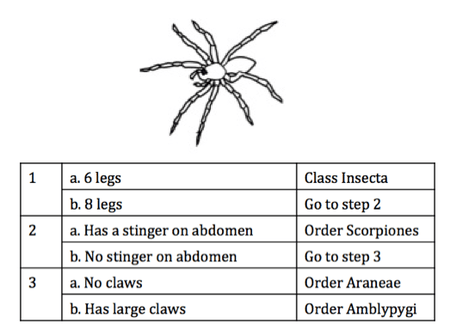
An illustration and a dichotomous key are given. What is the correct classification for this organism?
a)
Class Insecta
b)
Order Amblygygi
c)
Order Araneae
d)
Order Scorpiones
15.
A table of arachnid and insect characteristics is shown. Which characteristic could be used to distinguish between
arachnids and insects?
a)
Jointed legs
b)
Body segments
c)
Presence of eyes
d)
Presence of antennae
16.
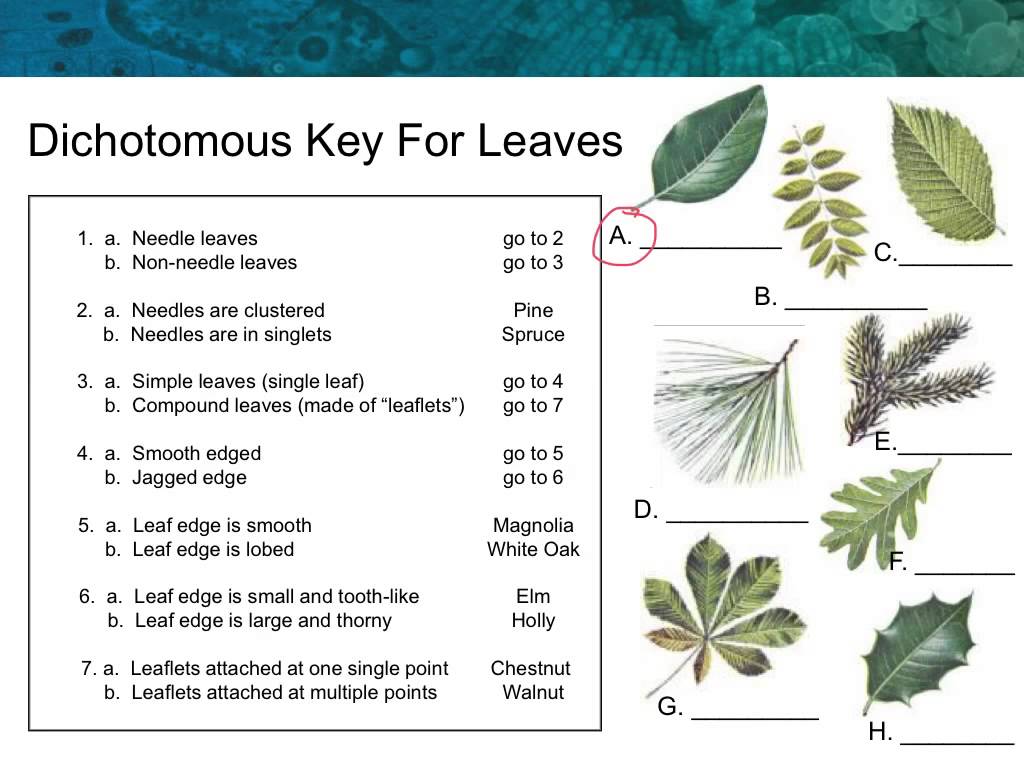
A dichotomous key for trees is provided. Hikers found a tree that has large brown cones and single sharp needles. What species of tree have the hikers found?
a)
Juniper
b)
Pine
c)
Spruce
d)
Fir
17.
What is a dichotomous key used for in science?
a)
To organize biomes
b)
Classify organisms
c)
Identify bacteria only
d)
None of these
18.
A student discovers an arachnid with a segmented abdomen, long legs, and a tail with no stinger. The student uses the dichotomous key below to identify it. Which arachnid has the student found?
a)
Whip Scorpion
b)
Wind Scorpion
c)
Daddy long legs
d)
Scorpion
19.
The 8 levels of classification, most broad to most specific.
a)
Domain, Genus, Family, Order, Class, Phylum, Kingdom, Species
b)
Domain, Species, Kingdom, Genus, Phylum, Family, Class, Order
c)
Domain, Kingdom, Phylum, Class, Order, Family, Genus, Species
d)
Order, Kingdom, Species, Domain, Phylum, Family, Class, Genus
20.
Which organisms are most closely related?
a)
Equus caballas (Horse) & Equus burchellii (Zebra)
b)
Cyanea artica (Jellyfish) &
Ctenodiscus crispatus (Mud Starfish)
c)
Naja naja (cobra) & Glycine max (soya bean)
d)
Ophiocomina nigra (black brittle star) & Brassica nigra (black mustard)
21.
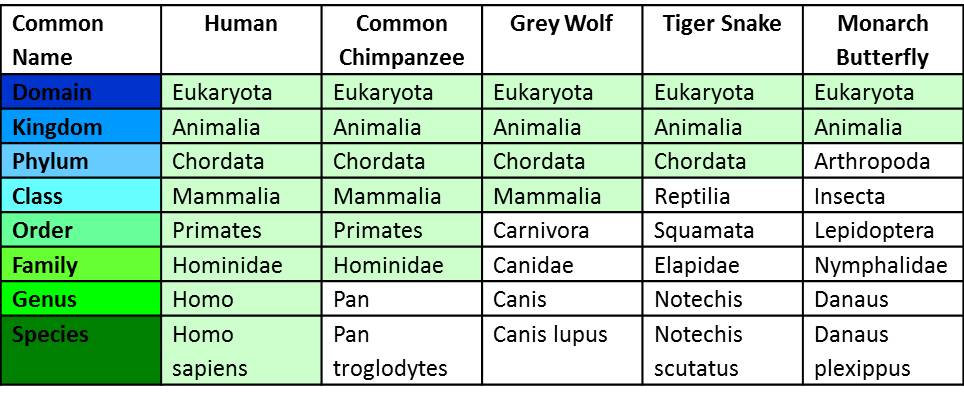
Which organism in the table is least closely related to the chimpanzee?
a)
human
b)
grey wolf
c)
tiger snake
d)
monarch butterfly
22.
Which kingdoms are prokaryotic?
a)
Archaebacteria and Animalia
b)
Eubacteria and Archaebacteria
c)
Fungi and Protista
d)
Plantae and Eubacteria