wayground logo

Free Printable Worksheets

Font size

S
M
L
XL
Worksheets

C2: Chapter 8 Sound and Light Study Guide

Total questions: 77

Worksheet time: 3hrs 34mins

Name
Class
Date
1.

The volume of a sound corresponds to the

a)

amplitude

b)

frequency

c)

wavelength

2.

The pitch of a sound corresponds to the

a)

amplitude

b)

frequency

c)

wavelength

3.

Between waves B and D, which is louder?

a)

Wave B

b)

Wave D

4.

Between waves F and G, which is lower in pitch?

a)

Wave F

b)

Wave G

5.

_____?______ materials do not allow ANY light waves to pass through.

a)

Opaque

b)

Transparent

c)

Translucent

6.

_____?_____ materials allow SOME light waves to pass through, but not in a straight path.

a)

Opaque

b)

Transparent

c)

Translucent

7.

_____?_____ materials allow ALL light waves to pass through easily.

a)

Opaque

b)

Transparent

c)

Translucent

8.

Below are two waves. Based upon their properties, what color light is Wave 1?

a)
b)
9.

When you yell in a canyon, you hear an echo of your voice. Why is this?

a)

The sound waves are absorbed by the walls of the mountains.

b)

The sound waves are reflected by the walls of the mountians.

c)

The sound waves are transmitted through the walls of the mountains.

10.

In movie theaters, they build the walls between theaters with materials that block the sounds from traveling to the next theater. What material would be best?

a)

Materials that transmit sound waves.

b)

Materials that absorb sound waves.

11.

Which letter shows a wave being reflected?

a)

A

b)

B

c)

C

12.

Which letter shows a wave being transmitted?

a)

A

b)

B

c)

C

13.

Electromagnetic waves ________ a medium to travel through, while mechanical waves ___________ a medium.

a)

do not need/need

b)

need/do not need

14.

Why do diamonds look so shiny?

a)

They absorb light waves.

b)

The reflect light waves.

c)

Light is refracted as it passes through.

15.

The brightness of a light corresponds to the

a)

amplitude

b)

frequency

c)

wavelength

16.

The color of a light corresponds to the

a)

amplitude

b)

frequency

17.

Between waves B and D, which is brighter?

a)

Wave B

b)

Wave D

18.

Select ALL waves that are louder than wave A.

a)

Wave B

b)

Wave C

c)

Wave D

19.

Select ALL waves that are lower in pitch than wave A.

a)

Wave B

b)

Wave C

c)

Wave D

20.

The amplitude of a wave is...

a)

The distance from crest to crest.

b)

This distance from trough to trough.

c)

The distance from a crest to a trough.

d)

The distance from either a crest or a trough to the equilibrium.

21.

The frequency of a wave is...

a)

The number of waves that a pass in a given time.

b)

The height of a the wave.

c)

The distance between wave crests.

d)

The strength of the wave.

22.

A longitudinal wave that can only travel through matter

a)

Light

b)

Gamma Ray

c)

Sound

d)

Microwave

23.

The distance between one point on a wave and another

a)

Frequency

b)

Area

c)

Diameter

d)

Wavelength

24.

How high or low we perceive a sound to be

a)

Frequency

b)

Echo

c)

Pitch

d)

Decible

25.

Which part of the ear contains the Ear Canal for amplifying sounds?

a)

Outer

b)

Middle

c)

Inner

26.

At which decibel can sound become harmful to our ears?

a)

10

b)

90

c)

105

d)

120

27.

Light is an Electromagnetic (EM) Wave that can travel through matter AND ____?

a)

Time

b)

Space

c)

Walmart

d)

Dimensions

28.

The following is NOT a type of EM wave

a)

Radio Wave

b)

Light Wave

c)

Sound Wave

d)

X-Ray

29.

Match the following terms to their definitions:

1. Light bounces off an object's surface

2. Light passes through an object

3. Light is absorbed by a material

a)

Transmission

Reflection

Absorption

b)

Reflection

Absorption

Transmission

c)

Transmission

Absorption

Reflection

d)

Reflection

Transmission

Absorption

30.

Your favorite middle school science teacher

a)

Mr. Hemenway

b)

Señor Hemenway

c)

海門威先生

d)

All of the above

31.

Match the following terms to their definitions:

1. Allows almost all light to pass through and forms a clear picture

2. Does not allow light to pass through

3. Allows most light to pass through, but forms a blurry picture

a)

Opaque

Translucent

Transparent

b)

Transparent

Opaque

Translucent

c)

Opaque

Transparent

Translucent

d)

Transparent

Translucent

Opaque

32.
Which term means to bounce off the surface of something?
a)
Refract
b)
Absorb
c)
Reflect
d)
prism
33.
Fill in the blank with the best answer: After light passes through a convex lens the light comes together at a __________. 
a)
Spot
b)
Focal point
c)
point
d)
Local Point
34.
What is vibration?
a)
how loud a sound is
b)
the back and forth movement of matter
c)
how high or low a sound is
d)
the loudness or softness of a sound
35.
What is frequency?
a)
the number of vibrations per second
b)
how high or low a sound is
c)
the loudness or softness of a sound
d)
the back and forth movement of matter
36.
Sound is a form of? 
a)
energy
b)
pitch
c)
volume
37.
Measure of how high or low a sound is
a)
amplitude
b)
compression
c)
speed of sound
d)
pitch
38.
What is volume?
a)
how high or low a sound is
b)
the loudness or softness of a sound
c)
the number of vibrations per second
d)
vibrations
39.
When a rainbow is formed outside naturally, what causes the light to refract?
a)
A. Small raindrops
b)
B. Sunlight rays
c)
C. Tiny mirrors
d)
D. Glass prisms
40.
Which explains why the fork looks different under water?
a)
light can't pass through the glass
b)
the wavelength of light lengthens
c)
the amount of light increases when going through water
d)
light is refracted at an angle
41.
Smooth surfaces _______ a lot of light.
a)
reflect
b)
bend
c)
absorb
d)
twist
42.
Another name for light bending is ....
a)
Reflaction
b)
Absorbing
c)
Refraction
d)
mirror
43.
Opaque means...
a)
No light passes through it
b)
All light passes through it
c)
Some light passes through it
44.
_____ is a lens that is thicker in the middle and makes an object appear bigger.
a)
prism
b)
convex lens
c)
concave lens
d)
mirror
45.
______ is a lens that is thicker on its edges and makes an object appear smaller?
a)
mirror
b)
convex lens
c)
concave lens
d)
prism
46.
___________ is a from of energy that we can see with our eyes.
a)
shadow
b)
light
c)
energy
d)
reflection 
47.
rainbow
a)
light is reflected
b)
light is refracted
c)
light is absorbed
48.
What do bats and dolphins use to find things? 
a)
their eyes
b)
their ears
c)
echolocation
49.
You will see a flash of lightening before you hear the thunder that goes with it because-
a)
the eye is quicker than the ear
b)
thunder occurs much later than lightening
c)
sound travels faster through the  atmosphere than light
d)
light travels faster through the atmosphere than sound
50.
Band of color in a rainbow, or from a light passing through a prism.
a)
Spectrum
b)
Space
c)
Prism
d)
Refraction
51.
Sound is caused by? 
a)
force
b)
vibrations
c)
instruments
52.
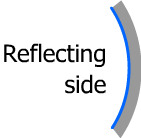
The following is a picture of what type of mirror? 
a)
Convex Mirror
b)
Concave Mirror
c)
Plane Mirror
d)
Flat Mirror
53.
The following is a picture of what type of mirror? 
a)
Convex Mirror
b)
Concave Mirror
c)
Plane Mirror
d)
Flat Mirror
54.
_____ is a lens that is thicker in the middle and makes an object appear bigger.
a)
prism
b)
convex lens
c)
concave lens
d)
mirror
55.
Put the visible light colors in order from longest wavelength to shortest wavelength
a)
Violet, Indigo, Blue, Green, Orange, Yellow, Red
b)
Red, Yellow, Green, Orange, Violet, Blue, Indigo
c)
Red, Orange, Yellow, Green, Blue, Indigo, Violet
56.
Which of the following electromagnetic waves is given off as heat? 
a)
Radio Waves
b)
Infrared Rays
c)
Visible Light
d)
Gamma Rays
57.
The _______________ determines the color of visible light. 
a)
wavelength
b)
speed
c)
amplitude
d)
light
58.
As the frequency of an electromagnetic wave increases, the amount of energy in that wave...
a)
increases.
b)
decreases.
c)
stays the same.
59.
High frequency waves have _________ wavelengths.
a)
varying
b)
long
c)
the same
d)
short
60.
__________ objects reflect all colors; __________ object absorb all colors
a)
white ; black
b)
black ; white
c)
red ; violet
d)
violet ; red
61.
A red banner will reflect  ________ and will ________ all other colors of light
a)
only red light ; absorb
b)
all colors of light ; absorb
c)
all colors but red ; transmit
d)
only red light ; transmit
62.
Which type of mirror magnifies a close up image, like a make-up mirror.
a)
Concave
b)
Convex
c)
Specular
d)
Plane
63.
Which type of mirror is shown.
a)
Concave
b)
Convex
c)
Specular
d)
Plane
64.
All electromagnetic waves have the same...
a)
frequency
b)
speed
c)
wavelength
d)
energy
65.
Objects that absorb all visible light appear to be
a)
black
b)
yellow
c)
white
d)
red
66.
In your eye, _______________ refracts light
a)
retina
b)
lens
c)
iris
d)
pupil
67.
This image shows an example of 
a)
regular reflection
b)
diffuse reflection
c)
divergent reflection
d)
convergent reflection
68.
Angle of incidence is equal to the angle of reflection gives us the __________________
a)
Law of refraction
b)
Law of reflection
c)
Law of diffraction
69.

The complete range of electromagnetic waves placed in order of increasing frequency

a)

Interference of waves

b)

Sonar

c)

Radar

d)

Electromagnetic spectrum

70.

When an object or wave hits a surface through which it cannot pass through and it bounces back

a)

reflection

b)

refraction

c)

rarefaction

d)

diffraction

71.

The changing of direction of a wave when it enters a region where its speed changes in relation to its medium

a)

reflection

b)

refraction

c)

rarefaction

d)

diffraction

72.

The distance between two corresponding parts of a wave, such as crest to crest

a)

trough

b)

wavelength

c)

amplitude

d)

frequency

73.

The number of complete waves that pass a given point in a certain amount of time

a)

trough

b)

wavelength

c)

amplitude

d)

frequency

74.

Electromagnetic waves travel at what speed?

a)

Speed of the wave varies depending on the wavelength

b)

Speed of the wave varies depending on the frequency

c)

Speed of sound

d)

Speed of light

75.

Waves on the EM spectrum with the lowest frequency and longest wavelengths are _________________

a)

gamma rays

b)

x-rays

c)

microwaves

d)

radio waves

76.

Waves on the EM spectrum with the highest frequencies and shortest wavelength are __________________

a)

gamma rays

b)

x-rays

c)

microwaves

d)

radio waves

77.

Which of the following waves on the EM spectrum have the greatest amount of energy?

a)

infrared waves

b)

ultraviolet waves

c)

microwaves

d)

visible light