wayground logo

Free Printable Worksheets

NEW

Font size

S
M
L
XL
Worksheets

UA 5 Biotech Review

Total questions: 47

Worksheet time: 52mins

Name
Class
Date
1.
What does DNA stand for?
a)
Deoxyribonucleic acid
b)
Denitrogenous acid
c)
Deribonucleic acid
d)
Diribonucleic acid
2.
Which of the following best describes a DNA molecule?
a)
double helix
b)
contains ribose
c)
made of amino acids
d)
contains Uracil
3.
DNA is a polymer made of:
a)
Nucleotides
b)
Ribosomes
c)
Purines
d)
Pyrimidines
4.
Why is DNA important?
a)
it is very small and very complicated
b)
it's in everything
c)
it serves as the blueprint for traits of all living things
d)
because we eat it every day for energy
5.
In a molecule of double-stranded DNA, the amount of Adenine present is always equal to the amount of
a)
cytosine
b)
guanine
c)
thymine
d)
uracil
6.
Which organelle is DNA usually found in?
a)
cell membrane
b)
vacuole
c)
ribosome
d)
nucleus
7.
DNA codes for...
a)
bases
b)
proteins
c)
amino acids
d)
phosphates
8.
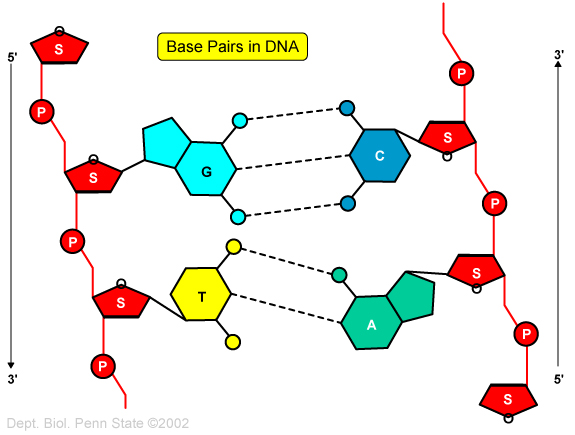
Which shows the correct complementary base pairing for DNA?
a)
C-A, T-G
b)
A-G, C-T
c)
C-G, U-A
d)
T-A, G-C
9.
the process of making a copy of DNA
a)
transcription
b)
double helix
c)
DNA replication
d)
replication fork
10.
Nitrogenous bases are joined by which type of bond?
a)
polar bonds
b)
ionic bonds
c)
covalent bonds
d)
hydrogen bonds
11.

ATT-TGA-GCC- Original

ATT-GAG-CC - Mutated

The example above is an example of a

a)

Insertion- Frameshift

b)

Deletion- Substitution

c)

Deletion -Frameshift

d)

All of the above

12.
Mutated DNA sequences that can be passed from parent to offspring --
a)
occur in somatic cells (body cells)
b)
occur in gametic cells (sex cells)
c)
are rejected by meiosis
d)
only occur if the parent is exposed to harmful substances
13.
The process to go from mRNA to a protein is called ____
a)
transcription
b)
rRNA
c)
replication
d)
translation
14.
The main function of tRNA is to...
a)
carry a message that, when translated, forms proteins
b)
form a portion of ribosomes
c)
string together complementary RNA and DNA strands
d)
bring amino acids from the cytoplasm to the ribosomes
15.
What is the location in the cell for translation?
a)
nucleus
b)
mitochondria
c)
ribosome
d)
chloroplast
16.
What is the three base sequence of mRNA that codes for a single amino acid?
a)
Anticodon
b)
Codon
c)
Protein
17.
The mRNA leaves the ________ to find the ribosome to make proteins.
a)
cell
b)
nucleotide
c)
nucleus
18.
21 nucleotides will provide how many codons?
a)
3 amino acids
b)
5 amino acids
c)
7 amino acids
d)
9 amino acids
19.
Set of nitrogen bases that are complementary to one codon
a)
peptide bond
b)
polypeptide
c)
anti-codon
d)
amino acid
20.
A type of substitution in which no  amino acids change is called 
a)
Missense
b)
Nonsense
c)
Silent
d)
Deletion
21.

Point mutation involves

a)

deletion

b)

insertion

c)

duplication

d)

changes in single base pair

22.

Identify the mutation in the picture.

a)

Deletion

b)

Inversion

c)

Duplication

d)

Translocation

23.
DNA → RNA → Protein Discovering this sequence of events was a major milestone in molecular biology
a)
Central Dogma of Molecular Biology
b)
transfer RNA (tRNA)
c)
ribosomal RNA (rRNA)
d)
Chargaff’s Rules
24.
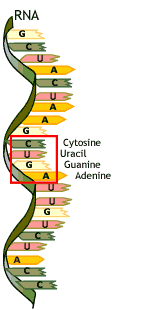
In RNA, Uracil pairs with ______. 
a)
cytosine
b)
adenine
c)
guanine
d)
thymine
25.
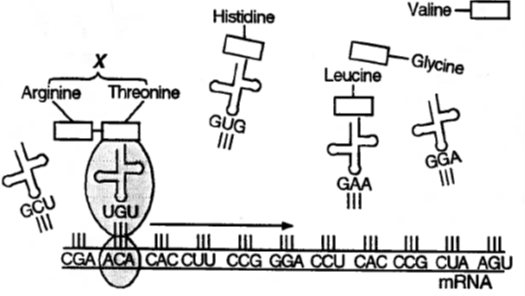
What process is going on in this photo? 
a)
Transcription 
b)
Translation 
c)
Replication 
d)
All the above 
26.
How many amino acids are coded for by this sequence of nucleotides:
ATG GGA ACT CCA
a)
4
b)
2
c)
6
d)
12
27.
What is the three base sequence of mRNA that codes for a single amino acid?
a)
Anticodon
b)
Codon
c)
Protein
28.
DNA sequence ACCTG produces which mRNA strand? 
a)
UGGAC
b)
TGGAC
c)
GTCCA
29.
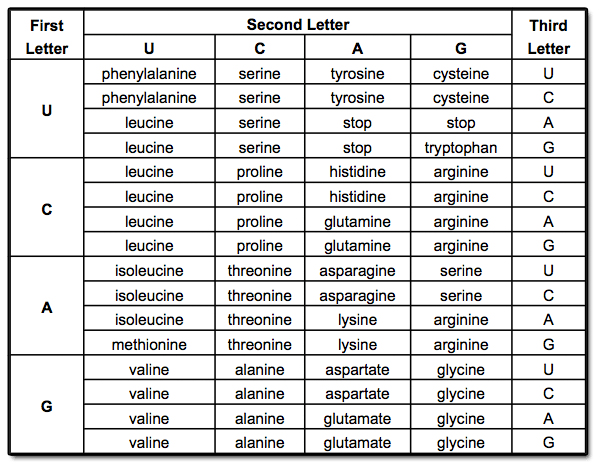
What amino acid is represented by the codon UUA?
a)
Phenylalanine
b)
Tyrosine
c)
Leucine
d)
Stop codon
30.
How does RNA differ from DNA?
a)
RNA contains uracil and deoxyribose
b)
RNA contains ribose and thymine
c)
RNA contains uracil and ribose
d)
RNA contains adenine and ribose
31.
T1 - ____ is the activation of a gene that results in transcription.
a)
Gene expression
b)
Gene technology
c)
Eukaryotic expression
d)
Prokaryotic expression
32.
The physical appearance of a trait is known as the-
a)
genotype
b)
phenotype
c)
characteristics
d)
intelligence
33.
Mark is heterozygous. If B is for brown hair, and b is for blonde hair, what is Mark's phenotype?
a)
Brown Hair
b)
Blonde Hair
c)
Brown and Blonde Hair
d)
Black Hair
34.
Mark is heterozygous. If B is for brown hair, and b is for blonde hair, what is Mark's genotype?
a)
BB
b)
bb
c)
Bb
d)
bB
35.

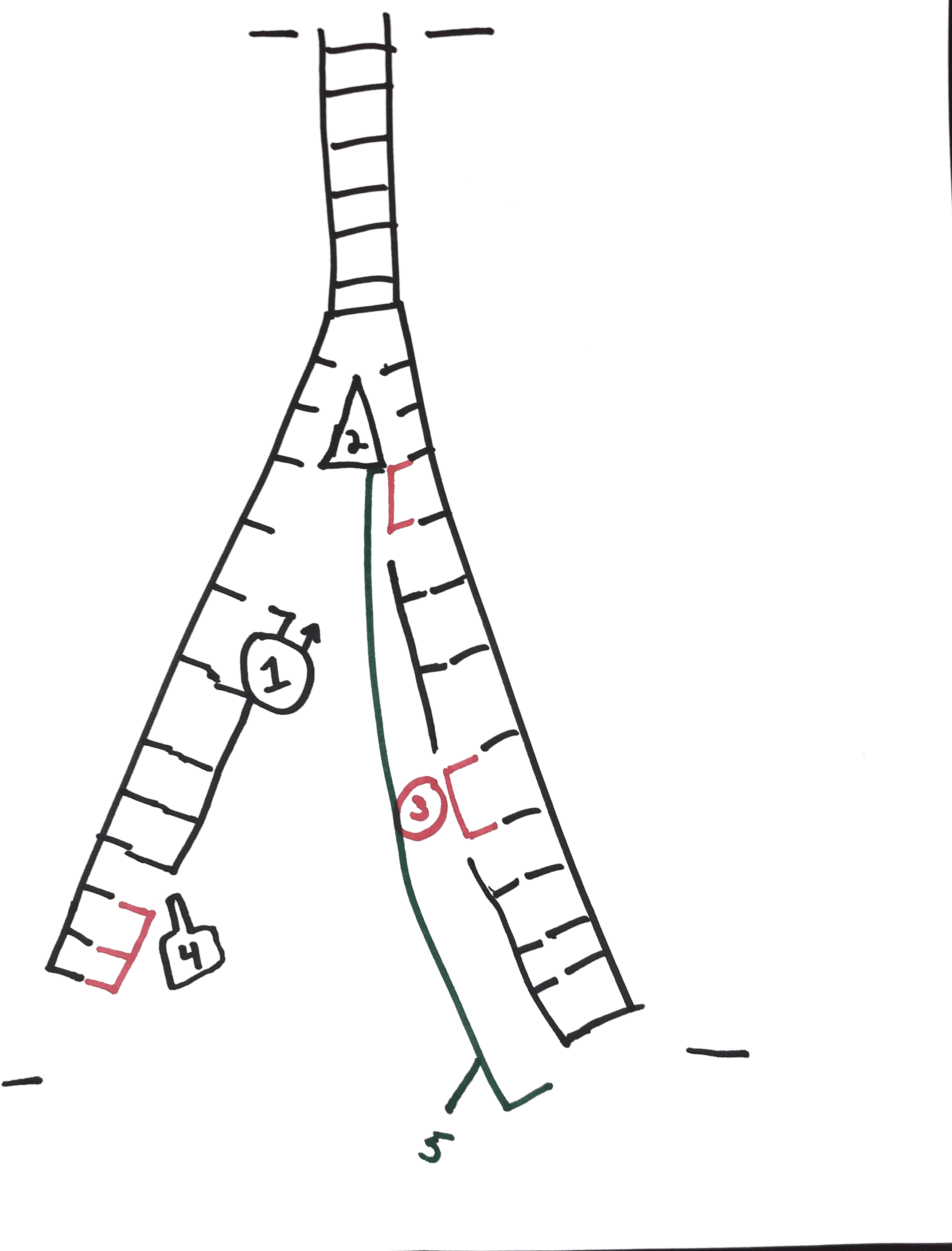
Enzyme that breaks hydrogen bonds (unzips)

a)

Ligase

b)

Polymerase

c)

Primase

d)

Helicase

36.

Number 1 in the picture above

a)

Replication

b)

DNA Polymerase

c)

Primase

d)

Ligase

37.
A clone can be BEST thought of as a(n)  _____ created in the lab. 
a)
identical twin
b)
GMO
c)
science fiction experiment
38.
Why might people be against cloning? 
a)
It's creepy
b)
It can cause unknown defects
c)
It is detrimental to genetic diversity
d)
All of the above
39.
GMO stands for
a)
genetically made organism
b)
genetically modified organism
c)
gene manipulated organism
d)
Genetic mutant organism
40.

Genetic engineering is the indirect manipulation of an organism's genes using biotechnology

a)

TRUE

b)

FALSE

41.

Stem cells are

a)

undifferentiated or unspecialized cells in the body.

b)

differentiated or specialized cells in the body.

c)

only found in the inner mass cells of blastocyst

d)

only found in a fetus

42.
Stem cells can be obtained from _________.
a)
embryos
b)
some adult tissues
c)
umbilical cord blood
d)
all of the above
43.
What is the difference between embryonic stem cells and adult stem cells?
a)
Embryonic can differentiate into more cell types than adult
b)
Adult only turn into blood, while embryonic turn into many things.
c)
Adult can differentiate into more cell types than embryonic
d)
Adult grow bigger than embryonic
44.
How many parent(s)are needed for asexual?
a)
4
b)
1
c)
9
d)
100
45.
All Offspring of Asexual reproduction are identical
a)
True
b)
False
46.

Sexual reproduction results in

a)

Genetically unique offspring

b)

Genetically identical offspring

47.

Sexual reproduction results in

a)

No variation

b)

Large amounts of variation