Wayground logo

Free Printable Worksheets

Font size

S
M
L
XL
Worksheets

Ecology: Part I

Total questions: 41

Worksheet time: 47mins

Name
Class
Date
1.

Which of the following is an abiotic factor?

a)

Predation

b)

Competition

c)

Water

d)

Organisms

2.

Which of the following is an example of a biotic factor?

a)

Soil

b)

Weather

c)

Predators

d)

Climate

3.

Define habitat

a)

An organism's role in an ecosystem

b)

Where an organism lives in an ecosystem

c)

The relationships an organism has in an ecosystem

d)

A symbiotic relationship

4.

One organism benefits while the other neither unharmed NOR benefitted (neutral)

a)

Mutualism

b)

Parasitism

c)

Predator-Prey

d)

Commensalism

5.
Fungi are a  ________
a)
Autotrophs
b)
Heterotroopers
c)
Decomposers
d)
Primary Consumers
6.

In the wild, some alligators gets their teeth cleaned by birds. The birds gets their food from the alligators' teeth.

What type of symbiosis is this?

a)

Mutualism

b)

Commensalism

c)

Parasitism

d)

Neutralism

7.

In an ecosystem, there are populations of moose, rabbits, grass, and pine trees. Suddenly, a fire blazes through the area, which kills all of the populations. As the months go on, new species of grass begin to take root. This attracts animals, and eventually the ecosystem is restored.


What type of ecological succession happened?

a)

Primary succession

b)

Secondary succession

c)

Tertiary succession

d)

None of the above

8.

What is this picture describing?

a)

It is describing natural selection.

b)

It is describing direct competition between flamingos and ducks.

c)

It is describing abiotic factors of the tundra.

d)

It is describing the niche of each bird.

9.

What Biome is covered in permafrost (frozen subsoils)?

a)

Tropical Rain Forest

b)

Desert

c)

Tundra

d)

Tropical Savanna

10.

What Biome is very dry; receives very little rainfall?

a)

Tropical Rain Forest

b)

Desert

c)

Tundra

d)

Tropical Savanna

11.

Each step in a food chain is called a trophic level. What percentage of energy available at one trophic level is transferred to organisms at the next level?

a)

about 2 percent

b)

about 10 percent

c)

about 25 percent

d)

about 50 percent

12.
What is the ultimate source of energy for all ecosystems?
a)
the Sun
b)
plants
c)
secondary consumers
d)
primary consumers
13.
Largest number of individuals of a population that the environment can support...  
a)
carrying capacity
b)
population crash
c)
lag phase
d)
mutualism
14.
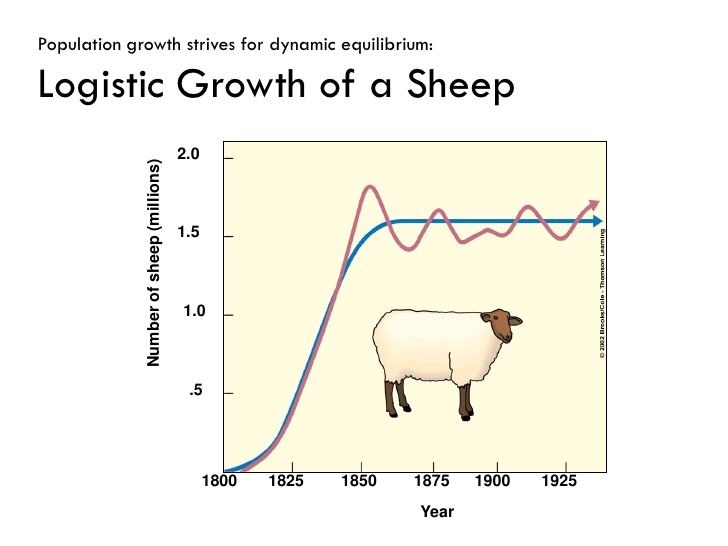
What is the carrying capacity for this sheep population?
a)
1.8 million
b)
1.25 million
c)
1.6 million
d)
1.o million
15.
When a population grows past the ecosystem's carrying capacity, what happens to the population?
a)
Continues to grow
b)
The population starts to die off to return to carrying capcity
c)
The population will go extinct due to lack of resources
d)
The population grows then finds a new carrying capacity
16.
Food, water, sunlight, shelter, and space are resources that are often __________.
a)
limiting factors
b)
wet
c)
messy
d)
found in rocks
17.
What type of growth is represented behind?
a)
exponential
b)
logistics
c)
a good kind
d)
representative
18.

Which of the following are density dependent factors?

a)

competition for resources

b)

predation

c)

disease

d)

natural disasters

19.

Which of the following are examples of a density independent factors?

a)

forest fire

b)

seasonal cycles

c)

storms

d)

disease

20.

Which of the following are density dependent factors?

a)

competition for resources

b)

predation

c)

disease

d)

natural disasters

21.
In this Food Web Pyramid what is the proper name for the organisms above the producer level at the bottom.
a)
herbivores
b)
consumers
c)
carnivores 
d)
omnivores
22.
Which of the following would provide the most energy in an ecosystem?
a)
Producers
b)
Herbivore
c)
Omnivore
d)
Carnivore
23.
Which of the following is an accurate food chain?
a)
Owl, Grasshopper, Grain
b)
Bird, Fox, Rabbit
c)
Carrot, Rabbit, Fox
d)
Grass, Mice, Bird
24.
Why are decomposers located to the side of the pyramid?
a)
They recycle dead material from all levels
b)
The eat living things from all levels
c)
They are not a living organisms
d)
They are too large to fit on the pyramid
25.
What is total amount of dried mass of an organisms called?
a)
Energy
b)
Population
c)
Biomass
d)
Food Web
26.

One chicken is injected with a growth hormone while another chicken is not injected with a growth hormone. After one year, both chickens are weighed. What is the dependent variable?

a)

If the chicken was injected with a growth hormone or not

b)

The weight of the chicken

c)

The type of chicken

27.

A bug repellent was sprayed on one arm. On the other arm, the bug repellent was not sprayed. After 2 hours, the number of bug bites are recorded. What is the independent variable?

a)

The type of bug repellent

b)

If an arm was sprayed with bug repellent or not

c)

The number of bug bites

28.

Group A decides to exercise for a month. Group B decides not to exercise during the same month. Afterwards, they measure the amount of weight that each group lost. what is the dependent variable?

a)

If a group exercises or not

b)

How much weight each group lost

c)

The type of exercise

29.
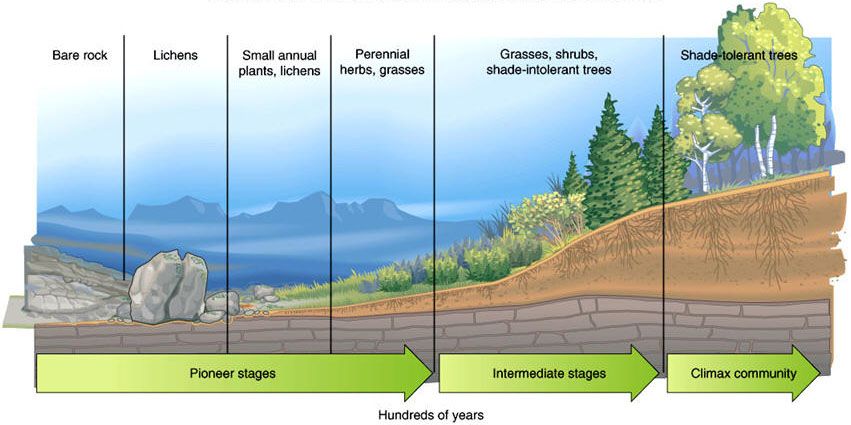
What is the order of succession shown in this figure?
a)
A, B, C, D
b)
B, A, D, C
c)
C, D, A, B
d)
D, A, B, C
30.
The picture shows what type of succession?
a)
primary
b)
secondary
c)
tertiary
d)
quadanary
31.
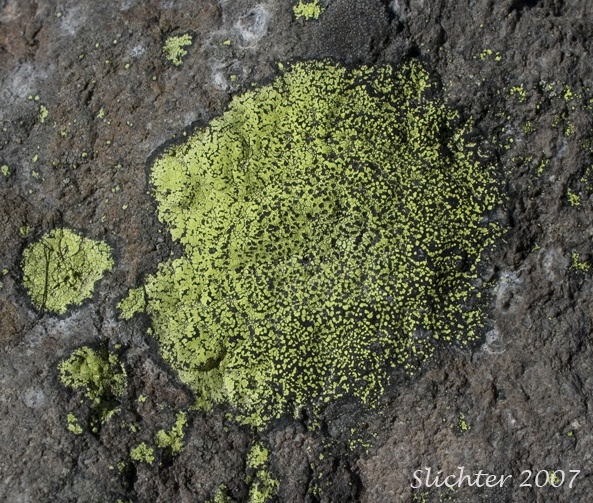
What is the name given to lichen or algae after a primary succession?
a)
pioneer species
b)
volunteer species
c)
founder species
d)
conqueror species
32.
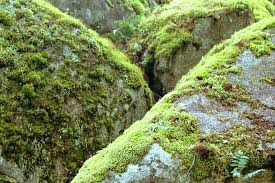
What are examples of pioneer species in a primary succession?
a)
Bushes and Shrubs
b)
Oak trees
c)
Mossess and Lichens 
d)
A rose Bush
33.
Succession type?
a)
primary succession
b)
secondary succession
c)
tertiary succession
d)
variable succession
34.

A species that plays a critical role in the health, maintenance, growth, or definition of an ecosystem.

a)

keystone

b)

invasive

c)

engineer

d)

predator

35.
In this food chain, what will happen if the frogs become extinct?
a)
The snakes will increase.
b)
The grasshoppers will decrease.
c)
The eagles will remain the same.
d)
The grasshoppers will increase.
36.
A food chain shows the transfer of ___ from one organism to another. 
a)
matter
b)
consumers
c)
energy
d)
habitat
37.
What factor describes when populations increase because animals are moving into a population?
a)
Emigration
b)
Limiting Factors
c)
Immigration
d)
Exponential Growth
38.
What factor describes when populations decrease because animals are moving out of a population?
a)
Emigration
b)
Limiting Factors
c)
Immigration
d)
Exponential Growth
39.
Nesting birds often space themselves evenly from other nests. This pattern is called
a)
clumped dispersion.
b)
uniform dispersion.
c)
random dispersion
d)
scatter dispersion
40.
Which kind of dispersion is #1?
a)
clumped
b)
random
c)
uniform
41.

The average number of individuals of the same species per unit of surface area at a given time is the ……………………

a)

population density

b)

population growth

c)

population birth rate

d)

population size