wayground logo

Free Printable Worksheets

NEW

Font size

S
M
L
XL
Worksheets

genius

Total questions: 67

Worksheet time: 6hrs 8mins

Name
Class
Date
1.
Metals are good conductors of electricity because
a)
they contain free electrons
b)
the atoms are lightly packed 
c)
they have high melting point
d)
all of the above
2.
Planets do not twinkle because
a)
they emit light of a constant intensity
b)
Their distance from the earth does not change the  time
c)
They are very far away from the earth resulting in decrease in intensity of light
d)
They are nearer to earth and hemce we recieve a greater amount of light and, therefore minor variations in the intensity are not noticeable
3.
Pa (Pascal) is the unit for
a)
Thrust
b)
Pressure
c)
Frequency
d)
Conductivity
4.
Stars appears to move from east to west because
a)
All stars move from east to west
b)
The earth rotates from west to east
c)
The earth rotates from east to west
d)
The background of the stars moves from west to east
5.
Light from the sun reaches us in nearly
a)
2 minutes
b)
4 minutes
c)
8 minutes
d)
16 minutes
6.
Light year is a unit of
a)
Time
b)
Distance
c)
Light
d)
Intensity of light
7.
Large transformers, when used for some time, become very hot and are cooled by circulating oil. The heating of the transformer is due to
a)
The heating effect of current alone
b)
Hysteresis loss alone
c)
both the heating effect of current and hysteresis loss
d)
intense sunlight at noon
8.
The absorption of ink by blotting paper involves 
a)
Viscosity of ink
b)
Capillary action phenomenon
c)
Diffusion of ink through the blotting
d)
Siphon action
9.
It is easier to roll a stone up a sloping road than to lift it vertical upwards because
a)
work done in rolling is more than in lifting
b)
work done in lifting the stone is equal to rolling it
c)
Work done in both is same but the rate of doing work is less in rolling
d)
work done in rolling a stone is less than in lifting it
10.
When exposed to lower air pressure, the boiling point of water
a)
Decreases
b)
Increases
c)
Remains the same
d)
All of the above
11.
Which of these is a unit of work?
a)
Watt
b)
Meter
c)
Joule
d)
Newton
12.
The orbits of the planets around the sun are 
a)
Circular
b)
Horizontal
c)
Elliptical
d)
Diagonal
13.
Motion occurs when......................
a)
the speed of an object changes. 
b)
an object's distance from another object changes. 
c)
there is an increase or decrease in an object's speed. 
14.
Newton's Second Law states.........................
a)
that an object in motion, stays in motion; an object at rest stays at rest. 
b)
For every action there is an equal and opposite reaction.
c)
that acceleration occurs when a force acts upon an object. 
15.
Average speed is calculated..............
a)
by dividing the total distance by the total time. 
b)
by dividing distance by time. 
c)
by multiplying mass and acceleration. 
16.
What is acceleration?
a)
The speed and direction of an object's motion. 
b)
An increase or decrease in speed, or a change in direction. 
c)
The tendency of an object to resist change in its motion. 
17.
A measurement of the amount of matter in an object. 
a)
Gravity
b)
Weight
c)
Mass
d)
Speed
18.
a)
This is an example of Newton's First Law.
b)
This is an example of Newton's Second Law.
c)
This is an example of Newton's Third Law.
19.
When an object rolls over a surface. 
a)
Sliding Friction 
b)
Rolling Friction 
c)
Fluid Friction 
20.
Inertia........................
a)
is the tendency of an object to resist change in its motion.
b)
is an increase or decrease in an object's speed. 
c)
is the speed and direction of an object's motion. 
21.
Newton's Third Law states that.......................
a)
an object at rest, stays at rest; an object in motion stays in motion. 
b)
acceleration occurs when a force is exerted on an object. 
c)
for every action, there is an equal and oppostite reaction. 
22.
a)
This is an example of Newton's First Law.
b)
This is an example of Newton's Second Law.
c)
This is an example of Newton's Third Law.
23.
The Law of Inertia is also known as.................
a)
the Law of Conservation. 
b)
Newton's First Law.
c)
the Law of the Land. 
24.
When an object moves through a gas or a liquid. 
a)
Sliding Friction
b)
Rolling Friction
c)
Fluid Friction
25.
Constant Speed is................
a)
the speed of an object calculated by taking the total distance and how long it took that object to move that distance. 
b)
when an object moves at the same speed for an extended period of time. 
c)
the speed and direct an object is moving. 
26.
The speed and the direction of an object's motion is it's............................
a)
inertia. 
b)
acceleration.
c)
velocity. 
27.
This is an example of..........
a)
Newton's First Law
b)
Newton's Second Law
c)
Newton's Third Law
28.
a)
This is an example of Newton's First Law.
b)
This is an example of Newton's Second Law.
c)
This is an example of Newton's Third Law.
29.
Friction is........................
a)
the force that one surface exerts on another when they rub against one another. 
b)
the force that causes an object to accelerate. 
c)
when gravity causes an object to stop moving. 
30.
When a solid slides over a solid. 
a)
Sliding Friction
b)
Rolling Friction
c)
Fluid Friction
31.
A measurement of the force of gravity on a person or object. 
a)
Gravity 
b)
Friction
c)
Weight
d)
Mass
32.
Gravity is...........................
a)
the speed in which an object travels. 
b)
the force that pulls things together. 
c)
the weight and mass of an object. 
33.
a)
This is an example of Newton's First Law.
b)
This is an example of Newton's Second Law.
c)
This is an example of Newton's Third Law.
34.
Newton's First Law States.......................
a)
Acceleration is produced when a force acts upon an object. 
b)
For every action, there is an equal and opposite reaction. 
c)
An object at rest, stays at rest; an object in motion stays in motion.
35.

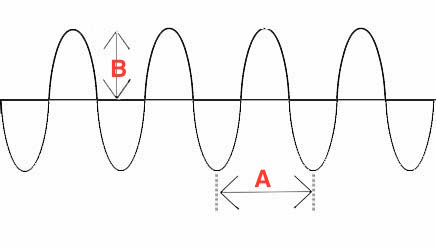
What property of this wave is represented by the letter "A"

a)

amplitude

b)

crest

c)

trough

d)

wavelength

36.
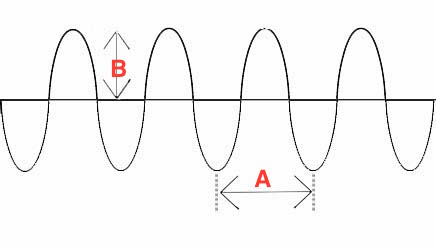
What property of the wave is represented by the letter "B"?
a)
amplitude
b)
crest
c)
trough
d)
wavelength
37.
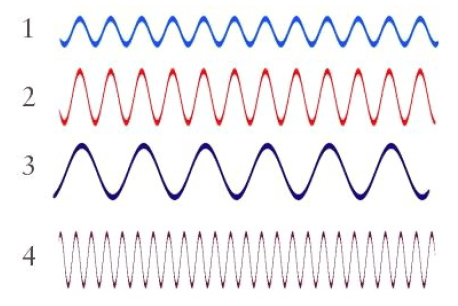
Which wave in the diagram has the greatest frequency?
a)
1
b)
2
c)
3
d)
4
38.
The number of wavelengths that pass a point each second
a)
frequency
b)
wavelength
c)
pitch
d)
amplitude
39.
When the sound source moves, the frequency changes
ex. police car siren sounding lower pitch after the car passes
a)
pitch
b)
frequency
c)
Doppler Effect
d)
medium
40.

If the wavelength of a wave increased, what would happen to the frequency?

a)

decrease

b)

increase

c)

stay the same

41.

What type of interference is represented in the diagram?

a)

Constructive

b)

Destructive

42.

What type of interference do noise cancelling headphones use?

a)

Constructive Interference

b)

Destructive Interference

43.

What type of interference is represented in this diagram?

a)

Constructive

b)

Destructive

44.

Definition: Crest

a)

The highest point of a transverse wave

b)

The lowest point of a transverse wave

c)

The center of a transverse wave

d)

The distance between two points on a wave

45.

Definition: Trough

a)

The center of a wave

b)

The resting position of a wave

c)

The lowest point of a transverse wave

d)

The highest point of a transverse wave

46.

What is the frequency of a wave?

a)

# of oscillations produced in a certain amount of time

b)

The distance the wave oscillates from it's resting position

c)

The lowest point of a transverse wave

d)

Resting point of a wave - no wave movement

47.

What is the amplitude of a wave?

a)

Where there is no wave movement

b)

The distance the wave oscillates from it's resting position

c)

A disturbance that transfers energy from one place to another

d)

The distance between two corresponding parts of a wave

48.

What is a medium?

a)

The lowest point of a transverse wave

b)

The size of a wave

c)

The middle of a wave

d)

Matter through which a wave travels

49.

What type of matter can waves travel through?

a)

Solid

b)

Liquid

c)

Gas

d)

All of the Above

50.

Sound waves in musical instruments or tubes create standing waves that enhance which type of interference to make louder sounds?

a)

Constructive

b)

Destructive

51.
Which of the following would you hear as a low pitched sound? 
a)
sound wave with a frequency of 50 Hz
b)
sound wave with frequency of 10,000 Hz
c)
sound wave with an intensity of 10 dB
d)
sound wave with an intensity of 100 dB
52.
What does pitch depend on?
a)
amplitude 
b)
frequency
c)
intensity 
d)
volume of sound
53.
When you make sounds by plucking a rubber band, you make the rubber band move back and forth very quickly.  This movement is called.
a)
loudness
b)
amplitude
c)
pitch
d)
vibration
54.
A student holds two vibrating objects.  Object A is vibrating faster than object B.  Which statement is true?
a)
A is louder than B
b)
B is louder than A
c)
A will have a higher pitch than B
d)
B will have a higher pitch than A
55.
If you roll a large sheet of paper into a funnel, you can hear the sound better.  This process of increasing the loudness of a sound is called
a)
measuring a wave
b)
absorption
c)
reflection
d)
amplification
56.
Which of the following would produce the highest pitch?
a)
phone
b)
whistle
c)
truck horn
d)
dog's growl
57.
Which of the following would produce the loudest sound?
a)
jet plane
b)
pin falling
c)
doorbell
d)
whisper
58.
How is sound produced by these instruments?
a)
Striking the surface
b)
vibrating columns of air
c)
plucking the strings
59.

Sound travels FASTEST through which of these materials?

a)

A type of gas, like helium

b)

Empty space

c)

A metal such as iron

d)

Water

60.
Sound Waves Move faster in what temperature 
a)
Heat 
b)
Cold
c)
Doesn't Matter
d)
Both
61.
Which of the following does sound depend on?
a)
type of medium
b)
distance to the medium
c)
height of the medium
d)
vibration of the medium
62.
A disturbance that travels through a medium as a longitudinal wave
a)
sound
b)
wavelength
c)
pitch
d)
frequency
63.

The ear does which of the following jobs:

a)

Collects sound

b)

Processes sound

c)

Sends sound signals to the brain

d)

All of the above

64.

Ears help you keep your balance:

a)

True

b)

False

65.

Which of the following is a good way to take care of your ears?

a)

Wear earplugs at loud music concerts

b)

Don’t poke your ears with cotton swabs

c)

Keep the volume down on your music player

d)

All of the above

66.

What separates the outer ear from the middle ear?

a)

Auricle

b)

The ear wall

c)

Eardrum

d)

Cochlea

67.

Fluid moving in the _______causes you to feel dizzy after you stop spinning.

a)

Eustachian tubes

b)

Semicircular canals

c)

Erie canals

d)

Ear canals