
 Worksheets
G.12 CH.2
Total questions: 66
Worksheet time: 4hrs 20mins


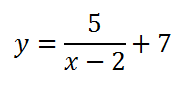


Select the graph that show the corresponding vertical & horizontal asymptotes to this function


What's the horizontal asymptote of the function?
y = 0
No horizontal asymptote
y = 2
y = 4

What's the horizontal asymptote of the function?
y = 0
No horizontal asymptote
y = 1
y = 9

What's the horizontal asymptote of the function?
y = 0
No horizontal asymptote
y = 1/2
y = 1

What's the vertical asymptote of the function?
x = -9
x = 9
x = 3 , x = -3
x = 3

What's the vertical asymptote of the function?
x = 5
x = 0
x =5 , x = -5
x = 25

What's the vertical asymptote of the function?
x = -4, x = 1
x = 4, x = -1
x = -4, x = -1
x = 4, x = 1

Select the graph that show the corresponding vertical & horizontal asymptotes to this function


What is the equation of the horizontal asymptote?
y = 0
y = -2
y = 2
There isn't one

What is the domain?
x ≠ 3
x ≠ -1
x ≠ 3, -1
x ≠ 3, 1

Find the x-intercept(s), if one exists.
(1, 0)
(-1, 0)
(1, 0), (-1, 0)
(0, 0), (1, 0)

What are the coordinates of the y-intercept, if one exists.
(0, 0)
(0, 1)
(0, -1)
there isn't one

What are the x and y intercepts?
(4, 0) and (0, -4)
(-4, 0) and (0, -4)
(-4, 0) and (0, 4)
(0, 0) and (0, -4)

What is the equation of the rational function graphed?


What is the equation of the graph?


Which one of the following statements is always TRUE?
When a graph is increasing, its derivative is negative.
When a graph is decreasing, so is its derivative.
When a graph is decreasing, its derivative is negative.
When a graph is increasing, so is its derivative.

f''(x) is pictured. Which x values are inflection points of f(x)?
x=-5 and -1
x=-3
x=0
no inflection points
For a function g(x), g'(-2)=0 indicates that x=-2 is ________________.
an inflection point
a critical point
a local maximum
a local minimum
Which of the following describes an interval of f(x) that is both decreasing and concave up?
f '(x) < 0 and f "(x) < 0
f '(x) < 0 and f "(x) > 0
f '(x) > 0 and f "(x) > 0
f '(x) > 0 and f "(x) < 0
For a function g(x), g''(3) = -8 indicates that g(x) is ____________ at x=3.
increasing
decreasing
concave up
concave down

f(x) is pictured. Inflection points are most likely at which x values?
x=0 and 1.5
x=2 and 2.5
x=2.25
x=1
When f'(x) changes from positive to negative, there is ...
a local maximum.
a local minimum.
no maximum or minimum
a point of inflection
If (a,b) is a local minimum on f(x), then what will be true about f''(a)?
f "(a) is positive
f "(a) is negative
f "(a) = 0
f "(a) is also a local minimum
If f''(x)>0, then what will be true about f'(x) over that same interval?
f '(x) is constant
f '(x) is increasing
f '(x) is decreasing
f '(x) must have an inflection point in that interval
If (a,b) is a local maximum of f(x), then what will be true about f''(a)?
f "(a) is positive
f "(a) is negative
f "(a) = 0
f "(a) is also a local maximum
The concavity of a function is described by its _______________.
first derivative
second derivative
third derivative
any derivative determines concavity
If f '(3) = 0 and f"(3) < 0, then which of the following must be true about the graph of f(x)?
There is a local max at x=3
There is a local min at x = 3
There is an inflection point at x = 3
There is an x-intercept at x = 3
What will be true at an inflection point? (select the best answer)
f(x)=0 and there is a sign change
f'(x)=0 and there is a sign change
f''(x)=0 and there is a sign change
The function is increasing then decreasing

2x
3
6
9
Let f(t) be the depth (cm) of the water in a tank at time t (minutes). Using correct units, explain the best meaning of the statement f '(30) = 20.
During the first 30 minutes, the water in the tank rises 20 cm.
After 30 minutes, the water in the tank is up to 20 cm in depth.
At 30 minutes, the water in the tank is increasing to 20 cm.
At 30 minutes, the water in the tank is increasing at 20 cm/min

The function shown is the graph of f '(x), the derivative of f(x). The domain is [-3,5]. On which interval is the graph of f(x) concave upward?
(-1,1) & (3,5]
[-3,-2) & (4,5]
[-3,-1) & (1,3)
(-2,1) & (1,4)

This graph is of the second derivative, f" (x). For what value of x does the first derivative, f '(x) have a local maximum?
x = 0
x = 1
x = 2
x = 4
x = 5

There is(are) ...

Find the intervals of concavity for
f(x) = x2 + 2x + 1.
concave up: (-∞,∞)
concave down: (-∞,∞)
concave up: (2, ∞)
concave down: (-∞,2)
concave up: (-∞,2)
concave down: (2, ∞)
Find the relative minimum values for f(x)=3x4-2x3-9x2
-1
0
1.5
-1 and 1.5


Over what interval(s) is f(x) concave up? (Be careful this is a graph of f'!)
(-∞, -3) ∪ (1, ∞)
(-3, 1)
(-∞,-3) U (1, ∞)
(-5, 0)U(2, ∞)

If f'(x) = 0 what does that imply about the x value?
It is a critical point, it is a possible max, min, or point of inflection.
That the limit does not exist.
g(x)=2x3-3x2


