
 Worksheets
Conservation of Mechanical Energy & Power
Total questions: 40
Worksheet time: 2hrs 0mins


Where does the pendulum have the greatest kinetic energy?
A
B
C
D
E
The sum of the kinetic and potential energy in a system is known as the system's _____________________ energy.
mechanical
chemical
thermal
combined
How much kinetic energy (K) does a baseball with a mass of 0.143 kg have if it is travelling at a velocity of 41.1 m/s?
HINT: K = mv2/2
120.8 joules
89.7 joules
108.3 joules
156.6 joules

What is the maximum gravitational potential energy that this 1.3 kg ball can have in this situation?
HINT: Ug = mgh, where g = 9.8 m/s2
2.55 joules
1.65 joules
3.15 joules
3.94 joules
If a ball tossed into the air has a maximum gravitational potential energy of 5.75 joules, what is its maximum kinetic energy in the same toss?
5.75 joules
11.14 joules
2.88 joules
7.93 joules
Which of the following is correct according to the work-energy theorem?
The net work on an object causes a change in the kinetic energy of the object.
Work is equivalent to the magnitude of the force applied to the object times the displacement of the object in the direction of the force.
Energy is the ability to do work.
The work done on an object is equivalent to the mass of the object times the acceleration that a force causes to occur.

At which point in the picture must the cart have the most MECHANICAL energy?
Point 1
Point 2
Point 3
They would all be the same
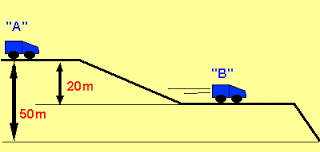
In diagram 2, if the mass of the car is 600 kg, what is the change in potential energy from point A to point B?
411,600 J
294,000
176,400 J
117,600 J
1. A ball has a 17 J of kinetic energy and its mechanical energy is 25 J. If the ball has a mass of 3.2 kg, what is its height above the ground?
0.26 m
0.52 m
5.2 m
25 m
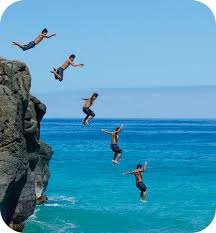
A cliff diver with a mass of 125 kg jumps off a 50m high cliff, how fast will he be traveling just before he hits the water? (His height at this point is 0m)
(HINT: Find PE first. then KE = 1/2mv2
g = 9.8 m/s2
61,250 m/s
980 m/s
31.3 m/s
247.5 m/s

A person with a mass of 60 kg jumps in the air. If the gravitational potential energy is 1,470 J at the highest point, how did they jump?
3.2 m
49 m
24.5 m
2.5 m

The skateboarder shown above has a potential energy of 2,800 J and kinetic energy of 0J at a height of 4 meters. How much total mechanical energy will she have after 2 seconds? Neglect friction and air resistance.
2000J
1600J
1400J
2800J
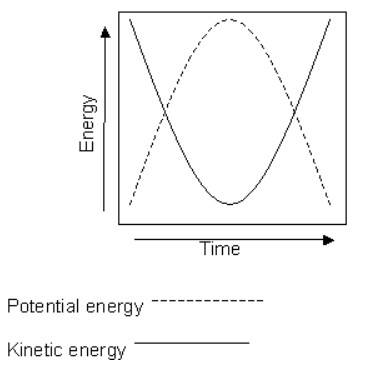
This graph depicts what type of relationship between kinetic and potential energy?
Non-Linear
Linear
Inverse
Poly-atomic

A 5.0 kg object is pushed across the floor and the attached force vs. displacement graph describes the forces and displacement. What is the change in KE of the object? (Hint: Net work = change in kinetic energy)
45 J
30 J
735 J
40 J
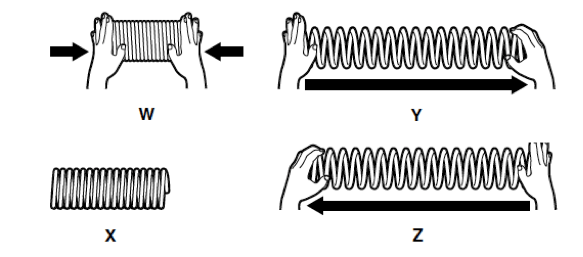
Elastic potential energy is energy stored in an object, such as a spring, due to the object being stretched or compressed. In which position is it most likely that the spring has lost its elastic potential energy?
W
Y
X
Z
Which graph best represents the relationship between the potential energy stored in a spring and the change in the spring’s length from its equilibrium position?


The graph below represents the relationship between the force applied to a spring and spring elongation for four different springs.
Which spring has the greatest spring constant?
A
B
C
D
When a 1.53-kilogram mass is placed on a spring with a spring constant of 30.0 newtons per meter, the spring is compressed 0.500 meter. How much energy is stored in the spring?
3.75 J
7.50 J
15.0 J
30.0 J

What physical quantity is represented by the slope of each line?
the potential energy of the spring
the period of the spring
the spring constant
the maximum elongation of the spring
A catapult with a spring constant of 1.0 × 10⁴ newtons per meter is required to launch an airplane from the deck of an aircraft carrier. The plane is released when it has been displaced 0.50 meter from its equilibrium position by the catapult. The energy acquired by the airplane from the catapult during takeoff is approximately
1.3 × 10³ J
2.0 × 10⁴ J
2.5 × 10³ J
1.0 × 10⁴ J

What is the spring constant for this spring?
0.020 N/m
2.0 N/m
25 N/m
50. N/m
A 100 N force is applied to move an object a horizontal distance of 5 meters at constant speed in 10 seconds. How much power is done?
50J
50W
500J
500W
During the Powerhouse lab, Jerome runs up the stairs, elevating his 102 kg body a vertical distance of 2.29 meters in a time of 1.32 seconds at a constant speed. Determine the power generated by Jerome.
1.73 x 10³ W
1.48 x 10³ W
1.91 x 10³ W
1.27 x 10³ W
A new conveyor system at the local packaging plan will utilize a motor-powered mechanical arm to exert an average force of 890 N to push large crates a distance of 12 meters in 22 seconds. Determine the power output required of such a motor.
490 Watts
40. Watts
11 x 103 Watts
0.55 Watts
The area under a force vs. displacement graph tells you the
mass of the object
momentum of the object
work done on the object
impulse of the object

On a work vs time graph, you can calculate the power by
the area.
the y-axis.
the y-intercept.
the slope.
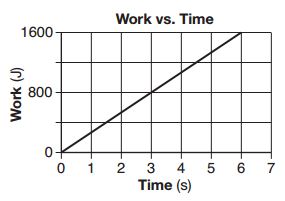
How much power was generated from 0-4 seconds?
1100 W
4 W
267 W
1600 W

