wayground logo

Free Printable Worksheets

Font size

S
M
L
XL
Worksheets

Unit 2 Living Environment EXAM #1

Total questions: 50

Worksheet time: 38mins

Name
Class
Date
1.

Has membrane bound organelles

a)

Prokaryote

b)

Eukaryote

c)

Both

2.

What can only be found in plant cells?

a)

Chloroplast

b)

Vacuole

c)

Nucleus

d)

Cell membrane

3.
Stem cells are
a)
cells that grow uncontrollably
b)
undifferentiated and can be any type of cell
c)
never go through cell division
d)
only found in embryos
4.
This type of cell carries oxygen throughout the body.
a)
gamete
b)
platelet
c)
white blood cell
d)
red blood cell
5.
The powerhouse of the cell is the...It converts energy from food into energy the cell can use
a)
Mitochondrion
b)
Golgi body
c)
Nucleus
d)
Ribosomes
6.
Where are proteins made? These are small, grain-like or rod shaped organelles.
a)
Golgi body
b)
Mitoichondrion
c)
Chromosomes
d)
Ribosomes
7.

Active transport across a cell membrane from low to high concentration, requires

a)

energy (ATP)

b)

no energy

c)

water

d)

oxygen

8.

Two Erlenmeyer flasks are arranged as the diagram below. After several minutes, all of Erlenmeyer flasks are filled up by glucose solution. Why did it happen?

a)

It happens because of diffusion

b)

It happens because of osmosis

c)

It happens because of gravitation force

d)

It happens because of shaking hands

9.

The diffusion of water across a selectively membrane is called

a)

diffusion

b)

active transport

c)

homestatsis

d)

osmosis

10.
_______ regulates what enters and leaves a cell.  
a)
Cell Membrane
b)
Nucleus
c)
Mitochondria
d)
Cytoplasm
11.
 An animal cell placed in a hypertonic (salty) solution will
a)
Stay the same
b)
Shrink- get smaller
c)
Swell- get bigger
12.

Foods synthesized in the process of Photosynthesis by plants is stored as

a)

Starch

b)

Protein

c)

Vitamins

d)

Fats

13.
What is the name of the simple sugar that is produced in photosynthesis?
a)
Sucrose
b)
Dextrose
c)
Glucose
d)
Lactose
14.
The tendency of an organism to maintain a balanced state in order to stay healthy.
a)
Stimuli
b)
Response
c)
Tropism
d)
Homestasis
15.
Name the levels of organization in the human body in order from smallest to largest:
a)
Tissue, organ, organ system
b)
Organ system, tissue, organs, cells
c)
Cells, tissue, organs, organ system
d)
Cells , organs, tissue, organ system
16.
The two types of feedback systems that help organisms maintain homeostasis are:
a)
positive and negative 
b)
receptor and effector
c)
static and dynamic
d)
minor and major
17.
The term for maintaining internal temperature is: 
a)
Thermoregulation
b)
Thermometer
c)
Homeothermal
d)
Homeostasis
18.
When glucose levels in the blood rise, your brain sends a signal to your pancreas. The pancreas releases insulin, which opens channels in cell membranes to allow glucose to enter the cell, lowering blood sugar levels. 
a)
Positive Feedback Response
b)
Negative Feedback Loop 
19.
These two body systems regulate feedback mechanisms.
a)
Skeletal & Muscular
b)
Skeletal & Endocrine
c)
Muscular & Nervous
d)
Endocrine & Nervous
20.

Which hormone is released when blood sugar gets too high?

a)

glucose

b)

glucagon

c)

glycogen

d)

insulin

21.
Cellular Respiration's goal is to
a)
make water
b)
make ATP
c)
make glucose
d)
make  oxygen
22.
Organisms that make energy from the sun are called..
a)
hetertrophs 
b)
autotrophs 
c)
carbohydrates 
d)
consumer 
23.

What part of the leaf allows gases in and out?

a)

Stomate

b)

ATP

c)

Chloroplast

d)

Chlorophyll

24.

Enzymes are an example of

a)

Lipids

b)

Carbohydrate

c)

Protein

d)

Nucleic Acid

25.
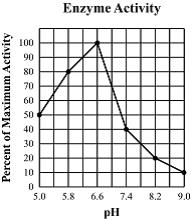
Which of the following conclusions can be drawn from this graph?
a)
The optimum pH of the enzyme is 6.6.
b)
The optimum pH of the enzyme is 5.8
c)
The enzyme’s activity increases as pH increases 5.0 to 9.0
d)
The enzyme’s activity is greater around pH of 8.0 .
26.
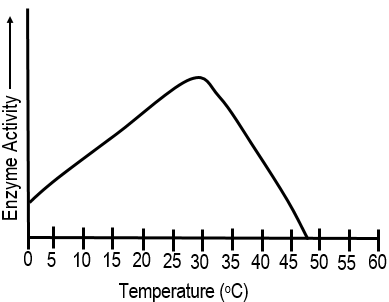
Based on the graph, what is the optimal temperature for this enzyme? 
a)
15oC
b)
40oC
c)
30oC
d)
35oC
27.
The main purpose of the ____________ system is to break food particles into pieces that can be used.
a)
circulatory
b)
respiratory
c)
digestive
d)
skeletal
28.
What is responsible for delivering oxygen and removing carbon dioxide from the body?
a)
cell nucleus
b)
excretory system
c)
nervous tissue
d)
respiratory system
29.

What is the most important function of the excretory system?

a)

Break down food

b)

Pump blood

c)

Remove waste

d)

Voluntary movement

30.
What system is the body's way of fighting off pathogens that would make it sick?
a)
Excretory
b)
Immune
c)
Digestive
d)
Endocrine
31.

functions in support and movement

a)

skeletal

b)

urinary

c)

muscular

d)

digestive

32.

The (a)   system plays a major part in hormone production.

33.

Which gland is responsible for regulating weight?

a)

1

b)

2

c)

3

d)

none of the above

34.

If you had the flu you, what pathogen has attacked your body?

a)

bacteria

b)

parasites

c)

fungus

d)

virus

35.
A white blood cell that makes antibodies
a)
T cell
b)
bacteria
c)
B cell
d)
mast cell
36.
Antibodies are made by...
a)
Your own cells.
b)
The pathogen.
37.

A 3 month old baby contracts a virus called whooping cough (pertussis) after receiving the first of a sequence of 3 necessary DPT vaccines designed to prevent 3 diseases (diphtheria, pertussis, and tetanus). The vaccines are given at 2, 4, and 6 months of age to allow the body to develop specific immunity against these diseases. After the infant recovered from the disease, the doctor informed the parents that from now on the infant would only need the DT (diphtheria, tetanus) part of the vaccine. Why does the infant only need the DT vaccine?

a)

The infant had the first of a series of vaccines which caused the disease

b)

The infant had the pertussis disease and has already produced antibodies against the disease.

c)

The infant had the first of a series of vaccines which protected him from getting the disease.

d)

The infant had the pertussis disease and will get diphtheria in the future.

38.
The result of meiosis is:
a)
two diploid cells
b)
two haploid cells
c)
four diploid cells
d)
four haploid cells
39.
A human zygote should have _____ chromosomes inside.
a)
46
b)
23
c)
92
d)
64
40.
In which type of cells will mitosis occur?
a)
egg cells
b)
sperm cells
c)
jail cells
d)
Body cells except the sperm and egg cells
41.
Which is a type of Asexual Reproduction
a)
Flowers being pollinated
b)
Binary fission
c)
Chickens laying fertilized eggs
d)
Conjugation
42.
What types of cells are found only in organisms that reproduce sexually?
a)
blood cells 
b)
neurons 
c)
skin cells 
d)
gametes 
43.

Sometimes your skin has a cut and then in a few days, it recovers, what process is that regarding cell reproduction?

a)

meiosis

b)

mitosis

c)

photosynthesis

d)

protein synthesis

44.

Where does fertilization take place?

a)

Ovary

b)

uterine linning

c)

Vagina

d)

Fallopian tube

45.

During fertilization, nucleus in the head of sperm fuses with the ovum nucleus to form a ___________________

a)

embryo

b)

zygote

c)

foetus

d)

baby

46.

A human life begins with

a)

fertilization

b)

birth

c)

first breath

d)

heart formation

47.

Which of the following sequences represents the correct order of events in the formation of a human fetus?

a)

Zygote → Blastocyst → Embryo → Fertilization

b)

Fertilization → Zygote → Blastocyst → Embryo

c)

Blastocyst → Embryo → Differentiation → Zygote

d)

Fertilization → Growth → Differentiation → Zygote

48.

The hormone that causes a female's eggs to grow and mature is called ____________.

a)

FSH

b)

LH

c)

Oxytocin

d)

Prolactin

49.

The most important hormone produced by the testes is ___________.

a)

Testosterone

b)

FSH

c)

Estrogen

d)

LH

50.

What is the purpose of Mitosis?

a)

Growth of an organism and Repair of damaged tissue

b)

To help the body get rid of extra cells

c)

To increase the amount of classwork you have to do

d)

To get rid of the nucleus