
 Worksheets
AP Chem Thermodynamics Practice
Total questions: 81
Worksheet time: 59mins
True
False
Which phase of matter has the greatest motion and the least orderly arrangement?
For which of these processes is the value of ΔH expected to be positive?
The temperature increases when calcium chloride dissolves in water.
Steam condenses to liquid water
Steam condenses to liquid water
Dry ice sublimates
The reaction ½ A2 + 2 B2 + C ⟶ CAB4 has an enthalpy of formation of -104 kJ and a change in entropy of -60.8 J/K at 30 °C. Calculate the value of Gibb's free energy and state whether the reaction is thermodynamically favorable (i.e., spontaneous) at these conditions.
-85.6 kJ, thermodynamically favorable
-18.3 kJ, not thermodynamically favorable
+18.3 kJ, thermodynamically favorable
+85.6 kJ, not thermodynamically favorable

For which of the following processes would ΔS have a negative value (look at the states s, l, or g) ?
2Fe2O3 (s) → 4Fe(s)+3O2(g)
H2(g) + C2H4(g) → 3C2H6(g)
Mg2+(aq)+2OH-(aq) → Mg(OH)2(s)

NH3(g) + 2CH4(g) + 5/2 O2(g) → H2NCH2COOH(s) + 3H2O(l)... At constant temp, ΔS is...
increasing
decreasing
staying the same
speeding up
What is the equation for Gibbs Free Energy?
ΔG = ΔH + TΔS
ΔH = ΔG - TΔS
ΔS = ΔH - TΔG
ΔG = ΔH - TΔS
A process will be spontaneous when the change in free energy is...
zero
positive
negative
Free energy change at equilibrium is...
Zero
Positive
Negative
Which combination of ΔH and ΔS will never be thermodynamically favorable at any temperature?
+ΔH and +ΔS
+ΔH and -ΔS
-ΔH and -ΔS
-ΔH and +ΔS
1. Given the following information, calculate ΔG0 for the reaction below at 250C:
SnCl4(l) + 2 H20(l) → SnO2(S) + 4HCl(g),
ΔH0=+133.0 kJ and ΔS0 =+401.5 J/K
-252.6 kJ
-13.4 kJ
13.4 kJ
252.6 kJ
When a reaction is exothermic and the products have more entropy than the reactants, the reaction is
thermodynamically favorable, with a negative ΔG
thermodynamically favorable, with a positive ΔG
not thermodynamically favorable, with a negative ΔG
thermodynamically favorable, with a positive ΔG

A
B
C
D
Given the balanced equation:
I2(s) + energy ⟶ I2(g)
As a sample of solid iodine sublimes, the entropy of the sample
increases because the particles are less randomly arranged
increases because the particles are more randomly arranged
decreases because the particles are less randomly arranged
decreases because the particles are more randomly arranged

A
B
C
D
E

A
B
C
D
E
A reaction that is spontaneous at any temperature has a
______ entropy change and a ____ enthalpy change.
positive, positive
positive, negative
negative, negative
negative, positive
A reaction that is spontaneous at low temperatures only has a ____ entropy change and a _____ enthalpy change.
positive, positive
positive, negative
negative, negative
negative, positive
A reaction that is thermodynamically favorable at high temperatures but not thermodynamically favorable at low temperatures has a ____ entropy change and a ____ enthalpy change.
positive, positive
positive, negative
negative, negative
negative, positive
A reaction that is not thermodynamically favorable at any temperature has a
____ entropy change and a ____ enthalpy change.
positive, positive
positive, negative
negative, negative
negative, positive
Calculate the standard entropy change for the following reaction:
Cu(s)+1/2 O2(g) → CuO(s).
Given that
S0 (Cu(s)) = 33.15 J/K*mol
S0 (O2(g)) = 205.14 J/K*mol
S0 (CuO(s)) = 42.5 J/K*mol
195.66 J/K.mol
93.09 J/K.mol
-93.09 J/K.mol
+195.66 J/K.mol
Given the following information, calculate ΔG0 for the reaction below at 250C:
SnCl4(l) + 2 H20(l) → SnO2(S) + 4HCl(g),
ΔH0=133.0 kJ and ΔS0 =401.5 J/K
-252.6 kJ
-13.4 kJ
13.4 kJ
252.6 kJ
Given the following information, calculate ΔG0 for the following reaction below at 250 C: 2H2O2(l) →2H2O(l) + O2(l)
if the equilibrium constant Kc = 8.52 x 1040
-37700 kJ
-342.6 kJ
+233.5 kJ
-233.5 kJ
If ΔH and ΔS are both negative , then the sign of ΔG is ____.
positive
negative
indeterminate
Calculate the temperature at which a given reaction would become spontaneous if ΔH =+119kJ and ΔS=+263J/(K mol)
452 K
2210 K
382 K
363 K
Which process is accompanied by a decrease in entropy?
boiling of water
condensing of water vapor
subliming of iodine
melting of ice
Systems in nature tend to undergo changes toward
lower energy and less disorder
lower energy and more disorder
higher energy and less disorder
higher energy and more disorder
Thermodynamically favorable reactions are driven by
Solid magnesium dissolves in a hydrochloric acid, releasing hydrogen gas and heat from a solution of magnesium chloride. What is the sign of ΔH for this reaction?
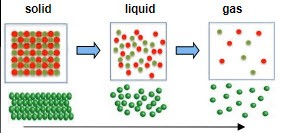
Identify whether the following results in an increase or decrease in entropy:
3 moles of gas (on reactant side) ⟶ 6 moles of gas (product)
increase
decrease
no change
Which reaction has the greatest increase in entropy?
2H20 (l) ⟶ 2H2 (g) + O2 (g)
2H2O(g) ⟶2H2(g) + O2(g)
H2O(g) ⟶ H2O(l)
H2O(l) ⟶ H2O(s)
Given the change of phase:
CO2(g) ⟶ CO2(s)
As CO2(g) changes to CO2(s), the entropy of the system ____.
decreases
increases
remains the same
Solid magnesium dissolves in a solution of hydrochloric acid, releasing hydrogen gas, and the temperature of the contents of the baker increases. What is the sign on ΔG for this reaction?
As NaCl dissolves according to the equation NaCl(s) → Na+(aq) + Cl-(aq), the entropy of the system

Predict the entropy change, ΔS.
ΔS = +
ΔS = -
ΔS = 0
ΔS = no change
occur only with a sustained energy input
occur without any additional assistance
are very fast
For the reaction C2H6 (g) ⟶ C2H4 (g) + H2 (g)
ΔHο is +137 kJ/mol and ΔSοis +120 J/K mol. This reaction is:
nonspontaneous at all temperatures
proceeding at a rapid rate
spontaneous only at high temperatures
spontaneous at all temperatures
spontaneous only at low temperature
A reaction that is not spontaneous at low temperature can become spontaneous at high temperature if ΔH is __________ and ΔS is __________.
+, +
-, -
+, -
-, +
+, 0
For a reaction to be spontaneous under standard conditions at all temperatures, the signs of ΔHΟ and ΔSΟ must be __________ and __________, respectively.
+, +
+, -
-, +
-, -
+, 0
Calculate ∆G and state if the process is spontaneous or nonspontaneous using the following information:
∆Hsystem = 145 kJ, T = 293 K, ∆Ssystem = 192 J/K
-56111 kJ/mol ; nonspontaneous
-56111 kJ/mol ; spontaneous
89 kJ/mol ; spontaneous
89 kJ/mol ; nonspontaneous
Calculate ∆G and state if the process is spontaneous or nonspontaneous
∆Hsystem = -15.9 kJ, T = 373 K, ∆Ssystem = -268 J/K
99964 kJ/mol ; nonspontaneous
84 kJ/mol ; nonspontaneous
84 kJ/mol ; spontaneous
99964 kJ/mol ; spontaneous
Under certain conditions, iron ore (Fe3O4) can be converted to iron for the following reaction:
Fe3O4(s) + 4 H2(g) → 3 Fe(s) + 4 H2O(g).
∆H = 149.8 kJ and ∆S = 6100 J/K.
Is the reaction thermodynamically favorable at 298 K?
Yes, because ΔG < 0
Yes, because ΔG > 0
No, because ΔG < 0
No, because ΔG > 0
Which of the following statements describes a system with Keq < 1 ?
Which of the following statements describes a system with Keq > 1 ?
ΔG < 0
ΔG > 0
The value of Keq for a particular system at equilibrium is known to be 340 at 23 °C. This means...
...the reaction is thermodynamically favorable in the forward direction.
...the reaction is thermodynamically favorable in the reverse direction.
...the reaction is not thermodynamically favorable in any direction.
thermodynamic favorability cannot be determined from this data.
The value of Keq for a particular system at equilibrium is known to be 2.45x10⁻¹³ at 23 °C. This means...
...the reaction is thermodynamically favorable in the forward direction.
...the reaction is thermodynamically favorable in the reverse direction.
...the reaction is not thermodynamically favorable in any direction.
thermodynamic favorability cannot be determined from this data.
A nonspontaneous reaction...
...will be product favored at equilibrium.
...will not favor the reactants nor the products at equilibrium.
...will be reactant favored at equilibrium.
...will not require energy in order to occur.
For the reaction 2NO (g) ⟷ N2 (g) + O2 (g) has a K = 1.0x1031.
Which statement is correct?
The reaction has ΔG < 0 since the K value is very large. The reaction must be exothermic since the ΔS is very small and will not affect the value for ΔG
The reaction has ΔG < 0 since the K value is very large. The reaction must be exothermic since the value for ΔS is very large
The reaction has ΔG >0 since the K value is very large. The reaction must be endothermic since the value for ΔS is close to zero and will not affect the value for ΔG
Calculate the value of ΔG° at 298 K if the equilibrium constant is equal to 24.29. (Hint: R=8.314 J mol-1 K-1)
7903 kJ/mol
-7903 kJ/mol
7.903 kJ/mol
-7.903 kJ/mol
The entropy will usually increase when
a molecule is broken into two or more smaller molecules
a reaction occurs that results in an increase in the number of moles of gas
a solid changes to a liquid
all of these
Which reaction has a +ΔS ?
AgNO3(aq) + NaCl(aq) → AgCl(s) + NaNO3(aq)
H2O(g) + CO2(g) → H2CO3(aq)
H2(g) + I2(g) → 2Hl(g)
C2H2O2(g) → 2CO(g) + H2(g)
Consider a reaction with ΔHrxn = -77.91 kJ/mol and ΔSrxn = -0.4211 kJ/mol. At what temperature will the reaction switch between nonspontaneous and spontaneous?
(a)
Consider a reaction with ΔHrxn = 90.84 kJ/mol and ΔSrxn = 0.1082 kJ/mol. At what temperature will the reaction switch between nonspontaneous and spontaneous?
839.6 K
816.2 K
848.99 K
16 K
K = 13.2 for a reaction at 25°C. What is ΔG?
(Include units with your answer: ex. +4500 J/mol or +4.5 kJ/mol)
(a)
For a reaction at 25°C, ΔG = -28.0 kJ/mol. What is K?
1.011
1.111
0.805
6
8.1 x 10⁴
When ΔG is negative, a process is thermodynamically favorable.
True
False
A reaction has both positive ∆S° and ∆H° values. From this information alone, you can conclude that the reaction
is thermodynamically favorable at any temperature.
is not thermodynamically favorable at high temperatures.
can be thermodynamically favorable only at low temperatures.
can be thermodynamically favorable only at high temperatures.
Which of the following is not expected to have a value of zero at 25°C and 1 atm?
∆H°f for F2 (g)
∆G°f for Li(s)
S° for Fe(s)
∆H°f for Mg(s)
A certain non-spontaneous reaction has ∆H of 12.3 kJ and a ∆S of 42 J/K. At approximately what temperature would the reaction become spontaneous?
-20°C
0°C
20°C
100°C
A student volunteers to bring ice tea to a class picnic. She boils water to which she has added tea bags. Time is running short, so she places hot tea into an insulated, steel container, adds some ice cubes then seals the container. Assume that there is no heat exchange with the surroundings. Which of the following would be true?
The total energy and entropy both remain the same.
The total energy decreases while the entropy increases.
The total energy and entropy decreases.
None of the above.
Which of the following is true when ice melts?
∆H<0 ∆S<0
∆H=0 ∆S=0
∆H<0 ∆S>0
∆H>0 ∆S>0
Which of the following is true for the condensation of benzene, C6H6?
∆H°>0, ∆S°>0
∆H°>0, ∆S°<0
∆H°<0, ∆S°>0
∆H°<0, ∆S°<0
At a certain temperature C(s) + O2 (g) ⟶ CO2 (g) has a ∆G of -339.4 kJ. This means that at this temperature
the system is at equilibrium.
gaseous carbon dioxide is unstable.
gaseous carbon dioxide spontaneously forms.
this system has a high reaction rate.
K > 1
When propane burns in air, heat is released:
C3H8 (g) + 5O2 (g) ⟶ 3CO2 (g) + 4H2O(g)
What are the signs of ∆H, ∆S, and ∆G for this process?
∆H<0 ∆S>0 ∆G>0
∆H<0 ∆S>0 ∆G<0
∆H<0 ∆S<0 ∆G<0
∆H<0 ∆S<0 ∆G>0
It is observed that the reaction producing KCl from its elements goes essentially to completion. Which of the following statements must be true about the thermodynamic favorability of the reaction?
K(s) + 1/2 Cl2(g) ⟶ KCl(s)
The reaction is favorable and enthalpy-driven.
The reaction is favorable and entropy-driven.
The reaction is favorable and driven by both the enthalpy and entropy changes.
The reaction is unfavorable due to unfavorable changes in enthalpy and entropy.

Given the data included, what is the Gibbs free energy change for the reaction:
2SO2 (g) + O2( g) → 2SO3 (g)
-70.0 kJ
+70.0 kJ
+140.0 kJ
-140.0 kJ
If ΔH and ΔS are both positive , then the sign of ΔG is ____.
positive
negative
indeterminate
Given the following information, calculate Kc for the reaction below at 250C:
SnCl4(l) + 2 H20(l) → SnO2(S) + 4HCl(g),
ΔG0=13.4 kJ
(a)
When ΔG is negative, a process has a Keq < 1
True
False
When ΔG is positive, a process has a Keq < 1
True
False
Given the following information, calculate Kc for the reaction below at 250C:
SnO2(S) + 4HCl(g), → SnCl4(l) + 2 H20(l)
ΔG0=-13.4 kJ
However, no products are observed when the tin(IV) oxide and hydrochloric acid are combined. Which of the following explains this reaction?
The entropy change for the reaction is negative
The reaction has a very large activation energy
The reaction is not thermodynamically favorable
The enthalpy change for the reaction is a large, positive value
Under certain conditions, iron ore (Fe3O4) can be converted to iron for the following reaction:
Fe3O4(s) + 4 H2(g) → 3 Fe(s) + 4 H2O(g).
∆H = 149.8 kJ and ∆S = 6100 J/K.
However, at 25oC, the formation of iron metal is found to proceed very slowly. Which of the following statements is consistent with this information?
The reaction is thermodynamically favorable, but the reaction has a large activation energy
The reaction is thermodynamically favorable, but the reaction has a small activation energy
The reaction is not thermodynamically favorable, but the reaction has a large activation energy
The reaction is not thermodynamically favorable, but the reaction has a small activation energy

