wayground logo

Free Printable Worksheets

Font size

S
M
L
XL
Worksheets

Chemistry Semester 2 exam review 2026

Total questions: 84

Worksheet time: 1hrs 23mins

Name
Class
Date
1.
Metals like to ________ electrons.
a)
Gain
b)
Lose
c)
Anhilate
d)
Juggle
2.
What type of bond is NO2?
a)
ionic
b)
covalent
c)
metallic
3.
In the picture shown, element x is likely __________.
a)
Carbon
b)
Oxygen
c)
Nitrogen
d)
Fluorine
4.
Nitrogen's ion
a)
N3-
b)
N2-
c)
N-
d)
N3+
5.
What is the electric charge of all ionic compounds?
a)
0
b)
+1
c)
+2
d)
+3
6.
CaO
a)
Calcium Oxygen
b)
Oxygen Calcium
c)
Oxygen Calcide
d)
Calcium Oxide
7.
What's the formula for chlorine dioxide
a)
ClO2
b)
CLO
c)
ClO3
d)
HClO2
8.
An ion with a positive charge is a/an 
a)
anion
b)
cation
9.
Insoluble in Water
a)
Ionic
b)
Covalent
10.
Shared Electrons
a)
Ionic
b)
Covalent
11.
What is the FORMULA for...
copper (II) sulfide
a)
Cu2S
b)
CuS2
c)
CuS
d)
Cu(II)S
12.
What is the formula for tin (I) phosphate?
a)
Sn(PO4)
b)
Sn3(PO4)2
c)
Sn2(PO4)
d)
Sn3(PO4)
13.
How many total valence electrons are available in a CO2 molecule?
a)
10
b)
12
c)
14
d)
16
14.
How many electrons are shared between the carbon atoms in an ethyne molecule?
a)
2
b)
4
c)
6
d)
8
15.
Which of the following is the correct Lewis structure for water?
a)
A
b)
B
c)
C
16.
What shape would PHhave?
a)
Trigonal pyramidal
b)
Trigonal planar
c)
tetrahedral
d)
Linear
17.
Is NO2+1 polar or nonpolar ?
a)
polar
b)
nonpolar
18.

Which sample has hydrogen bonding?

a)

H2S

b)

CH4

c)

NH3

d)

HI

19.
What molecular shape is the structure shown here? (H2O)
a)
tetrahedral
b)
trigonal planar
c)
bent
d)
trigonal pyramidal
20.

Which substance would have the weakest intermolecular forces of attraction?

a)

CH4

b)

NaCl

c)

H2O

d)

MgF2

21.

Which substance has the weakest intermolecular forces?

a)

Substance A, boiling point of 75 °C

b)

Substance B, boiling point of 105 °C

c)

Substance C, boiling point of 25 °C

d)

Substance d, boiling point of 45 °C

22.

Intermolecular forces for: CO2

a)

Dispersion Force

b)

Dipole dipole

c)

Hydrogen bonding

23.
What do we call a covalent bond where electrons are shared UNEVENLY or UNEQUALLY?
a)
Ionic
b)
Polar Covalent
c)
Nonpolar Covalent
d)
Van der Waals Force
24.

Which intermolecular force is characterized by partially oppositely charged ions?

a)

Dipole-dipole

b)

Hydrogen bonding

c)

London dispersion forces

25.

What are the products of this reaction? (Cu II)

Cu+ AgNO3-->

a)

Cu(NO3)2+Ag

b)

Cu + NO3 + Ag

c)

CuAg+NO3

d)

Cu+ AgNO3

26.

What type of chemical reaction is this one?

Al(OH)3 --> Al2O3 + H2O

a)

Decomposition

b)

Combustion

c)

Synthesis

d)

Single Replacement

27.
In writing a chemical equation that produces hydrogen gas, the correct representation of hydrogen gas is
a)
2H
b)
OH
c)
H
d)
H2
28.
What type of reaction is this?
2 C6H14 + 19 O2 --> 12 CO2 + 14 H2O
a)
Single Replacement
b)
Double Replacement
c)
Combustion
d)
Decomposition
29.
3KOH + H3PO4 --> K3PO4 + 3H2O
a)
Synthesis 
b)
Decomposition
c)
Single displacement
d)
Double displacement
30.

Write a balanced equation for this DR reactions

NaOH + Fe(NO3)3 -->


iron is Fe (III)

a)

NaFe + OH(NO3)3

b)

2NaNO3 + 3Fe(OH)3

c)

NaNO3 + FeOH

d)

3NaNO3 + Fe(OH)3

31.

FeS + HCl →


Iron is Fe(II)

a)

HS + FeCl

b)

H2S + FeCl2

c)

HS + Fe2Cl

d)

No Reaction

32.

Write a Balanced Equation for this reaction: C2H4 + 3 O2 -->

a)

C2O2 + H4

b)

CO2 + HOH

c)

CO + H

d)

2 CO2 + 2H2O

33.

Predict the products of the single replacement reaction:


Ca + Al2O3 -->

a)

Ca + Al2O3

b)

Ca + Al + O2

c)

CaAlO3

d)

Al + CaO

34.
What is the arrow in a chemical equation...
H2 + O --> H2O
a)
Reactants
b)
Products 
c)
Yields 
d)
Chemical Equation 
35.

How do you show that a reaction needs to be heated?

a)
b)

(H)

c)
d)

(aq)

36.
the starting materials in a chemical reaction
a)
Products
b)
Reactants
c)
Starters
d)
Enders
37.

What is the right ratio of chemicals for the BCE (Balanced Chemical Equation)?

__Ca + __H2O --> __Ca(OH)2 + __H2

a)

2,1 --> 2,1

b)

1,2 --> 1,1

c)

1,2 --> 2,4

d)

1,2 --> 2,1

38.

What type of chemical reaction is this one?

Ca + MgCl2 --> CaCl2 + Mg

a)

Decomposition

b)

Combustion

c)

Synthesis

d)

Single Replacement

39.
Mg + F →
a)
MgF
b)
MgF₂
c)
FMg
40.
Si + S8 --> Si2S4
a)
Synthesis (combination)
b)
Decomposition
c)
Single replacement
d)
Double replacement
41.
When Pressure increases then the Volume must...
a)
Increase
b)
decrease
42.
What type of relationship to pressure and volume have?
a)
direct
b)
inverse
c)
no relationship
d)
I don't know
43.
In order to convert to Kelvin, you add ______ to the Celsius measurement.
a)
372
b)
273
c)
237
d)
732
44.
Calculate the volume that a 0.323-mol sample of a gas will occupy at 265 K and a pressure of 0.900 atm (make sure you use the correct R value).
a)
7.18 L 
b)
7.81 L
c)
4.63 L
d)
4.36 L
45.
You have a gas that has a pressure of 2 ATM and a volume of 10L.  What would be the new volume if the pressure was changed to 1 ATM?
a)
5 L
b)
20 L
c)
It would stay at 10L
d)
1 L
46.
Determine the Kelvin temperature required for 0.0470 mol of gas to fill a balloon to 1.20 L under .998 atm pressure. 
a)
0 K 
b)
107 K 
c)
207 K 
d)
307 K 
47.
Three gases, Ar, N2 and H2 are mixed in a sealed container. Ar has a pressure of 255 torr, N2 has a pressure of 228torr and H2 has pressure of 752torr. What is the total pressure in the container?
a)
483torr
b)
270torr
c)
1235torr
48.

Which of the following graphs represents pressure versus volume (V) for a real gas at a constant temperature

a)

A

b)

B

c)

C

d)

D

49.
If an atom of Fluorine has an atomic mass of 19 amu, it has a Molar mass of ____
a)
19 lbs.
b)
19 kg
c)
How am I supposed to know?
d)
19 g
50.
What is the molar mass of dihydrogen dioxide (H2O2)?
a)
48 g/mole
b)
34.02 g/mole
c)
36.5 g/mole
d)
35.5 g/mole
51.
How many moles are in a 18 L tank of nitrogen gas at STP? 
a)
0.9 moles
b)
1 mole
c)
0.8 moles
d)
0.75 moles 
52.
What is the molar mass of (NH4)2CO3 ?
a)
144 g
b)
138 g
c)
96 g
d)
78 g
53.

How many of each element are in the compound Cu3(PO4)2

a)

3 copper, 2 phosphorus, 8 oxygen

b)

3 copper, 1 phosphorus, 8 oxygen

c)

3 copper, 1 phosphorus, 6 oxygen

d)

1 copper, 3 phosphorus, 6 oxygen

54.
How many electrons does Si contain? (click to see image)
a)
14
b)
28
c)
2
d)
4
55.
What is an ion?
a)
A Charged Atom
b)
A Large Atom
c)
A Small Atom
d)
A Cute Atom
56.
How many total electrons does Mg+2 (a magnesium ion) have?
a)
10
b)
12
c)
14
d)
22
57.
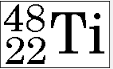
How many protons does this isotope of titanium have?
a)
48
b)
22
c)
26
d)
70
58.

A pure substance

a)

elements

b)

mixtures

c)

compounds

d)

elements and compounds

e)

elements and mixtures

59.

a pure substance made up of only one type of atom and cannot be separated by physical or chemical processes

a)

element

b)

mixture

c)

compound

d)

matter

60.

a substance that is a combination of pure substances but has not undergone a chemical change - it can be separated by physical means

a)

element

b)

mixture

c)

compound

d)

atom

61.

two more atoms of different elements chemically bonded to form a new substance

a)

element

b)

mixture

c)

compound

d)

matter

62.

identify the model

a)

element

b)

compound

c)

mixture of elements

d)

mixture of compounds

e)

mixture of elements and compounds

63.
Boiling point,melting point, and density are some of an element's
a)
pure properties
b)
physical properties
c)
chemical properties
64.
An element's ability to react with acid is an example of a
a)
physical property
b)
melting point
c)
chemical property
65.
Italian Salad Dressing
a)
heterogeneous mixture
b)
homogeneous mixture
66.
Type of mixture that has the SAME COMPOSITION in every part.
a)
Homogenous
b)
Heterogeneous
67.
salt water is a 
a)
compound
b)
element
c)
heterogeneous mixture
d)
solution
68.

A mixture in which 2 or more substances are mixed:

-it can be filtered

-settles into layers over time

-does NOT show the Tyndall effect.

a)

Colloid 

b)
Solution
c)
Suspension 
69.

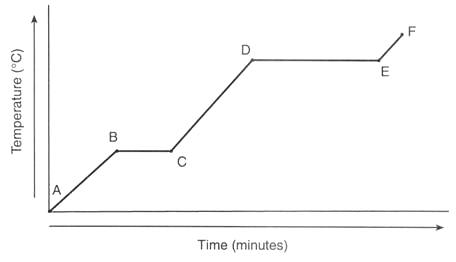
Between which points is the temperature of the substance remaining constant?

a)

A-B only

b)

A-B, C-D, and E-F

c)

B-C only

d)

B-C and D-E

70.

In which region(s) of the heating curve would water be a liquid and a gas at the same time?

a)

A

b)

B

c)

C

d)

D

e)

E

71.
Water exists as a _____________ at 3 mmHg and 50 °C.
a)
solid
b)
liquid
c)
gas
d)
supercritical fluid
72.
What phase change(s) may occur at pressures below 4.58 mmHg?
a)
sublimation/deposition
b)
melting/freezing
c)
all phase changes are possible at these pressures
d)
vaporization/condensation
73.
What change occurs from C to D?
a)
condensation
b)
vaporization
c)
melting
d)
sublimation
74.

A plasma can be made in a laboratory by

a)

cooling a gas to very low temperatures

b)

cooling a gas and reducing the pressure

c)

heating a gas to extremely hot temperatures

d)

heating a liquid to the point it turns into a gas

75.

What is the term for a fluid that thickens under shear force?

a)

Shear thinning fluid

b)

Shear thickening fluid

c)

Newtonian fluid

d)

Non-Newtonian fluid

76.

BEC form when gases are _____________

a)
mixed with liquid nitrogen
b)
cooled to near absolute zero
c)
exposed to high pressure
d)
heated to extreme temperatures
77.

What is a non-Newtonian fluid?

a)
A fluid that is always at room temperature
b)

A fluid that has a viscosity that responds to changed in pressure.

c)

A fluid that has a viscosity that responds to changed in temperature

d)
A fluid that only exists in space
78.
How many lone pairs are in this molecule's structure?
a)
6
b)
2
c)
0
d)
4
79.
According to the octect rule, how many valence electrons do elements need for stability?
a)
18
b)
8
c)
17
d)
0
80.
What is the name of pairs of electrons that do not participate in bonding? 
a)
outer pair
b)
unvalenced pair
c)
lone pair
d)
inner pair
81.

What are the correct formulas and coefficients for the products of the following single-replacement reaction?

Mg + Al(OH)3

a)

No Reaction

b)

Al + Mg(OH)3

c)

Al + Mg(OH)2

d)

MgAl + (OH)3

82.
What is true about an ionic bond?
a)
the nonmetal transfers electrons to the metal
b)
the metal transfers electrons to the nonmetal
c)
no electrons are transferred
d)
both the nonmetal and metal transfer electrons to each other
83.

What is the main reason that ionic compounds have high melting and boiling points?

a)

The covalent bonds within the molecules are very strong.

b)

The ionic bonds create a strong lattice that requires a lot of energy to break.

c)

The molecular structure allows them to vaporize easily.

d)

Ionic compounds do not have high melting and boiling points.

84.

Which of the following compounds is likely to have ionic bonds?

a)

CO2CO_2 (Carbon dioxide)

b)

NaClNaCl (Sodium chloride)

c)

O2O_2 (Oxygen gas)

d)

CH4CH_4 (Methane)