
NEW
Font size
 Worksheets
Climate and Water Systems
Total questions: 60
Worksheet time: 38mins
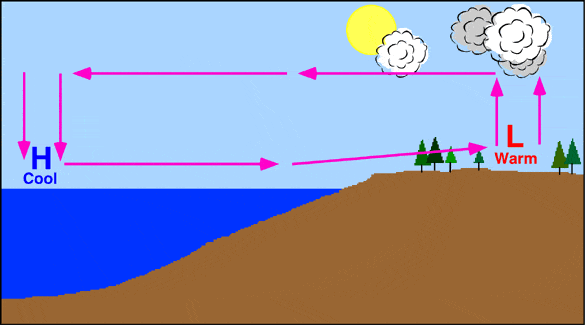
True or False? Inland cities are cooler during the summer and warmer during the winter.
True
False
Convection currents are caused by
lighter, warmer air sinking and pushing cooler, heavier air upward.
cooler, heavier air sinking and pushing lighter, warmer air upward.
an oven.
the ocean.
True or False? Deeper, cooler water moves to the surface, allowing it to absorb more energy from the sun.
True
False
True or False? Water can store energy for a long time.
True
False
True or False? Soil has a higher heat capacity than water.
True
False
In a specific location,
The sun heats the surface during both the day and the night.
The surface cools during both the day and the night.
The surface cools during the day and is heated by the sun during the night.
The surface is heated by the sun during the day and cools off during the night.
True or False? On a given day, in a specific location, the weather can be different from the climate.
True
False
What is the difference between weather and climate?
Weather describes the environmental conditions in a region over many years, whereas climate describes the environmental conditions day to day.
Weather describes the environmental conditions in a region day to day, whereas climate describes the environmental conditions over many years.
Weather describes hot environments, whereas climate describes cold environments.
Weather describes cold environments, whereas climate describes hot environments.
Gravity plays a major role in the global movement of water in which of the following processes?
Water vapor rising into the atmosphere
Water flowing in rivers and streams
The shifting of ocean currents as they strike land
The expansion of water as it turns into ice
Which of the following processes contributes most to the movement of water from land to the atmosphere?
Evaporation
Precipitation
Condensation
Crystallization
When developing a model of the cycling of water between the land, ocean, and atmosphere, one must include the forces that propel the water. For the model, these forces would be which of the following?
Rivers, streams, and tributaries
The polar ice caps and ocean
Plants, animals, and human activity
The Sun’s radiation and gravity

The map of northern California shows some features along with annual rainfall. The information on the map provides evidence that rainfall on land is influenced by –
the temperature of the ocean.
the elevation of the land.
proximity to the Equator.
low pressure systems.

A map of average sea surface temperatures over the entire Earth is provided. Warm water is less dense than cold water. Based on this information and the map provided, it could be predicted that, as a general trend, ocean water will –
rise at the Equator.
be less dense at the poles.
flow from west to east.
be warmer near the continents.

The Canary Current is an ocean current that moves in a southwesterly direction along the northwest edge of Africa. Based on this information, one can predict that the winds above the ocean in this area blow mostly in what direction?
Towards the northwest
Towards the southwest
Towards the southeast
Towards the northeast
The geography of a region affects its weather because the shape of landforms influences –
the amount of sunlight entering the atmosphere.
the survival rate of organisms living there.
the volume of sediment reaching the ocean.
the flow of winds and ocean currents.

Which molecule is most responsible for the adverse effects of pollution and deforestation on Earth's climate?
hydrogen gas
carbon dioxide
ammonia
iron oxide
Michael said to his friends "Pollution and deforestation have no effect on Earth's climate." Which is the most accurate critique of Michael's statement?
Michael is correct. Pollution and deforestation have no effect on Earth's climate.
Michael should be saying something about trash and smoke affecting Earth's climate.
It would be better if Michael talked about the effect of hurricanes and volcanoes on Earth's climate.
Michael would be more accurate to say "Pollution and deforestation are probably contributing to a change in Earth's climate."
Millions of years ago, Earth's continents were in different places than they are today. Which statement is probably true about ocean currents millions of years ago compared with today?
Surface currents and density currents would follow the same routes that they follow today.
Density currents would have different routes, but surface currents would follow the same routes.
Surface currents would have different routes, but density currents would follow the same routes.
Both surface currents and density currents would have different routes.
the location of a source of a material or resource - water
groundwater
reservoir
evaporation
water cycle
the continual movement of water between the land, ocean, and the air
rock cycle
flow of liquid
water cycle
water wheel
water stored below Earth's surface in soil and rock layers
groundwater
evaporation
precipitation
pond
water that is released from clouds in the sky
precipitation
condensation
evaporation
transpiration
water in its gaseous form, when water evaporates
Water vapor
Hydrocone
Water gas
Hydrology
the properties of the atmosphere at a given time and location, including temperature, air movement and precipitation
Climate
Atmosphere
Weather
Condensation
the current or past long-term weather conditions characteristic of a region or the entire Earth.
Climate
Weather
Radiation
Atmosphere
Water vapor in the atmosphere is called
humidity
condensation
evaporation
precipitation
What would you expect to happen to the air presure as a storm approaches?
It would increase
It would decrease
It would remain steady
It would increase and decrease wildly
The element of weather that is caused by difference in air pressure between two air masses is
drought
humidity
wind
fog
When you go higher in altitude, air pressure
increases
decreases
remains steady
changes randomly
Stormy weather comes with a
Sunny skies comes with a

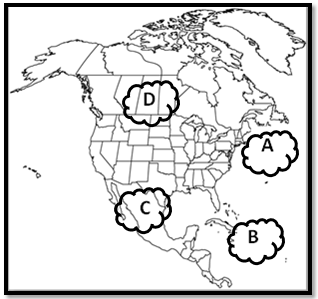
What type of front is shown?
Warm Front
Cold Front
Occluded Front
Stationary Front
What is a Tornado?
A thunderstorm cloud that drops ice balls.
When two tectonic plates hit and the earth starts to shake.
When lava starts to erupt from a cone.
A rapid whirling funnel shaped cloud
What kind of weather happens during a cold front?
Clear skies, temp. hot
Rain or thunderstorms
Clear skies, temp. warms
Clear skies, temp. cools
Which way do high pressure systems rotate?
North to south
South to north
Clockwise
Counter clockwise

Which Climate Zone is the arrow pointing to?
Polar
Temperate
Tropical

This instrument allows students to determine which weather property?
Air temperature
Relative humidity
Wind speed
Wind direction
A student writes the following statement in a journal: "it was 84° at 3 p.m. on Tuesday in the schoolyard." This statement BEST describes which system?
Local weather
Local climate
Regional weather
Regional climate
Sustainability is
being able to meet the needs of the present without compromising the ability of future generations to meet their own needs
a note that is held for a duration of time
recycling, as though "facilities exist" when in reality most of the things we recycle end up in the garbage because recycling facilities are sparse. We do not hold companies responsible for their packaging
caring only about my needs and vowing to take action when the lack of finite resources begins to effect me
Water treatment is
treating water fairly
a process used in spas in which water is used to plump the skin
the process of removing potentially dangerous substances from water to make it more acceptable for a desired end-use
the process of adding potentially dangerous substances to water to make it less acceptable for a desired end-use
A Glacier is
a large piece of ice
a river of ice, formed from snow accumulated over hundreds of years, that moves slowly downhill under the force of gravity
the French word for ice cream
a made up term that "Scientists" use when talking about their Global Warming conspiracies
An Icecap is
a large area of ice that permanently covers land
a river of ice, formed from snow accumulated over hundreds of years, that moves slowly downhill under the force of gravity
a drink from Tim Hortons
the top of a mountain
Precipitation is
leaving your work to the last minute
solid or liquid water that floats into space
solid or liquid water that stays in the atmosphere as clouds
solid or liquid water that falls to Earth’s surface
Aquifer is
a geological formation of water
a geological formation of loose rock or soil that is saturated with groundwater
a geological formation of fur from prehistoric creatures
a geological formation of solid rock through which water cannot flow
Groundwater
water that seeps through soil and cracks in rock; source of water for underground springs and wells
comes out of its hole once per year and it it sees its shadow, spring will come early
water that stays on the ground
water that is created by grinding stones
Runoff
water from icebergs and snowmelt that flows over Earth’s surface
water from the perspiration of a group of marathon runners that flows over Earth’s surface
water from precipitation and tears that flows over Earth’s surface
water from precipitation and snowmelt that flows over Earth’s surface
What percentage of Earth is covered in water?
97%
90%
3%
93%
Sources of salt water on Earth include lakes, rivers and streams.
True
False
Approximately how much of the Earth is covered in fresh water?
5%
1%
3%
2%
Most of Earth's fresh water is in the form of...
Ice
Lakes
Ponds
Rivers
because of the effect they can have on the environment.
Which of the following is a possible negative effect of the use
of these chemicals on the environment?
These chemicals are expensive to produce.

