
 Worksheets
Operation of Galvanic Cell
Total questions: 10
Worksheet time: 17mins
Oxidation occurs at the...
anode
cathode
Reduction occurs at the...
anode
cathode
Consider the galvanic cell reaction Zn (s) + Cu2+ (aq) → Cu (s) + Zn2+ (aq). When the cell is running spontaneously, which is the only true statement?
The copper electrode loses mass and the zinc electrode is the cathode.
The copper electrode gains mass and the copper electrode is the cathode.
The zinc electrode gains mass and the zinc electrode is the anode.
The zinc electrode loses mass and the zinc electrode is the cathode.
In any Galvanic Cell, which half cell will undergo reduction?
The half cell with the lower standard electrode potential
The half cell with the higher standard electrode potential

For this cell, the
electrons will flow from the aluminium to the hydrogen half-cell.
aluminium electrode will be the positive anode.
concentration of aluminium ions in solution will be falling.
hydrogen half-cell will be the negative cathode.

For this cell, the overall equation will be
2Al(s) + 3H2(g) → 2Al3+(aq) + 6H+(aq)
3Cl-(aq) + Al(s) → AlCl3(aq)
2Al3+(aq) + 3H2(g) → 2Al(s) + 6H+(aq)
2Al(s) + 6H+(aq) → 2Al3+ (aq) + 3H2(g)
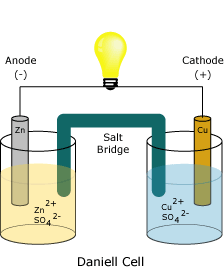
In the above Galvanic Cell, which half cell is undergoing reduction?
Cu | Cu2+
Zn | Zn2+

Which changes could take place at positive electrode in a voltaic cell?
I and II
I and III
II and III
I, II and III
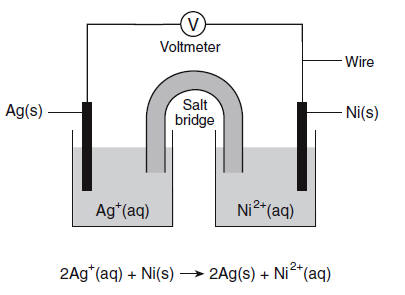
What reaction occurs at the anode?
Ag+ (aq) + e- →Ag (s)
Ag (s) → Ag+ (aq) + e-
Ni2+ (aq) + 2e- → Ni (s)
Ni (s) → Ni2+ (aq) + 2e-
In a voltaic cell, the salt bridge is necessary for
the movement of electrons to create a current.
the movement of ions to create a current.
the movement of electrons and maintain the electrical neutrality of solution.
the movement of ions and maintain the electrical neutrality of solution.

