wayground logo

Free Printable Worksheets

NEW

Font size

S
M
L
XL
Worksheets

Unit 5 Lesson 2: Mendel and Heredity

Total questions: 36

Worksheet time: 36mins

Name
Class
Date
1.

The likelihood that a specific event will occur:

a)

accountability

b)

dominant

c)

probability

d)

recessive

2.

When the two alleles of a particular gene are different:

a)

heterozygous

b)

homozygous

c)

genotype

d)

phenotype

3.

The set of alleles that an individual has:

a)

heterozygous

b)

phenotype

c)

homozygous

d)

genotype

4.

A diagram used to predict the outcomes of a genetic cross:

a)

karyotype

b)

Punnett Square

c)

Pedigree

d)

Venn diagram

5.

The allele that is not expressed when the dominant corresponding allele is present:

a)

dominant

b)

heterozygous

c)

recessive

d)

homozygous

6.

A version of a gene:

a)

allele

b)

trait

c)

character

d)

generation

7.

When the two alleles of a particular gene are the same:

a)

homozygous

b)

genotype

c)

heterozygous

d)

phenotype

8.

Dominant alleles are represented with a:

a)

capital letter

b)

lower case letter

c)

shape

d)

symbol

9.

A detectable trait or traits that result from the genotype such as color, shape, etc:

a)

genotype

b)

homozygous

c)

heterozygous

d)

phenotype

10.

The passing of genetic traits from parents to offspring:

a)

geneology

b)

heredity

c)

cellology

d)

physiology

11.

What is the scientific study of heredity?

a)

Genetics

b)

Epistemology

c)

Pathology

d)

Podiatry

12.

Organisms with 2 different alleles for a trait is known as...

a)

Dominant

b)

Recessive

c)

Homozygous

d)

Hybrid

13.

Which is the term for a section of a DNA molecule that carries information for traits such as hair and eye color?

a)

gene

b)

offspring

c)

dominant trait

d)

recessive trait

14.
If a pea plant were homozygous recessive for height, how would its alleles be represented?
a)
TT
b)
Tt
c)
tt
d)
tT
15.
Mendel's law of segregation states that during meiosis, the alleles that control each trait separate, and only _________________ from each pair is/are passed to the offspring
a)
one allele
b)
the dominant trait
c)
two alleles
d)
the recessive trait
16.
A couple has two children, both of whom are girls. What is the likelihood that their 3rd child will be a girl?
a)
0%
b)
25%
c)
50%
d)
100%
17.
What would the phenotype be for the offsprings?  T is dominant for tall pea plants
a)
50% tall, 50% short
b)
25% tall, 75% short
c)
100%  tall, 0% short
d)
75% tall, 25% short
18.
In mussels, the allele for brown coloring (B) is dominant, and the allele for blue coloring(b) is recessive. For which parental genotypes are 100% of the offspring expected to be blue?
a)
BbxBb
b)
bbxbb
c)
BBxbb
d)
BBxBB
19.
In guinea pigs, the alleles for black hair(B) is dominant to the allele for brown hair(b). Two black-haired guinea pigs are crossed. One of the pigs is homozygous for black hair and one is heterozygous. What percentage of their offspring are expected to have black hair? Create a  punnett square.
a)
25%
b)
50%
c)
75%
d)
100%
20.
T - tall and t = short
In the punnett square below, what belongs in the missing square
a)
tt
b)
Tt
c)
Bb
d)
TT
21.
Which of the following crosses will yield only homozygous recessive offspring?
a)
RRYY x RRYY
b)
RrYy x RrYy
c)
rryy x rryy
d)
RrYy x rryy
22.

Why do complex organisms have an even number of chromosomes?

a)

Genes are present in even numbers

b)

Organisms get one chromosome from each parent

c)

Organisms are made up of an even number of cells

d)

It is just by chance

e)

it is just by luck.

23.

Which of the these is homozygous?

a)

gg

b)

Yy

c)

Nn

d)

Ee

24.
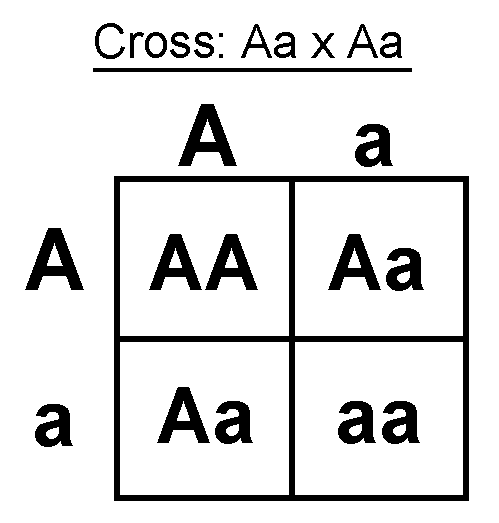
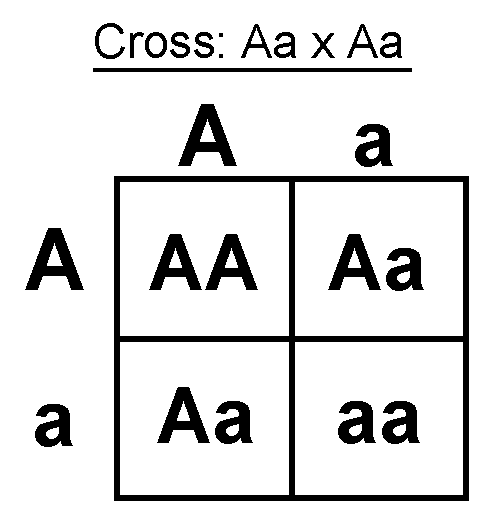
What is the probability of heterozygous offspring?
a)
25%
b)
50%
c)
0%
d)
100%
25.
What allele combination should go in the missing box?
a)
AA
b)
Aa
c)
aa
d)
none of these
26.
What is the phenotype of the offspring? (A-Brown hair; a-blond hair) 
a)
50 % Brown Hair and 50% Blond Hair 
b)
25 % Brown Hair and 75% Blond Hair 
c)
75 % Brown Hair and 25% Blond Hair 
d)
0% Brown Hair and 100% Blond Hair 
27.

If you know that long hair (H) is dominant to short hair (h) and are shown this picture, can you say if this guinea pig is Hh or HH?

a)

No, Hh and HH have the same phenotype

b)

No, this guinea pig would be hh

c)

Yes, Hh and HH will look different

28.

What is the probability of Aa?

a)

50%

b)

100%

c)

25%

d)

0%

29.

If brown (B) is dominant to blue (b), what are the possible phenotype(s) of this cross?

a)

Brown and blue

b)

Bb and bb

c)

Brown

d)

Bb

30.

These parents are

a)

Homozygous

b)

Heterozygous

c)

The same

d)

Heterozygous

31.

What is the genotypic ratio of the offspring?

a)

3 AA : 1 aa

b)

1 AA : 3 aa

c)

1 AA : 2 Aa : 1 aa

d)

2 AA : 2 aa

32.

What are the phenotype percentages of the offspring?

(A-Brown fur color; a-white fur color)

a)

50 % Brown fur and 50% White fur

b)

25 % Brown fur and 75% White fur

c)

75 % Brown fur and 25% White fur

d)

0% Brown fur and 100% White fur

33.
What percent of offspring will have the recessive trait?
a)
25
b)
50
c)
75
d)
100
34.
What is the probability of homozygous dominant offspring?
a)
0%
b)
100%
c)
50%
d)
25%
35.
A heterozygous long-tusked elephant is crossed with a homozygous recessive short-tusked elephant. What is the probability of the offspring having short tusks?
a)
0%
b)
25%
c)
50%
d)
75%
36.

Long tongues (T) are dominant to short tongues (t) in green tree frogs. What is the probability that two frogs that are heterozygous for long tongues could produce offspring with short tongues?

a)

100%

b)

75%

c)

50%

d)

25%