wayground logo

Free Printable Worksheets

Font size

S
M
L
XL
Worksheets

Major Test: Simple Machines

Total questions: 68

Worksheet time: 3hrs 45mins

Name
Class
Date
1.
Which is not a type of simple machine?
a)
spring
b)
screw
c)
pulley
d)
wedge
2.
work is...
a)
energy from the sun
b)
a type of machine
c)
a force that moves an object
d)
a force that pulls you toward the earh
3.
What type of simple machine is found on the cap of a pickle jar?
a)
lever
b)
inclined plane
c)
pulley
d)
screw
4.
Which of these is not an example of an inclined plane?
a)
ladder
b)
stairs
c)
wall
d)
driveway
5.
Which is an example of someone using a simple machine to do work?
a)
a boy runs across a football field
b)
a banker counts money
c)
a mother pushes a stroller up a ramp
d)
a girl eats a sandwich
6.
Jan is using a screwdriver, which is a type of ...
a)
a pulley
b)
a screw
c)
a lever
d)
a wheel and axle
7.
Which is a characteristic of a simple machine?
a)
They run on electricity.
b)
They take a long time to make.
c)
They have few or no moving parts.
d)
They are not very large.
8.
Which type of simple machine would be found on the bottom of a wagon??
a)
a pulley
b)
a screw
c)
a wedge
d)
a wheel and axle
9.
A ramp.
a)
Lever
b)
Inclined Plane
c)
Wedge
d)
Screw
10.
What type of simple machine is shown here?
a)
Pulley
b)
Wheel and Axle
c)
Lever
d)
Wedge
11.
Something similar to a see-saw that can lift an object.
a)
Wedge
b)
Screw
c)
Lever
d)
Wheel and Axle
12.
Mechanical Advantage:  To increase or decrease the applied force.
a)
Lever
b)
Pulley
c)
Wheel and Axle
d)
Screw
13.
Mechanical Advantage:  To move objects to a greater height.
a)
Pulley
b)
Wedge
c)
Lever
d)
Inclined Plane
14.
Mechanical Advantage:  To hold things together or to lift an object.
a)
Screw
b)
Pulley
c)
Wedge
d)
Wheel and Axle
15.
Mechanical Advantage:  To change the direction of a force.
a)
Wedge
b)
Pulley
c)
Screw
d)
Wheel and Axle
16.
Something that can split an object apart.
a)
Wedge
b)
Pulley
c)
Screw
d)
Wheel and Axle
17.
Something that can hold things together or lift an object.
a)
Wheel and Axle
b)
Lever
c)
Screw
d)
Pulley
18.
Stairs
a)
wedge
b)
pulley
c)
inclined plane
d)
wheel and axle
19.
Name this simple machine. 
a)
Pulley
b)
Wheel and Axle
c)
Inclined Plane
d)
Lever
20.
Name this simple machine.
a)
Lever
b)
Wedge
c)
Pulley
d)
Inclined Plane
21.
Name this simple machine. 
a)
Screw
b)
Lever
c)
Pulley
d)
Wedge
22.

What is effort (input) force?

a)

the force one exerts on a machine

b)

the force which an effort force must overcome in order to do work on an object via a simple machine.

c)

the force the machine exerts on a object

d)

the output work times the input distance

23.

A box of weight W is lifted by a force F using a lever as shown below.

What is the mechanical advantage of the lever (MA=Input Distance/Output Distance)?

a)

0.5

b)

2

c)

3

d)

6

24.

Using a lever, Joe is able to lift a 10,000 N car off of the ground with a force of 1000 N. What is the mechanical advantage of the lever (MA=Output Force/Input Force)?

a)

1

b)

10

c)

100

d)

1000

25.
if a load of a lever is 100 newtons and the force you apply is 20 newtons, what is your mechanical advantage?
a)
120 N
b)
5 N
c)
2000 N
d)
80 N
26.

The mechanical advantage of this inclined plane is...(MA=Resistance Force/Effort Force)

a)

2.4

b)

3.4

c)

4.4

27.
The amount by which a machine multiplies input force is known as the 
a)
work.
b)
power.
c)
output force.
d)
mechanical advantage.
28.
Jeff is a landscaping contractor and lifts a rock weighing 600 pounds by wedging a board under the rock. Jeff weighs 150 pounds and puts all of his weight on the lever. How much mechanical advantage did the lever provide to Jeff in lifting the rock?
a)
0
b)
2
c)
4
d)
8
29.

Which of the lever would it take less force to lift?

a)

Lever A

b)

Lever B

30.

How much effort would it take to lift Lever A?

a)

60 N

b)

50N

c)

40 N

d)

30 N

31.

How much effort would it take to lift Lever B?

a)

60 N

b)

50 N

c)

40 N

d)

30 N

32.

What is mechanical advantage?

a)

The advantage a machine has over a bicycle

b)

A measure of how much a simple machine reduces work

c)

A measure of when is the best time to use a simple machine

d)

the number of times a machine increases input force

33.

What is effort (input) force?

a)

the force one exerts on a machine

b)

the force which an effort force must overcome in order to do work on an object via a simple machine.

c)

the force the machine exerts on a object

d)

the output work times the input distance

34.

What is resistance (output) force?

a)

the force required by a machine in order to accomplish work (the force you put on the machine)

b)

The force that is exerted by a machine

c)

the force the machine exerts on a object

d)

the output work times the input distance

35.

What is effort (input) distance?

a)

the force required by a machine in order to accomplish work (the force you put on the machine)

b)

the force which an effort force must overcome in order to do work on an object via a simple machine.

c)

the distance an input force acts through

d)

the output work times the input distance

36.

What is resistance (output) distance?

a)

the force required by a machine in order to accomplish work (the force you put on the machine)

b)

the force which an effort force must overcome in order to do work on an object via a simple machine.

c)

the distance an input force moves a machine

d)

the distance through which the output force is exerted

37.
What is the efficiency of a machine if 55.3 J of work are done on the machine, but only 14.3 J is produced by the 1machine?
a)
0.25 J
b)
26%
c)
386%
d)
3.86 J
38.
What is the efficiency of the machine if the input is 263 J and the output is 142 J? 
a)
6.26%
b)
54%
c)
100%
d)
260%
39.
What is the mechanical advantage for the inclined plane?
a)
5
b)
1/5
c)
45
d)
17
40.
What is the efficiency of a machine if 55.3 J of work are done on the machine, but only 14.3 J is produced by the 1machine?
a)
0.25 J
b)
26%
c)
386%
d)
3.86 J
41.
What is the efficiency of the machine if the input is 263 J and the output is 142 J? 
a)
6.26%
b)
54%
c)
100%
d)
260%
42.
A machine has a work output of 8 joules and requires 10 joules of work input to operate. What is the machine's efficiency?
a)
8 J
b)
10 J
c)
80%
d)
800%
43.
What is the efficiency of a machine that has work input of 40 joules and work output of 35 joules?
a)
87.50%
b)
1200
c)
1.142
d)
114%
44.
Work output of a large machine in a factory is 89,000 Joules, and its input is 102,000 joules. Work output of a similar machine is 92,000 joules, and its work input is 104,000 joules. Which machine has greater efficiency?
a)
The first machine
b)
The second machine
c)
Not enough information provided
45.
What is the mechanical efficiency of a machine whose work input is 250 J and work output is 30 Joules??
a)
12 % ME
b)
83 % ME 
c)
.12 % ME 
d)
.83% ME 
46.
A girl on a motorbike passes by at a speed of 15 m/s. Her mass is 40 kg. What is her kinetic energy
a)
300 Joules
b)
600 Joules
c)
950 Joules
d)
4500 Joules
47.
Calculate the potential energy of a roller coaster at the top of a 72 m hill that has a mass of 112 kg.
a)
79,027 J
b)
790,720 J
c)
7,020 J
d)
790,700 J
48.
At what position does the pendulum have the greatest gravitational potential energy?
a)
Position D
b)
Position C
c)
Position B
49.
At what position does the pendulum have the greatest kinetic energy?
a)
Position D
b)
Position C
c)
Position B
50.
Which character has the greatest gravitational potential energy?
a)
Character A
b)
Character B
c)
Character C
d)
Character D
51.
Which skier has the greatest kinetic energy?
a)
Skier A
b)
Skier B
c)
Skier C
d)
Skier D
52.
Calculate the kinetic energy of a 2 kg rock that rolls down the hill with a velocity of 8 m/s.
a)
64 Joules
b)
16 Joules
c)
128 Joules
d)
8 Joules
53.
Calculate the kinetic energy of a truck that has a mass of 2900 kg and is moving at 55 m/s.
a)
4,386,250 J
b)
159,500 J
c)
79,750 J
d)
8,772,500
54.
Barry Bonds swings a bat which has a mass of 1.5 kg at a velocity of 55 m/s. How many joules of kinetic energy could he give to a baseball?
a)
2269 Joules
b)
83 Joules
c)
41 Joules
d)
4 Joules
55.

Which of the following is the best example of work being done.

a)

doing homework

b)

lifting a box

c)

pushing a stationary box

d)

holding a box

56.
Work is done when a weightlifter holds a barbell still above his head.
a)
True
b)
False
57.

You push against the back of your friends car that is stuck. You push and be become very tired, but the car does not move. Did you do work?

a)

Yes, work was done

b)

No, work wasn't done

58.

What would 54N be an example of?

a)

work

b)

power

c)

distance

d)

force

59.

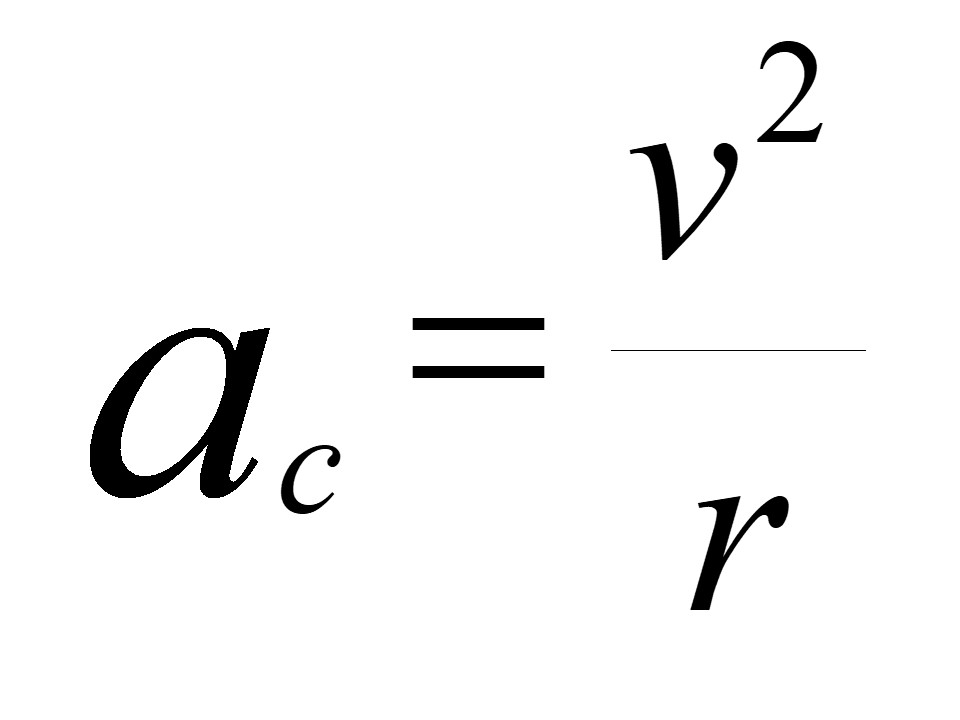
What's the centripetal acceleration of an object traveling 2.3 m/s around a circle of diameter 0.6 m?

a)

5 m/s2

b)

17.63 m/s2

c)

10 m/s2

d)

8.81 m/s2

60.
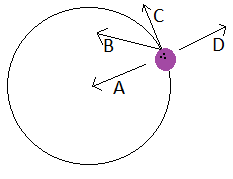
Which represents the acceleration of the ball?
a)
A
b)
B
c)
C
d)
D
61.
Centripetal acceleration is ...
a)
Acceleration toward the center of a curved or circular path
b)
Acceleration toward the outside of a circle
c)
Vertical motion instead of horizontal motion
62.
Which of the following is the unit for centripetal force?
a)
J
b)
m/s2
c)
kg⋅m/s
d)
N
63.
When a car goes around a circular curve on a horizontal road at constant speed, what force causes it to follow the circular path?
a)
the normal force from the road
b)
gravity
c)
the friction force from the road
d)
No force causes the car to do this because the car is traveling at constant speed and therefore has no acceleration.
64.
Which of the following is not a centripetal force?
a)
tension
b)
rotational
c)
normal force
d)
friction
65.
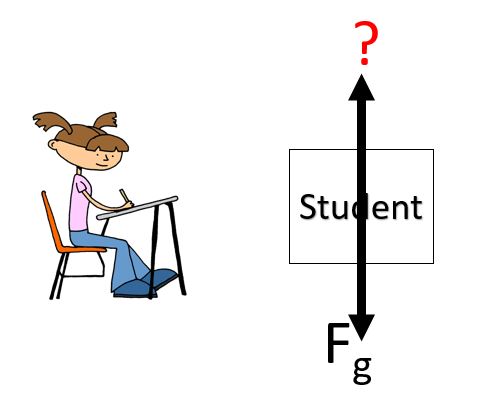
Name the missing force....
a)
weight force
b)
normal force
c)
frictional force
d)
tension force
66.

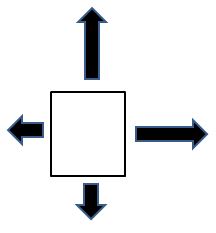
This object would be moving (pick all that are correct):

a)

up

b)

down

c)

left

d)

right

67.

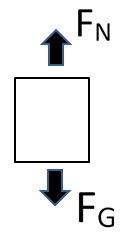
The down-arrow in this diagram is most-likely:

a)

gravity

b)

normal

c)

a push or pull

d)

friction

68.

Which of the following is true about this free-body diagram?

a)

the forces are are balanced

b)

the object is free-falling

c)

the object is moving upward

d)

the forces are unbalanced