
 Worksheets
PE/KE/Work/Power/ and Force Diagrams
Total questions: 73
Worksheet time: 52mins
What is stored energy due to position above the ground?
kinetic energy
potential energy
thermal energy
nuclear energy
What is energy due to motion?
kinetic energy
potential energy
thermal energy
nuclear energy
What is the sum of kinetic energy and potential energy of a system?
mechanical energy
electrical energy
moving energy
nuclear energy

Where does the pendulum have the greatest kinetic energy?
A
B
C
D
E
Where does the pendulum have the least amount of potential energy?
A
B
C
D
E
Where does the pendulum have the greatest potential energy? (pick 2)
A
B
C
D
E
Where does the pendulum stop moving for just a split second so that it's kinetic energy is zero? (pick 2)
A
B
C
D
E
Where does the pendulum have the same amount of kinetic energy and potential energy? (pick 2)
A
B
C
D
E

Where is potential energy at its maximum?
a
b
c
d
Where is kinetic energy at its maximum?
a
b
c
d
Where is potential energy changing to kinetic energy?
a
b
c
d

What is the kinetic energy at W, where the car is stopped?
0J
10,000J
20,000J
can not be determined
What is the mechanical energy of the system? (ignore friction)
0J
10,000J
20,000J
can not be determined
What is the kinetic energy at position X? (ignore friction)
0J
1,000J
19,000J
can not be determined
What is the kinetic energy at position Y? (ignore friction)
0J
10,000J
20,000J
can not be determined
You do work only when you exert a force on an object and move it
Which of the following is the best example of work being done.
doing homework
lifting a box
pushing a stationary box
holding a box
W=5000 Joules
t=???
The sum of all forces acting on an object and direction is called the
Balanced Force
Net Force
Unbalanced Force
Contact Force
Forces have both ________ and direction.
Magnitude
Speed
Gravity
Height
A Newton is a unit of ______.
Acceleration
Inertia
Force
Velocity

Name the missing force.
Gravitational Force
Normal Force
Friction Force
Applied Force

Name the missing force.
Normal Force
Push/Pull Force
Friction Force
Tension Force

Name the missing force.
Normal Force
Friction Force
Gravitational Force
Push/Pull Force

Name the missing force.
Gravitational Force
Normal Force
Tension Force
Friction Force
The force that keeps objects on top of surfaces instead of letting them sink into the surface is known as:
Normal Force
Gravitational Force
Friction Force
Air resistance

This diagram can be used to indicate which of the following? (TWO correct answers)
An object at rest
An object accelerating
An object decelerating
an object moving at a constant velocity (speed)
(Trick question -- there is only one correct answer)

Which of the following is true about this free-body diagram?
the forces are balanced
the object is moving upward
the object is free-falling
the forces are unbalanced
A leftward force is applied to a crate to push it across the floor at a constant speed. Which is the correct force diagram?


A rightward force is applied to a dresser to accelerate it to the right across the bedroom floor.


When the net force is EQUAL to zero, the forces are:
balanced
unbalanced
nonexistent
When the net force is NOT EQUAL to zero, the forces are:
balanced
unbalanced
cancelled
When the forces are balanced there is no change in motion or direction
True
False
Net force is defined as:
all the forces on acting on an object combined
the forward force on an object
the upward force on an object
When forces are going in the SAME direction you
add them
subtract them
multiply them
divide them
When forces are going in the OPPOSITE direction you
add them
subtract them
multiply them
divide them
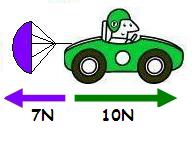
What is the net force?
3 N
3 N, right
17 N, right
3 N, left

What is the net force?
20 N, right
0 N, no movement
400 N, right
40 N, right
Mr. O'Dell has a mass of 86 kg and is standing on a diving platform 27 meters high. What will be his maximum velocity right as he enters the water?
529 m/s
23.02 m/s
20 m/s
520 m/s
Mr. O'Dell has a mass of 86 kg and is standing on a diving platform 27 meters high. What will be his Kinetic Energy half way down?
11389.41
22778.82
11389.41 J
22778.82 J
Match the following
The rate at which velocy changes
acceleration
Net force is equal to 0 N
Balanced Forces
Net force is greater than 0 N
unbalanced force
A unit of force
Newton
Total force acting on an object and its direction
Net Force


Ted is trying to move a fridge through his house, he gets stuck on a carpet and even though he is pushing the fridge, it is not moving. What force is acting against him?
gravity
friction
applied force
normal force
A push or pull exerted on an object is called a(n):
Force
Net force
Momentum
Speed
In a force diagram the sizer or length of the arrow tells you:
the strength of the force
the distance of the force
the direction of the force
When determining the NET force on an object you should (TWO correct answers):
subtract forces in opposite directions
add forces in the same direction
subtract forces in the same direction
add forces in the opposite direction
multiply the forces in the same direction
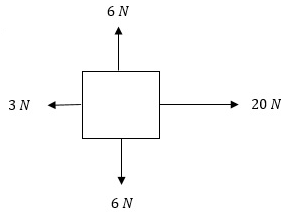
What is the NET FORCE of this diagram?
17 N, right
17 N, left
23 N, right
12 N, up

This ball sits at the top of the hill and later gets pushed down. For letter B (halfway down) on this diagram, how much POTENTIAL energy does the ball have? Answer with a NUMBER, not a word.
(a)
This ball sits at the top of the hill and later gets pushed down. For letter A on this diagram, how much KINETIC energy does the ball have? Answer with a NUMBER, not a word.
(a)
The faster an object moves, the _____ kinetic energy it has.
more
less
none of the above
all of the above
How could you increase the gravitational potential energy of an object without changing its mass and gravity?
Make the object larger
Lower the object towards the ground
Raise the object farther off the ground
Allow the object to roll on the ground

What is the KE of a 0.8 kg football that is kicked at a velocity of 10m/s?
80 J
3.2 J
160 J
40 J

What two factors affect an object's kinetic energy (KE)?
area and volume
mass and weight
weight and height
mass and speed

Where would this tossed baseball have the least amount of kinetic energy?
point W
point X
point y
point z

Clyde and Marilyn are riding a roller coaster. During which section(s) of the track is their kinetic energy converted to potential energy?
from point B to point D only
from point A to point B and from point C to point D
from point A to point B only
from point B to point C only

The rock in the picture is pushed over the edge and it begins to fall. Which type of energy conversion is taking place?
mechanical to heat
sound to mechanical
potential to kinetic
kinetic to potential

What is the GPE of the 3N blue marble at point A? (GPE = weight x height)
15 Joules
9.6 J
6 Newtons

Total Mechanical Energy (ME) = PE + KE. What is NOT true about the ME of the snowboarder?
The ME = 50,000J at every single point
The total ME energy is the same - energy is neither created nor destroyed
ME decreases as the snowboarder reaches the bottom

