
 Worksheets
H Disease & DNA Replication
Total questions: 70
Worksheet time: 2hrs 1mins
Drag the correct labels to each section of the diagram for a nucleotide of DNA.
Nitrogenous Base
Phosphate
Deoxyribose
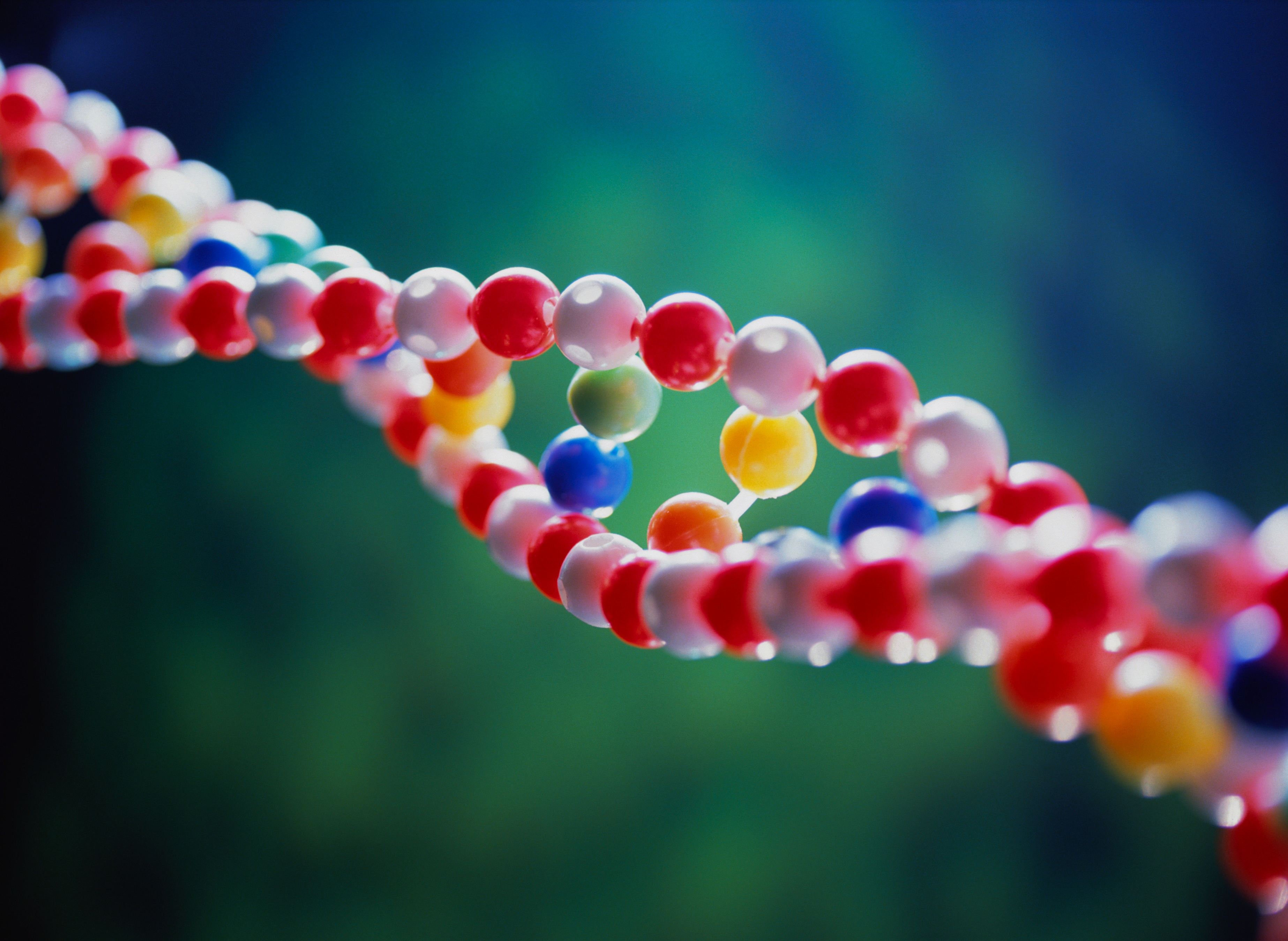
What are the 4 nitrogenous bases in DNA?
adenine, thymine, cytosine, and uracil
adenine, uracil, cytosine, and guanine
(a) forms the sides (backbone) of the DNA ladder.
DNA is usually found in the (a) (organelle) of a cell.

In a molecule of double-stranded DNA, the amount of Adenine present is always equal to the amount of (a) .
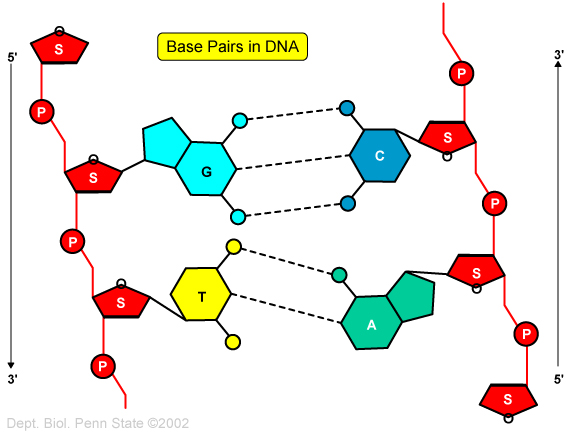
Nitrogenous bases are joined together by what type of bond?
(a)

Replicate the following strand of DNA:
AATCATGGA
(a)
The enzyme that unzips the DNA to prepare for replication is (a) .

The order of replication is (a) .

The enzyme that joins the Okazaki fragments in the lagging strand is (a) .

This picture is illustrating the (a) nature of DNA.
The strand of DNA that is replicated continuously from 5' to 3' is known as (a)
If the percentage of DNA is made of 30% Thymine, the correct percentage of Guanine is (a) .
The enzyme responsible for adding the RNA primer to the template strand is (a) .

Chromosomes are composed of (a) .
What enzyme keeps DNA from overwinding ahead of replication forks?
Primase
Topoisomerase
Single-Stand Binding Protein
Helicase
The primer is composed of _____.
amino acids
RNA only
DNA only
RNA and DNA
How do the leading and the lagging strands differ?
The leading strand is synthesized in the same direction as the movement of the replication fork, and the lagging strand is synthesized in the opposite direction.
The leading strand is synthesized at twice the rate of the lagging strand.
The leading strand is synthesized in short fragments that are ultimately stitched together, whereas the lagging strand is synthesized continuously.
The leading strand is synthesized by adding nucleotides to the 3' end of the growing strand, and the lagging strand is synthesized by adding nucleotides to the 5? end.
If a portion of DNA strand reads:
3' A A A T T T C 5'
The matching strand would read (a) .
(a) is not an enzyme used in replication.
The (a) strand is made in short fragments during DNA replication


Which of the following help(s) to hold the DNA strands apart while they are being replicated?
single-strand DNA binding proteins
Topoisomerase
primase
DNA ligase
The correct match for polarity, the ending molecule, and the strand name is (a)
In which direction do enzymes (a) ?
In which direction to enzymes build new strands?
5'-3'
3'-5'
3'-3'
5'-5'
The disc shaped protein core that DNA wraps around is called (a)
Place the following in sequential order: 1. Recoil, 2. Straightens the double helix, 3. Breaks Hydrogen bonds, 4. Adds Free nucleotides. The correct sequence is (a) .
What is the role of DNA ligase in the replication of DNA?
It helps in unwinding the DNA helix
It joins the Okazaki fragments on the lagging strand
It adds nucleotides to the growing DNA strand
It prevents the reannealing of DNA strands
What is the function of the enzyme primase in DNA replication?
It unwinds the DNA double helix
It synthesizes a short RNA primer
It joins the Okazaki fragments
It adds nucleotides to the growing DNA strand
What is the role of the enzyme helicase in the process of DNA replication?
It synthesizes a short RNA primer
It unwinds the DNA double helix
It joins the Okazaki fragments
It adds nucleotides to the growing DNA strand
What is the function of the enzyme topoisomerase in DNA replication?
It unwinds the DNA double helix
It synthesizes a short RNA primer
It relieves strain in the DNA ahead of the replication fork
It adds nucleotides to the growing DNA strand
Decide if the descriptions best fit DNA, RNA, or both.
Made of nucleotides
Type of nucleic acid
Single stranded
Short
A, U, C, G
Ribose
Double stranded
Long
A, C, T, G
Deoxyribose
If a DNA molecule has 30% Guanine bases, how many Cytosine bases will it have?
30%
25%
20%
10%
If a person suffered from a disorder where their DNA fragments were unable to fill in the missing slots in between the fragments of the lagging strand, they would most likely have a disorder that affected which enzyme?
DNA Helicase
DNA Ligase
DNA polyermase
RNA Polymerase
If a person suffered from a disorder where their DNA fragments were unable to fill in the missing slots in between the fragments of the lagging strand, they would most likely have a disorder that affected which enzyme?
DNA Helicase
DNA Ligase
DNA polyermase
RNA Polymerase

Which letter in the picture below depicts the replication fork in DNA replication?
A
C
B
None of the above

The picture below shows an enzyme unwinding and unzipping DNA.
What is the name of this enzyme?
DNA Helicase
DNA Ligase
DNA polyermase
RNA Polymerase
The twisted ladder shape of DNA is known as a
Double Helix
Triple Helix
Single Helix
Double felix

nucleotide
A and T are connected by (a) in DNA and G and C are connected by (b) .
What is the primary function of DNA polymerase during DNA replication?
To unwind the DNA double helix
To synthesize a new DNA strand by adding nucleotides
To join Okazaki fragments
To prevent DNA strands from reannealing
Which of the following statements about the lagging strand during DNA replication is true?
It is synthesized continuously
It is synthesized in short segments called Okazaki fragments
It is synthesized in the 3' to 5' direction
It requires no RNA primers
What is the role of topoisomerase in DNA replication?
To hold the DNA strands apart
To synthesize RNA primers
To relieve the strain caused by unwinding of the DNA helix
To add nucleotides to the growing DNA strand
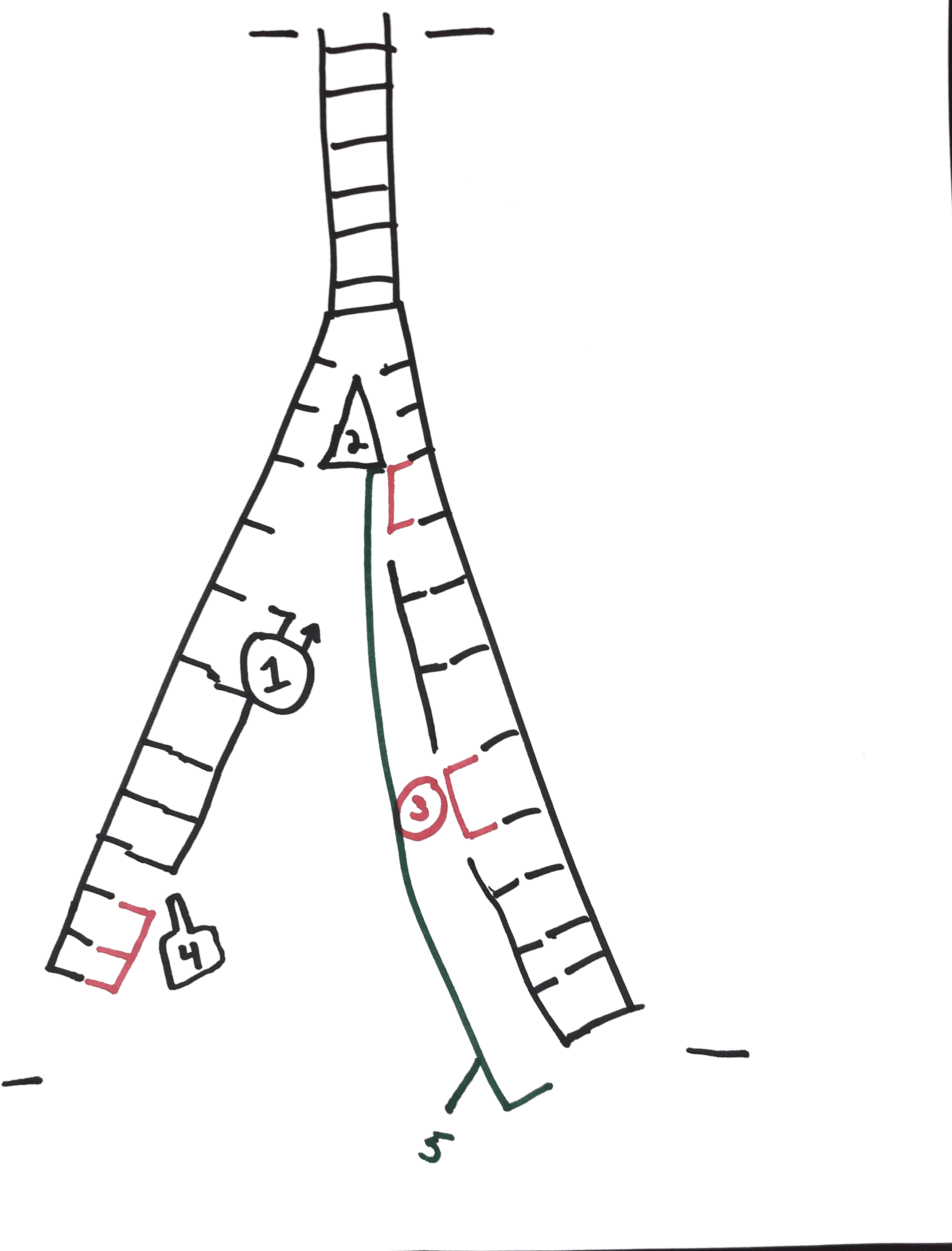
Number 1 in the picture above
Replication
DNA Polymerase
Primase
Ligase
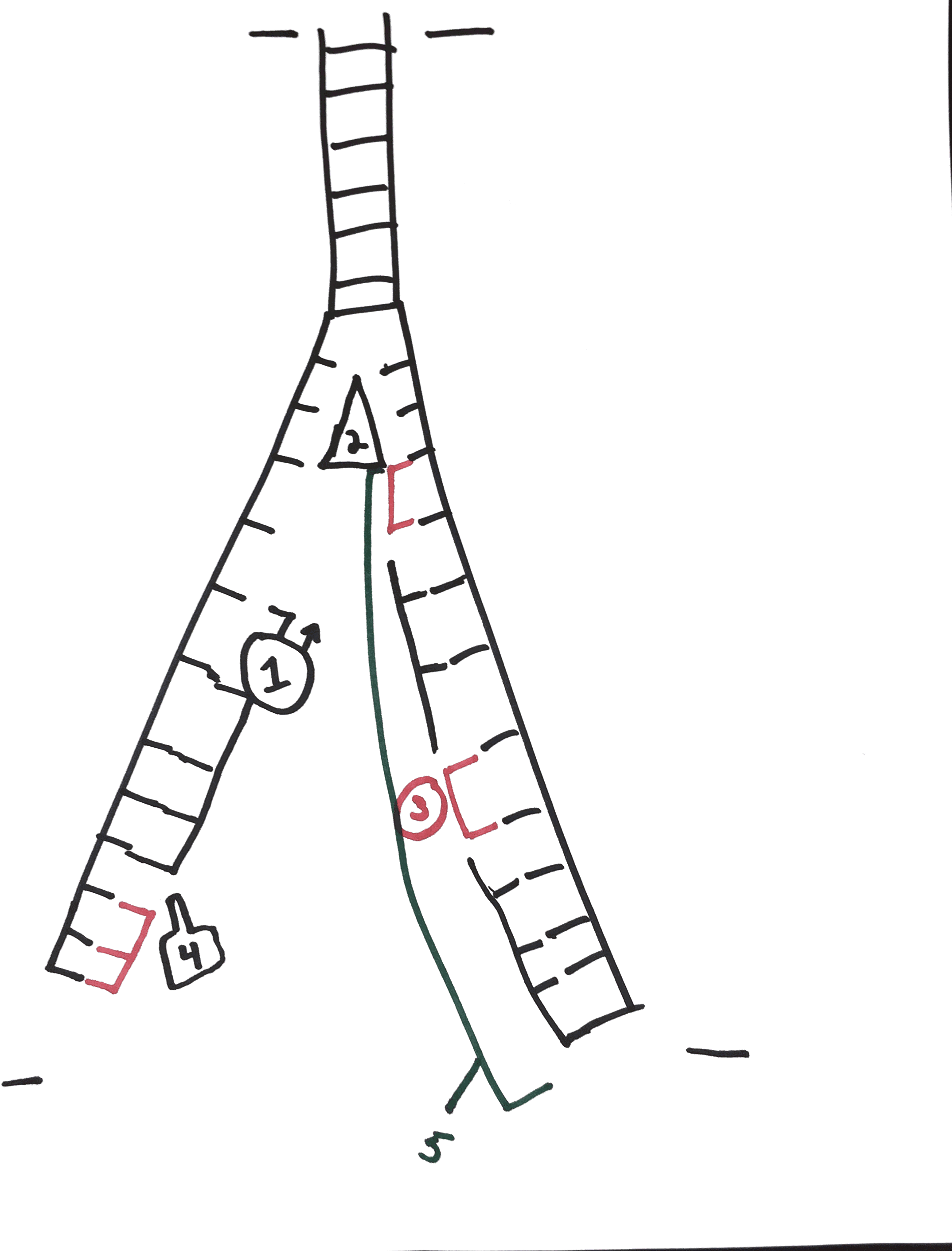
#4 in the picture
Polymerase
Primase
Helicase
Ligase
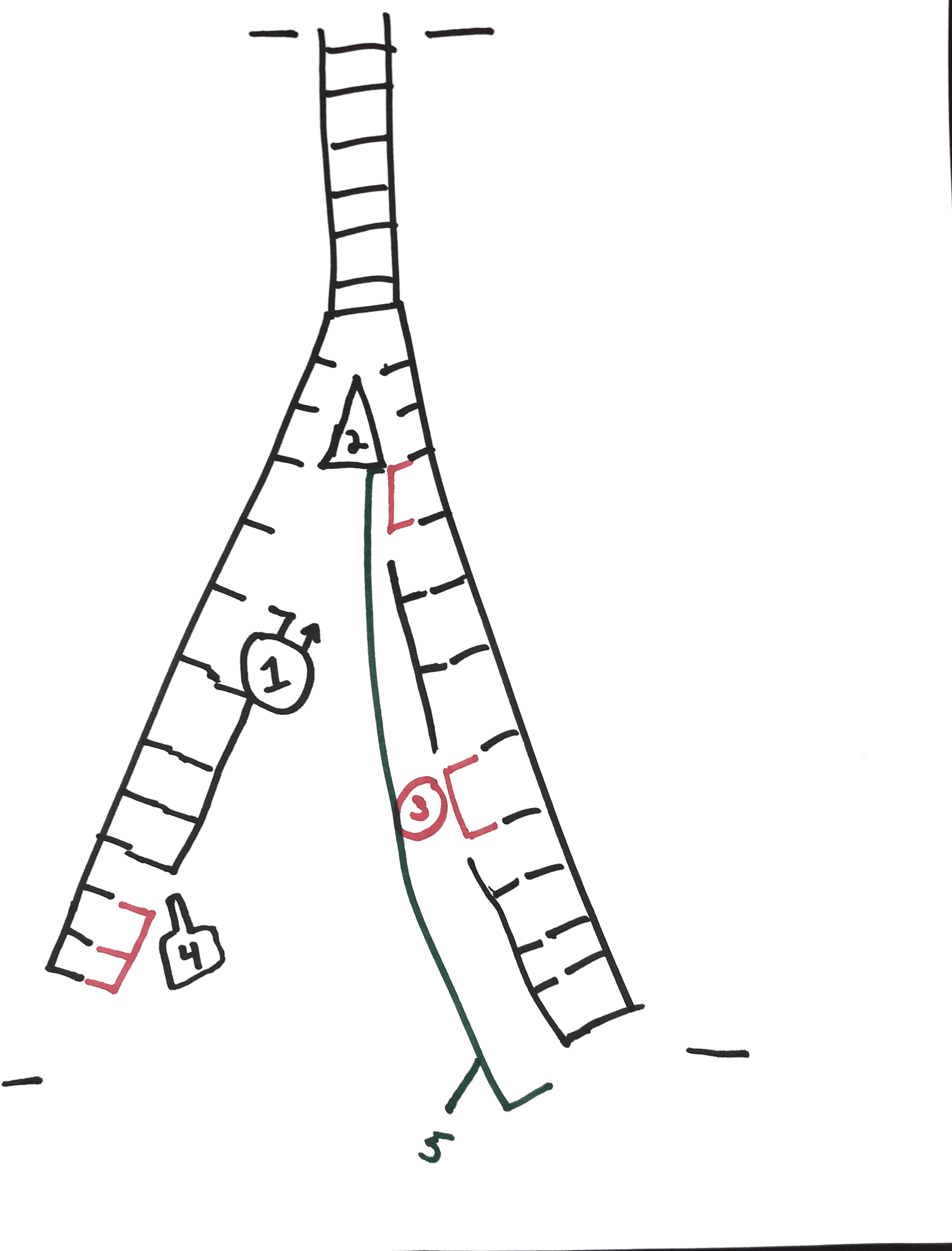
#5
Leading strand
Lagging Strand
Replication fork
Helicase
ATG TGA CAG
Adenine bonds with (a) and Cytosine bonds with (b)
Topoisomerase
Loosens DNA helix
Helicase
Unzips DNA strand
Primase
Starts base pairing and placing Okazaki fragmenst
DNA Polymerase
Adds bases and proofreads strand
Ligase
Reattaches DNA at end of replication
Which is in order from largest to smallest structure?
chromosome, DNA strand, gene, nucleotide
chromosome, gene, DNA strand, nucleotide
gene, DNA strand, chromosome, nucleotide
DNA strand, chromosome, gene, nucleotide

A segment of a DNA strand is shown. Which of these is the correct complementary DNA strand for the segment shown?
5' AGGTCAGGT 3'
5' ACCUGAGGU 3'
5' TGGACTGGA 3'
5' TCCAGTCCA 3'

Eight components present in nucleic acids are listed in the box. Which components bond with adenine in a section of double-stranded DNA?
1, 3, 5, and 6 only
3 and 5 only
2 and 4 only
3, 4, 7, and 8 only

A student used poster board to construct this model of a section of DNA. Which statement describes this model of DNA?
the model is inaccurate because the base pairs are incorrect
the model is accurate because it contains correctly paired bases
the model is accurate because it shows each base splitting to form a double helix
the model is inaccurate because some typical bases in DNA are missing

A student builds a model of a DNA strand. Which of these models of a DNA strand shows bases that are complementary to the ones on the student's DNA model?


The three components of a nucleotide are (a) , (b) group, and (c) base.

A model of a DNA molecule is shown. The arrow indicates -
the bond between adjacent phosphate and deoxyribose molecules
the junction of introns and exons in the sense strand of DNA
the hydrogen bond between complementary nucleotides
the junction of a codon and a DNA triplet

