wayground logo

Free Printable Worksheets

NEW

Font size

S
M
L
XL
Worksheets

Quarter 2 Review

Total questions: 69

Worksheet time: 45mins
Name
Class
Date
1.
Which of the following sequences of processes correctly reflects the central dogma?
a)
protein synthesis, transcription, translation
b)
protein synthesis, translation, transcription
c)
transcription, translation, protein synthesis
d)
translation, transcription, protein synthesis
2.
Which do DNA and RNA have in common?
a)
Both are double stranded.
b)
Both contain ribose molecules.
c)
Both contain phosphate groups.
d)
Both contain uracil.
3.
If the structure of DNA were likened to a ladder, what would make up the “supporting structure” (not the “rungs”) of the ladder?
a)
amino acids and sugars
b)
nucleotide bases, including thymine
c)
nucleotide bases, including uracil
d)
sugar-phosphate molecules
4.
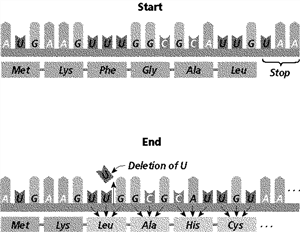
What process is shown in the illustration below?
a)
commensalism
b)
deletion
c)
passive transport
d)
replication
5.
What type of mutation has occurred in Figure 12-3?
a)
substitution
b)
frameshift
c)
lethal
d)
insertion
6.
What is the complimentary mRNA sequence to the DNA sequence A-T-T-G-C-A.
a)
T-A-A-C-G-T
b)
U-A-A-C-G-T
c)
U-A-A-C-G-U
d)
T-A-A-G-C-U
7.
Which defines a codon in DNA or mRNA?
a)
pair of nucleic acid and sugar
b)
pair of phosphate and sugar
c)
three-base code
d)
two-base code
8.
What mutation has occurred here? 
T-G-A-C-C-A
T-G-A-G-C-A
a)
Substitution
b)
Deletion
c)
Insertion
d)
Frameshift 
9.
Are all mutations bad?
a)
Yes
b)
No
10.
Which organelle is DNA usually found in?
a)
cell membrane
b)
vacuole
c)
chloroplast
d)
nucleus
11.
DNA is often considered the "______________" of life.
a)
Blueprint
b)
Mistake
c)
Swimming Pool
d)
Smelly Cheese
12.
What are the building blocks of proteins called?
a)
DNA
b)
RNA
c)
Ribosomes
d)
Amino Acids
13.
DNA has a ______ strand; RNA has a ______ strand.
a)
double/double
b)
double/triple
c)
double/single
d)
single/single
14.
In RNA, the nitrogen base____ replaces ____ that was present in DNA. 
a)
A, U (adenine, uracil)
b)
C, G (cytosine, guanine)
c)
U, T (uracil, thymine)
d)
U, A (uracil, adenine)
15.
The "central dogma" states that genetic information flows from 
a)
Protein-->mRNA-->DNA
b)
Protein-->DNA-->mRNA
c)
mRNA-->DNA-->Protein
d)
DNA-->mRNA-->Protein
16.
Transcription takes place in the 
a)
cytoplasm
b)
ribosome
c)
mitochondrion
d)
nucleus
17.
Translation occurs in the
a)
nucleus
b)
mitochondria
c)
cytoplasm
d)
golgi apparatus
18.
Assembles RNA during transcription
a)
RNA Polymerase 
b)
Mutations
c)
Gene Expression
d)
Point Mutation
19.
A new organism is produced from one parent organism.
a)
Sexual Reproduction
b)
Asexual Reproduction
20.
Mitosis is a type of ________________ reproduction.
a)
Sexual
b)
Asexual
21.
How many chromosomes does a human cell have?
a)
42
b)
46
c)
24
d)
64
22.
How many daughter cells are produced in mitosis?
a)
1
b)
2
c)
4
d)
6
23.

California blackworms, also known as mudworms, are able to break apart. Each body section that broke apart is able to become an identical new worm. What type of reproduction does this example represent?

a)

Sexual reproduction

b)

Asexual reproduction

24.

Penguins lay 1-2 fertilized eggs that the male and female take turns incubating on their feet. What type of reproduction does this example represent?

a)

Sexual reproduction

b)

Asexual reproduction

25.
Which of these lists presents the stages of the cell cycle in the correct order?
a)
interphase, mitosis, cytokinesis
b)
cytokinesis, mitosis, interphase
c)
mitosis, interphase, cytokinesis
d)
interphase, cytokinesis, mitosis
26.
Which of these phases of mitosis take place first?
a)
anaphase
b)
telophase
c)
prophase
d)
metaphase
27.
Identify the stage of mitosis.
a)
interphase
b)
prophase
c)
metaphase
d)
anaphase
28.

What is the image above:

a)

Chromosome

b)

Chromotid

c)

Centromere

d)

Centriole

29.

A chromosome is packaged

a)

DNA

b)

Protein

c)

Carbohydrates

d)

Lipids

30.

What stage of mitosis is depicted here

a)

Prophase

b)

Metaphase

c)

Anaphase

d)

Telophase

31.

What stage of mitosis is depicted here

a)

Prophase

b)

Metaphase

c)

Anaphase

d)

Telophase

32.

Centrioles pull the chromosomes apart towards the opposite sides of the cell describes:

a)

Prophase

b)

Metaphase

c)

Telophase

d)

Anaphase

33.

In which phase does a cell spend most of its life?

a)

Interphase

b)

Prophase

c)

Metaphase

d)

Anaphase

e)

Telophase

34.

The splitting of the cytoplasm and cell membranes is called?

a)

Interphase

b)

Telophase

c)

Centromere

d)

Cytokinesis

35.
What is it called when a sperm and egg meet?
a)
meiosis
b)
fertilization
c)
cell division
d)
mitosis
36.
Which process and type of resulting cells are represented?
a)
mitosis, gametes
b)
mitosis, body cells
c)
meiosis, gametes
d)
meiosis, body cells
37.
The chromosomes that pair up during meiosis, are called __________ chromosomes.  
a)
homozygous 
b)
asexual
c)
homologous
d)
genes
38.
A male shark has 40 chromosomes in each of its sex cells. How many would be present in its body cells?
a)
20
b)
40
c)
80
d)
160
39.
Which letter(s) in the diagram correspond to cells that are haploid? 
a)
A
b)
B
c)
C
d)
A and B
40.
What causes genetic variation in meiosis?
a)
chromosomes lining up
b)
crossing over of chromosomes
c)
separation of chromosomes
d)
chromosomes pulling apart
41.
What is one of the advantages, why is it better to reproduce sexually versus asexually?
a)
survival of the fittest
b)
overproduction
c)
genetic variation
d)
cloning
42.
Females have ____ and males have _____ chromosomes.
a)
XX, XY
b)
XY, XX
c)
XX, XX
d)
XY, XY
43.
Identify the phase:
a)
Metaphase I
b)
Metaphase II
c)
Anaphase I
d)
Anaphase II
44.
Identify the phase.
a)
Metaphase I
b)
Metaphase II
c)
Anaphase I
d)
Anaphase II
45.
Identify the phase.
a)
Telophase I
b)
Telophase II
c)
Metaphase I
d)
Metaphase II
46.

Is this a normal human karyotype?

a)

YES

b)

NO

47.

Is this karyotype for a male or female?

a)

MALE

b)

FEMALE

48.

Which of the following is a homozygous recessive genotype?

a)

HH

b)

dd

c)

Aa

49.

Which of the following is a heterozygous genotype?

a)

Gg

b)

UU

c)

pp

50.

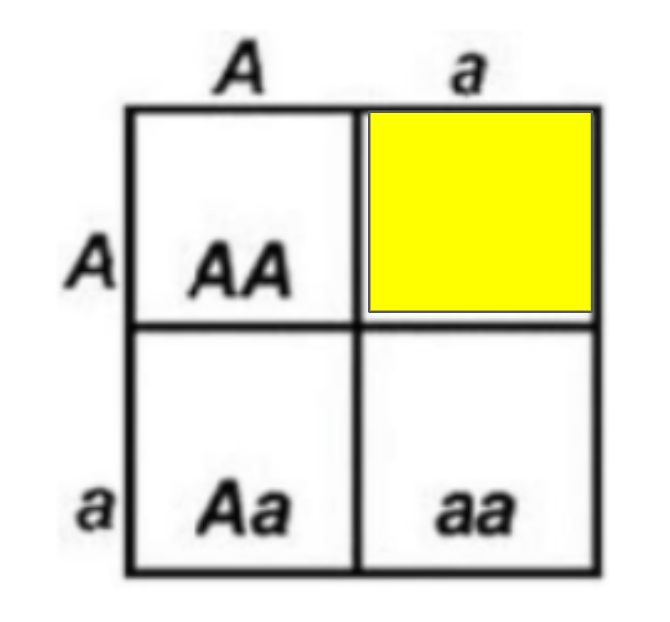
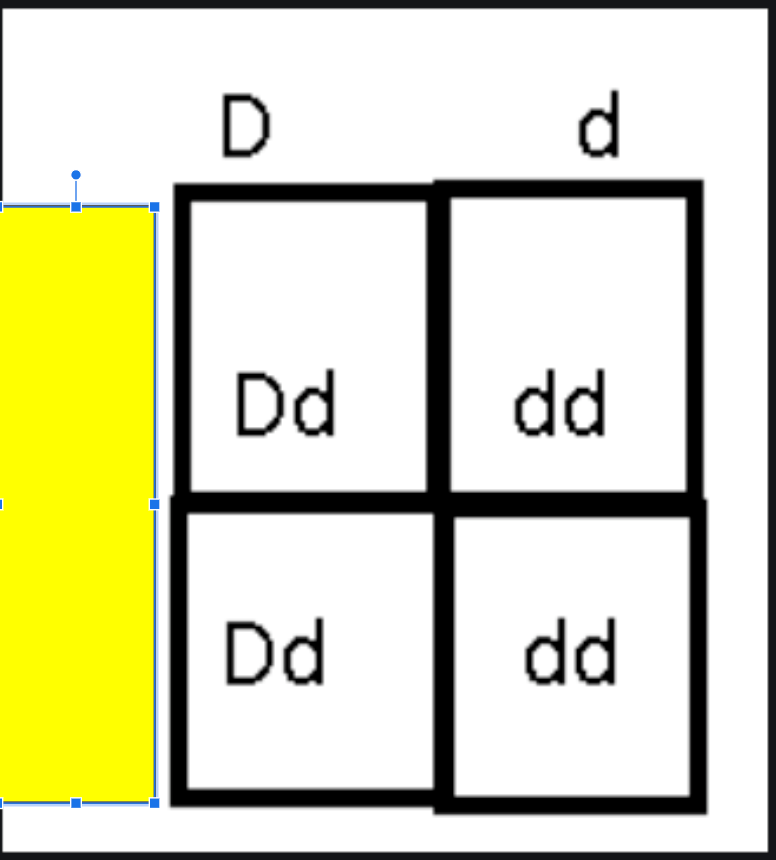
Fill in the Yellow Box

a)

AA

b)

Aa

c)

aa

51.

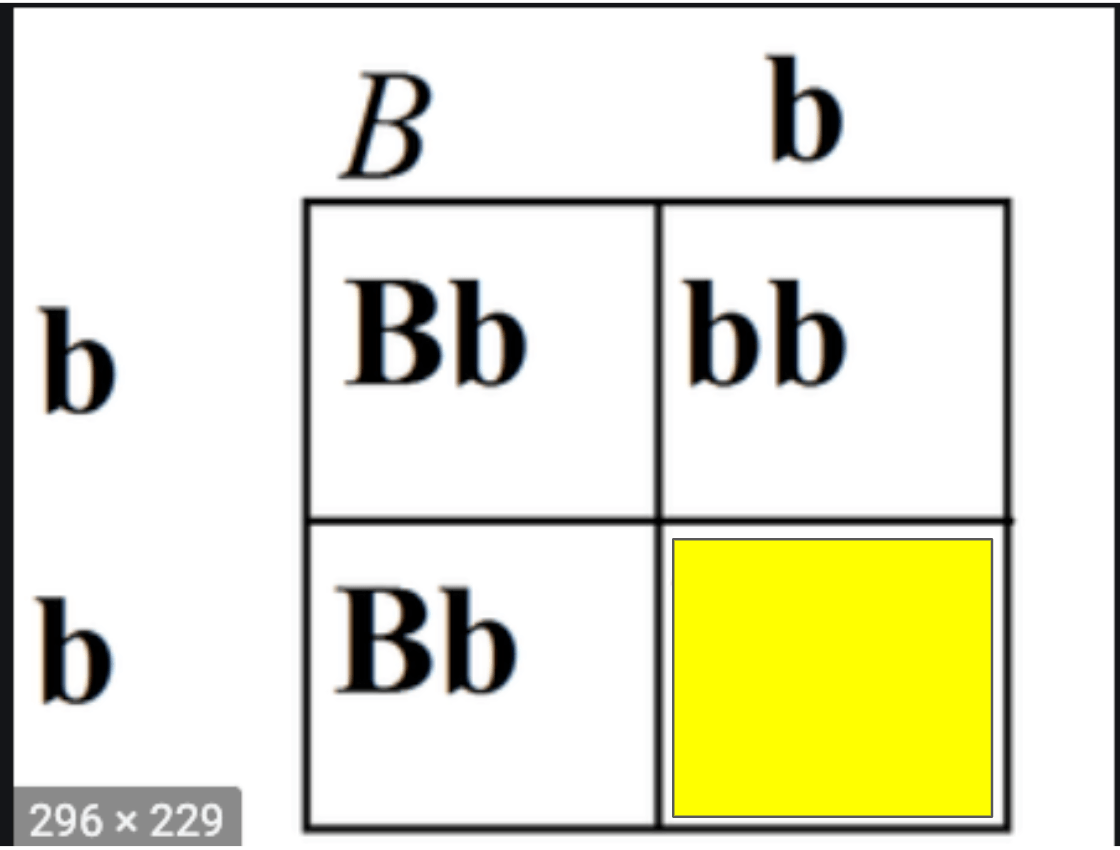
Fill in the Yellow Box

a)

Bb

b)

BB

c)

bb

52.

How chance the offspring born from this cross will have a homozygous dominant genotype?

a)

25%

b)

50%

c)

75%

d)

100%

53.

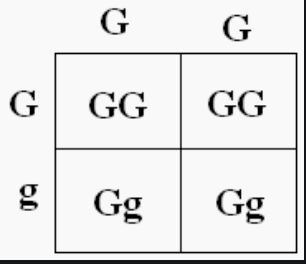
The punnett square is used to tell the color of a frogs skin. "G" means green skin and "g" means brown skin. What is the chance the baby frogs will have brown skin?

a)

0%

b)

25%

c)

50%

d)

100%

54.

What is the mother's genotype?

a)

DD

b)

Dd

c)

dd

55.
How many generations are shown in this pedigree?
a)
1
b)
2
c)
3
d)
4
56.
How many kids did the mother and father from the first generation have?
a)
2
b)
4
c)
5
d)
6
57.
In the second generation-how many people are carriers of the trait?
a)
2
b)
3
c)
5
d)
6
58.
The process by which the genetic code of DNA is copied into a strand of RNA is called
a)
translation
b)
transcription
c)
transformation
d)
replication
59.

What enzyme does transcription use?

a)

DNA polymerase

b)

ligase

c)

RNA polymerase

d)

helicase

60.

Which RNA carries the message?

a)

mRNA

b)

rRNA

c)

tRNA

61.
Translation takes place in the 
a)
ribosome
b)
chloroplast
c)
nucleus
d)
mitochondria
62.
Brings the amino acids to the ribosome
a)
mRNA
b)
tRNA
c)
rRNA
d)
DNA
63.
What would be the tRNA anticodon for the mRNA codon CAG?
a)
GTC
b)
GUC
c)
CUG
d)
CAG
64.
What is the term for a three-nucleotide sequence that codes for an amino acid?
a)
base
b)
codon
c)
amine
d)
serine
65.
Which phrase best describes translation?
a)
converts mRNA into a polypeptide
b)
catalyzes bonds between amino acids
c)
produces RNA from DNA molecules
d)
recycles tRNA molecules for reuse
66.
What type of bonds are forming during translation?
a)
Peptide bonds
b)
Hydrogen bonds
c)
Acid bonds
67.
How many amino acids are coded for by this sequence of nucleotides:
ATG GGA ACT CCA
a)
4
b)
2
c)
6
d)
12
68.
Which phase of which process does this picture show?
a)
Transcription
b)
Translation
c)
Replication
69.
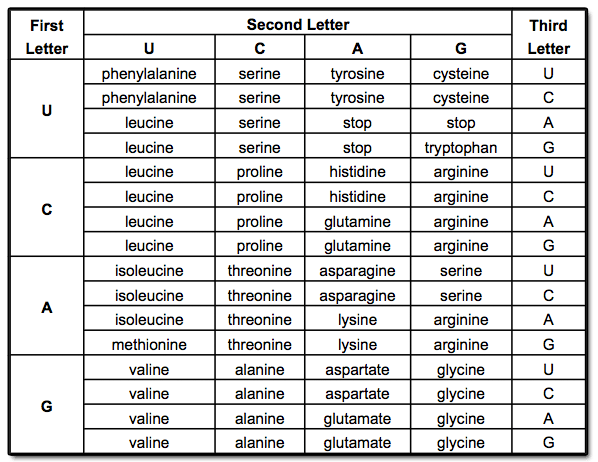
What is the correct amino acid sequence for the mRNA code AUGCCAGUAUGA
a)
Met-Pro-Ala-Val
b)
Met-Pro-Val
c)
Tyr-Gly-His
d)
Tyr-Gly-Arg-His