
 Worksheets
Week 22 Quiz 6th Grade
Total questions: 34
Worksheet time: 46mins
Bouncing of a light ray when it strikes a reflecting surface is called.........
Refraction
Dispersion
Reflection
Diffraction
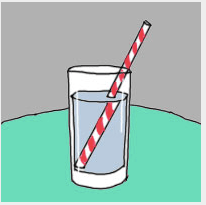
Why does the straw appear to be bent?
light is reflected
light is absorbed
light is turned
light is refracted

What is the best explanation for Mickey seeing himself in the mirror?
refraction
absorbed
reflection
flipped


The question mark is next to the __________ energy.
Transmitted
Reflected
Absorbed
Potential

The question mark is next to the ______________ energy
Reflected
Transmitted
Absorbed
Mechanical

The question mark is next to the _____________ energy.
Reflected
Transmitted
Absorbed
Nuclear

What type of behavior is represented by the diagram?
transmission
scattering
reflection
refraction

Why does the sky look blue during midday and red during sunset
Reflection of light
Refraction of light
Dispersion of Light
Scattering of Light
Which of the following is example light scattering ?
( There CAN be more than 1 answer)


The length of a crest (peak) or trough measured from the middle line.
Wavelength
Frequency
Amplitude
Medium
The high points of a transverse wave.
Crest (peak)
Trough
Wavelength
Amplitude
The low points of a transverse wave.
Crest (peak)
Trough
Amplitude
Wavelength
The distance between any two crests (peaks) or troughs.
Frequency
Amplitude
Wavelength
Transverse
The number of times the wavelength occurs in one second, measured in units called hertz.
Amplitude
Wavelength
Medium
Frequency
All waves carry ______________.
Sound
Light
Water
Energy

What does the arrow in the picture represent?
amplitude
wavelength
frequency
trough

What does the arrow in the picture represent?
wavelength
echolocation
amplitude
peak
If the amplitude increases, the energy of the wave:
increases
decreases
stays the same
The highest point of a wave is called what?
trough
wavelength
peak
amplitude
What happens when you increase the amplitude of a sound?
it makes the sound louder
it makes the sound travel faster
it makes the sound softer
it changes the pitch or note of the sound
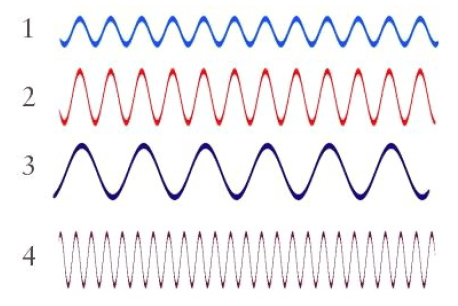
Which wave in the diagram has the greatest frequency?
1
2
3
4
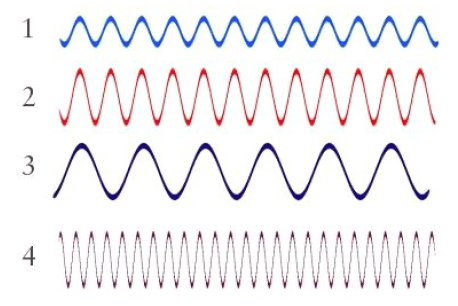
Which wave in the diagram has the longest wavelength?
1
2
3
4
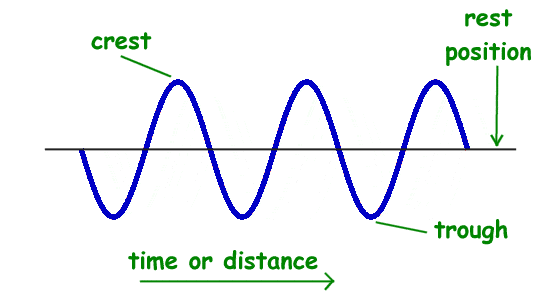
What is measured from crest to crest or trough to trough?
mediums
resting position
wavelength
origin

Higher pitches have more waves.
True (Periodic)
False (nah bro)

A low-pitch voice would sound like a deep voice.
Very true, professor.
No, professor.

