Wayground logo

Free Printable Worksheets

Font size

S
M
L
XL
Worksheets

optical

Total questions: 41

Worksheet time: 24mins

Name
Class
Date
1.
How does light travel
a)
It curves around corners
b)
Really slow
c)
In a straight line
d)
In circles
2.
Which term describes when light bounces off of a smooth surface?  
a)
Refraction
b)
Transmission
c)
Absorption
d)
Reflection
3.
The imaginary line perpendicular to a reflecting surface is called _____.
a)
crooked line
b)
parallel line
c)
angular line
d)
normal line
4.
The ray of light that strikes a reflecting surface is called ________.
a)
incident ray
b)
reflected ray
c)
normal ray
d)
none of the above
5.
Law of reflection state that - The angle of incidence is .................. to the angle of reflection.
a)
equal
b)
double
c)
half
6.
........... – the angle between the normal and the reflected ray.
a)
Angle of incidence
b)
Angle of reflection
c)
Angle of coincidence
d)
Angle of direction
7.
........... – the angle between the normal and the incident ray.
a)
Angle of incidence
b)
Angle of reflection
c)
Angle of coincidence
d)
Angle of direction
8.
What is reflection?
a)
Reflection is the bouncing  of light off the surface that it strikes on.
b)
Reflection is the absorbing of light off the surface that it strikes on.
c)
Reflection is the bending of light off the surface that it strikes on.
d)
Reflection is the scattering of light off the surface that it strikes on.
9.

In the diagram, which letter represents the angle of incidence?

a)

A

b)

B

c)

C

d)

D

10.

Which diagram represents specular reflection?

a)

A

b)

B

11.

Which diagram represents diffuse reflection?

a)

A

b)

B

c)

C

d)

D

12.
We can see objects because of_______
a)
reflection
b)
refraction
c)
transmission
d)
diffraction
13.
How does light behave as it enters these mediums?
a)
continue its path as straight line.
b)
bends toward the normal
c)
bends away from the normal
d)
reflects
14.
Absolute refractive index of any medium is always _______.
a)
less than 1
b)
greater than 1
c)
1
d)
0
15.
Swimming pools and the ocean look shallower than they really are due to:
a)
reflection 
b)
dispersion
c)
refraction
d)
total internal reflection
16.
The formula to calculate the refractive index is
a)
n=cv
b)
n=v/c
c)
n=c/v
d)
v=nc
17.
What is this called?
a)
refraction
b)
reflection
c)
reconstroction
d)
retraction
18.
According to the Law of reflection, a light ray striking a mirror
a)
continues moving through the mirror in the same direction
b)
moves into the mirror at a slightly different angle
c)
bounces off the mirror toward the direction it came from
d)
bounces off the mirror at the same angle it hits.
19.
A ray of light traveling from air into crown glass strikes the surface at an angle of 30 degrees. What is the angle of refraction? (air n=1, crown glass n=1.532)
a)
39.7 degrees
b)
19.2 degrees
c)
59.1 degrees
d)
12.3 degrees
20.
Glass has a _____________ index of refraction than air.
a)
Equal
b)
Greater
c)
Less
d)
Impossible to say
21.
The fact the two angles are the same is an example of....
a)
Refraction
b)
Angle of Incidence
c)
Law of reflection
d)
Magnification
22.
Light travels through a liquid at 2.25 EE 8 m/s. What is the index of the liquid?
a)
1.33
b)
1.0
c)
1.523
d)
2.45
23.
What is the index of refraction of a refractive liquid if the angle of incidence in the air is 35 degrees and the angle of refraction is 14 degrees?
a)
1.33
b)
2.21
c)
2.37
d)
1.72
24.
If the angle of incidence of light traveling through air, and then striking water is 30 degrees what is the angle of refraction? (n=1 air, n=1.33 water)
a)
15 degrees
b)
22 degrees
c)
43 degrees
d)
17 degrees
25.
Light has the lowest velocity in which medium?
flint glass n=1.70
barium glass n=1.60
crown glass n=1.523
water n=1.33
diamond n=2.45
a)
diamond
b)
water
c)
flint glass
d)
barium glass
26.
The point where the rays meet is known as....
a)
Fire
b)
the focal point
c)
refraction
d)
Plane of the lens
27.
The bouncing of light is known as
a)
Mirror
b)
Refraction
c)
Index of refraction
d)
reflection
28.
What is this image showing?
a)
Reflection
b)
Refraction
c)
The law of reflection
d)
Concave Mirror
29.
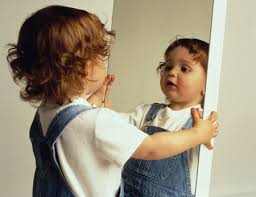
The image formed in a flat mirror is
a)
larger than the object and farther away.
b)
reduced and closer to the mirror.
c)
a real image of the object.
d)
equal to the height and distance of the object.
30.
Why does the lower part of the child appear so much different in size from the upper part?
a)
The light rays that travel through water and then into air are refracted.
b)
The light rays that travel through water and then into air are enlarged.
c)
The light rays that travel through air and then into water are reflected.
d)
The light rays that travel through air and then into water are reduced.
31.
The velocity of light in vacuum is _______ m/s
a)
3x10⁸
b)
3x10¹²
c)
3x10⁶
d)
3x10¹⁰
32.

Choose the correct statement that describes what happens to the ray of light if the critical angle is 48o and the angle of incidence is 48o

a)

refract

b)

totally internally reflect

c)

travel along the boundary

33.

What is the refractive index of a fibre optic pipe if the critical angle is 30 degree?

Outside is air.

a)

2.0

b)

1.7

c)

2.4

34.

When angle of incident (i) equals to critical angle (c) if light is traveled from a denser medium to a less dense medium,

a)

total internal reflection occurs.

b)

angle of refraction is equal to 90 degree.

c)

light is refracted out

d)

light travel in straight line

35.

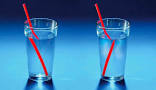
Why does the pencil appear bent?

a)

Light rays travelling from parts of the pencil above the water bend away from the normal and appear closer to the horizontal surface, thus making the pencil appear broken.

b)

Light rays travelling from parts of the pencil above the water bend towards from the normal and appear closer to the horizontal surface, thus making the pencil appear broken.

c)

Light rays travelling from parts of the pencil under the water bend away from the normal and appear closer to the horizontal surface, thus making the pencil appear broken.

d)

Light rays travelling from parts of the pencil under the water bend towards from the normal and appear closer to the horizontal surface, thus making the pencil appear broken.

36.

What is total internal reflection

a)

Where a wave is refracted at the boundary between a dense medium and a less dense medium when the angle of incidence is greater than the critical angle.

b)

Where a wave is refracted at the boundary between a dense medium and a less dense medium when the angle of incidence is smaller than the critical angle.

c)

Where a wave is reflected at the boundary between a dense medium and a less dense medium when the angle of incidence is greater than the critical angle.

d)

Where a wave is reflected at the boundary between a dense medium and a less dense medium when the angle of incidence is smaller than the critical angle.

37.

What happens to the speed of light in a more optically dense medium?

a)

it slows down

b)

it speeds up

c)

stays the same because all light travels at the speed of light

38.

When the angle of refraction is 90 °\degree  the angle of incidence is called the... 

a)

Angle of incidence

b)

Critical angle

c)

Angle of total internal reflection

d)

Angle of refraction

39.

When will total internal reflection occur?

a)

When light travels from a less dense to a more dense medium

b)

When the angle of incidence is smaller than the critical angle

c)

When the angle of incidence is greater than the critical angle

d)

When the light cannot pass through a medium

40.

For total internal reflection to occur, light must

a)

travel from a more dense to a less dense medium

b)

travel from a less dense to a more dense medium

41.

What happens to light during total internal reflection?

a)

The light reflects back into the original medium at the same angle.

b)

The light refracts closer to the normal line.

c)

The light refracts farther away from the normal line.

d)

The light reflects at the angle it would have refracted at.