wayground logo

Free Printable Worksheets

Font size

S
M
L
XL
Worksheets

ECDE 100 Lesson 5 Quiz

Total questions: 27

Worksheet time: 54mins

Name
Class
Date
1.
This personality type tries  to meet the desires of the id in a way that is socially acceptable in the world. It deals with the reality.
a)
Selfie
b)
Id
c)
Superego
d)
Ego
2.
The "Id" is defined as which part of your human personality?
a)
Based on morals and judgments about  right and wrong 
b)
Dealing with reality
c)
Needing to look good
d)
Meeting basic needs
3.
Sally was thirsty. However, she knew that her server would be back soon to refill her water glass, so she waited until then to get a drink, even though she really just wanted to drink from Mr. Smith’s glass. What is this an example of?
a)
Ego
b)
Id
c)
Latin
d)
Superego
4.
Sarah knew that she could steal the supplies from work and no one would know about it. However, she knew that stealing was wrong, so she decided not to take anything even though she would probably never get caught.
What is this an example of?
a)
Superego
b)
Ego
c)
Dishonesty
d)
Id
5.

Much of Freud's psychoanalytic theory on personality is criticized for lacking empirical support. What is one exception?

a)

The psychosexual stages of development

b)

The concept of defense mechanisms

c)

The three levels of consciousness

d)

The three personality structures

6.
Id is to ego as __________ is to ______________.
a)
pleasure principle; reality principle
b)
reality principle; morality principle
c)
pleasure principle; morality principle
d)
Identification; Oedipus Complex
7.

Our psyche is a manifestation of which of these?

a)

The collective unconscious

b)

The ego

c)

The senex

d)

The crone

8.
Which approach views the individual as a product of the unconscious mind, desires and aggressions?
a)
Biophysiological
b)
Psychoanalytic
c)
Humanistic
d)
Cognitive
9.
According to Piaget, during the formal operational stage people begin to:
a)
reason abstractly
b)
adhere to social norms
c)
distinguish between good and bad behaviors
d)
become aware of the positive and negative consequences of their own behaviors
10.
According to Piaget, children come to understand that the volume of a substance remains constant despite changes in its shape during the ________ stage.
a)
sensorimotor
b)
preoperational
c)
concrete operational
d)
formal operational
11.
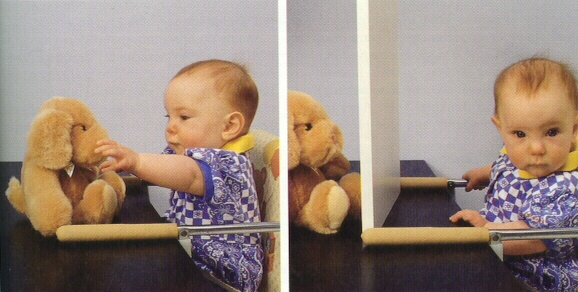
An infant who has developed object permanence...
a)
is attached to specific objects, such as a blanket.
b)
will see all objects as being the same.
c)
knows that an object, such as a rattle, exists even if it is not in view.
d)
cries when a wanted object is taken away.
12.
Four-year-old Jennifer mistakenly believes that her mother would like to receive a toy doll as a Christmas present. This best illustrates Piaget's concept of:
a)
accommodation
b)
attachment
c)
object permanence
d)
egocentricism
13.
In which of the following stages will children learn the concept of conservation?
a)
preoperational
b)
concrete operational
c)
sensorimotor
d)
formal operational
14.
Peek-a-boo works on children in what stage?
a)
Sensorimotor
b)
Preoperational
c)
Concrete Operational
d)
Formal Operational
15.
The ability to use deductive logic, think abstractly and systematically solve problems emerges during the:
a)
Concrete Operational Stage
b)
Sensorimotor Stage
c)
Formal Operational Stage 
d)
Preoperational State 
16.
The first stage of development is the _____ stage.
a)
adaptation
b)
assimilation
c)
accommodation
d)
sensorimotor
17.
How many stages did Piaget state people go through as they developed?
a)
5
b)
1
c)
4
d)
2
18.

Russian physiologist known primarily for his work in classical conditioning with dogs and salivation.

a)

Edward Thorndike

b)

John Watson

c)

Ivan Pavlov

d)

Martin Seligman

19.

Influential psychologist conducting research on operant conditioning; animals and humans can be trained using positive and negative reinforcement; as well as positive and negative punishment.

a)

B.F. Skinner

b)

Albert Bandura

c)

John Garcia

d)

Walter Mischel

20.

What learning theory is shown?

a)
Classical Conditioning
b)
Social/Observational
c)
Operant Conditioning 
d)
None of the above
21.

What learning theory is shown?

a)
Classical Conditioning
b)
Operant Conditioning 
c)
Social/Observational 
d)
None of the above 
22.
What type of conditioning is shown?
a)
Operant 
b)
Classical
23.
What is another name for classical conditioning? 
a)
Pavlovian Conditioning
b)
Representing Conditioning
24.
_____________ a behavior is followed by a reinforcer that increases chance the behavior will occur again. something good is presented that increases behavior in future
a)
Positive reinforcement
b)
Positive punishment
25.
___________ takes away unpleasant consequences after a behavior, increasing chance of behavior occurring again. something bad removed and encourages behavior
a)
Negative punishment
b)
Negative reinforcement
26.
___________ something bad is presented that discourages behavior in future
a)
Positive punishment
b)
Positive reinforcement
27.
___________ something good removes that discourages behavior in future
a)
Negative reinforcement
b)
Negative punishment