
 Worksheets
Physics 7: Pre-Comp Review 2022
Total questions: 125
Worksheet time: 2hrs 53mins




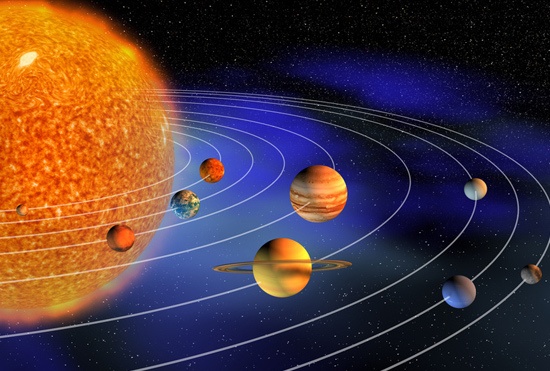
Why do all of the planets orbit the sun rather than Earth?
the sun has more mass
the sun is a star
the Earth is heavier
the sun is in the middle of the milky way
Which is the smallest measurement of mass?
gram
milligram
kilogram
Grams and kilograms measure...
capacity
length
time
mass
A rocket is deep in space, really far away from the influence of any celestial objects. The rocket does not need fuel to continue moving. This is an example of which law of motion?
1st Law of Motion
2nd Law of Motion
3rd Law of Motion
Law of Universal Gravitation
A football player exerts a force on the ball when he kicks a field goal equal to 50 N. What force does the ball exert on the player?
More than 50 N
50 N
Less than 50 N
Not enough information
Which law of motion can be used to describe the action-reaction pair?
1st Law of Motion
2nd Law of Motion
3rd Law of Motion
Law of Universal Gravitation
Which Law of Motion is responsible for why we use seatbelts in car?
1st Law
2nd Law
3rd Law
Law of Universal Gravitation
What net force must be applied to a 8.5 kg block of wood to accelerate 10m/ s2 to the right (+ direction).
85 km/h
850 N
85 m/s
85 N
What is weight?
The force of gravity pushing up on an object
An applied force of gravity accelerating an object perpendicular to the plane of Earth
A force of gravity acting on an object
An applied force entered on an object to accelerate it in a positive direction
What is gravity?
The force of attraction between two objects containing matter
The applied force of a celestial body on itself
The force of sticky friction between two surfaces
The mass of an object in revelation to the space it occupies
What is gravitational acceleration on Earth?
67 m / s2
6.667 x 10⁻¹¹ m / s2
9.8 N
9.8 m / s2
What is the direction of gravitational acceleration?
It depends on your location on Earth
Always down
Up in the Southern Hemisphere and up in the northern hemisphere
To the side because we live on the side of the Earth planet
What is mass?
The amount of matter divided by the object and another object close to it
The amount of space in relation to the matter in an object
The amount of particles of matter in a substance
The stuff in a thingy that accelerated at 10 miles per hour, but only on a Tuesday
A 60,000 N crate is stored on a shelf in a warehouse. Will a forklift that has a maximum lift mass of 10,000 kg be able to life the crate? (On Earth)
Yes, because the mass of the crate is less than the maximum lift mass of forklift
No, because the mass of the crate is more than the maximum lift mass of the forklift
Yes, because the forklift can lift anything it puts its mind to
No, because the weight of the crate is more than the maximum lift mass of the forklift
When the distance between two object is decreased, what occurs to the gravitational attraction between them?
Gravity increases
Gravity remains the same
The distance increases
Gravity decreases
From age 4 to 16, a student’s mass increases. What happens to their force of gravity?
It decreases because they get taller and further from Earth
It increases because as mass increases distance increases
It decreases because as mass increases the force of gravity also decreases
It increases because there is a proportional relationship between mass & gravity
Which of the following definitions describes inertial mass?
The force of gravity acting on an object
The amount of matter in an object
The measurement of an object’s resistance to acceleration
The amount of space and object takes up in respect to its surroundings

Calculate the net force of the following FBD
12 N down, 23N to the right1
12 N up, 23 N right
17 N to the right
35 N
What is Newton’s First Law of Motion commonly referred to as?
The Law of Inertia
The law of the land
The Law of Universal Gravitation
The Law of Acceleration
What is Newton’s Second Law of Motion?
Objects exerting a force will have an equal and opposite force oppose it
Every object will accelerate based on a specific force applied to it as long as the inertial mass of that object is able to overcome
Every time an object accelerates, the net force must be greater than the force applied to the gravitational constant of the second mass, when air resistance is negligible
The weight of an object is equal to the mass of the object in kilograms
What is the average acceleration of an object being dropped on Earth?
Not enough info
It depends on the mass of the object
It is equal to 9.8 m / s2
What is Newton’s Third Law of Motion?
The force entered on an object is equal to the mass of an object multiplied by the object’s acceleration
The force needed to accelerate an object
For every action that occurs, there is an equal but opposite reaction occuring
Force = mass(acceleration)
What can we say about the motion of an object that has a constant velocity to the right at 5 m/s?
The object is in static equilibrium
The object will eventually accelerate negatively
The object is in dynamic equilibrium


If there are two forces going in the opposite direction how would you find the net force?
Subtract
Add
Neither
Multiply

What is the net force in this example?
200 N
125 N
50 N
75 N

Which direction will the net force be?
Right
Left
Up
Down

Is this a balanced or unbalanced force?
Balanced
Unbalanced

If both people are exerting a force of 20 N, what is the net force?
20 N
40 N
400 N
0 N

If both people are exerting a force of 30 N, what is the net force?
30 N
60 N
300 N
0 N

If the boy is pulling with a force of 10 N and the girl is pushing with a force 20 N, what is the net force on the box?
10 N
20 N
30 N
0 N


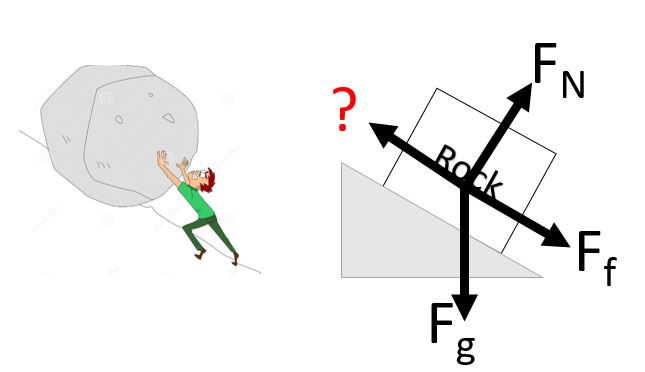

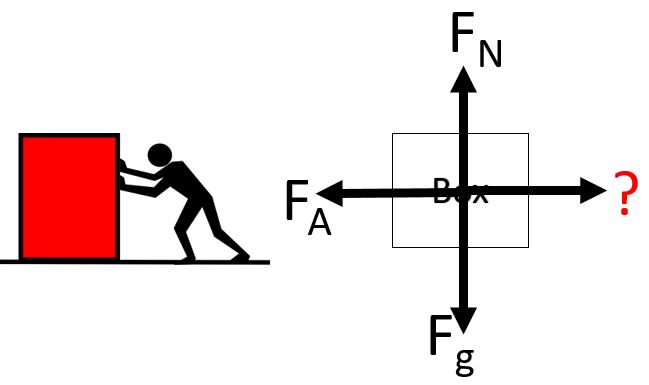

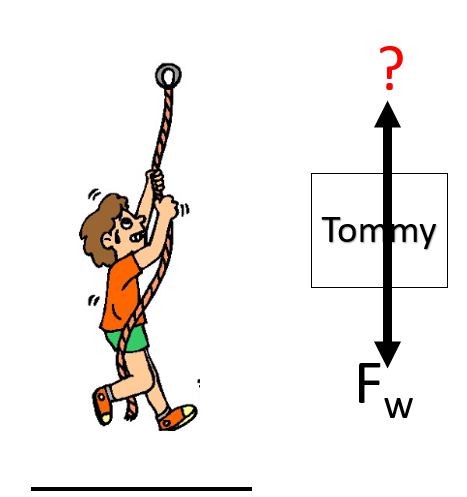
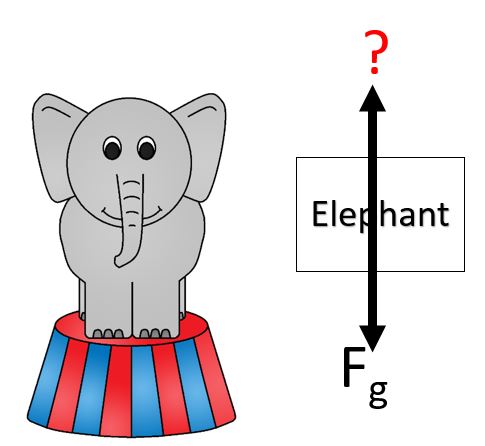


What best describes what the normal force would look like here?
Straight down and parallel to the gravitational force
Directly upward
Straight to the right
Upward but at an angle
Rina’s mother asked her to help move some items from the hall closet to the garage. One item she wanted to move was a large box of old school books. Rina tried to lift the box, but could not pick it up. What force was Rina NOT able to overcome?
frictional force
gravitational force
applied force
normal force
Leanna decided to rearrange her bedroom by moving her dresser to the opposite wall. She tried pushing it, but found that the dresser would not move. What force was Leanne NOT able to overcome?
normal force
gravitational force
tension force
frictional force
How do the magnitudes of static and kinetic friction compare?
They are equal
The magnitude of kinetic friction is greater
The magnitude of static friction is greater

What force ultimately slows the roller coaster to a stop?
Applied
Normal
Friction
Gravitational

Look at the illustration below of a block sitting on a table-top. The magnified view illustrates a force that exists between the two objects.
Which type of force is demonstrated in the magnified view?
normal force
applied force
gravitational force
frictional force

What type of friction is not moving?
static
kinetic
fluid

In each of the following cases, determine where the car has no acceleration?
A car speeds up after a stoplight turns green.
A car slows down as it approaches a red light
A car with the cruise control set at 80 km/h going down a straight highway
A car turning a curve at a constant speed
The SI unit for acceleration is
mph
ft/sec
m/s2
m/s
When are you undergoing an acceleration in a car? (Choose all that are correct)
speed up
slow down
make turns
constant speed
A positive acceleration means that your object is _____.
not accelerating
not moving
speeding up
slowing down
The equation for acceleration is...


Acceleration can be... (select all that apply)
speeding up
slowing down
staying at constant speed
changing directions

Velocity is different from speed because...
Velocity is distance/time. Speed is displacement/time.
Velocity is speed in a certain direction and can be positive or negative.
Speed is velocity in a certain direction. Both can only be positive.
Velocity is how much speed changes over time.
What is the equation for velocity?


Select the equation for acceleration.


Select the equation for speed


Select all the scenarios that represent acceleration of the car.


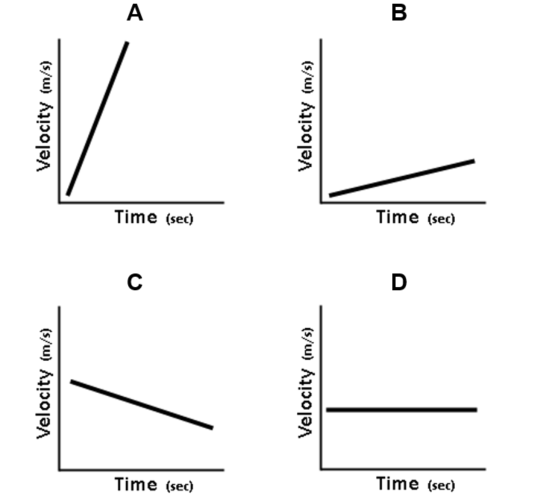
This chart represents the velocity of a motorcycle over time. Select the correct statement regarding the motorcycle's movement.
The motorcycle is speeding up.
The motorcycle has 0 acceleration.
The motorcycle is slowing down.
The motorcycle has constant acceleration.

This chart represents the velocity of a bicycle over time. Select the correct statement regarding the bicycle's movement.
The bicycle has constant velocity.
The bicycle has constant speed.
The bicycle is accelerating.
The bicycle has 0 acceleration.

The image shows two cars with the same speed moving in different directions. What is true about the velocity of the cars?
Each car has the same velocity because the speeds are the same.
Each car has a different velocity because they are going in different directions.

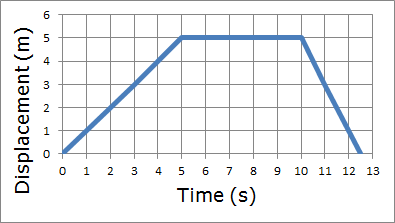
The slope of this position vs time graph is?
Constant
Increasing
Decreasing
0

The slope of this position vs time graph is...
Constant
Increasing
Decreasing
0

A change in velocity requires the application of a ___________.
sound
magnet
forehead
force (push or pull)

A coffee filter begins falling at position 0 and lands at position -10. What is the coffee filter's displacement?
-10
0
10
20

A horse accelerates from a velocity of 0m/s to 20 m/s in 3 seconds. What is the acceleration of the horse?
60 m/s2
6.67 m/s2
0.15 m/s2
30 m/s2

A train decelerates from a velocity of 90 m/s to 80m/s in over 10 seconds. What is the train's acceleration?
-1 m/s2
1 m/s2
10 m/s2
-10 m/s2

An elevator moves from rest to 2 m/s over 8 seconds. What is the elevator's acceleration?
16 m/s2
-8 m/s2
0.25 m/s2
2 m/s2

A car begins at position x = 10 and travels to position x = -30. What is the car's displacement?
-40
40
10
30

