
 Worksheets
Full STAAR Review
Total questions: 125
Worksheet time: 2hrs 42mins
Name
Class
Date
1.
What is velocity?
a)
the quickness of an object
b)
the location of an object
c)
acceleration
d)
speed in a specific direction
2.
What is the formula to calculate speed?
a)
Speed = time/distance
b)
Speed = distance/time
c)
Speed = distance x time
d)
Speed = time x distance
3.
Shona cycles at an average speed of 8km/h. How far has she travelled if she cycles for 4 hours?
a)
55km
b)
32km
c)
43km
d)
32miles
4.
A runner races in the 100 meter dash. It takes her 10 seconds to finish. What is her average speed?
a)
10 m/s
b)
1000 m/s
c)
100 seconds
d)
10 seconds
5.

What is this graph showing?
a)
Constant Speed
b)
Acceleration (speeding up)
c)
Deceleration (slowing down)
d)
No motion
6.

What does this graph represent?
a)
Constant speed
b)
Acceleration
c)
Not moving
7.

What does this graph represent?
a)
Constant speed
b)
Acceleration
c)
Not moving
8.
A 20 kg bike accelerates at 10 m/s2. what was the force?
a)
25 Newtons
b)
20 Newtons
c)
200 Newtons
d)
10 Newtons
9.
F=MA
An object of mass 10 kg is accelerated upward at 2 m/s2. What force is required?
An object of mass 10 kg is accelerated upward at 2 m/s2. What force is required?
a)
20 N
b)
2 N
c)
5 N
d)
0 N
10.
If a force of 26 N is exerted on two balls, one with a mass of 0.52 kg and the other with a mass of 0.78 kg, which ball will have the greater acceleration? (F=ma)
a)
The one with a mass of .78 kg will have the greatest acceleration.
b)
The one with a mass of .52 kg will have the greatest acceleration.
c)
They will both accelerate at the same rate.
11.
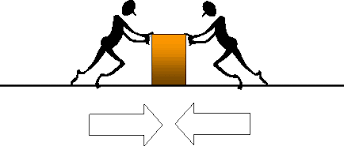
If an object is stationary (not moving) the forces acting upon it are _____________
a)
unbalanced
b)
weak
c)
balanced
d)
Hulk Smash!
12.

In a tug of war, when one team is pulling with a force of 100 N and the other at 80 N. What is the net force?
a)
20 N
b)
80 N
c)
100 N
d)
180 N
13.

What is the net force?
a)
17 N Right
b)
3 N Right
c)
3 N Left
d)
17 N Left
14.
It takes 20 N of force to move a box a distance of 10 m. How much work is done on the box ?
a)
200 J
b)
20.0J
c)
2 J
d)
200 N
15.
Two factors that determine work are
a)
amount of the force, and effort used
b)
amount of the force, and type of force
c)
mass, and distance
d)
amount of force and distance moved
16.
You apply a force of 18 N to a dresser and move it 3.0 m. How much work did you do on the dresser?
a)
54 N
b)
6.0 J
c)
54 J
d)
27 J
17.
In which of the following situations do your arms do work on books?
a)
holding a heavy stack of books while standing
b)
carrying a heavy stack of books
c)
dropping a stack of books onto a table
d)
picking up a pile of books from the floor
18.
Ms. McDonald holds a desk perfectly still above her head. If she holds the desk at a height of 0.5 meters above her head, and applis 68 Newtons of force to do so, how much work has she done?
a)
34 Joules
b)
0 Joules
c)
68 Joules
d)
340 Joules
19.
What law is best described by inertia?
a)
1st
b)
2nd
c)
3rd
20.

a)
1st
b)
2nd
c)
3rd
21.

a)
1st
b)
2nd
c)
3rd
22.
F = MxA
a)
1st
b)
2nd
c)
3rd
23.

The chart below lists the forces applied to each of four toy cars. If all the cars accelerate at the same rate, which car must have the largest mass?
a)
P
b)
Q
c)
R
d)
S
24.

In the picture, the vehicle will move because of...
a)
Newton's 1st Law
b)
Newton's 2nd Law
c)
Newton's 3rd Law
d)
Newton's 9th Law
25.

In the picture, the blocks are flying out of the truck based on which of Newton's laws?
a)
Newton's 1st Law
b)
Newton's 2nd Law
c)
Newton's 3rd Law
d)
Newton's 6th Law
26.

When all the forces on an object are equal and opposite, & the net force is zero, that's...
a)
balanced forces
b)
unbalanced forces
c)
terminal velocity
d)
reaction forces
27.
__________ is stored energy.
a)
Potential
b)
Kinetic
c)
None of the above
d)
All of the above
28.
Energy due to motion is ____________ energy.
a)
Potential
b)
Energy
c)
Kinetic
d)
Friction
29.
When you stretch a rubber band, you are storing __________ energy.
a)
kinetic
b)
potential
c)
none of the above
d)
all of the above
30.

What kind of energy is in a rock at the edge of a cliff?
a)
Potential
b)
Kinetic
31.

What kind of energy is in an acorn hanging from an oak tree?
a)
Potential
b)
Kinetic
32.

What kind of energy is in a stretched rubber band?
a)
Potential
b)
Kinetic
33.
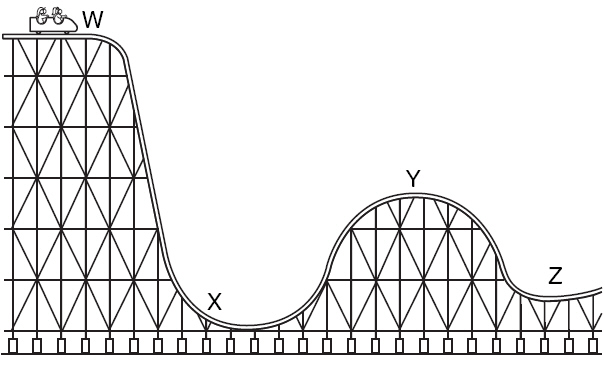
At which point is potential energy greatest?
a)
W
b)
X
c)
Y
d)
Z
34.

As a pendulum swings from its highest to lowest position, what happens to its kinetic and potential energy?
a)
Both the potential energy and kinetic energy decrease
b)
The potential energy decreases while the kinetic energy increases
c)
The kinetic energy decreases while the potential energy increases
d)
Bothe the potential energy and kinetic energy increase
35.

At which point is kinetic energy greatest?
a)
W
b)
X
c)
Y
d)
Z
36.
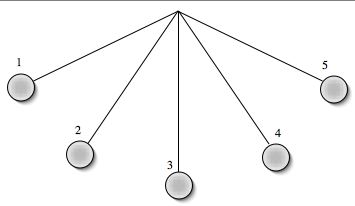
When a pendulum swings, at which point is kinetic energy highest?
a)
1
b)
2
c)
3
d)
4
37.
How many Aluminum are in Al2O3?
a)
3
b)
2
c)
5
38.
How many Sodium (Na) are in 6NaCl?
a)
1
b)
12
c)
6
39.
How many Chlorine are in MgCl2?
a)
2
b)
1
c)
3
40.
How many Magnesium are in 10MgCl2?
a)
10
b)
5
c)
20
41.
Which is the correct formula for:
three hydrogen (H)
one sulfur (S)
four oxygen (O)
three hydrogen (H)
one sulfur (S)
four oxygen (O)
a)
H3SO4
b)
HSO4
c)
H4S3O
d)
H2O
42.
Which of the following is a sign that a chemical reaction has occurred?
a)
change in shape
b)
melting
c)
formation of a gas
d)
dissolving
43.
Is hammering wood together to build a house a chemical or physical change?
a)
chemical
b)
physical
44.
Is bleaching your hair a physical or chemical change?
a)
physical
b)
chemical
45.

Is burning wood a chemical or physical change?
a)
chemical
b)
physical
46.
A change in the size, shape, or state of matter.
a)
chemical change
b)
physical change
c)
chemical reaction
d)
electron change
47.
Which of the following is NOT an example of a physical change?
a)
crumpled paper
b)
pencil sharpening
c)
shrunken clothing
d)
sour milk
48.
Kim puts an ice cube in a beaker and it melts. This is a good example of:
a)
a physical change.
b)
a chemical change.
c)
an experiment.
d)
an analysis.
49.

Photosynthesis is an example of a
a)
physical change
b)
chemical change
50.
Which two particles make up the nucleus of an atom?
a)
Protons and Electrons
b)
Protons and Neutrons
c)
Molecules and Compounds
d)
Neutrons and Electrons
51.
What is the role of an electron in an atom?
a)
Electrons live inside the nucleus and carry a neutral charge.
b)
Electrons circle the nucleus and have a positive charge.
c)
Electrons circle the nucleus and have a negative charge.
d)
Electrons live inside the nucleus and have a negative charge.
52.
In an atom, what is the number of protons equal to?
a)
The number of electrons.
b)
The number of neutrons.
c)
The number of molecules.
d)
The number of nuclei.
53.
Which of the following determines the type of element that an atom makes?
a)
The size of the nucleus.
b)
The number of protons.
c)
How much the atom weighs.
d)
The number of neutrons.
54.
How many protons are present in phosphorus-31
a)
15
b)
16
c)
31
d)
46
55.
What is the atomic number for an element with 41 neutrons and a mass number of 80?
a)
39
b)
41
c)
80
d)
121
56.
Which of the subatomic particles is the lightest
a)
all have the same mass
b)
protons
c)
neutrons
d)
electrons
57.
Where are electrons of an atom found?
a)
Nucleus
b)
Electron Cloud
c)
Some are in the nucleus and some in the electron cloud.
d)
They are moving everywhere.
58.
Most of the nonmetals on the periodic table are located...
a)
on the left side
b)
at the bottom
c)
on the right side
d)
in the middle
59.
_______ are the ROWS on the periodic table.
a)
Families
b)
Groups
c)
Periods
d)
Elements
60.
________ are the COLUMNS on the periodic table and are organized by similar properties.
a)
Classifications
b)
Groups
c)
Periods
d)
Elements
61.
Atoms with similar properties are most likely located...
a)
in the same period.
b)
in the same group.
c)
in different periods.
d)
to the right and left of each other.
62.

Most of the elements on the periodic table are classified as _____.
a)
Metals
b)
Nonmetals
c)
Metalloids
d)
Periods
63.
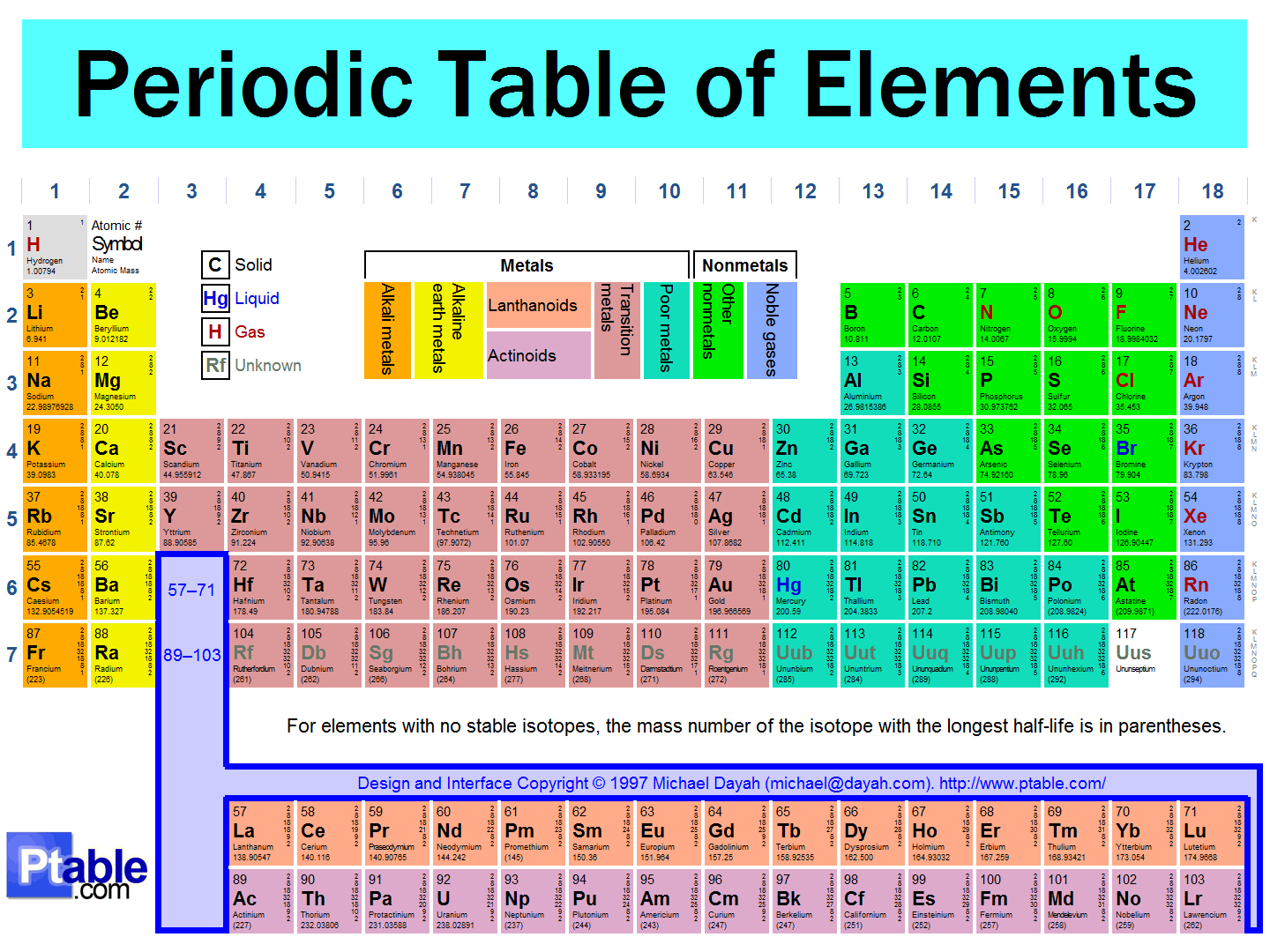
This class of elements are sometimes called "semiconductors."
a)
Metals
b)
Nonmetals
c)
Metalloids
d)
Groups
64.

What's a valence electron?
a)
electrons in the second energy level
b)
electrons in the outermost energy level
c)
the atomic number
d)
electrons in the first level
65.

Organic or Inorganic?
a)
Organic
b)
Inorganic
66.

Organic or Inorganic?
a)
Organic
b)
Inorganic
67.

Organic or Inorganic?
a)
Organic
b)
Inorganic
68.

Organic or Inorganic?
a)
Organic
b)
Inorganic
69.

Which organism do the owl and the weasel compete for in the food web?
a)
Hawk
b)
Spider
c)
Grasshopper
d)
Shrew
70.

Which of the following is a herbivore?
a)
cricket
b)
frog
c)
hawk
d)
shrew
71.
What might happen if you remove a primary consumer from the ecosystem?
a)
There would be more food for secondary consumers.
b)
The number of primary consumers would increase.
c)
The number of plants would increase.
d)
The number of secondary consumers would increase.
72.
A frog eats a fly. The frog and fly are demonstrating ________.
a)
mutualism
b)
competition
c)
predator/prey
d)
parasitism
73.
A tapeworm inside a dog is
a)
competition
b)
predation
c)
commensalism
d)
parasitism
74.

How many primary consumers are there in this food web?
a)
1
b)
2
c)
3
d)
4
75.

Makes its own food
a)
autotroph
b)
heterotroph
c)
herbivore
d)
biomass
76.
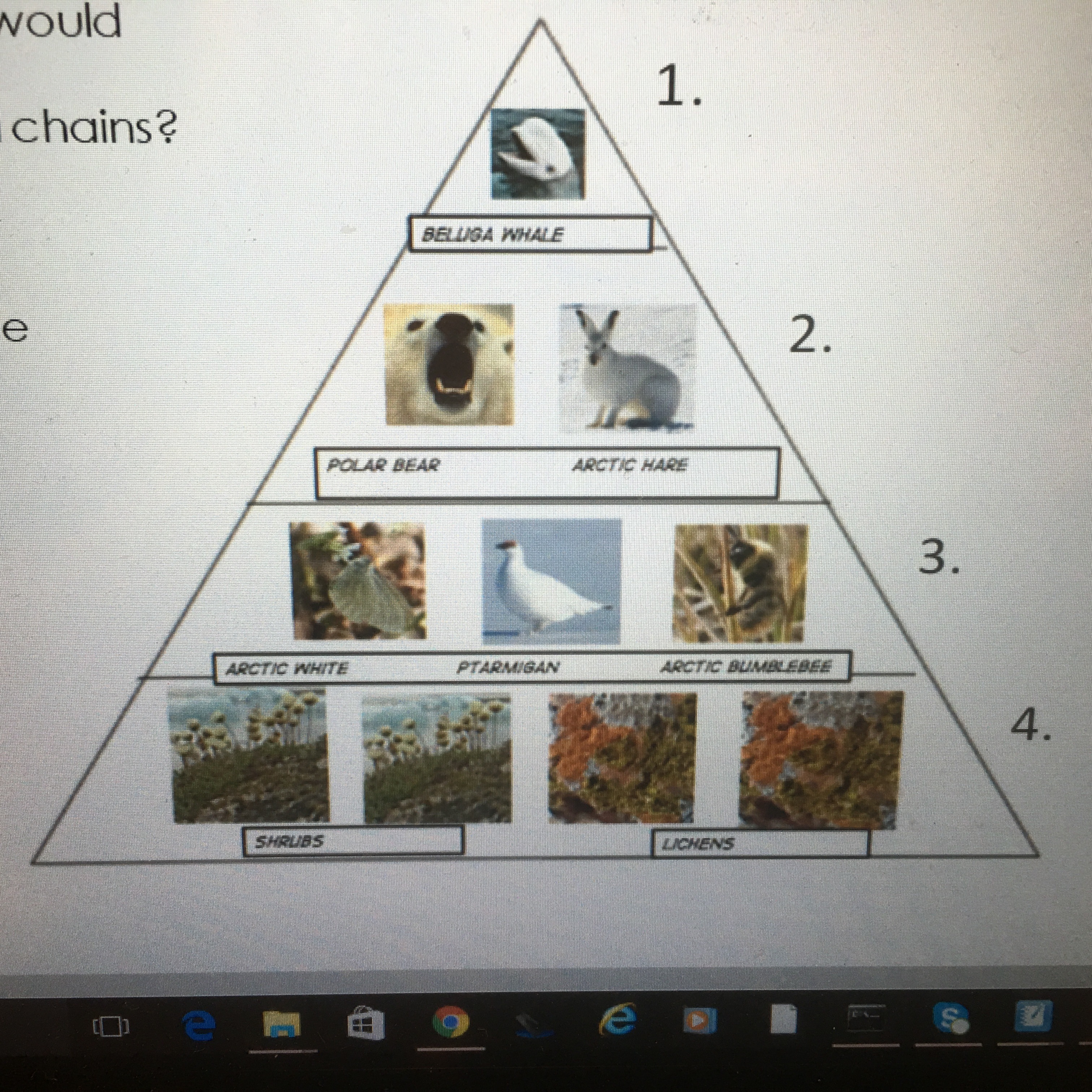
Based on the model, which consumers would receive the greatest amount of energy captured by the producers in their food chains?
a)
Beluga Whale
b)
Polar Bear and Arctic Hare
c)
Ptarmigan and Arctic Bumble
d)
Lichens and Shrubs
77.
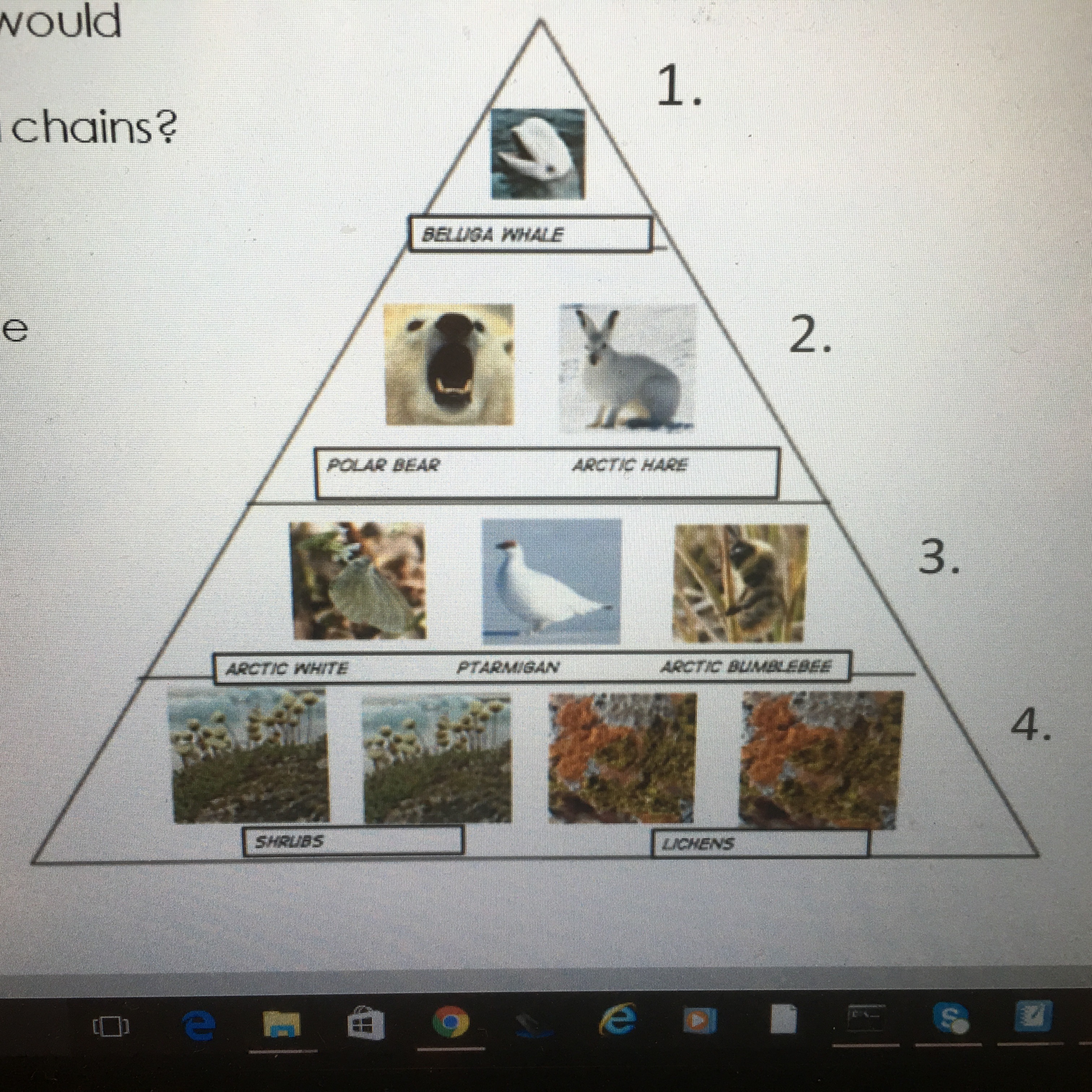
Which is the apex predator?
a)
Ptarmigan
b)
Polar Bear
c)
Lichens
d)
Beluga Whale
78.
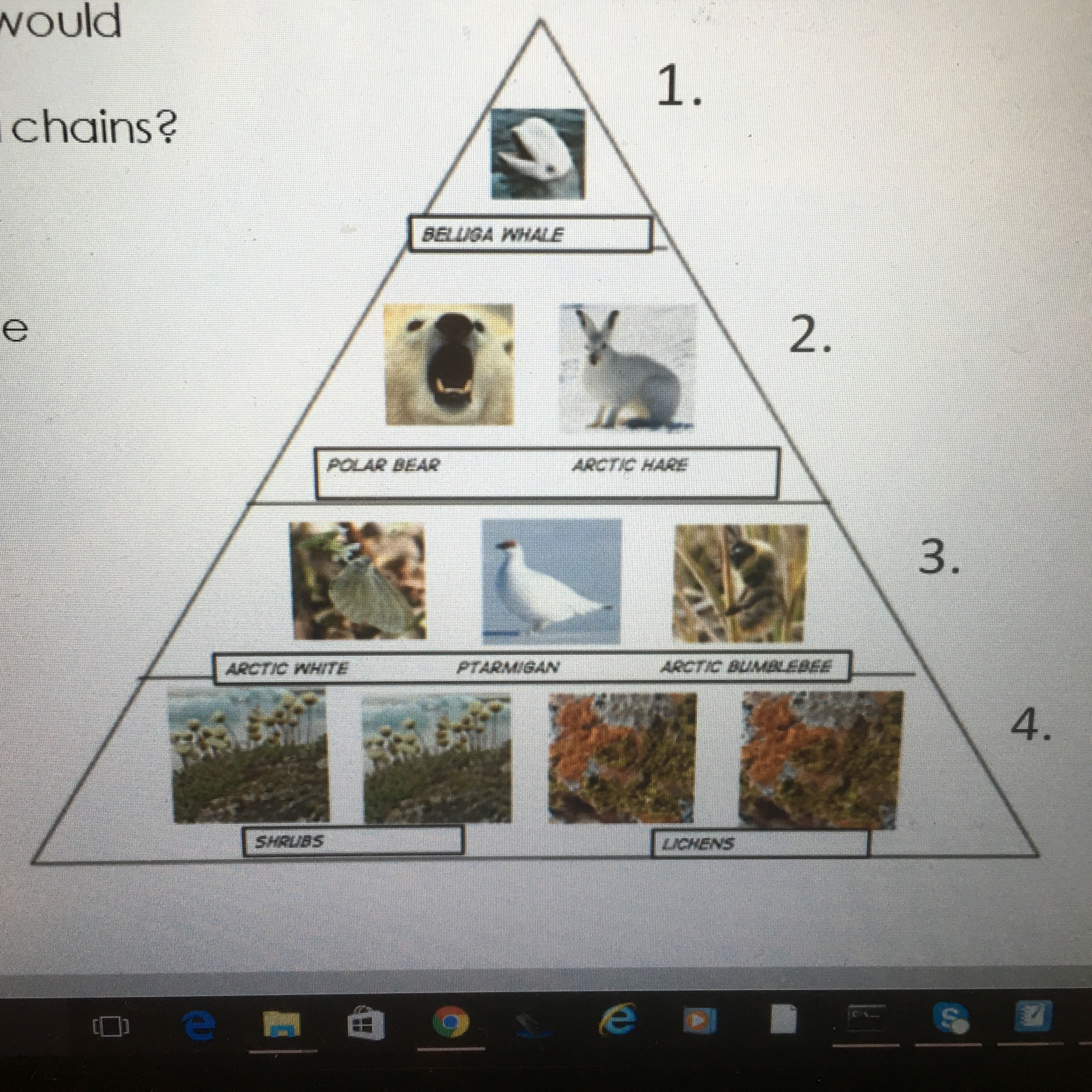
Which group are the producers?
a)
1 and 2
b)
3 and 4
c)
4
d)
3
79.
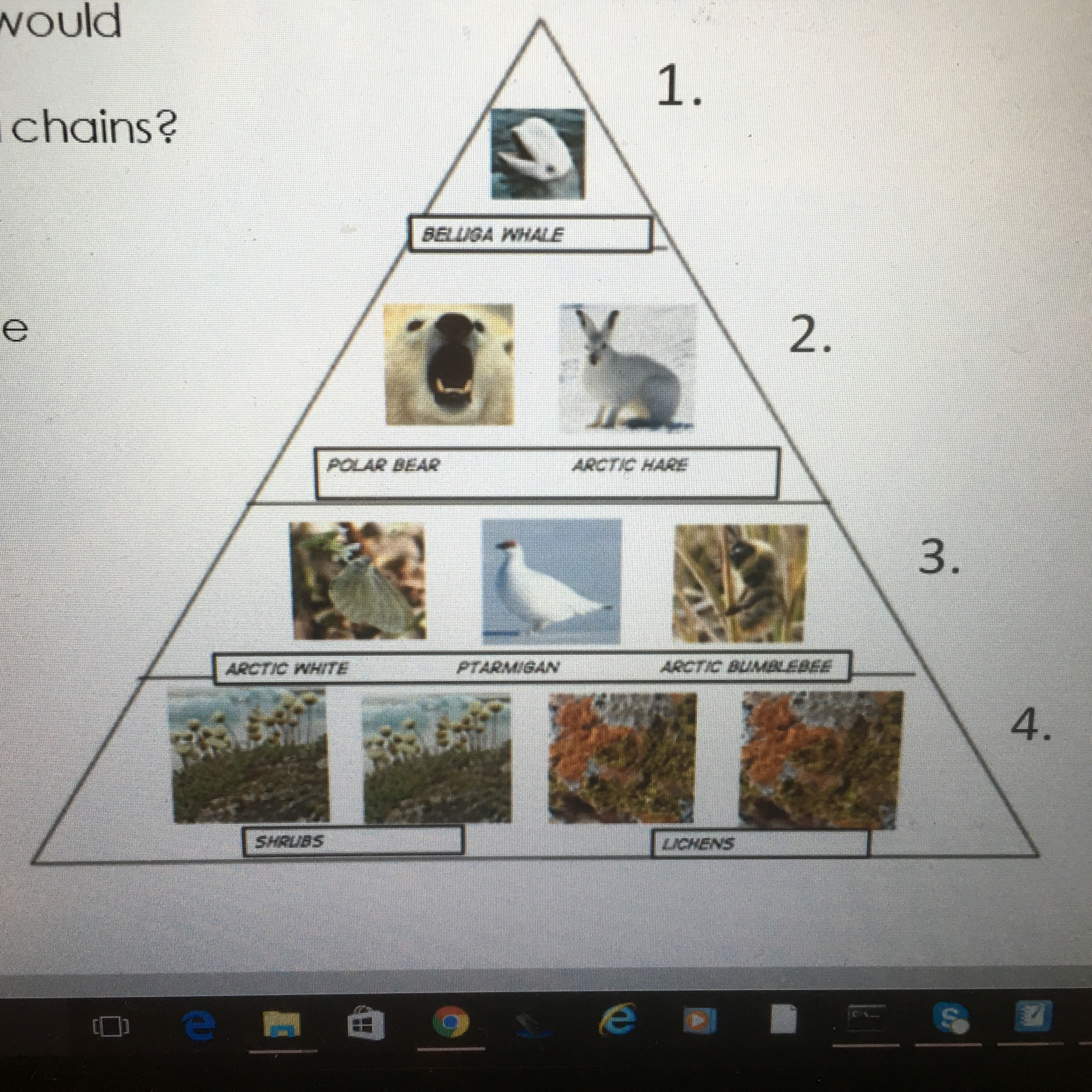
Which trophic level is the Primary consumer?
a)
1
b)
2
c)
3
d)
4
80.
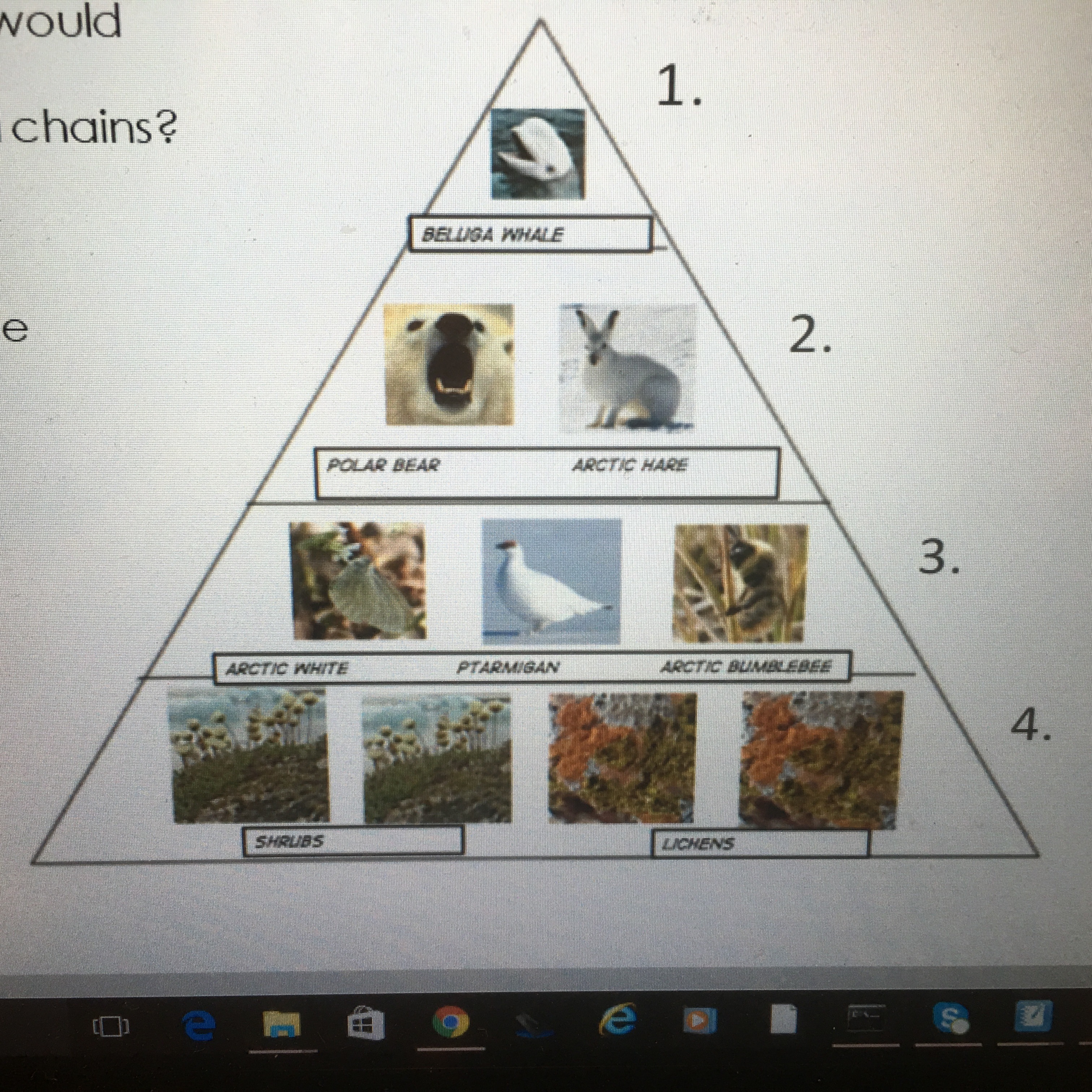
Which trophic level has the greatest amount of energy to use?
a)
Producers
b)
Primary consumers
c)
Secondary consumers
d)
Tertiary consumers
81.

Which option is biotic?
a)
Light
b)
Water
c)
Salt in the water
d)
Angel fish
82.

Which biome is more likely to survive a change in the environment?
a)
High (rich) biodiversity
b)
Low (poor) biodiversity
83.

What does biodiversity mean?
a)
Only one species in an area.
b)
The different amount of species in an area
c)
All abiotic life
d)
Nitrogen fixation
84.
Which option is abiotic?
a)
Plants
b)
Bacteria
c)
Water
d)
Fungi
85.
Succession that occurs in an area with NO SOIL
a)
ecological succession
b)
primary succession
c)
secondary succession
d)
pioneer speciles
86.
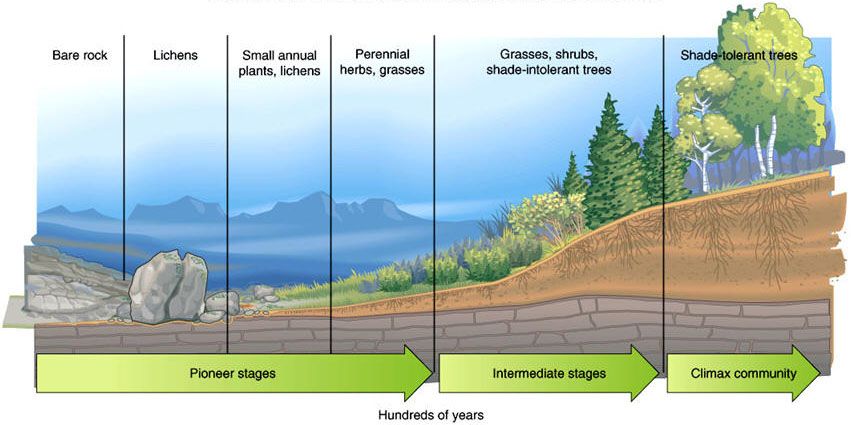
The picture shows what type of succession?
a)
primary
b)
secondary
c)
tertiary
d)
quadanary
87.
Starts with BARE ROCK followed by lichen
a)
primary succession
b)
secondary succession
c)
both types of succession
88.
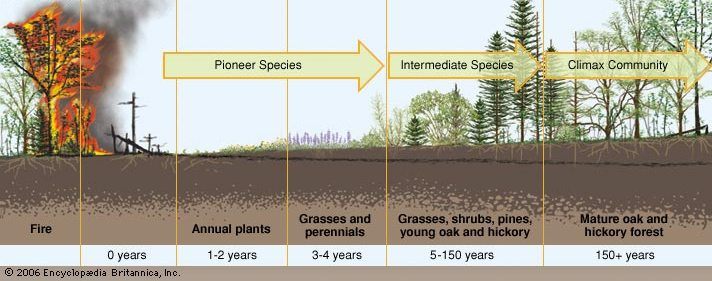
The picture shows what type of succession?
a)
primary
b)
secondary
c)
tertiary
d)
quadanary
89.

A dichotomous key for trees is provided. Hikers found a tree that has large brown cones and single sharp needles. What species of tree have the hikers found?
a)
Juniper
b)
Pine
c)
Spruce
d)
Fir
90.

A student discovers an arachnid with a segmented abdomen, long legs, and a tail with no stinger. The student uses the dichotomous key below to identify it. Which arachnid has the student found?
a)
Whip Scorpion
b)
Wind Scorpion
c)
Daddy long legs
d)
Scorpion
91.
About how many days does it take to moon to go through a complete cycle?
a)
7 days
b)
365 days
c)
29 days
d)
20 days
92.

When the Earth is between the moon and sun, it is most likely a:
a)
new moon
b)
full moon
c)
waxing crescent
d)
waxing gibbous
93.
Changes in the moon's appearance are
a)
phases
b)
eclipses
c)
stages
d)
cycle
94.
Define Waxing
a)
Moon is increasing and light part appears to be growing
b)
Completely illuminated
c)
dark side is facing earth
d)
Moon is decreasing and light part appears to be�shrinking
95.

Name the phase of the moon for letter a
a)
First Quarter
b)
Last Quarter
c)
Waxing Gibbous
d)
Waning Gibbous
96.

Name the phase of the moon for letter f
a)
Waning Gibbous
b)
Waxing Gibbous
c)
Waning Crescent
d)
Waxing Crescent
97.

Name the moon phase
a)
waning crescent
b)
waxing crescent
c)
waning gibbous
d)
waxing gibbous
98.

In the diagram given, what happens as we move to the left?
a)
Stars Get Larger
b)
Stars get Colder
c)
Stars get hotter
99.

Which star is the coldest?
a)
Yellow Star
b)
Red Star
c)
Orange Star
d)
Blue Star
100.
Which of these stars is hottest?
a)
Red Star
b)
Yellow Star
c)
Orange Star
d)
Blue Star
101.

As a whole, Giants are considered hotter than White Dwarfs.
a)
True
b)
False
102.
Which category is our Sun located in?
a)
White Dwarfs
b)
Supergiants
c)
Main Sequence
d)
Giants
103.
I am the control center of the cell and house the DNA. Who am I?
a)
Cytoplasm
b)
Nucleus
c)
Ribosome
d)
Golgi Apparatus
104.
What is the function of the cell membrane?
a)
Produces ATP
b)
Produces proteins and lipids
c)
Keep the organelles in place
d)
Control what enters and leaves the cell
105.
I am the tough exterior that protects plant cells and gives them their shape. Who am I?
a)
Cell wall
b)
Cell membrane
c)
Cytoplasm
d)
Mitochondria
106.
What is the function of chloroplasts?
a)
Helps plants make food from the sun
b)
Protects plant cells
c)
Store food and water
d)
Make energy for the cell
107.
Which of the following organelles will you NOT find in an animal cell?
a)
Cell membrane
b)
Cell wall
c)
Golgi Apparatus
d)
Lysosome
108.
I am located in the leaves of plants, but NOT the roots. Who am I?
a)
Lysosomes
b)
Chloroplasts
c)
Vacuole
d)
Mitochondria
109.

According to cell theory, where did this cell come from?
a)
another living cell
b)
energy from sun
c)
a multicellular organism
d)
the nonliving environment
110.
All cells come from___________ cells.
a)
pregnant
b)
pre-existing
c)
paternal
d)
pin size
111.
What is the difference between prokaryotic and eukaryotic.
a)
prokaryotic has a nucleus and eukaryotic does not
b)
eukaryotic has a nucleus and prokaryotic does not
c)
prokaryotic has DNA and eukaryotic does not
d)
eucaryotic have a cell wall and prokaryotic
112.
Which of the following statements supports the cell theory as it is stated today?
a)
Not all cells are alive.
b)
Cells must contain a nucleus.
c)
All abiotic are composed of more than one cell
d)
Cells come from preexisting cells through cell division.
113.
Is a plant cell prokaryotic or eukaryotic?
a)
eukaryotic
b)
prokaryotic
114.
What is responsible for delivering oxygen and removing carbon dioxide from the body?
a)
cell nucleus
b)
excretory system
c)
nervous tissue
d)
respiratory system
115.
The __________ is the main organ of the nervous system.
a)
heart
b)
lungs
c)
brain
d)
skin
116.
Which of the following body systems work together for support, protection, and movement?
a)
respiratory and cardiovascular
b)
skeletal and muscular
c)
skeletal and integumentary
d)
digestive and respiratory
117.
transports materials throughout the body
a)
nervous system
b)
lymphatic system
c)
circulatory system
d)
respriatory system
118.
The mouth/tongue, stomach, small intestine, and large intestine are part of the
a)
digestive system
b)
lymphatic system
c)
excretory system
d)
endocrine system
119.
Body system the breaks down nutrients for our bodies
a)
digestive system
b)
respiratory system
c)
excretory system
d)
endocrine system
120.

What is the elevation of point B?
a)
800 ft
b)
850 ft
c)
900 ft
d)
1000 ft
121.
How does fossil evidence support Wegener's hypothesis of continental drift?
a)
Similar fossils are found along continental margins that appear to join together.
b)
Fossils are found in areas where the present-day climate could not have supported the organisms that made the fossils.
c)
Similar fossils of giant, land-dwelling dinosaurs are found on continents separated by oceans.
d)
all of the above
122.
Plate movement is caused by ______________.
a)
the rotation of the Earth
b)
ocean tides
c)
convection currents in the mantle
d)
the moon's gravity
123.

Himilayan Mountains
a)
converging continent to continent
b)
earthquake in subduction zone
c)
converging ocean to continent
d)
transformational
124.

This is an example of -
a)
convergent
b)
divergent
c)
transform
125.
divergent
a)
come together
b)
divide
c)
touch
100 %

