wayground logo

Free Printable Worksheets

Font size

S
M
L
XL
Worksheets

Unit 8 Evolution

Total questions: 124

Worksheet time: 4hrs 8mins
Name
Class
Date
1.
Structures with the same parts have different functions; suggests that organisms share a common ancestry
a)
vestigial structures
b)
homologous structures
c)
adaptive radiation
d)
fossil
2.
Which of the following is an example of a vestigial structure?
a)
the wings of a red-tailed hawk
b)
the hind limbs of a house cat
c)
the fins of sharks
d)
the tailbone of a human
3.
The diagram shows fossils in different rock layers. Which of these statements about the age of these fossils is most likely correct?
a)
Fossil A and C are the same age
b)
Fossil B is older than fossil C
c)
Fossils A is older than fossil B
d)
Fossil D is older than fossil C
4.

What do we call a change in a species over time?

a)

Adaptation

b)

Evolution

c)

Extinction

d)

Environmental influences

5.
Ostrich wings are examples of
a)
homologous structures
b)
vestigial structures
c)
adaptations
d)
traits
6.
The environment around Manchester, England, changed during the Industrial Revolution.  How did this change affect peppered moths living in the area?
a)
Natural selection favored moths with dark wings because predators could not see them on the soot-colored trees.
b)
Natural selection favored moths with white wings that were easy for predators to see.
c)
Natural selection favored moths with white wings because predators could not see them on the soot-colored trees.
d)
Natural selection caused moths with white wings to become extinct.
7.
When an organism completely dies out, it is called.....
a)
Adaption
b)
Extinction
c)
Fossilization
d)
Mutation
8.
Two organisms that are closely related would have
a)
very similar DNA sequence
b)
exactly the same DNA sequences
c)
no proteins in common
d)
completely different DNA sequence
9.
Comparing human hemoglobin of chimpanzees, horses, kangaroos, and chickens, reveal that humans have the fewest amino acid differences with 
a)
Kangaroos
b)
Horses
c)
chickens
d)
chimpanzees
10.
Where the better adapted organisms survive to pass traits along to offspring.
a)
Evolution
b)
Natural Selection
c)
Extinction
d)
Artifical Selection
11.
Natural selection is when ____________ decides who survives and who doesn't
a)
nature
b)
humans
c)
animals
d)
years
12.
Why are advantageous traits more likely to be passed onto offspring?
a)
Because they are more likely to survive and reproduce.
b)
Because they come from dominant alleles.
c)
Because they come from recessive alleles.
d)
Because the trait is an acquired phenotype.
13.
Which best describes mutations?
a)
Always helpful
b)
Always harmful
c)
Can be helpful or harmful
d)
Always neutral
14.
Study of embryos of various organisms to show a common ancestor because of similarities in development
a)
natural selection
b)
embryology
c)
speciation
d)
evolution
15.
What does Darwin's theory of evolution suggest?
a)
species change over time
b)
extinct species are not related to living species
c)
different species can interbreed
d)
animals that look alike are most closely related
16.

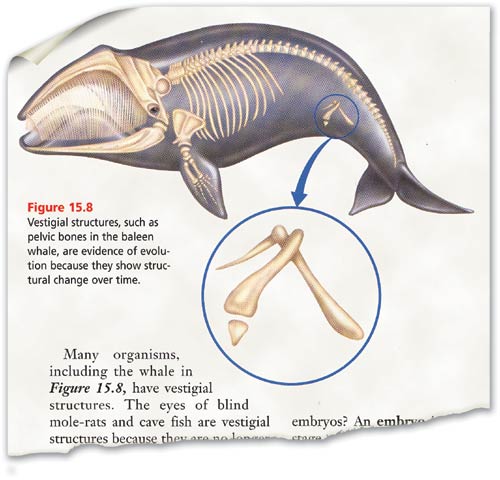
Whales are aquatic mammals that contain a pelvis (hip) bone. Even though it does not aid in its movement, the function must have been used by a common ancestor of the whale. Thus, the pelvis is referred to as a(n)

a)

vestigial structure

b)

analogous structure

c)

homologous structure

17.
A theory has significant evidence to support it.  True or False
a)
True
b)
False
18.
Where humans have bred organisms together based on traits we like.
a)
Evolution
b)
Natural Selection
c)
Extinction 
d)
Artificial Selection
19.
Genetic differences between organisms of the same species
a)
Variation
b)
Adaptation
c)
Behavior
d)
Environment
20.
The difference in the physical traits of an individual from those of other individuals in a group is called a(n)
a)
change
b)
adaption
c)
species
d)
variation
21.
An error in DNA copying that results in a new trait
a)
Homeostasis
b)
Mutation
c)
Natural Selection
d)
Selective Breeding
22.
A virus killed most of the seals in the North Sea (e.g. dropped the population from    8000 to 800).  In an effort to help preserve the species, scientists caught 20 of the   remaining seals and used them to start a new population in the northwest Pacific   Ocean.  Which of the following statements would accurately describe the new   population?  
a)
The new seal population is genetically less diverse than the original population 
b)
The new seal population is genetically more diverse than the original population
c)
There is equal genetic variety compared  to the original population 
d)
None of the answers
23.
Genetic drift is change in the allele frequency of a population due to...
a)
random chance
b)
natural selection
c)
non-random mating (sexual selection)
d)
artificial selection
24.
 Genetic Drift is more likely to happen in... 
a)
aquatic populations
b)
small populations
c)
terrestrial populations
d)
older populations
25.
Happens only in small populations, and is the change in the frequency of a gene variant (allele) in a population due to random sampling of organisms.
a)
Extinction
b)
Genetic Drift
c)
Bottleneck Effect
d)
Founder Effect
26.
This mechanism of evolution occurs when populations migrate.
a)
Extinction
b)
Gene flow
c)
Genetic drift
d)
Natural Selection
27.
Which of the following is true?
a)
Gene pool frequencies do not change as a result of migration in or out of a population.
b)
Gene flow occurs only as a result of isolation of a small population.
c)
Gene flow can cause new alleles to enter a population's gene pool.
d)
Gene flow is due the the selection of the most favorable traits.
28.
Which of the following cannot introduce new alleles into a population's gene pool?
a)
Mutataion
b)
Natural selection
c)
Gene Flow
d)
All of the above introduce new alleles into the population
29.

The founder effect will create a new population with ____________ genetic diversity than the original population.

a)

more

b)

less

c)

the same

d)

less or the same

30.

Selection pressures act on .......

a)

genotypes.

b)

phenotypes.

c)

allele frequencies.

d)

amino acid sequences

31.
A few deer wander out of their native woods into a completely new park where no deer had ever been before. They go on to create an entirely new population.
a)
Genetic Drift
b)
Natural Selection
c)
Non-random mating
d)
Mutation
32.
Yellow toucan birds seek out one another to make babies together and tend to avoid the green toucan birds.
a)
Genetic Drift
b)
Non-random mating
c)
Gene flow
d)
Mutation
33.
During gestation (pregnancy), a developing male pig had a change in his genetic code. The result was that he was able to walk and do karate.
a)
Genetic Drift
b)
Non-random mating
c)
Mutation
d)
Natural Selection
34.
Five hundred years after the deer had established a flourishing population in the park, a few of them venture back to their original woods and have babies with the deer there.
a)
Genetic Drift
b)
Mutations
c)
Non-random mating
d)
Gene flow
35.
Bats are common in Texas, especially in rocky regions. Bats with longer hang claws have demonstrated higher fitness because of their ability to cling to rock while resting.
a)
Adaptation
b)
Non-random mating
c)
Gene Flow
d)
Mutation
36.
Wolves from the Arizona mesa were transferred to the Colorado Rockies after a forest fire destroyed their habitat. They quickly became part of the local pack and had offspring.
a)
Mutation
b)
Natural Selection
c)
Genetic Drift
d)
Gene Flow
37.
7 Wild Mustangs were taken from the prairies of Iowa after a Texan Rancher purchased them and provided them with their own pasture. Those 7 Mustangs eventually became 122.
a)
Genetic Drift (small popultaion)
b)
Non-random mating
c)
Gene flow
d)
Mutations
38.
Logan was born with unique abilities for quick healing and awesome claws that stick out of his fingers.
a)
Gene flow
b)
Natural Selection
c)
Mutation
d)
Genetic Drift
39.
What does the image represent?
a)
Founder effect
b)
Bottleneck effect
c)
Natural Selection
d)
Mutations
40.
A scientist puts 100 houseflies in a sealed container; then sprays an insecticide into the container.  Ninety-six of the flies die.  Four survive.  The scientist lets the survivors mate and produce offspring, then repeats the experiment with 100 offspring.  Fifty-six of them survive the spray.  This experimental result is evidence of – 
a)
adaptive radiation 
b)
speciation
c)
natural selection
d)
extinction
41.
Why are advantageous traits more likely to be passed onto offspring?
a)
Because they are more likely to survive and reproduce.
b)
Because they come from dominant alleles.
c)
Because they come from recessive alleles.
d)
Because the trait is an acquired phenotype.
42.

All primates have the following features EXCEPT:

a)

large brains

b)

arms that rotate at the shoulders

c)

grasping hands

d)

bipedalism

43.

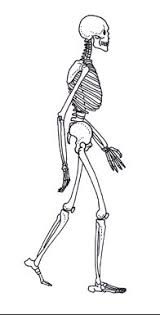
The ability to walk upright on two legs is called:

a)

bipedalism

b)

quadropedalism

c)

bicyclepedalism

d)

tripedalism

44.

Which hominid species is most closely related to Homo sapiens?

a)

Homo habilis

b)

Australopithecus afarensis

c)

Homo neanderthalensis

d)

Homo heidelbergensis

45.

Why was having a larger brain advantageous for early hominins?

a)

It made them able to walk upright

b)

It helped them to see better

c)

It increased intelligence and helped them hunt and survive

d)

It prevented them from making dangerous weapons

46.

According to the theory of evolution, which of the following statements is true?

a)

Humans evolved from chimpanzees

b)

Chimpanzees evolved from humans

c)

There is no evolutionary relationship between humans and chimpanzees

d)

Humans and chimps evolved from common ancestors

47.

If the fossil record of human evolution is incomplete, why do scientists still believe humans evolved from ape-like ancestors?

a)

Because existing evidence in the fossil record strongly suggests it

b)

Because scientists make a lot of money by promoting the theory of evolution

c)

Because the theory of evolution is more than 100 years old, which means it must be correct

d)

Because humans and apes look similar to one another

48.

Most recent ancestral species from which two different species evolved

a)

common ancestor

b)

relative dating

c)

fossil record

d)

analogous structures

49.

What is is the study of how and why plants and animals live where they do?

a)

Evolution

b)

Adaptive Radiation

c)

Biogeography

d)

Biogeology

50.
Change that occurs over time:
a)
Analogous
b)
Homologous
c)
Evolution
d)
Biogeography
51.
What happens when species produce too many offspring?
a)
Species share the limited resources 
b)
Species eat less so that all can survive
c)
Only those that are least fit can survive
d)
Only those that are best fit can survive
52.
The climate of a certain area is cold, and snow is found on the ground most of the year. Equal numbers of two populations of rabbits are introduced into this climate by a group of scientists. One of the populations is brown and the other is white. Predict what will happen over several generations.
a)
There will be equal numbers of brown and white rabbits
b)
There will be more brown rabbits that white rabbits
c)
There will be more white rabbits than brown rabbits
d)
There is no way to predict what will happen to the rabbit population
53.

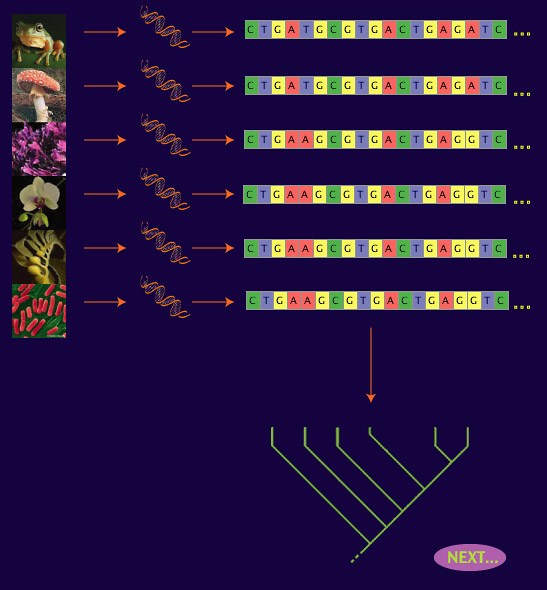
Below is DNA from 4 organisms. From this gene, which organism appears to be most closely related to the Dog?

a)

Chimpanzee

b)

Fly

c)

Mushroom

d)

none of these

54.

Homologous structure are used by biologist for evidence of common ancestry. Homologous structures have the same basic structure ___________________________

a)

, but different function

b)

and same function

55.

Which of the following is a common MISCONCEPTION of Natural Selection.

a)

Organisms that are well adapted to the environment grow and reproduce

b)

Organisms that are the most fit are always the strongest and fastest

c)

within a population mutations are random

d)

Natural selection occurs based on the environmental factors

56.

The Galapagos Tortoise shell evolving from round to "saddle-back" which allows the tortoise to stretch its neck, is most likely natural selection due to ________________ .

a)

genetic mutation

b)

change of food source

c)

addition of a predator

d)

a natural disaster like a hurricane

57.
Which species’ DNA is most similar to the DNA of the toothed whale? 
a)
Hippopotamus 
b)
Baleen Whale
c)
Grazing Mammals
d)
Camels
58.

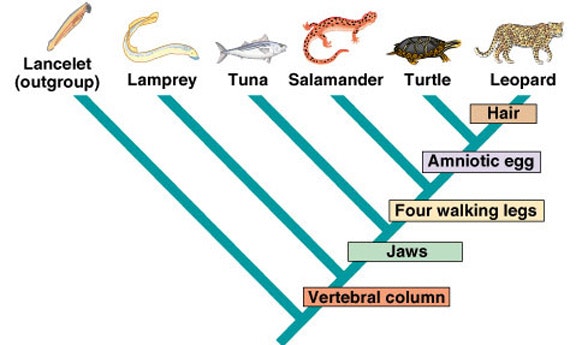
What trait separates lampreys from tuna on this cladogram?

a)

Hair

b)

Vertebral column

c)

amniotic egg

d)

jaws

59.
The picture shows the members of the Camelidae family. The physical features and the geographical origin of these animals provide evidence that - 
a)
they live in the same type of environment.
b)
have slowly evolved to become herbivores.
c)
have a common ancestor.
d)
exchanged DNA in the past.
60.

What do pigeons have in common with lizards?

a)

Mammary glands

b)

Claws

c)

Feathers

d)

Fur

61.

Which conclusion is supported by the cladogram?

a)

Liverworts and Ferns are the most closely related

b)

Cycads and Flowering Plants are the most closely related

c)

Moss and Cycads are the most closely related

d)

Liverworts and Flowering Plants are the most closely related
62.
Darwin wrote that organisms with traits that are best suited to the environment will ________________
a)
increase in number
b)
become extinct
63.
Study of embryos of various organisms to show a common ancestor because of similarities in development
a)
natural selection
b)
embryology
c)
speciation
d)
evolution
64.
If species A and B have very similar genes and proteins, what is probably TRUE?
a)
species A and B share a relatively recent common ancestor
b)
species A evolved independently of species B for a long period
c)
species A is younger than species B
d)
species A is older than species B
65.
A bumble bee has just enough weight to open up the snapdragon flower and get the nectar/pollen inside.  Other insects cannot do this. This adaption is an example of........
a)
convergent evolution
b)
co-evolution
c)
divergent evolution
d)
speciation
66.
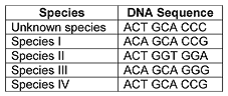
T12. According to this data, the unknown species is most closely related to: 
a)
Species I
b)
Species II
c)
Species III
d)
Species IV
67.
Flying fish, flying birds, and bats are examples of which of the following?
a)
convergent evolution & homologous structures
b)
convergent evolution & analogous structures
c)
divergent evolution & homologous structures
d)
divergent evolution & analogous structures
68.
What happens in divergent evolution? 
a)
organisms become more similar
b)
organisms become less similar
c)
species become more related
d)
adaptive radiation always occurs
69.

The wings of robins (a type of bird) and the wings of butterflies (a type of insect) are an

example of

a)

Divergent evolution

b)

Convergent evolution

c)

Punctuated evolution

d)

Adaptive radiation

70.
Two organisms that have a common ancestor but overtime evolved into different species. What is this called
a)
convergent
b)
divergent
c)
coevolution
71.

_____ is the evolution toward similar traits in unrelated species.

a)

Coevolution

b)

Divergent evolution

c)

Convergent evolution

d)

speciation

72.
What term describes the variety of different organisms found in an ecosystem?
a)
population
b)
biodiversity
c)
ecosystem services
73.
Which evidence of common ancestry is being studied in this visual?
a)
biogeography
b)
fossil record
c)
anatomical homology
d)
molecular homology
74.
Which evidence of common ancestry is being studied in this visual?
a)
biogeography
b)
fossil record
c)
anatomical homology
75.
Which evidence of common ancestry is being studied in this visual?
a)
biogeography
b)
fossil record
c)
anatomical homology
76.
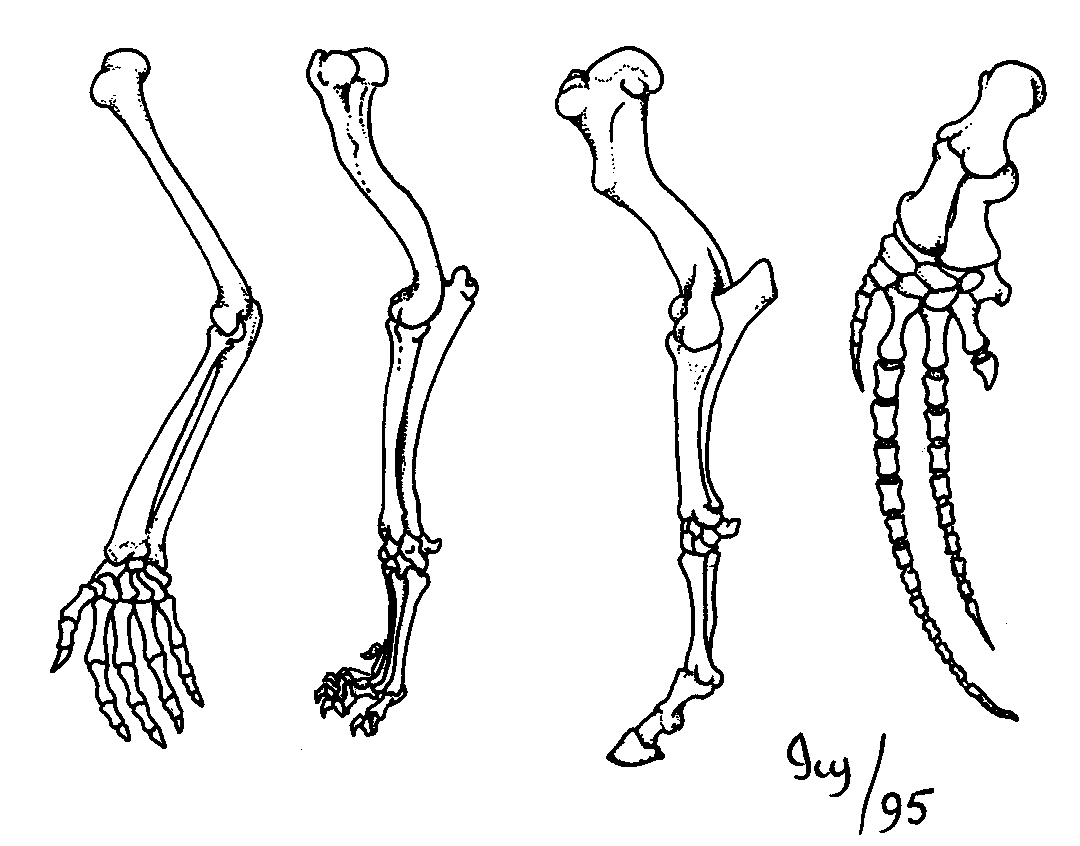
Scientists compare the limbs of organisms to look for evidence of common ancestry. These limbs provide evidence of common ancestry because they -
a)
perform the same function
b)
are the same size
c)
have the same basic structure
d)
are parts of the same animal
77.
The similarities among early stages of the embryos provide evidence that -
a)
these organisms evolved from a common ancestor
b)
the organisms all retained their gills and tails
c)
the organisms belong to the same species
78.
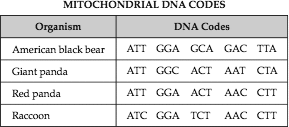
What conclusions can be made based on this table shown?
a)
the American black bear and the giant panda are most closely related
b)
the giant panda and the red panda are most closely related
c)
the red panda and the racoon are the most closely related
79.

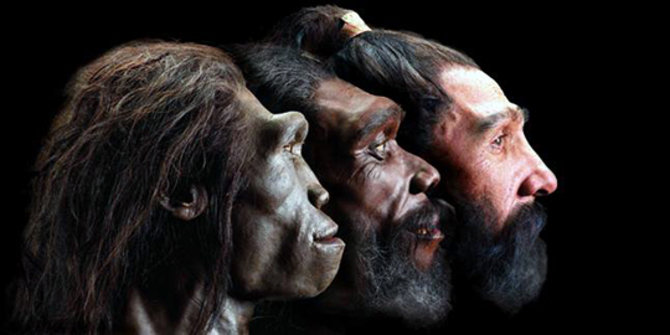
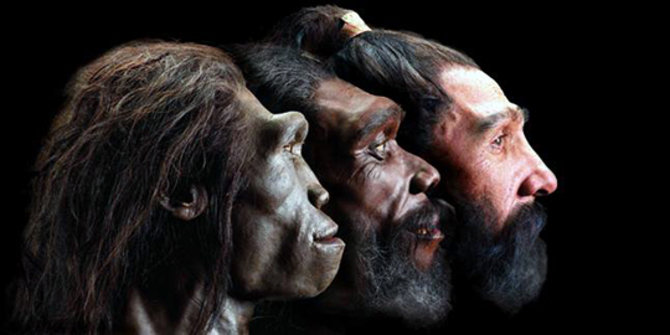
Scientists have found evidence that about 2.4 million years ago a gene regulating jaw muscles mutated and may have led to the more graceful human jaw we see today. The diagram below shows the skulls of 3 hominid species. Which statement below most closely explains the link between jaw size and hominid evolution?

a)

The jaws of hominids evolved to be smaller and less protruding over time as did the skull.

b)

The jaws of hominids evolved to be larger and more protruding over time.

c)

There appears to be no change in the jaws of hominids over time.

d)

The jaws of hominids changed over time due to a change in brain size

80.

How is the scientific theory of evolution supported by the comparison of the skulls and skeletons of modern humans and extinct hominids?

a)

By making the hip, spine, and skull comparisons, the age of different hominid specimens can be determined.

b)

Comparison of skull and skeletons provides evidence that humans and different hominid species interacted.

c)

Similarity in skull shapes, hands, and hips between extinct hominids and humans supports a common ancestry.

d)

Skull and skeleton comparisons can explain why hominids were inferior and became extinct while humans evolved.
81.
Which of the following correctly summarizes the physical changes that early humans went through over the past million years or so?
a)
Brain size increased as jaw size decreased
b)
Brain size decreased as jaw size increased
c)
Bipedalism increased as use of tools increased
d)
Bipedalism decreased as the use of tools increased
82.

Homo sapiens and other species of humans belong to the same group called:

a)

hominins

b)

primates

c)

homo sapiens

d)

Lucy

83.

All of these are advantages of bipedalism EXCEPT:

a)

Hands are free to carry food.

b)

Save energy when walking long distances.

c)

Hands are free to use tools.

d)

Easier to balance on two legs.

84.

This feature allowed hominins to work in groups, communicate, solve problems, and create new things.

a)

large brain

b)

color vision

c)

smaller teeth

d)

bipedalism

85.
Which kingdom do humans belong to?
a)
Plantae
b)
Fungi
c)
Animalia
d)
Protista
86.
The scientific name for an organism is made from the:
a)
class and family name
b)
genus and species name
c)
domain and kingdom name
d)
kingdom and phylum name
87.
Term given to describe the 2 name naming system is:
a)
dichotmous key
b)
binomial nomenclature
c)
2 scientific names
d)
binomial key
88.
The 8 levels of classification, most broad to most specific.
a)
Domain, Genus, Family, Order, Class, Phylum, Kingdom, Species
b)
Domain, Species, Kingdom, Genus, Phylum, Family, Class, Order
c)
Domain, Kingdom, Phylum, Class, Order, Family, Genus, Species
d)
Order, Kingdom, Species, Domain, Phylum, Family, Class, Genus
89.
A dichotomous key for trees is provided. Hikers found a tree that has large brown cones and single sharp needles. What species of tree have the hikers found?
a)
Juniper
b)
Pine
c)
Spruce
d)
Fir
90.
Members of this kingdom never have a cell wall
a)
Animalia
b)
Plantae
c)

Fungi

d)
Protista
91.
Molds, yeast, and mushroom belong to kingdom:
a)
Eubacteria
b)
Archaebacteria
c)
Protista
d)
Fungi
92.
The scientific name for water bear is Hypsibius dujardini.  What is its genus?
a)
Hypsibius 
b)
dujardini
c)
water 
d)
tardigrade
93.
If two species share the same class, they also share the same______.
a)
phylum
b)
order
c)
genus
d)
species
94.
Who is the closest relative to the birds?
a)
crocodiles
b)
sharks
c)
fish
d)
amphibians
95.
Who is the closest relative to the sharks?
a)
crocodiles
b)
sharks
c)
ray-finned fish
d)
amphibians
96.

The taxonomic level that would include the MOST number of species

a)

class

b)

kingdom

c)

phylum

d)

genus

97.

What characteristics are used to divide organisms into kingdoms?

a)

number of cells, nucleus, obtaining energy

b)

number of legs, mammal, reptile

c)

obtaining energy, habitat, nucleus

d)

number of cells, eggs or live birth, aquatic or terrestial

98.
Use the phylogenetic tree.  Which hypothetical organism is the most recent ancestor for Organisms A and G?
a)
1
b)
2
c)
3
d)
4
99.
What can a classification system show about an organism?
a)
absolute age of an organism
b)
what an organism is made of
c)
its relationship to other organisms
d)
which organisms are the strongest
100.
Which can be inferred by viewing a phylogenetic tree?
a)
ancestral lineages
b)
color variation in species
c)
food choice of an organism
d)
probability of extinction in a population
101.
Which domain is capable of living in extreme environments like hot springs, geysers, or very salty waters?
a)
Bacteria
b)
Archaea
c)
Eukarya
102.
Which domain includes all animals and plants?
a)
Archaea
b)
Eukarya
c)
Bacteria
103.
Which two kingdoms are entirely multicellular?
a)
Animalia and Plantae
b)
Animalia and Protista
c)
Protista and Plantae
104.
Which kingdoms have some organisms that can make their own food (autotrophic)?
a)
Plantae and Animalia
b)
Fungi and Plantae
c)
Protista and Plantae
105.
Animals must eat other organisms for food, so they are classified as--
a)
heterotrophs
b)
autotrophs
c)
eukaryotic
d)
prokaryotic
106.
Cladograms are constructed by grouping organisms together based on their____________ characteristics.
a)
shared
b)
different
c)
similar
d)
opposite
107.
What is a dichotomous key used for in science?
a)
To organize biomes
b)
Identify organisms
c)
Identify bacteria only
d)
None of these
108.
What is an organism called when it is able to produce its own food using light energy?
a)
Heterotroph
b)
Autotroph
c)
Eukaryote
d)
Prokaryote
109.
This kingdom is eukaryotic, uni and multicellular, heterotrophic, and has a cell wall made of chitin.
a)
Plant
b)
Fungi
c)
Animal
d)

Protist

110.
This kingdom is multicellular, autotrophic, and has a cell wall made of cellulose.
a)
Fungi
b)
Plant
c)

Animal

d)

Protist

111.
Kingdom with the following characteristics: eukaryotic cells, unicellular or multicellular, autotrophic or heterotrophic 
a)
Fungi
b)

Animal

c)

Protist

d)
Plant
112.
Nutrition that consists of obtaining organic nutrients from other living being
a)
Autotrophic
b)
Photosynthesis
c)
Interaction
d)
Heterotrophic
113.
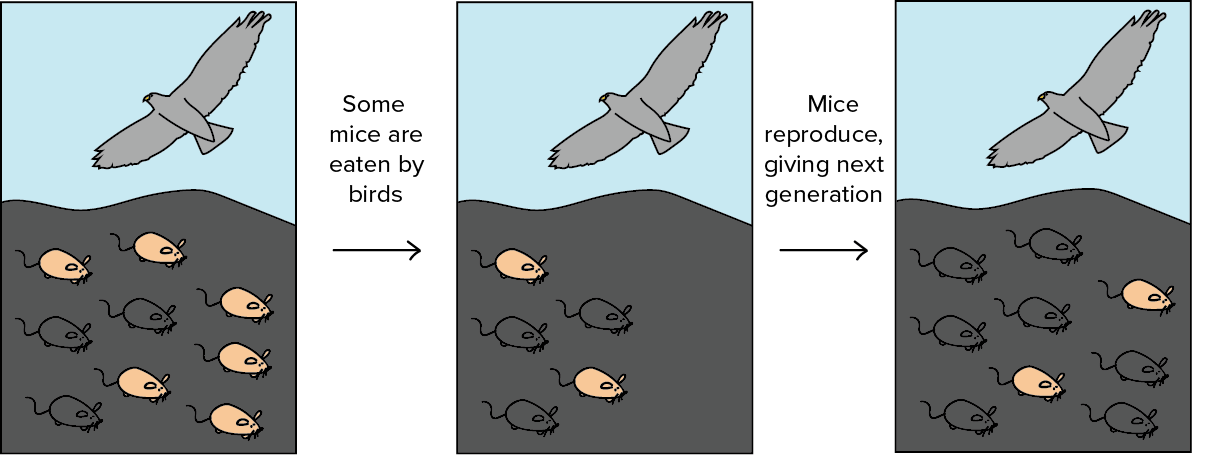
Why is the mouse population changing over time?
a)
The light mice can reproduce more successfully than the dark mice
b)
The hawks eat more dark mice than light mice because the dark mice taste better
c)
The hawks eat more light mice than dark mice because they can see the light mice more easily
d)
The hawks eat more dark mice than light mice because they can see the dark mice more easily
114.
What process is being shown in this image?
a)
Variation
b)
Natural Selection
c)
Selective Breeding
d)
Homeostasis
115.

Where do adaptations come from?

a)

The individual organism decides to adapt

b)

Mutations that give an organism an advantage in its environment

c)

Genetic recombination during meiosis

d)

Both mutations and genetic recombination are sources of adaptation

116.

"Organisms that are better adapted to the environment survive to pass traits to their offspring" is the definition of

a)

Natural Selection

b)

Evolution

c)

Selective Breeding

d)

Artificial Selection

117.

Which best describes the role of mutations in natural selection?

a)

Mutations help an organism to better survive in their environment

b)

An organism may acquire a helpful mutation by interacting with the environment

c)

A mutation may result in a beneficial trait that makes an organism more likely to survive and reproduce

d)

Organisms with certain traits are more likely to win competitions for mutations

118.

The more genetic variation a population has,

the more likely it is for some individuals to

a)

evolve

b)

migrate

c)

survive

d)

mutate

119.

Mutations are important because they bring about

a)

death of the organism in which they develop

b)

genetic variation needed for a population to evolve

c)

benefits for the individual, not for the population

d)

changes in genotype, but not phenotype

120.
Why do frogs and other organism reproduce so many eggs or offspring?
a)
so that their babies can have friends to play with
b)
the more offspring the more likely the offspring will survive
c)
the more offspring the less likely offspring will survive 
d)
the more offspring the less competition
121.

Why is competition important for natural selection?

a)

It shows which variations are more successful, allowing the organisms with those variations to survive.

b)

It causes organisms, regardless of which traits they have, to die out, reducing the population size.

c)

It causes organisms to get stronger due to having to outcompete other species.

d)

Competition is not important for natural selection.

122.

How do you "win" at natural selection?

a)

survive

b)

go extinct

c)

survive & reproduce

123.

Scientists can explore whether two different animal species have evolved from a common ancestor, using evidence from all of the sources below except

a)

analysis of strands of DNA

b)

comparisons of bones and muscles

c)

comparison of the experiences of each organism

d)

studies of embryos during development

124.
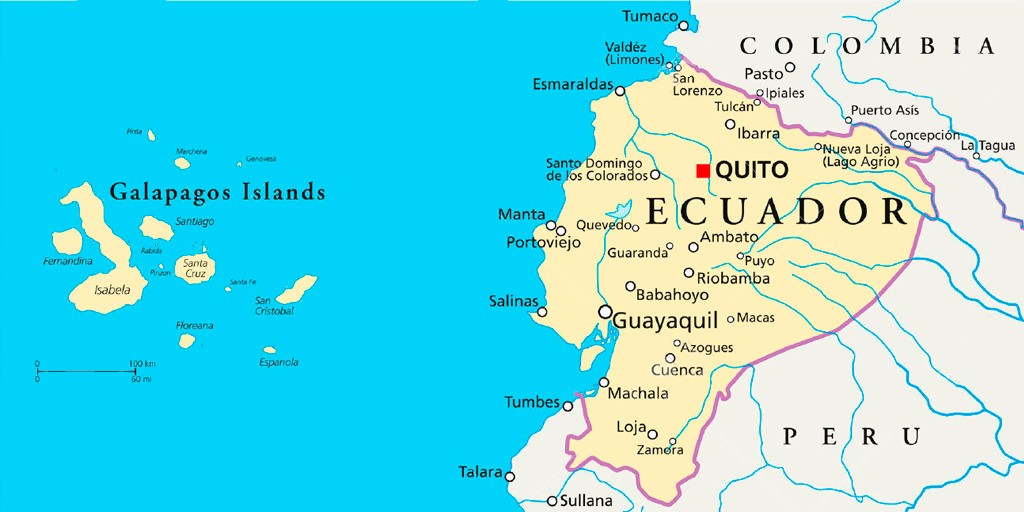
The Galapagos Islands, a small group of islands off the coast of Ecuador, is home to reptiles such as the giant tortoise and the iguana. The eastern islands are much older than the islands to the west.  Which statement about the origin of these reptiles is best supported by this information?
a)
The ancestor of each species came from different continents at different times.
b)
The common ancestors of the reptiles probably came from Equador.
c)
The common ancestor of each species evolved in Peru and came to the islands at the same time.