wayground logo

Free Printable Worksheets

Font size

S
M
L
XL
Worksheets

Keystone Biology Cumulative Review

Total questions: 121

Worksheet time: 1hrs 1mins
Name
Class
Date
1.
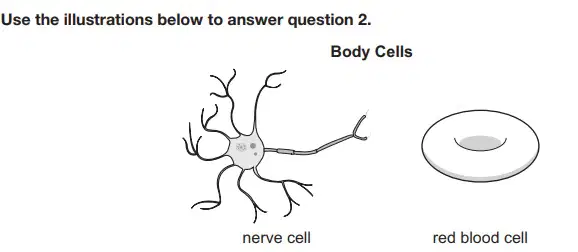
Which statement best explains why these cells have structural differences?
a)
A. The cells have different functions.
b)
B. The cells evolved in different organisms.
c)
C. One of the cells develops into the other type of cell.
d)
D. One of the cells is more primitive than the other cell.
2.
Life functions are performed at many levels of biological organization. Which level of biological organization is the simplest level at which a structure can support life functions?
a)
A. cell
b)
B. tissue
c)
C. organelle
d)
D. organ system
3.
A jackrabbit has large ears containing blood vessels that help it maintain a constant body temperature by adjusting heat exchange with the surrounding environment. Which characteristic of life is best described by this example?
a)
A. growth
b)
B. energy use
c)
C. organization
d)
D. homeostasis
4.
All living organisms must maintain homeostasis in order to survive. Which statement best describes one way humans maintain homeostasis?
a)
A. Temperature is regulated by giving off carbon dioxide.
b)
B. Water content is regulated by giving off carbon dioxide.
c)
C. Temperature is regulated by sweating.
d)
D. Water content is regulated by sweating.
5.
The shivering mechanism in bumblebees often serves the same purpose as it does in mammals. During which condition will the action of shivering most help a bumblebee to maintain homeostasis?
a)
A. decrease in available oxygen
b)
B. low environmental temperature
c)
C. uncontrolled rise in core temperature
d)
D. depletion of oxygen in muscle tissues
6.
Which of the following is essential to proper functioning of all prokaryotic and eukaryotic organisms?
a)

A. O2

b)

B. CO2

c)

C. ATP (ENERGY)

d)

D. NaCl

7.
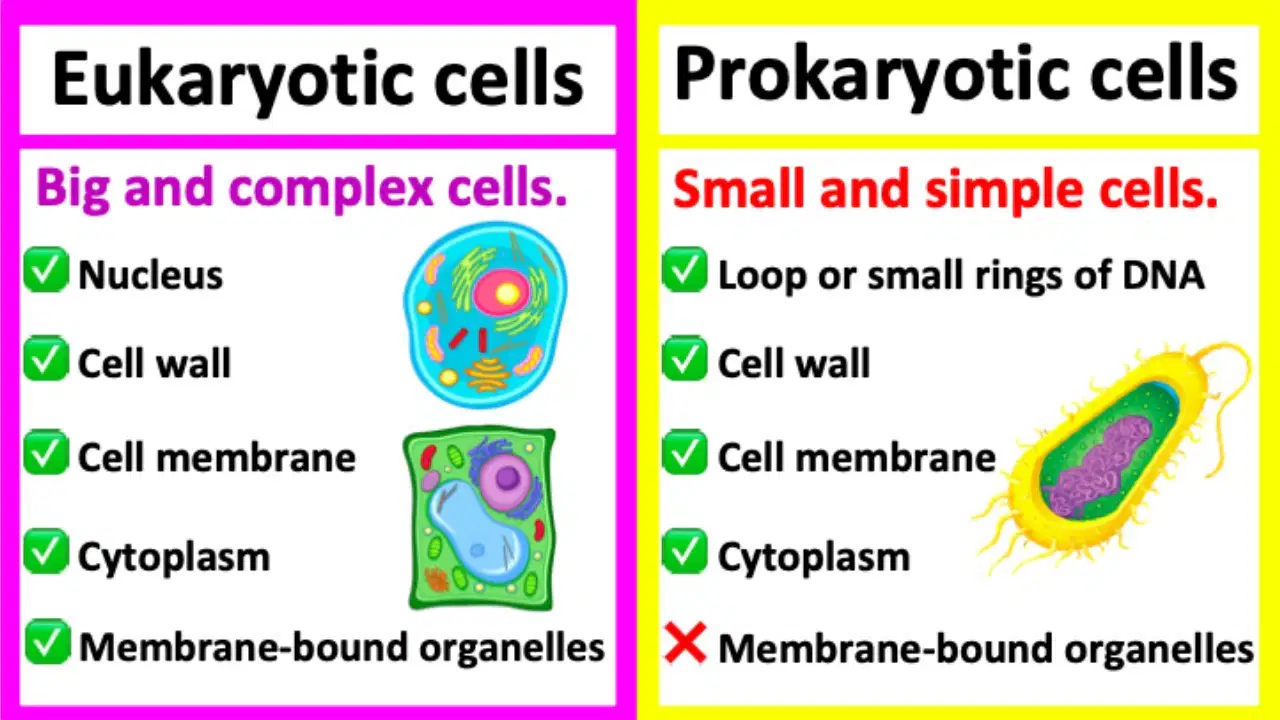
Which statement best describes a difference between prokaryotic cells and eukaryotic cells?
a)
A. The presence of both DNA and ribosomes in prokaryotic cells indicates that they are more complex than eukaryotic cells.
b)
B. The larger size of prokaryotic cells indicates that they are more complex than eukaryotic cells.
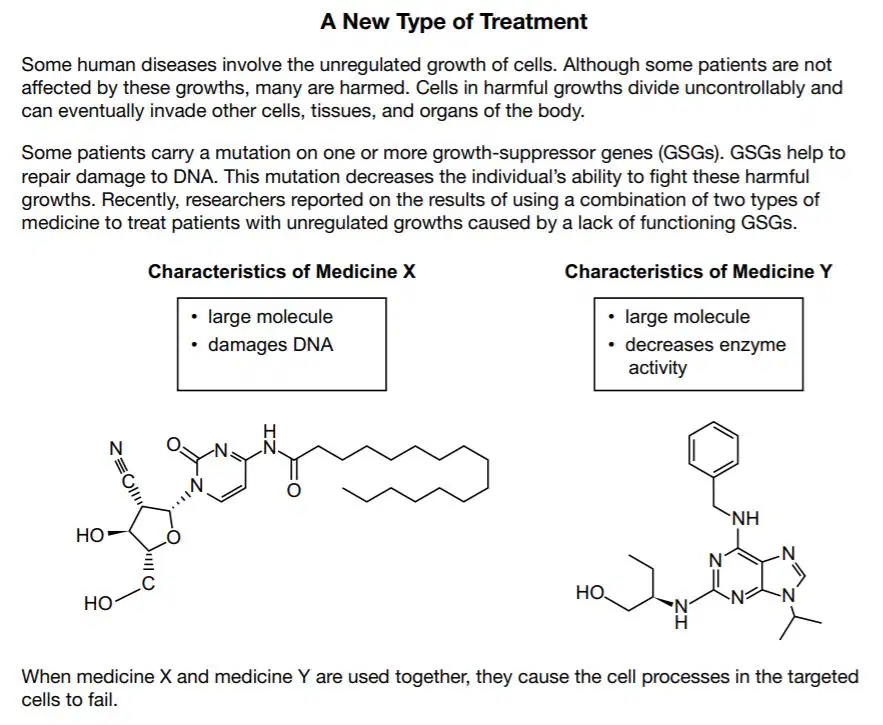
c)
C. The larger size of eukaryotic cells indicates that they are more complex than prokaryotic cells.
d)
D. The presence of membrane-bound organelles in eukaryotic cells indicates that they are more complex than prokaryotic cells.
8.
Which characteristic is shared by all prokaryotic and eukaryotic organisms?
a)
A. the ability to reproduce asexually
b)
B. the ability to make their own food
c)
C. the need for a source of energy
d)
D. the need for oxygen for respiration
9.
Which characteristic is shared by both prokaryotes and eukaryotes?
a)
A. contain genetic material
b)
B. make their own food
c)
C. have organ systems
d)
D. need oxygen gas to breathe
10.
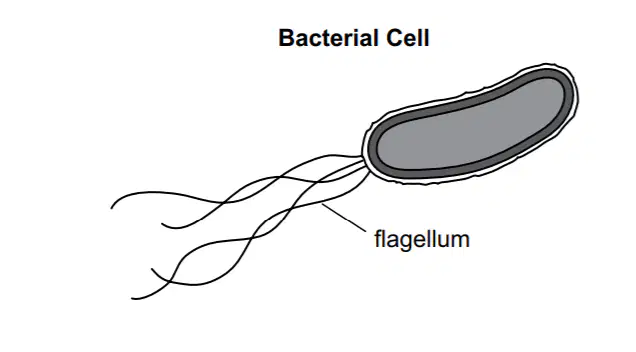
A scientist observes a single-celled organism with several long, whip-like tails. Which function do the whip-like tails most likely perform for the organism?
a)
A. defense against predators
b)
B. movement through an environment
c)
C. detection of the location of a light source
d)
D. measurement of atmospheric temperature changes
11.
Most prokaryotes and eukaryotes maintain a reserve of ATP. Which feature of prokaryotes and eukaryotes makes the ATP reserve necessary?
a)
A. They have cell membranes.
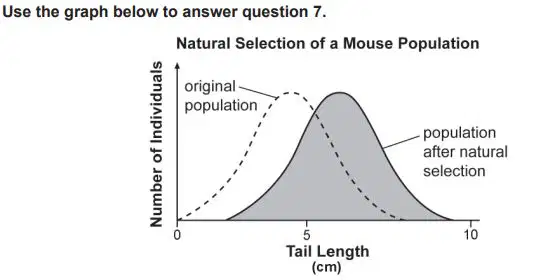
b)
B. They use energy to function.
c)
C. They can change over time.
d)
D. They have the ability to reproduce.
12.
Which of the following is a characteristic of life that all prokaryotic and eukaryotic organisms share?
a)
A. They have the ability to achieve movement
b)
B. They have the ability to use oxygen
c)
C. They have the ability to obtain and use NaCl
d)
D. They have the ability to obtain and use chemical energy
13.
2. Which statement best compares eukaryotic cells and prokaryotic cells?
a)
A. Eukaryotic cells are smaller than prokaryotic cells.
b)
B. Prokaryotic cells are more complex than eukaryotic cells.
c)
C. Prokaryotic cells contain a distinct central organelle, and eukaryotic cells do not.
d)
D. Eukaryotic cells contain membrane-bound organelles, and prokaryotic cells do not.
14.
The bacterium Acetobacter Aceti is found in acidic environments and has an acidic cytoplasm. For this reason, most of its proteins are able to function in acidic conditions. This property distinguishes Acetobacter Aceti proteins from those of most other organisms. Which characteristic does Acetobacter Aceti most likely share with other organisms?
a)
A. the method that the organism uses to reproduce itself
b)
B. the physical and chemical responses to environmental changes
c)
C. the type of organelle used to produce energy for cellular functions
d)
D. the process used to form proteins by transcription and translation
15.
Which property of water is most responsible for plants being able to transport water from their roots to their leaves?
a)

A. the attraction between molecules

b)

B. a capacity to dissolve many substances

c)

C. the ability to form a low-density crystalline structure when frozen

d)

D. a capacity to absorb large amounts of energy as temperature increases

16.
Trees are typically able to transport water from their roots to their stems and leaves. Which statement describes the property of water that most supports the transportation of water to all parts of a tree?
a)

A. Water forms a crystalline structure when it freezes.

b)

B. Water dissolves fewer substances than any other liquid.

c)

C. Water has strong attractions to itself and many other molecules.

d)

D. Water can absorb large amounts of energy with minimal temperature changes.

17.
Carbon can combine with many different elements but frequently combines with oxygen, hydrogen, and nitrogen to form organic molecules. Which statement best explains why carbon is able to form a large number of different molecules?
a)

A. Carbon forms only ionic bonds.

b)

B. Carbon can form only ring structures.

c)

C. Carbon can form four covalent bonds.

d)

D. Carbon forms small, simple structures.

18.
Which characteristic allows carbon atoms to form chains and rings with other carbon atoms?
a)

A. Carbon has several forms.

b)

B. Carbon can form four covalent bonds.

c)

C. Carbon is the fourth most abundant element in the universe.

d)

D. Carbon is a structural part of lipids, carbohydrates, proteins, and nucleic acids

19.
The opening of the stomata allows water to evaporate from inside the leaf in a process known as transpiration. As this occurs, water molecules cling to one another and pull water in a continuous stream up the stem of the plant from the roots to the leaves. Which property of water makes this movement possible?
a)

A. cohesion

b)

B. freezing point

c)

C. high specific heat

d)

D. temperature-dependent density

20.
Cells are largely made of organic compounds that contain carbon. Which property of the carbon atom makes it an essential component of organic compounds?
a)

A. Carbon is a nonmetal.

b)

B. Carbon oxidizes to carbon dioxide.

c)

C. Carbon is solid at room temperature.

d)

D. Carbon can form four covalent bonds.

21.
Which of the following is a property of water that allows a water strider to walk on the surface of water?
a)

A. solubility

b)

B. cohesion

c)

C. high specific heat

d)

D. low freezing point

22.

The element carbon has multiple bonding patterns. Which bonding pattern CANNOT be formed by carbon? (more than 4 bonds)

a)

A. C—C

b)

B. C—C—C

c)

C. C∙C∙C

d)

D. C≡C≡C

23.
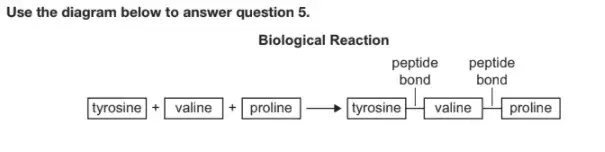
Which statement describes the formation of a protein molecule?
a)

A. Amino acids combine to form a protein chain.

b)

B. Fatty acid monomers dissolve to form a protein chain.

c)

C. Fatty acid monomers combine to form a protein chain.

d)

D. Amino acids dissolve monomers to form a protein chain.
24.
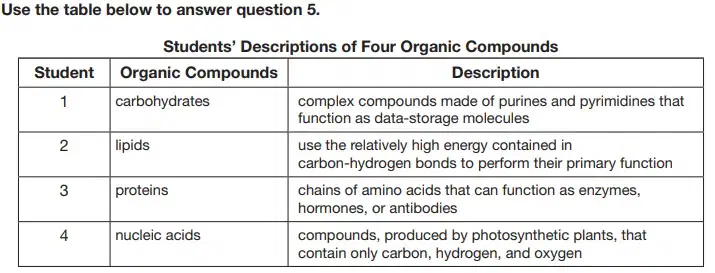
Which two students correctly described organic compounds?
a)

A. students 1 and 2

b)

B. students 2 and 3

c)

C. students 3 and 4

d)

D. students 2 and 4

25.
Which statement best describes the event shown in the diagram?
a)

A. Glucose is being synthesized in the chloroplast using nitrogen from plants.

b)

B. Amino acid monomers are joining together to form a protein macromolecule.

c)

C. A polymer in the nucleus is being broken into its individual monomer subunits.

d)

D. Lipid molecules are forming fatty acid chains in a dehydration synthesis reaction.
26.

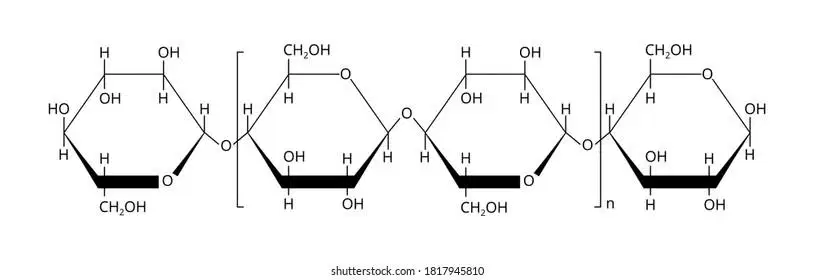
The title of the diagram is, Cellulose Model. The diagram shows a chain consisting of multiple three-part sequences of a rectangle connected to a hexagon connected to the letter “O”. There are six rectangles, six hexagons, and five “Os” shown. Cellulose is a carbohydrate and a polymer of glucose. Which statement best describes how cellulose is formed within living organisms? (the state forgot the image, I found a similar one I think)

a)

A. It is assembled by bonding individual atoms.

b)

B. It is constructed by connecting smaller monomer subunits.

c)

C. It is the product of the decomposition of a much larger molecule.

d)

D. It is the result of a physical change that alters the shape of a compound

27.
Many plants have a waxy coating on their leaves. Which statement describes the most likely structure and function of the waxy coating?
a)

A. The waxy coating is a protein that can help attract other organisms for pollination.

b)

B. The waxy coating is a protein that can help release waste molecules during transpiration.

c)

C. The waxy coating is a lipid that can help absorb more sunlight in hot environments.

d)

D. The waxy coating is a lipid that can help prevent excess water loss in dry environments.

28.
Which statement correctly describes how a protein is formed?
a)

A. A monosaccharide bonded to a side chain is broken apart.

b)

B. Amino acids are bonded together in a long chain to form a new molecule.

c)

C. A molecule containing glycerol bonded to three fatty acids is broken apart.

d)

D. A nitrogenous base, a sugar, and a phosphate group combine to form a new molecule.
29.
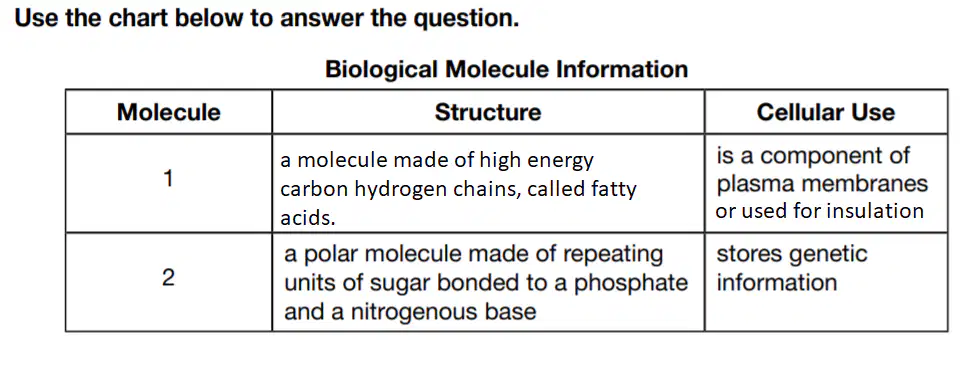
Which biological molecules are most likely represented by molecules 1 and 2?
a)

A. molecule 1: lipid molecule 2: nucleic acid

b)

B. molecule 1: lipid molecule 2: protein

c)

C. molecule 1: carbohydrate molecule 2: nucleic acid

d)

D. molecule 1: carbohydrate molecule 2: Protein

30.
Which process best describes the assembly of proteins from amino acids?
a)

A. Atoms are linked to form a compound.

b)

B. Monomers are linked to form a polymer.

c)

C. Atoms are added to a monomer until it becomes a polymer.

d)

D. Molecules are added to a compound until it becomes a monomer.

31.
Which statement best compares a carbohydrate and a nucleic acid?
a)

A. The sequence of monomers in a carbohydrate stores genetic information, and the bonds ina nucleic acid store energy a nucleic acid store energy a nucleic acid store energy

b)

B. The bonds in a carbohydrate store energy, and the sequence of nucleotides in a nucleic acid stores genetic information.

c)

C. A carbohydrate has a unique structure to assist diffusion across a plasma membrane, and a nucleic acid has a unique structure to assist chemical reactions.

d)

Option D. A carbohydrate has a unique structure to assist chemical reactions, and a nucleic acid has a unique structure to assist diffusion across a plasma membrane.
32.
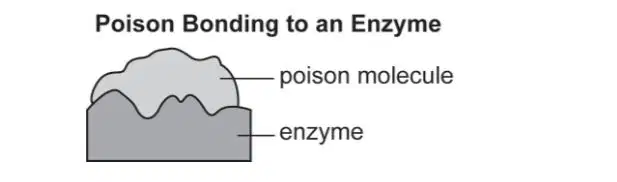
The diagram models how a poison bonds to the active site of an enzyme. Which function is the enzyme most likely unable to perform because of the attachment of the poison molecule?
a)

A. the release of stored chemical energy

b)

B. the donation of electrons to the substrate

c)

C. the supply of activation energy for a reaction

d)

D. the catalysis of the reaction with the substrate
33.
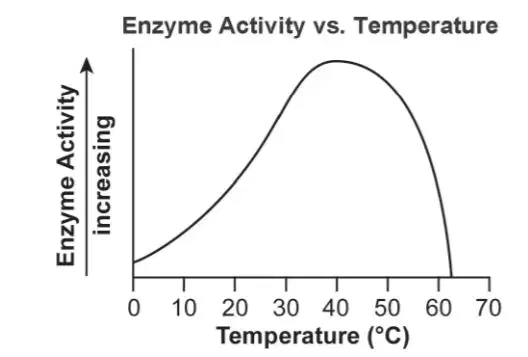
The graph shows how the activity of an enzyme changes at different temperatures. Which statement best describes what happens to the enzyme when the temperature of the reaction increases to 63°C?
a)

A. The enzyme is used up and the reaction stops.

b)

B. The enzyme begins to decrease the rate of the reaction.

c)

C. The enzyme continues to increase the rate of the reaction.

d)

D. The enzyme changes shape and can no longer speed up the reaction.

34.

Carbonic anhydrase is an enzyme involved in the reaction of carbon dioxide with water form a molecule that dissolves well in the liquid part of blood. How does carbonic anhydrase affect this reaction?

a)

A. by making the reaction reversible

b)

B. by changing chemical products of the reaction

c)

C. by increasing the time needed for the reaction to occur

d)

D. by decreasing the amount of energy needed to complete the reaction
35.
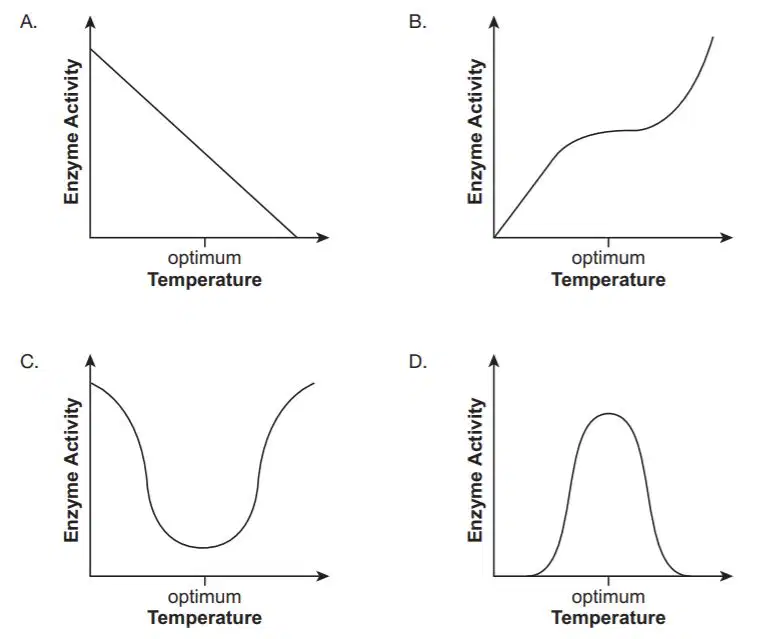
Which graph best shows how enzyme activity changes as the temperature is adjusted above and below the enzyme’s optimum temperature?
a)

graph A

b)

graph B

c)

graph C

d)

graph D

36.
The enzyme pepsin is found in the stomach. Which medicine is most likely to directly interfere with pepsin’s function?
a)

A. a medicine that affects pH

b)

B. a medicine that prevents clotting

c)

C. a medicine that blocks neural impulses

d)

D. a medicine that lowers cholesterol levels

37.
Which action must occur for an enzyme to catalyze a chemical reaction?
a)

A. A competitive inhibitor must first bind to an active site.

b)

B. A substrate must bind to an active site of the enzyme.

c)

C. A substrate must bind to an allosteric site of the enzyme.

d)

D. A noncompetitive inhibitor must first bind to an active site.

38.
Lipase is an enzyme that breaks down lipids in the digestive system of humans. It functions best at a pH range of 4.0 to 5.0. When a person takes an antacid tablet to relieve heart burn, the antacid increases the pH to around 7 in certain areas of the digestive system. Which initial effect would most likely be caused by a change in pH?
a)

. More lipids would be digested.

b)

B. Fewer lipids would be digested.

c)

C. The production of lipase molecules would increase.

d)

D. The production of lipase molecules would decrease.

39.
Which statement best describes a relationship between enzymes and a simple biological reaction?
a)

A. Enzymes will increase the amount of substrate formed during a biological reaction.

b)

B. Enzymes will decrease the amount of substrate formed during a biological reaction.

c)

C. A reaction rate can be increased when the specific enzyme for a biological reaction is present.

d)

D. A reaction rate can be decreased when multiple enzymes for a biological reaction are present

40.
Microbes in the digestive system break down food, which allows nutrients to be absorbed by the body’s cells. How will these body cells most likely be affected if an individual suffers from a high fever?
a)

A. The body cells will swell because an increase in temperature promotes greater water absorption.

b)

B. The body cells will stop absorbing nutrients because the heat melts the lipid bilayer of the plasma membrane.

c)

C. The body cells will shrivel because the heat eliminates the chemical gradients on either side of the plasma membrane.

d)

D. The body cells will bring in fewer nutrient molecules because the transport proteins lose their proper shape due to the high temperature.

41.
Each cell in the human body contains thousands of different enzymes responsible for regulating reactions within the cell. Which statement explains why a single enzyme is unable to regulate a variety of reactions?
a)

A. The binding of a product and an enzyme is specific.

b)

B. The binding of a substrate and an enzyme is specific.

c)

C. The enzyme is consumed by the products of the reactions.

d)

D. The enzyme is consumed by the substrates of the reactions

42.
Which statement is a hypothesis?
a)

A. The presence of an enzyme increased the reaction rate.

b)

B. The reaction rate increased 100% once the enzyme was introduced.

c)

C. Introducing an enzyme into a reaction did not increase the rate of the reaction.

d)

D. When an enzyme is introduced into a reaction the reaction rate will increase by 100%.

43.
The diagram shows an energy transformation that typically occurs in plant cell plastids. Which statement best describes this role of plastids in the plant cell?
a)

A. Chloroplasts transform light energy into chemical energy.

b)

B. Mitochondria transform light energy into chemical energy.

c)

C. Chloroplasts transform chemical energy into electromagnetic energy.

d)

D. Mitochondria transform chemical energy into electromagnetic energy

44.
Which statement best compares the energy transformations of photosynthesis and cellular respiration?
a)

A. Only photosynthesis uses oxygen to create energy.

b)

B. Only photosynthesis causes an increase in kinetic energy.

c)

C. Photosynthesis and cellular respiration both store energy in chemical bonds.

d)

D. Photosynthesis and cellular respiration both require chemical energy to make food.

45.
Which two statements correctly describe one similarity and one difference between cellular respiration and photosynthesis?
a)

A. statements 1 and 2

b)

B. statements 1 and 4

c)

C. statements 2 and 3

d)

D. statements 3 and 4

46.
Plant cells use sunlight to make their own food. Which structure allows plant cells to perform this function?
a)

A. nucleus

b)

B. vacuole

c)

C. chloroplast

d)

D. mitochondrion

47.
Which statement best explains why cellular respiration in plants and other organisms is dependent on photosynthesis?
a)

A. Photosynthesis is one of the final steps in cellular respiration.

b)

B. Photosynthesis provides the materials that fuel cellular respiration.

c)

C. Photosynthesis absorbs excess energy produced by cellular respiration.

d)

D. Photosynthesis absorbs materials that are catalyzed during cellular respiration.
48.
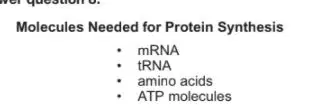
A plant cell uses the molecules in the list to synthesize a protein. What role do the ATP molecules play in the protein synthesis process?
a)

A. They provide energy.

b)

B. They increase activation energy.

c)

C. They convert energy into hereditary information.

d)

D. They absorb excess energy to prevent overheating.

49.
Which statement best describes a relationship between mitochondria and chloroplasts?
a)

A. Mitochondria release chemical energy from molecules and store it in chloroplasts.

b)

B. Chloroplasts release chemical energy from molecules and store it in mitochondria.

c)

C. Mitochondria convert chemical energy into light energy that can be used by chloroplasts.

d)

D. Chloroplasts convert light energy into chemical energy that can be used by mitochondria

50.
Which process uses the products of photosynthesis as reactants?
a)

A. active transport

b)

B. cellular respiration

c)

C. DNA replication

d)

D. protein synthesis

51.
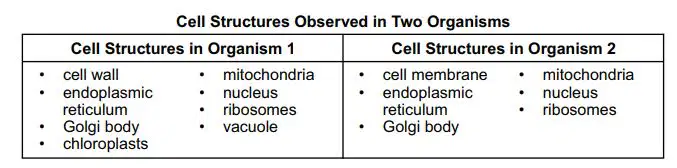
A student made lists of structures observed in cells from two different organisms. Which statement describes the most likely difference in the way that organism 1 and organism 2 obtain energy?
a)

A. Only organism 1 uses solar energy to make energy-rich compounds.

b)

B. Only organism 1 stores solar energy until it is needed for its life processes.

c)

C. Only organism 2 produces molecules for long-term energy storage.

d)

D. Only organism 2 transforms food energy into ATP during cellular respiration.

52.
A cell in the leaf of a green plant performs both photosynthesis and cellular respiration, often at the same time. Which statement best describes how these processes are related to each other?
a)

A. Both processes produce carbon dioxide.

b)

B. Both processes require energy directly from the Sun.

c)

C. Products of one process are used as some of the reactants for the other process.

d)

D. Thermal energy from one process is used as the energy source for the other process.

53.
A scientist observed that during the course of a chemical reaction the number of ATP molecules was reduced. What did the scientist most likely learn from the observation?
a)

A. The reaction produced water.

b)

B. The reaction consumed water.

c)

C. The reaction caused an output of energy.

d)

D. The reaction required an input of energy.

54.
Which process uses the products of photosynthesis as reactants?
a)

A. active transport

b)

B. cellular respiration

c)

C. DNA replication

d)

D. protein synthesis

55.
A scientist observed that during the course of a chemical reaction the number of ATP molecules was reduced. What did the scientist most likely learn from the observation?
a)

A. The reaction produced water.

b)

B. The reaction consumed water.

c)

C. The reaction caused an output of energy.

d)

D. The reaction required an input of energy
56.
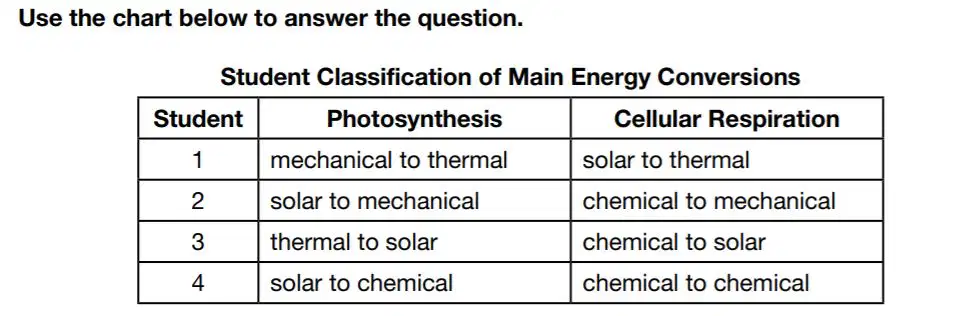
Four students classified the main energy conversions that occur during photosynthesis and cellular respiration. Which student best classified the energy conversions that occur in the two processes?
a)

A. student 1

b)

B. student 2

c)

C. student 3

d)

D. student 4

57.
A scientist observed that during the course of a chemical reaction the number of ATP molecules was reduced. What did the scientist most likely learn from the observation?
a)

A. The reaction produced water.

b)

B. The reaction consumed water.

c)

C. The reaction caused an output of energy.

d)

D. The reaction required an input of energy
58.
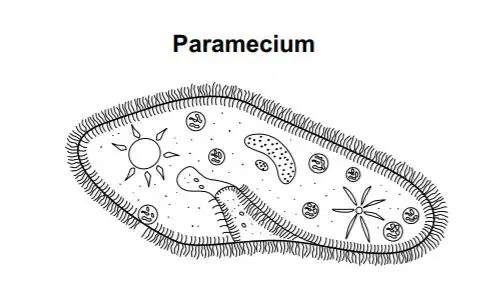
Which statement best describes a direct role of ATP in a paramecium?
a)

A. ATP provides the energy to move cilia.

b)

B. ATP stores the genetic code for replication.

c)

C. ATP signals the presence of other nearby organisms.

d)

D. ATP senses changes in the surrounding aquatic environment.

59.

Genetic mutations can cause chloroplasts in leaf cells to lack pigment and appear pale yellow . Which statement describes how a plant is most immediately affected by the presence of these genetic mutations?

a)

A . The ability to absorb minerals is reduced

b)

B . The rate of ATP production by mitochondria increases

c)

C . The sensitivity to changes in air temperature increases

d)

D . The amount of light energy transformed into chemical energy is reduced

60.

Muscle cells have a comparatively large number of mitochondria . Which action does this characteristic allow muscle cells to accomplish?

a)

A . rapidly release chemical energy for use

b)

B . rapidly convert carbohydrates into lipids

c)

C . reduce oxygen demand when releasing stored energy

d)

D . reduce carbon dioxide production when releasing stored energy
61.

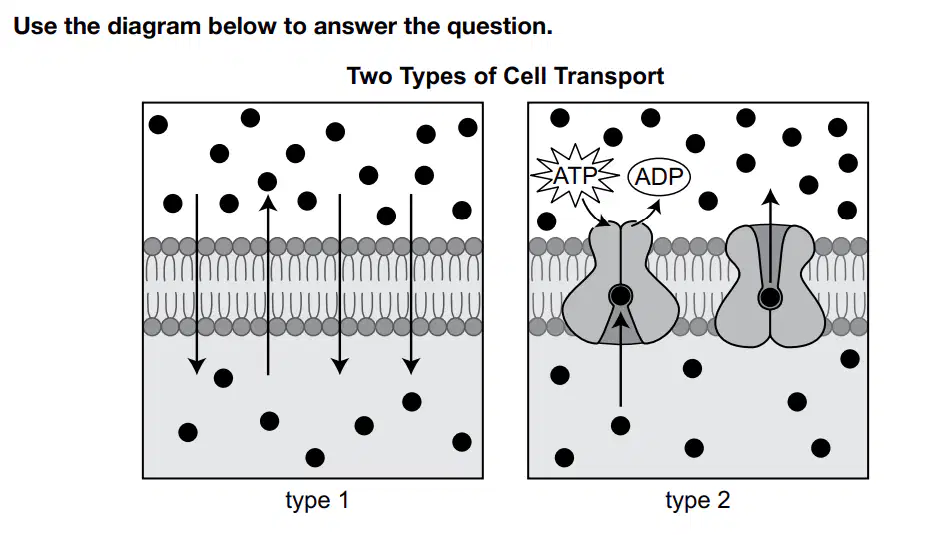
The diagram shows two types of cell transport . Which pair of statements best compares the two types of cell transport?

a)

A . Type 1 does not require energy and molecules move with their concentration gradient . Type 2 requires energy and molecules can move against their concentration gradient .

b)

B . Type 1 does not require energy and molecules can move against their concentration gradient . Type 2 requires energy and molecules move with their concentration gradient .

c)

C . Type 1 requires energy and molecules move with their concentration gradient . Type 2 requires energy and molecules can move against their concentration gradient .

d)

D . Type 1 does not require energy and molecules move with their concentration gradient . Type 2 does not require energy and molecules can move against their concentration gradient .

62.
Which activity would a cell be unable to perform if a mutation occurred that caused the Golgi apparatus to stop functioning?
a)

A. packaging proteins for transport out of the cell

b)

B. processing mRNA as it is transcribed from DNA strands

c)

C. providing the location for the delivery of amino acids by tRNA

d)

D. producing a template to guide the sequencing of amino acid chains
63.
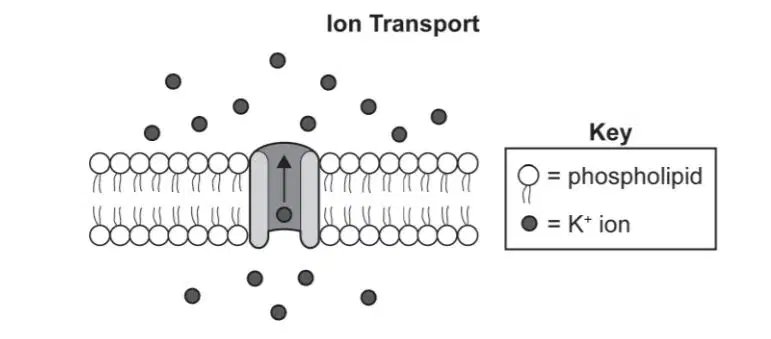
The diagram shows the movement of ions against a concentration gradient to an area of higher concentration. Which molecule provides the energy needed for this movement to occur in a cell?
a)

A. ATP

b)

B. mRNA

c)

C. protein

d)

D. lipid

64.
Which component of this membrane contains a hydrophobic region and acts as the primary barrier to most foreign substances?
a)

A. protein

b)

B. cholesterol

c)

C. carbohydrate chain

d)

D. phospholipid bilayer

65.
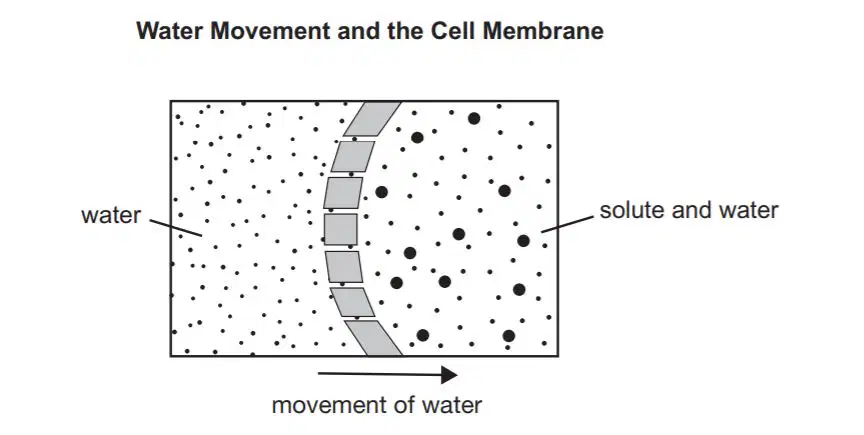
The relative concentration of solute inside and outside a cell can cause water molecules to move across the membrane. Which phrase would be an alternate title to the diagram?
a)

A. Exocytosis in a Cell

b)

B. Active Transport in a Cell

c)

C. Osmosis Across a Membrane

d)

D. Facilitated Diffusion Across a Membrane
66.
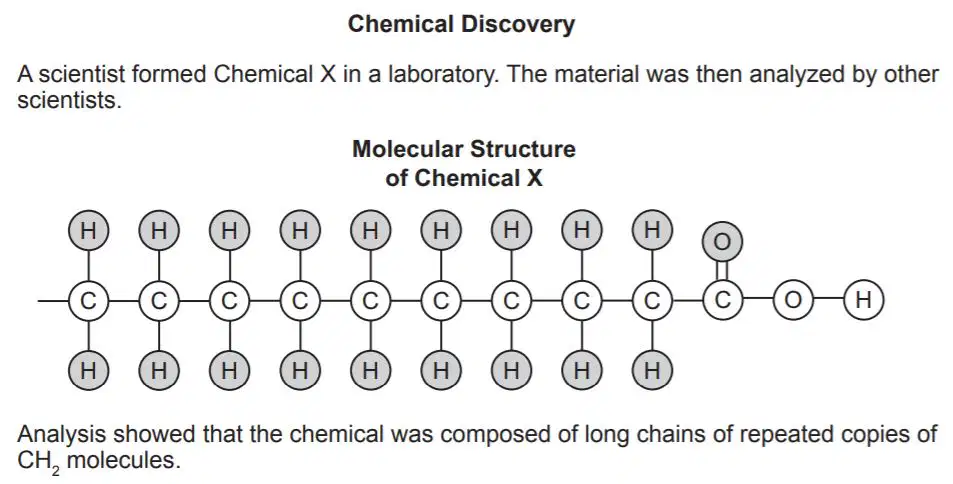
A researcher noticed that a similar CH₂ molecular structure was also located in the plasma membrane of an animal cell. This CH₂ molecular structure contained a negatively charged phosphate group. Which statement best describes the primary function of the CH2 and phosphate molecular structure located in the plasma membrane?
a)

A. It contains the genetic information needed for protein production.

b)

B. It catalyzes specifi c chemical reactions in the cytoplasm of a cell.

c)

C. It stores the energy that a cell needs to perform various life processes.

d)

D. It allows a cell to regulate the movement of materials into and out of a cell.
67.
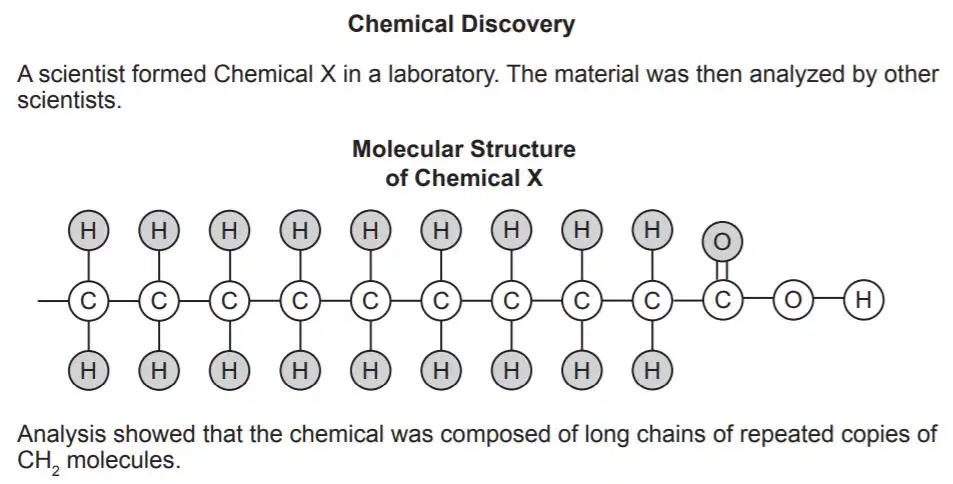
Which type of organic molecule was most likely formed by the scientist in the laboratory?
a)

A. lipid

b)

B. protein

c)

C. nucleic acid

d)

D. carbohydrate

68.
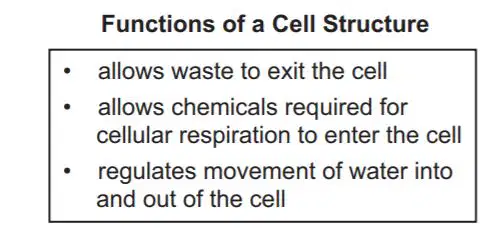
The functions of which cell structure are described in this list?
a)

A. a lysosome

b)

B. a mitochondrion

c)

C. the plasma membrane

d)

D. the endoplasmic reticulum

69.
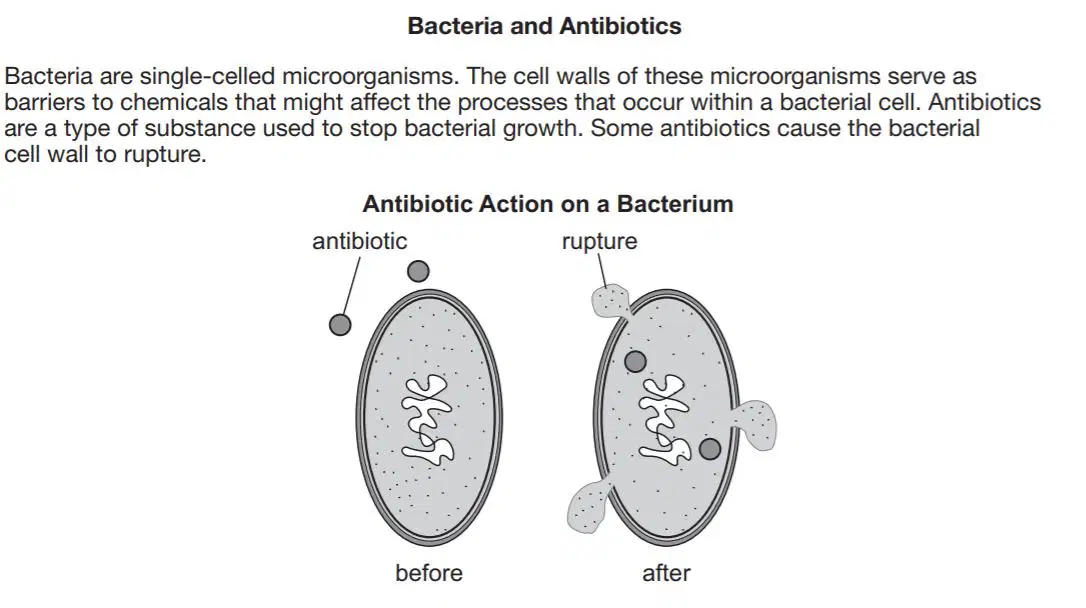
The function of which human organ is most like the cell walls of bacteria?
a)
A. skin
b)
B. liver
c)
C. heart
d)
D. pancreas
70.
Which statement best describes how antibiotics affect cellular homeostasis?
a)

A. Antibiotics remove chloroplasts from plant cells to cause starvation.

b)

B. Antibiotics interfere with the transport of intracellular and extracellular materials.

c)

C. Antibiotics increase the rate of DNA replication in human cells by forming nucleotides.

d)

D. Antibiotics decrease the rate of cellular respiration in animal cells by producing oxygen
71.
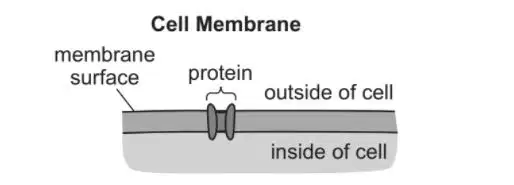
The indicated protein is part of a cell membrane. What is the most likely purpose of this protein?
a)

A. It allows passage of particles into and out of the cell.

b)

B. It manufactures phospholipids to repair membrane damage.

c)

C. It releases stored chemical energy in membrane carbohydrates.

d)

D. It attracts unbalanced electrical charges in the cell’s environment.

72.
Which statement best describes how active transport differs from passive transport?
a)

A. Only active transport requires ATP.

b)

B. Only active transport moves small particles.

c)

C. Only active transport relies on a plasma membrane.

d)

D. Only active transport allows substances to leave a cell.

73.
Which action is prevented by the plasma membrane?
a)

A. the flow of light into or out of the cell

b)

B. the flow of oxygen into or out of the cell

c)

C. unlimited flow of heat into or out of the cell

d)

D. unlimited flow of water into or out of the cell

74.
Which transport mechanisms require the formation of a vesicle to transport material into or out of a cell?
a)

A. diffusion and osmosis

b)

B. exocytosis and endocytosis

c)

C. exocytosis and calcium pumps

d)

D. diffusion and facilitated diffusion

75.
The Golgi apparatus is broken down during mitosis and then reformed. Which function would a cell be unable to perform during the time that its Golgi apparatus is broken down?
a)

A. copying genetic material to include in the new cell

b)

B. forming vesicles to import molecules into the cell

c)

C. processing and packaging proteins for cellular export

d)

D. correcting errors in the process of building a new cell
76.
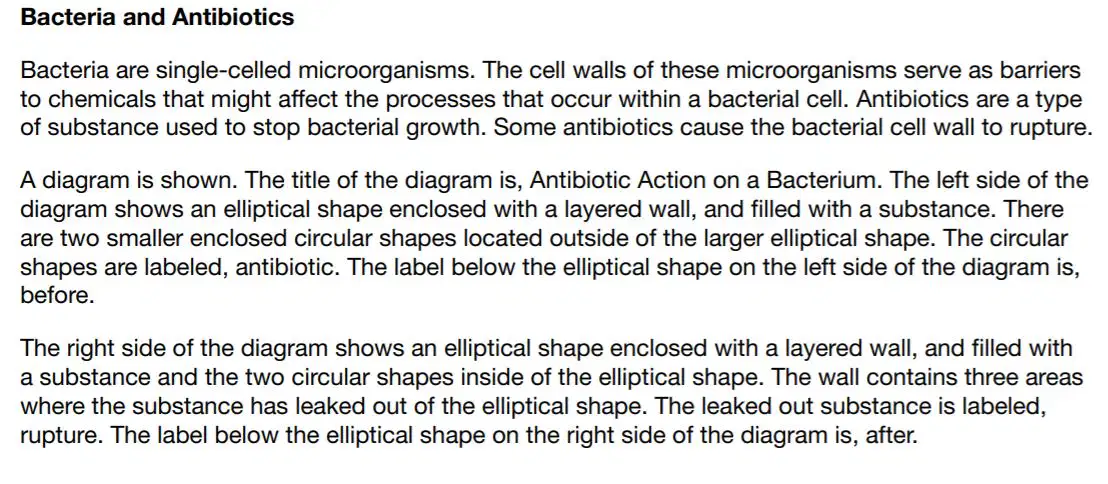
The function of which human organ is most like the cell walls of bacteria?
a)

A. heart

b)

B. liver

c)

C. pancreas

d)

D. skin

77.
Which statement best describes how antibiotics affect cellular homeostasis?
a)

A. Antibiotics remove chloroplasts from plant cells to cause starvation.

b)

B. Antibiotics interfere with the transport of intracellular and extracellular materials.

c)

C. Antibiotics increase the rate of DNA replication in human cells by forming nucleotides.

d)

D. Antibiotics decrease the rate of cellular respiration in animal cells by producing oxygen.

78.
Which statement best describes how channel and carrier proteins in the plasma membrane are similar?
a)

A. Both allow for the flow of molecules into and out of a cell.

b)

B. Both directly connect the membrane to the nucleus of a cell.

c)

C. Both use energy to continuously move water molecules out of a cell.

d)

D. Both cause the phospholipid bilayer to form a rigid membrane for a cell
79.
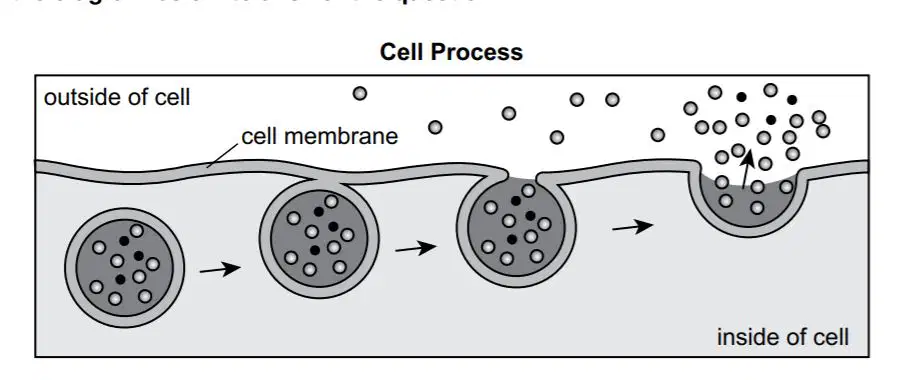
Which cell process is best modeled by the diagram?
a)

A. osmosis

b)

B. exocytosis

c)

C. passive transport

d)

D. facilitated diffusion

80.
In order for medicine X to produce the effects that the researchers observed, it must have entered into which part of the targeted cells?
a)

A. nucleus

b)

B. ribosomes

c)

C. Golgi apparatus

d)

D. rough endoplasmic reticulum

81.
Given the properties of the medicine Y molecule, which mechanism is most likely responsible for medicine Y’s entry into cells?
a)

A. osmosis

b)

B. exocytosis

c)

C. active transport

d)

D. simple diffusion

82.
Which of the following is most involved in providing structure for a plasma membrane?
a)

A. the number of protein channels embedded in the membrane

b)

B. the types of carbohydrates attached to proteins on the surface

c)

C. the types of proteins that are attached to the surface of the membrane

d)

D. the arrangement of the hydrophobic and hydrophilic ends of the phospholipids

83.
The shivering mechanism in bumblebees often serves the same purpose as it does in mammals. During which condition will the action of shivering most help a bumblebee to maintain homeostasis?
a)

A. decrease in available oxygen

b)

B. low environmental temperature

c)

C. uncontrolled rise in core temperature

d)

D. depletion of oxygen in muscle tissues

84.
How does a mitochondrion facilitate the movement of some materials between cells?
a)

A. It supplies the energy needed for moving molecules through membranes.

b)

B. It manufactures the proteins needed to form channels in cell membranes.

c)

C. It supplies digestive substances that break large molecules into smaller units.

d)

D. It produces fibers that attach to molecules and move them through the cytoplasm.

85.
Plants are dependent on water. In most plants, water is absorbed by the roots and then moves up the stem of the plant and into the leaves by capillary action. Which properties of water are most responsible for the capillary action in plants?
a)

A. adhesion and cohesion

b)

B. low density and adhesion

c)

C. polarity and high specific heat

d)

D. high specific heat and cohesion

86.
What is the main purpose for initiating the production of folding helpers in a cell?
a)

A. DNA replication

b)

B. forming gametes

c)

C. passive transport

d)

D. maintaining homeostasis

87.
What must be transmitted to new DNA strands during replication to maintain genetic information?
a)

A. individual atoms from existing DNA strands

b)

B. individual sugars from existing DNA strands

c)

C. the sequence of bases from existing DNA strands

d)

D. the sequence of phosphates from existing DNA strands

88.
Which statement best describes the process by which the millions of body cells that form a housefly can all contain the same genetic information?
a)

A. Original DNA is duplicated during replication and then distributed into two new cells.

b)

B. Original RNA is duplicated during replication and then distributed into two new cells.

c)

C. Original DNA is duplicated during replication and then distributed into four new cells.
d)

D. Original RNA is duplicated during replication and then distributed into four new cells.

89.
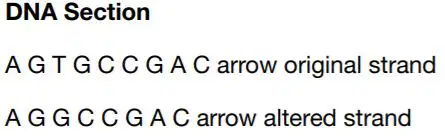
A section of DNA in a cell is altered. Which mutation is being illustrated in the DNA section below?
a)

A. deletion

b)

B. insertion

c)

C. duplication

d)

D. nondisjunction

90.
Which statement is true for all prokaryotic and eukaryotic organisms?
a)

A. Both types of organisms transform energy from sunlight into chemical energy.

b)

B. Both types of organisms assemble proteins through transcription and translation.

c)

C. Both types of organisms are made of cells, tissues, and organs that work together.

d)

D. Both types of organisms have DNA contained within a nucleus as genetic material.

91.
The DNA Replication diagram is incomplete. Which nucleotide sequence accurately shows the DNA strand that would be produced during DNA replication?
a)

A. TCCA

b)

B. AGGT

c)

C. UCCU

d)

D. AGGU

92.
In order to study genetic mutations, scientists must study genetic material. Which statement describes the genetic material scientists are most likely studying?
a)

A. They study alleles that contain chromosomes, which are RNA.

b)

B. They study alleles that contain genes, which are chromosomes.

c)

C. They study chromosomes that contain DNA segments, which are RNA.

d)

D. They study chromosomes that contain genes, which are DNA segments.

93.
Before cellular division, the cell must duplicate its DNA so that daughter cells will contain complete copies of the DNA. Which characteristic of DNA makes it most suitable as a molecule for this role?
a)

A. DNA is located in the nucleus.

b)

B. DNA is a large macromolecule.

c)

C. DNA is made of repeating sugar-phosphate subunits.

d)

D. DNA is made of two strands of complementary nucleotides.

94.
A mutation occurs at the midpoint of a gene, altering all amino acids encoded after the point of mutation. Which mutation could have produced this change?
a)

A. deletion of two nucleotides

b)

B. deletion of three nucleotides

c)

C. insertion of six nucleotides

d)

D. insertion of twelve nucleotides

95.
A genetic mutation involving a single base causes an error that affects the sequence of the next 500 amino acids in a protein. Which type of mutation could have produced this type of error in the protein?
a)

A. silent

b)

B. nonsense

c)

C. frame-shift

d)

D. substitution

96.
A scientist observes that a certain trait is determined by a single allele. An organism inherited one version of the trait from one parent and another version from the other parent. Both versions of the trait are expressed in the phenotype of the offspring. Which pattern of inheritance best classifies the observed trait?
a)

A. dominance

b)

B. sex-linkage

c)

C. co-dominance

d)

D. incomplete dominance

97.

An individual of a plant species shows a certain physical characteristic that requires two copies of the same allele to be expressed . Based on this information, how would the allele for the characteristic most likely be classified?

a)

A. dominance

b)

B. sex-linkage

c)

C. polygenic

d)

D. recessive

98.
The genetic material of two different individuals of the same species is analyzed. One individual has brown eyes. The other has blue eyes. Which characteristic for eye color would be the same for both individuals?
a)

A. the allele

b)

B. the DNA sequence

c)

C. the amount of pigment

d)

D. the location of the gene

99.
Which statement best describes the relationship between an allele and a gene?
a)

A. An allele is a variation of a gene that can be expressed as a phenotype.

b)

B. An allele is the part of a gene that attaches to messenger RNA molecules.

c)

C. An allele is a segment of a DNA molecule that controls replication of a gene.

d)

D. An allele is the primary protein made by a gene found in a developing embryo.

100.
A trait in cows is determined by two alleles of a single gene: allele R is dominant, and allele r is recessive. What is the probability of the dominant trait being expressed in the offspring of one RR parent and one rr parent?
a)

A. 25%

b)

B. 50%

c)

C. 75%

d)

D. 100%

101.
The genetic material of two different individuals of the same species is analyzed. One individual has brown eyes. The other has blue eyes. Which characteristic for eye color would be the same for both individuals?
a)

A. the allele

b)

B. the DNA sequence

c)

C. the amount of pigment

d)

D. the location of the gene

102.
The presence of a specific trait is genetically inherited. There are only two possible outcomes for this trait: an individual either inherits the trait or does not inherit the trait. Which statement best describes how parents influence this trait?
a)

A. Each parent contributes two genes for this trait.

b)

B. Each parent contributes one allele for this trait.

c)

C. Each parent contributes two chromosomes for this trait.

d)

D. Each parent contributes one nitrogenous base for this trait.
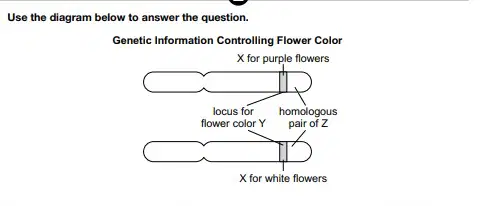
103.

Look at the diagram at the left.

a)

A .

X: allele

Y: flower color gene Z: chromosome

b)

B.

X: gene

Y: flower color allele Z: chromosome

c)

C.

X: allele

Y: flower color chromosome

Z: strand of DNA

d)

D.

X: gene

Y: flower color allele Z: strand of DNA
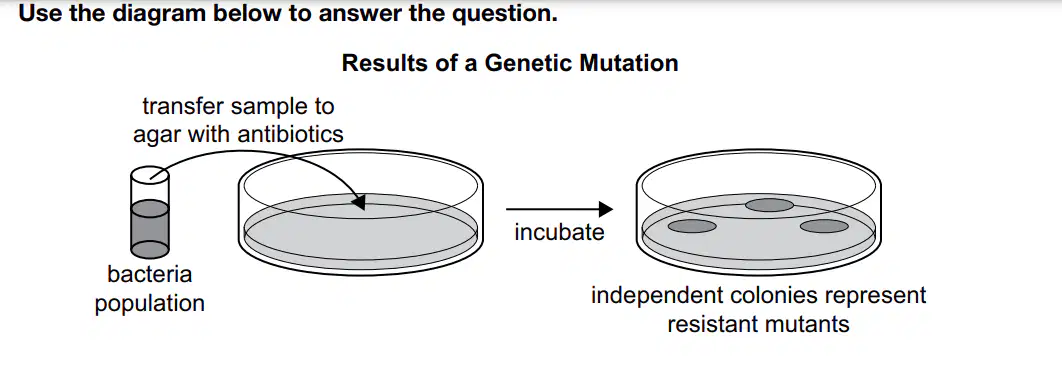
104.

The diagram shows several bacterial colonies that resulted when individual bacteria experienced a mutation . Which statement best describes how these colonies could change the genotypic makeup of future generations?

a)

A . They could teach offspring to develop antibiotic resistance .

b)

B . They could prey upon bacteria that are not antibiotic resistant .

c)

C . They could pass on genes for antibiotic resistance to offspring .

d)

D . They could be consumed by bacteria that are not antibiotic resistant

105.

What is Ms. K's favorite color ?

a)

Purple

b)

Green

c)

Orange

d)

Blue

106.
Which conclusion is best supported by the presence of ribosomes in prokaryotes and eukaryotes?
a)

A. Ribosomes have different functions in prokaryotes and eukaryotes.

b)

B. Both prokaryotes and eukaryotes store energy to power life functions.

c)

C. Ribosomes developed independently inside prokaryotes and eukaryotes.

d)

D. Both prokaryotes and eukaryotes make proteins to perform life functions
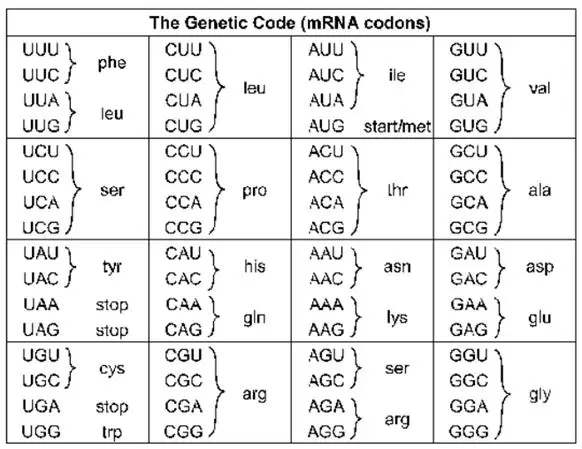
107.
A mutation occurred that caused a change in an mRNA sequence. The mRNA codon UAC was replaced by the codon UAA. Which statement describes the most likely outcome of the mutation?
a)

A. It will produce the same protein using a different set of codons.

b)

B. It will result in an incomplete protein that does not function properly.

c)

C. It will cause mRNA to attach a new amino acid chain during transcription.

d)

D. It will change the bonding pattern between the amino acids joining together.
108.
Name
4 lines
109.
Which statement best describes how geographic isolation can contribute to land animal speciation?
a)
A. Geographic isolation physically separates populations but allows them to interact.
b)
B. Geographic isolation physically separates populations and prevents them from interacting.
c)
C. Geographic isolation causes genetic changes in individual organisms but allows them to interact.
d)
D. Geographic isolation causes genetic changes in individual organisms and prevents them from interacting
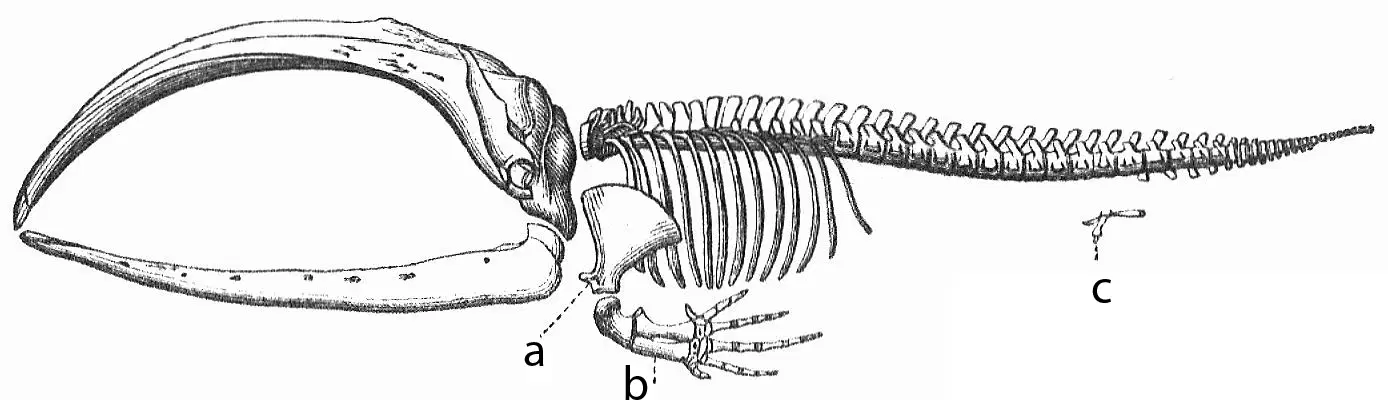
110.
Whales have vestigial femurs and pelvic bones (letter c) in the diagram. Which statement explains why the vestigial structures are most likely present in whales?
a)
A. Whales evolved over time from ancestors that lived on land.
b)
B. Whales evolved over time from fish species that once lived on land.
c)
C. Hind legs are an adaptation in whales that is selected for as they evolve into land mammals.
d)
D. Hind legs are an evolutionary adaptation observed in whales that walk along the ocean floor
111.
A population of squirrels was separated during the formation of the Grand Canyon. Over time the squirrels, separated by the canyon walls and the Colorado River, became unique species. Which mechanism most likely caused the development of the new species?
a)
A. habitat preference
b)
B. increased gene flow
c)
C. geographic isolation
d)
D. behavioral isolation
112.
A researcher observes two species of frogs in the same area. Both species have a similar diet. One species breeds in fast-moving streams, while the other species breeds in ponds. Both species are similar in appearance and have very similar DNA. Which information provides the best evidence that these two species descended from a common ancestor?
a)
A. the species’ similar diets
b)
B. the species’ shared habitat
c)
C. the species’ mating behaviors
d)
D. the species’ physical characteristics
113.
The graph represents the number of light brown and dark brown organisms living on the bottom of a clear, sandy lake 20 years ago. Over time, the lake bottom has become covered with dark sand and sediment. Which change has most likely occurred in the population? (graph missing)
a)
A. The number of light-brown individuals increased.
b)
B. The number of dark-brown individuals increased.
c)
C. The number of light-brown and dark-brown individuals increased.
d)
D. The number of light-brown and dark-brown individuals became equal.
114.
The Isthmus of Panama is a narrow strip of land that lies between the Caribbean Sea and the Pacific Ocean. It forms a land bridge that links North and South America. The formation of this is thmus separated two bodies of water that had previously been connected. How did the formation of this land bridge most likely influence the development of distinct marine species on either side of the land bridge?
a)
A. by decreasing genetic drift
b)
B. by causing a founder effect
c)
C. by increasing the rate of genetic mutation
d)
D. by preventing related populations from interacting
115.
Which statement describes how a mutation would most likely affect a population?
a)
A. Genotypic variation will increase in the population.
b)
B. Genotypic variation will decrease in the population.
c)
C. The occurrence of a preexisting gene will increase in the population.
d)
D. The occurrence of a preexisting gene will decrease in the population.
116.
Overuse of antibiotics has caused antibiotic resistance in some bacteria in a population. Which statement describes the most likely impact of natural selection on the bacterial population?
a)
A. Beneficial mutations have decreased, resulting in a larger population than normal.
b)
B. Only the genes for antibiotic resistance are now expressed, eliminating other genes.
c)
C. More antibiotic-resistant bacteria have survived, resulting in more offspring with this trait.
d)
D. The bacteria have become genetically isolated, resulting in decreased reproductive rates.
117.
The frequency of an allele in a fly population changes from 89% to 20% after three generations. Which other events most likely occurred during the same time period?
a)
A. an environmental change and a fly population increase
b)
B. an environmental change and a fly population decrease
c)
C. interbreeding of flies with an invasive species and fly population speciation
d)
D. interbreeding of flies with an established local species and fly population speciation
118.
Tail length in mice varies within a population. Scientists observed change in the distribution of tail lengths in a mouse population over time. At the genetic level, what has most likely happened to the allele for the shortest tail lengths?
a)
A. The allele changed from being dominant to being recessive.
b)
B. The allele changed from being autosomal to being sex-linked.
c)
C. The allele became less frequent than the alleles for longer tail lengths.
d)
D. The allele began to code for long tail lengths instead of the shortest ones
119.

What role does the enzyme rubisco play in the process of photosynthesis?

a)

A. It helps in the absorption of light energy.

b)

B. It catalyzes the fixation of carbon dioxide into sugar.

c)

C. It aids in the release of oxygen as a by-product.

d)

D. It breaks down glucose to release energy.

120.

Which statement best describes the role of mitochondria in animal cells?

a)

A. They synthesize proteins for cell repair.

b)

B. They package DNA into chromosomes.

c)

C. They convert glucose into usable energy.

d)

D. They create lipids for the cell membrane.

121.

How does the structure of a water molecule contribute to its properties as a solvent?

a)

A. The linear shape of water allows it to dissolve ionic compounds easily.

b)

B. The polarity of water allows it to interact with various solutes.

c)

C. The nonpolar nature of water prevents it from dissolving gases.

d)

D. The large size of water molecules helps in dissolving larger molecules.