
 Worksheets
Biology First Semester Final Exam Review
Total questions: 119
Worksheet time: 1hrs 13mins
1. What is an Organic compound?
A compound that contains carbon and is typically found in living organisms.
A compound that contains only metals.
A compound that contains only water.
A compound that contains only salts.
Select the option that correctly lists the 8 characteristics of living organisms.
Made of cells, Energy, Growth, Reproduce, Evolves, Homeostasis, DNA, Responds to Stimuli
Made of cells, Energy, Growth, Evolves, Homeostasis, DNA, Excretion, Digestion, Circulation
Made of cells, Energy, Growth, Evolves, Reproduction, Excretion, Photosynthesis, Adaptation
Energy, Reproduce, Evolves, DNA, Respiration, Excretion, Communication, Evolution
Select the correct order of the following terms from smallest to largest: Organ system, Tissue, Ecosystem, Cell, Organism, Community, Population, Organ.
Cell, Tissue, Organ, Organ system, Organism, Population, Community, Ecosystem
Tissue, Cell, Organ, Organ system, Organism, Population, Community, Ecosystem
Cell, Organ, Tissue, Organ system, Organism, Population, Community, Ecosystem
Cell, Tissue, Organ system, Organ, Organism, Population, Community, Ecosystem
In the kidney, Tubules and Henle cells create concentration gradients for urine concentration, collecting ducts respond to hormones like ADH for water absorption, and podocytes wrap around capillaries. All of these cells work together in the kidney for filtering and regulating hydration so they can be considered…
Organs
Anabolic catabolizers
Tissues
Organelles
During digestion, what is the purpose of breaking the bonds that hold macromolecules together?
to release chemical energy stored in the bonds
to catalyze other chemical reactions
to synthesize new macromolecules
to create glucose enzymes
When eating meat, you consume DNA, but you don’t become a chicken or cow or whatever. Explain.
Because your body breaks down the DNA and does not incorporate it into your own genetic material.
Because your body copies the animal's DNA into your own cells.
Because eating DNA changes your species.
Because animal DNA replaces your own DNA.
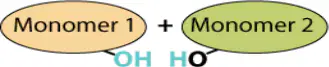
Refer to the diagram showing Monomer 1 + Monomer 2 (with H2O) forming a Polymer. Which of the following describes the chemical reaction shown above?
Dehydration synthesis because two monomers are forming a polymer
Dehydration synthesis because two polymers are forming a monomer
Hydrolysis because two monomers are forming a polymer
Hydrolysis because two polymers are forming a monomer
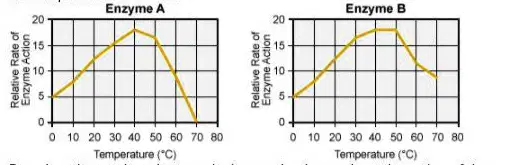
In the graph above, at what temperature is Enzyme A most effective/active?
40 degrees C
50 degrees C
60 degrees C
70 degrees C
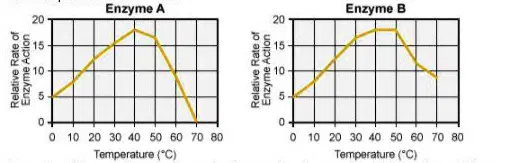
Why does enzyme activity begin to decrease rapidly beyond a certain temperature?
there is not enough substrate to break down
too much activation energy is needed to keep reaction going
the enzyme is becoming denatured and can no longer “fit” with its substrate
all the enzymes have been used up in the reaction
Which of the following would affect the reaction rate of a chemical reaction?
exposing the enzymes to an extreme pH
changing the shape of the substrate
changing the shape of the enzyme
adding more enzyme to the solution
all of the above could affect the rate of reaction
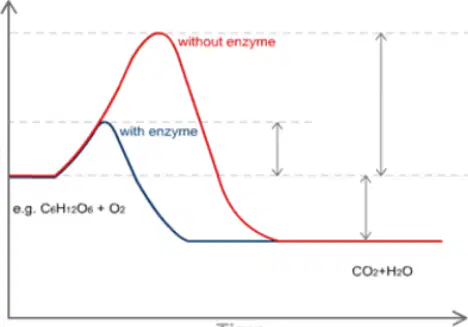
Examine the graph as you answer question #9. Which statement below accurately describes the relationship between enzymes and the chemical reactions they catalyze?
More activation energy is gained from a reaction that involves an enzyme.
Enzymes reduce the activation energy required to start a reaction
Dehydration synthesis forms a bond between the enzyme and its substrate.
Activation energy breaks bonds in the enzyme to catalyze the reaction.
Place the following organelles in the order in which DNA is translated into a protein and then modified for use in the organism: • Golgi body, Endoplasmic reticulum (ER), Nucleus, Ribosome
Nucleus, Ribosome, Endoplasmic reticulum (ER), Golgi body
Nucleus, Endoplasmic reticulum (ER), Ribosome, Golgi body
Ribosome, Nucleus, Endoplasmic reticulum (ER), Golgi body
Endoplasmic reticulum (ER), Nucleus, Ribosome, Golgi body
Homeostasis in living organisms refers to:
The maintenance of a stable internal environment.
The process of cell division.
The ability to move from place to place.
The absorption of nutrients from food.
Which of the following are products of the photosynthetic equation?
Oxygen, Water
Oxygen, Glucose
Carbon Dioxide, Glucose
Carbon Dioxide, Water
Which of the following represents the balanced equation for photosynthesis?
6CO2 + 6CH4 + Energy -> C6H12O6 + 6NO2
C6H12O6 + 6O2 -> 6CO2 + 6H2O + Energy
C6H12O6 -> 2C2H5OH + 2CO2
6CO2 + 6H2O + Energy -> C6H12O6 + 6O2
The leaves on a tree are most similar to…
A person running on a track
A solar panel charging batteries
A person eating a large lunch
A wind turbine generating electric current
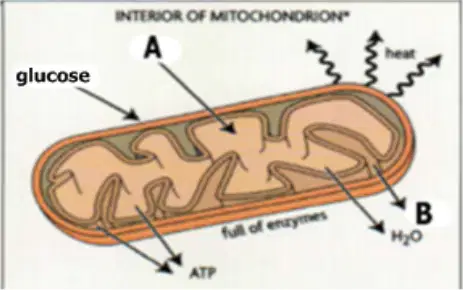
What process takes place in this organelle?
Cellular respiration
Photosynthesis
Protein synthesis
DNA replication
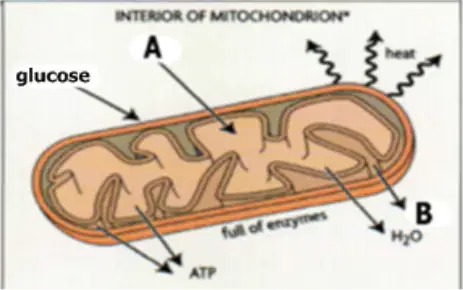
What molecule would the letter A represent? (Refer to the diagram of mitochondrion)
Glucose
Oxygen
ATP
Carbon dioxide
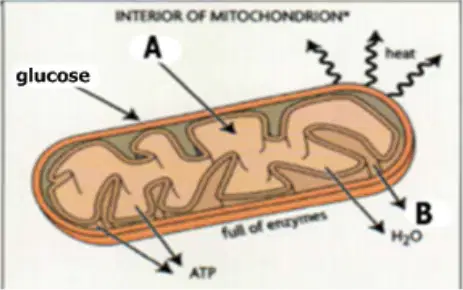
What molecule would the letter B represent?
Water (H2O)
Carbon dioxide (CO2)
Oxygen (O2)
Methane (CH4)
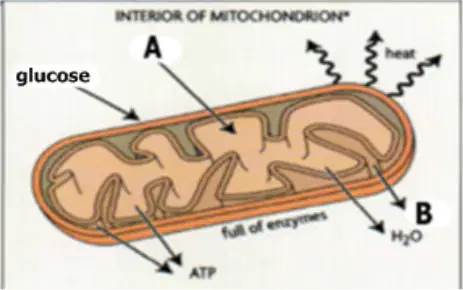
Which of these reactions takes place inside this organelle?
Anaerobic Respiration
Aerobic Respiration
Both
Neither
What would happen to the amount of oxygen produced in photosynthesis if there was a decrease in the amount of carbon dioxide available?
The amount of oxygen produced would decrease.
The amount of oxygen produced would increase.
The amount of oxygen produced would remain the same.
The amount of oxygen produced would fluctuate unpredictably.
Three factors that affect the rate of photosynthesis are:
Light intensity, carbon dioxide concentration, temperature
Soil type, leaf color, root length
Wind speed, rainfall, altitude
Plant age, seed size, flower color
37. Which is more usable in terms of energy: ADP or ATP? Why?
ADP is more usable because it contains more energy than ATP.
ATP is more usable because it contains more energy than ADP.
ADP is more usable because it is the primary energy currency of the cell.
ATP is more usable because it is the primary energy currency of the cell.
Energy in ATP molecules is stored in which part, and how is it released?
In the phosphate bonds; released when a phosphate group is removed
In the ribose sugar; released during hydrolysis
In the adenine base; released during cellular respiration
In the oxygen atoms; released when ATP is exposed to light
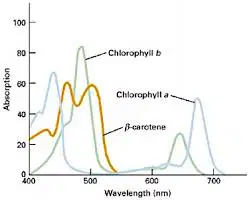
Chlorophyll (a) reflects which wavelength(s) of light?
500-600 nm
400-500 nm
600-700 nm
Chlorophyll a is able to absorb all wavelengths of light

The color of a leaf is dependent on the light it absorbs or reflects.
Absorbs
Reflects
Both absorbs and reflects
Neither absorbs nor reflects
The original source of energy for the majority of living things on earth is:
The Sun
Wind
Geothermal heat
The Moon
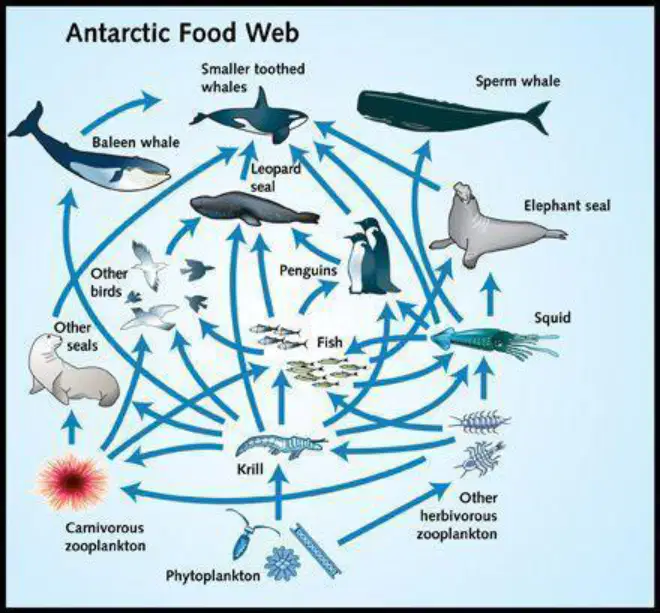
Which of the organisms in the food web are autotrophs?
Phytoplankton
Zooplankton
None are in this food web
Fish
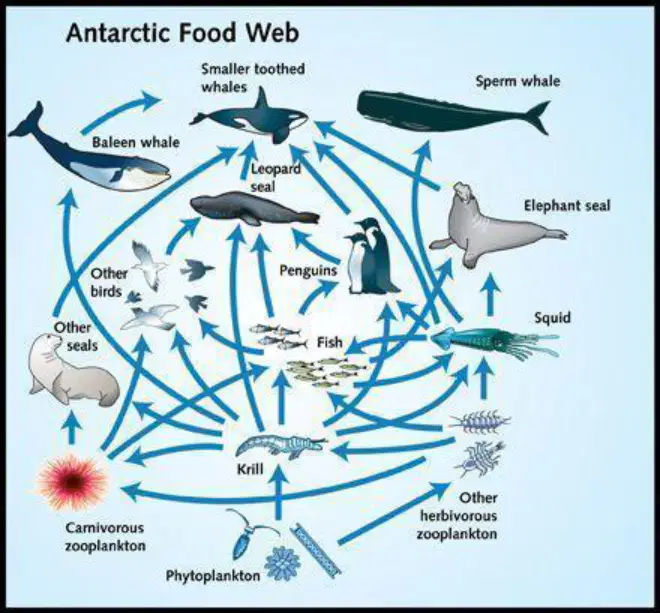
What type of organisms is missing from the food web, and why are they vitally important for an ecosystem?
Decomposers; they recycle nutrients back into the ecosystem.
Producers; they provide energy for all other organisms.
Consumers; they control the population of producers.
Predators; they maintain balance by eating prey.
List 3 ways nitrogen makes its way from the atmosphere into the biosphere:
Nitrogen fixation by bacteria, lightning, industrial fixation
Photosynthesis, respiration, transpiration
Evaporation, condensation, precipitation
Carbon fixation, decomposition, combustion
If nitrogen fixing bacteria were destroyed by a virus, what would be the result?
Nitrogen levels in the soil would decrease, affecting plant growth.
Plants would grow faster due to increased nitrogen.
Soil fertility would improve significantly.
There would be no impact on the nitrogen cycle.
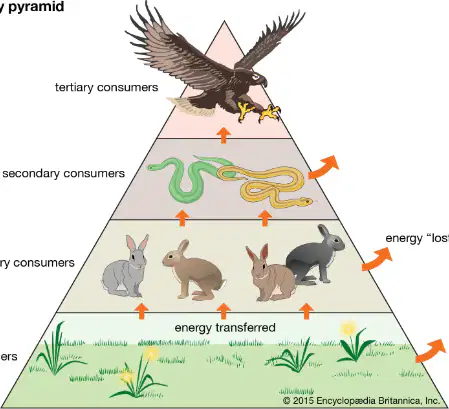
The trophic level that would lose the most energy as heat before the level above can feed upon it is
Producers
Primary consumers
Secondary consumers
Tertiary consumers
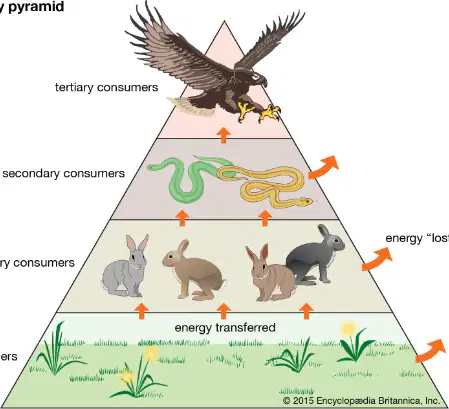
What does the answer from the previous question mean for the top consumers in this system?
It indicates the impact or role of top consumers in the ecosystem.
It shows the energy loss at each trophic level.
It describes the population size of top consumers.
It explains the food sources for producers.
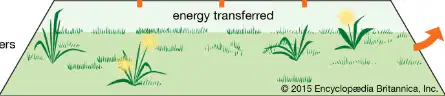
Producers are found at the bottom of the pyramid because:
they form the base by producing energy for all other levels
they consume other organisms for energy
they are the largest organisms in the ecosystem
they are at the top of the food chain
Consumers obtain carbon and other elements needed for their bodies by:
absorbing them directly from the atmosphere
eating other organisms
photosynthesizing their own food
drinking water only
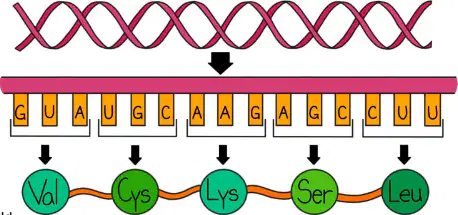
View the image to the right, what might happen to the shape of the protein if the DNA was modified?
The shape of the protein may change.
The protein will remain unchanged.
The DNA will become a protein.
The protein will disappear completely.
Which of the following is NOT a characteristic of DNA?
Double helix
Stores genetic info
Contains genes that determine traits on organism
Made of nucleotides A,U,C,G
Found in the nucleus of a cell
Which of the following correctly describes the components of DNA?
Deoxyribose sugar, ATCG, double stranded
Deoxyribose sugar, AUCG, double stranded
Ribose sugar, ATCG, double stranded
Ribose sugar, AUCG, single stranded
Create the complementary strand for the following sequence of DNA: A T C G C C T A A C G A
T A G C G G A T T G C T
A T G C C G T A A C G T
T A C G G C T T A G C T
T T G C G G A T T G C T
A DNA sample contains 15% thymine (T), what percentage of the sample is made up of adenine (A)?
30%
15%
85%
35%
70%
Humans have _____ chromosome(s) in their body cells, and _____ chromosome(s) in their sex cells
23, 23
23, 46
46, 23
22, 1
1, 22
Which of the following does NOT describe a body cell?
Has full set of DNA in the form of chromosomes
Also known as a somatic cell
Contains one set of chromosomes (Haploid)
All of the above correctly describe a body cell
Which of the following is true of embryonic development?
creates new generalized cells through mitosis
creates new cells through mitosis which become specialized over time
creates new generalized cells through meiosis
creates new cells through meiosis which become specialized over time
If a herbicide is sprayed in an ecosystem, plant A (which reproduces asexually) or plant B (which reproduces sexually) would have a better chance of survival because:
Plant B would have a better chance due to greater genetic variation.
Plant A would have a better chance due to faster reproduction.
Both plants would have an equal chance of survival.
Plant A would have a better chance due to resistance to herbicides.
How is the stored information used to express a trait?
The genes in the DNA instruct a cell how to synthesize protein.
Every time the DNA replicates, traits are expressed.
Codons in the DNA stimulate the DNA to replicate.
The nucleotides in the DNA bind with amino acids in order to direct the cells functions
Outline the events that occur during Interphase of a cell’s life cycle.
Interphase includes cell growth, DNA replication, and preparation for cell division.
Interphase is when the cell divides into two daughter cells.
Interphase is the stage where chromosomes separate and move to opposite poles.
Interphase is the phase when the cell undergoes mitosis and cytokinesis.
Compare the parent cell and daughter cells at the end of cytokinesis.
The daughter cells are genetically identical to the parent cell.
The daughter cells have twice as much DNA as the parent cell.
The daughter cells are genetically different from the parent cell.
The daughter cells have no nucleus compared to the parent cell.
76. Cancer relates to the cell cycle in which of the following ways?
It results from uncontrolled cell division due to disruptions in the cell cycle.
It helps regulate the cell cycle and prevent mutations.
It slows down the cell cycle to prevent cell growth.
It only affects cells that are not dividing.
Pertaining to stem cells, which of the following statements is true? Circle 2 answers
A stem cell can give rise to specialized cells
A stem cell can produce more stem cells
Specialized cells can become stem cells
Sexual reproduction produces variation while asexual reproduction produces clones

What type of macromolecule is this?
carb
lipid
nucleic acid
protein

What type of macromolecule is this?
carb
lipid
nucleic acid
protein

What type of macromolecule is this?
carb
lipid
nucleic acid
protein

What type of macromolecule is this?
carb
lipid
nucleic acid
protein
Which macromolecule is the source of stored energy?
Proteins
Lipids
Nucleic Acids
Carbohydrates
Glycerol and Fatty Acids are the building blocks for
Lipids
Protein
Nucleic Acids
Carbohydrates
Which macromolecule makes up enzymes, hormones, antibodies?
Lipids
Proteins
Nucleic Acids
Carbohydrates
Which macromolecule is responsible for cell growth and repair?
Carbohydrates
Nucleic Acid
Protein
Lipids
What are the building blocks for Proteins?
Nucleic Acid
Simple Sugars
Monosaccharies
Amino Acids
Nucleic Acids store
sugar
energy
genetic information
amino acids
DNA and RNA are an example of
Lipids
Proteins
Nucleic Acids
Carbohydrates
What are the building blocks for Nucleic Acids called?
glycerol
fatty acids
amino acids
nucleotides
Which macromolecule is the main source of energy?
Lipids
Proteins
Nucleic Acids
Carbohydrates
The building blocks for the carbohydrates is
simple sugars
carbon
hydrogen
oxygen
What is the main element within biomolecules?
carbon
hydrogen
oxygen
nitrogen
What is the correct order of organization in a body system?
atom, molecule, macromolecule, organelle, cell, tissue, organ, organ system, organism
cell, tissue, atom, macromolecule, organelle, organ system, organism, molecule, organ
atom, molecule, cell, macromolecule, tissue, organelle, organ, organ system, organism
organism, organ system, organ, tissue, cell, macromolecule, molecule, organelle, atom
Hormone regulation operates under which type of feedback mechanism?
positive feedback
negative feedback
zero feedback
Hormones are not regulated
Feedback loops are important because they allow organisms and the environment to
change based on new inputs
fall apart
change based on new outputs
maintain balance
What does it mean for enzymes to act as a catalyst?
They speed up chemical reactions.
They slow down chemical reactions.
They break down chemical reactions.
They build up chemical reactions.
What does it. mean for enzymes to be like a lock and key?
Enzymes can bond to anything.
Enzymes unlock the mysteries of the body.
Enzyems are specific and can only bond to specific substrates.
Enzyems can only bond to a substrate.
Which of the of the following is true of enzymes?
Enzymes are made of lipids.
Enzymes are made of proteins.
Enzymes are made of carbohydrates.
Enzymes are made of nucleic acids.
What does it mean for an enzyme to be denatured?
The enzyme shape has been changed.
The enzyme works super fast.
The enzyme works super slow.
The enzyme is able to be reused.
ribosome
Which organelle receives proteins and materials from the endoplasmic reticulum, packages them, and distributes them?
lysosomes
golgi apparatus
ribosomes
endoplasmic reticulum
What materials go through a membrane by simple diffusion?
sugar
ions
small, nonpolar molecules
large proteins

In the cell pictured, which way would water move?
Into the cell, causing the cell to swell
Out of the cell, causing the cell to shrink
In and out of the cell equally, keeping the shape the same

In the cell pictured, where would water move?
Into the cell, causing it to swell
Out of the cell, causing it to shrink
In and out of the cell equally, causing the shape to stay the same

In the cell pictured, which way would water move?
Into the cell, causing the cell to swell
Out of the cell, causing the cell to shrink
In and out of the cell equally, keeping the shape the same
In what part of the cell does photosynthesis occur?
Nucleus
Chloroplast
Epidermis
Vacuole
Which statement about photosynthesis is correct?
Plants get the energy they need for photosynthesis from water.
Plants get the energy they need for photosynthesis from soil.
Plants get the energy they need for photosynthesis from sunlight.
Plants do not require energy to perform photosynthesis.
What are the three parts of an ATP molecule?
Adenine, Thylakoid, and a phosphate group
Stroma, grana, and chlorophyll
Adenine, ribose, and three phosphate groups
NADH, NADPH, and FADH2
What is the purpose of photosynthesis?
make glucose
make ATP
make light
release carbon dioxide
Energy is released from ATP when the bond is broken down between ______________.
two phosphate groups
Adenine and ribose
Ribose and a phosphate group
Adenine and a phosphate group
Leaves appear green because the green portion of the light that strikes them is ____________.
Changed to heat
Absorbed
Destroyed
Reflected
If you continue to increase the intensity of light that a plant receives, what happens?
The rate of photosynthesis increases with light intensity.
The rate of photosynthesis decreases with light intensity
The rate of photosynthesis increases and then levels off.
The rate of photosynthesis does not change.
Which factors affect the rate of photosynthesis
temperature
carbon dioxide concentration
oxygen concentration
all of the above

What are the reactants of cellular respiration?
Carbon dioxide and water
Carbon dioxide and glucose
Oxygen and water
Oxygen and glucose

What are the products of cellular respiration?
Carbon dioxide and water
Carbon dioxide and glucose
Oxygen and water
Oxygen and glucose

What are the reactants of photosynthesis?
Carbon dioxide and water
Glucose and water
Oxygen and glucose
Sunlight and glucose

What are the products of photosynthesis?
Carbon dioxide and water
Oxygen and water
Oxygen and glucose
Carbon dioxide and glucose

Look at the diagram. Which gas would most likely be found in the greatest amount in the bubbles?
Bio means _________.
non-living
not/without
life
living
What is the function of DNA Helicase?
Unzips” the strand of DNA
Breaks the hydrogen bonds so that new nucleotides can be added
Bind to separated strands of DNA to keep the strands separate
Creates a strand of RNA nucleotides
DNA nucleotides must be added to something. Primase creates a strand of nucleotides that DNA Polymerase I can add nucleotides to. It is not in the final product.
Removes/replaces the RNA primer. Proofreads new DNA strand.
What is the function of DNA Polymerase III?
Removes/replaces the RNA primer. Proofreads new DNA strand.
Adds nucleotides to RNA primer, thus synthesizing a new strand of DNA. Has a “proofreading” role.
Relaxes DNA from super coil so it can be replicated.
Joins fragments of DNA together.
What is the end result of DNA replication?
Two identical DNA molecules each composed of one new and one original strand
Two non-identical DNA molecules each composed of one new and one original strand
Two identical DNA molecules. One is made up of the two old strands and one is made up of the two new strands.
Two non-identical DNA molecules. One is made up of the two old strands and one is made up of the two new strands.

What occurs in mitosis?
The cell is growing
The cell is divided
Nucleus is divided
What is the purpose of Mitosis?
Growth of an organism and Repair of damaged tissue
To help the body get rid of extra cells
To increase the amount of classwork you have to do
To get rid of the nucleus

