
 Worksheets
Biology Year to Date Challenge- Part 1
Total questions: 123
Worksheet time: 56mins
What type of microscope will produce images in color and in 3D ?
Scanning electron Microscope(SEM)
Dissecting Microscope
Transmission Electron Microscope
Compound Light Microscope
Why can the electron microscopes only produce images of non-living specimens?
They use light to produce an image
They are the size of a small room
The specimen is placed in a vacuum
The electrons bounce off the surface of the specimen
Which of the following is not a principle of the cell Theory?
Cells come from other cells
The cell is the monomer of life
All living things are made up of cells
Cells contain organelles
Which of the following do prokaryotic cells share with eukaryotic cells?
Cell wall, mitochondria, cytoplasm and DNA
Cell membrane, DNA, ribosomes and cytoplasm
Cell membrane, ribosomes, lysosomes and mitochondria
Cell wall, cytoplasm , ribosomes and DNA
What does TEM stand for?
transmission electron microscope
translation electron microscope
telepathic electron microscope
tori eats mangos
True or False: An electron microscope gives a higher resolution than a light microscope.
True
False
Only in certain conditions
True or False: You cannot see the nucleus of a cheek cell with a light microscope.
True
False
Only under certain conditions
Select the best answer to the question: Explain why a scientist might choose to use an electron microscope rather than a light microscope.
The light microscope won't show as much and it doesn't make the picture as bigger as the electron microscope.
Electron microscope is better for a scientist to choose than a light microscope it uses electrons and not light.
An electron microscope gives a greater magnification and better resolution than a light microscope.
Scientists might need to choose the electron microscope because it is cheaper and easier than the light microscope.
What type of microscope uses a magnetic field to operate?
electron microscope
light microscope
plasmid microscope
micro microscope
What does SEM stand for?
scanning electron microscope
sandwich electron microscope
soft electron microscope
Sara eats margarine
The microscopes we use are called
compound microscopes
dissecting microscopes
stereo microscopes
electron microscopes


A network of feeding interactions that shows all the interrelated food chains in an ecosystem
trophic level
food web
biomass pyramid
pyramid of numbers

Who is the producer?
leaf
catepillar
chamelon
snake
mongoose
Who is the primary consumer?
leaf
catepillar
chamelon
snake
mongoose
Who is the tertiary consumer?
leaf
catepillar
chamelon
snake
mongoose
What does the term 'biological diversity' mean?
Variety of gases
Variety of non-living organisms
Variety of minerals
Variety of living organisms
What does species diversity refer to?
Variety of non-living organisms
Variety of ecosystems
Variety of genes within a species
Number of species in a given area
What is one of the threats to biodiversity related to human population growth?
Overconsumption
Pollution
Invasive species
Habitat fragmentation
What is one of the threats to biodiversity related to pollution?
Invasive species
Population growth
Habitat fragmentation
Overconsumption
What is one of the threats to biodiversity related to overconsumption?
Habitat fragmentation
Invasive species
Population growth
Pollution
The natural environment in which an organism lives is called...
habitat
niche
biosphere
food chain
This is the job or role of a specific organism within its habitat.
producer
niche
photosynthesis
biotic

Why are some sharks considered a keystone species?
Because they are a top predator
They scare off smaller fish that may overgraze an area of sea grass
They are tertiary consumers
They are cartilaginous

A species that plays a critical role in the health, maintenance, growth, or definition of an ecosystem.
keystone
invasive
engineer
predator
Type of biodiversity that refers to the variety of habitats, communities, and ecological processes within and between ecosystems:
ecosystem diversity
species diversity
genetic diversity
none of these
Type of biodiversity that refers to all the differences between populations of species as well as between different species.
ecosystem diversity
genetic diversity
species diversity
none of these
The variety of organisms in a given area is called:
a species
a gene
abiotic factors
biodiversity
What do you call organisms that eat ONLY producers?
Carnivores
Herbivores
Omnivores
Detritivores
What do you call organisms that eat ONLY other consumers?
Carnivores
Herbivores
Omnivores
Detritivores
What is the MAIN source of energy supply for a food chain?
(HINT: Where did all the energy come from?)
Sunlight (absorbed by producers)
Producers
Other animals
Decomposers
What is the MAIN way most energy is lost in a food chain?
Heat
Respiration
Waste
Growth
On average, how much energy is passed from one level of a food chain to another?
10%
90%
100%
50%




What property of water allows for water to act as a temperature regulator for the world?
Cohesive Behavior
Expansion Upon Freezing
High Specific Heat
Universal Solvent
What type of resources are considered finite and cannot be replenished in a short amount of time?
Renewable Energy
Nonrenewable Energy
All Energy
Generational Energy
What type of energy is able to be regenerated in a short amount of time or are continuous?
Renewable Energy
Nonrenewable Energy
All Energy
Generational Energy
Which of the following are fossil fuels? (Select all that apply.)
Coal
Oil
Natural Gas
Nuclear Energy
Which of the following are renewable energy sources? (Select all that apply.)
Solar
Wind
Hydroelectric
Geothermal
Biomass
Used to generate gasoline, jet fuel, and kerosene, (a) can be used to generate electricity or to power vehicles.
(a) energy is converted to electricity using photovoltaic cells.
A turbine turned by air currents describes how electricity is generated via (a) power.

Why are fossil fuels nonrenewable?
fossil fuels come from the remains of prehistoric life, which takes along time to make again
when the store runs out of fossil fuels, they can't buy anymore
Energy that is made from heat inside Earth
Coal
Fossil Fuels
Geothermal
Solar

Which of the following would be classified as an environmental cost of hydroelectric power? SC.912.L.17.11
desertification
disruption of freshwater ecosystems
increased biodiversity
water pollution
Biomass power is a renewable energy source derived from plant and animal products. Which of these is a benefit of using biomass for power compared to nonrenewable resources? SC.912.L.17.11
Biomass power increases the amount of oxygen in the air.
Biomass power reduces the emission of greenhouse gasses.
Biomass power increases the clearing of forests and grasslands for energy crops.
Biomass power reduces organic waste in landfills and waste-treatment facilities.
Though we hear more about oil spills that occur in acquatic environments, they can also occur on land. Why would it be easier to contain an oil spill that occurs on land? SC.912.L.17.11
Oil spills at sea are more likely to contaminate animal habitats than oil spills on land.
Oil spills at sea are more likely to contaminate the atmosphere than oil spills on land.
Oil spills at sea are more likely to cling to plants than than oil spills on land.
Oil spills at sea are more likely to spread with water currents than oil spills on land are through erosion and deposition.
Our oceans offer a variety of renewable and nonrenewable resources that we use for various purposes. One such resource is sea salt. Which statement best classifies sea salt and describes its costs and benefits? SC.912.L.17.11
Sea salt is a renewable resource that is readily available, but production is not cost effective.
Sea salt is a renewable resource that is processed with little energy input, but harvesting the salt disrupts coastal ecosystems.
Sea salt is a nonrenewable resource that requires no processing, but at current rates, it will eventually become unsustainable.
Sea salt is a nonrenewable resource that has a wide variety of uses, but harvesting from the ocean can disrupt coastal ecosystems.
A population of mice lives in the northeastern United States. Over the last 50 years, the size of the mouse population decreased. What best explains the decrease in the size of the mouse population?
Fewer mice were born than died
All the mice die and no mice were born
More mice were born than died
Lots of mice immigrated into the population
When an environment has reached its carrying capacity for a certain population, which of the following is true?
Birth rate and immigration rate are equal death rate and emigration rate
Birth rate and immigration rate are greater than death rate and emigration rate
Birth rate and immigration rate are less than death rate and emigration rate
Birth rate is exponential
Which of the following describes how an abiotic factor can impact the population in an ecosystem?
A parasite that invades a host can reproduce and cause a decline in the host species population.
Organisms that compete for the same resources will keep each other from overpopulating.
Predators will prevent herbivores from depleting the plants and other resources in an ecosystem.
Seasonal variations in temperature can cause some of the individuals in a population to die.
Which pair of factors is most likely to increase the size of the population?
births and deaths
births and immigration
deaths and emigration
immigration and emigration
A population of kangaroos grows briefly and then stabilizes. What does the leveling off indicate?
The population has reached the carrying capacity of the environment.
The population has exceeded the carrying capacity of the environment.
The population is affected by a density-independent limiting factor.
The population is no longer able to adapt to environmental changes.

What happens if a population grows past its carrying capacity?
The population keeps growing
The population starts to die off
The entire species will go extinct
The carrying capacity just increases

The largest number of individuals that an environment can support long term is...
carrying capacity
emigration
immigration
population density
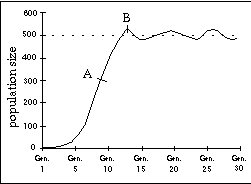
What is the carrying capacity of the graph?
around 500
more than 800
less than 300
around 700
When death rate is equal to birth rate...
population increases
population decreases
population stays the same.
population rapidly increases then becomes stable

Looking at the picture, what is the deepest part of the ocean that has no sunlight, low temperatures, and high water pressure?
Aphotic Zone
Abyssal Zone
Continental Shelf
Photic Zone
Algae are organisms that can produce their own food through photosynthesis. Which zone would you expect to find them living?
Limnetic Zone
Abyssal Zone
Benthic Zone
Photic Zone
Why should we remove an invasive species?
They won't be able to survive in a new environment.
They will eat native species and cause other species to decrease.
We should not remove them and let nature be.
Which is a consequence of an increase in greenhouse gases?
Ice caps freezing
global cooling
sea levels rising
What do we need to replace nonrenewable resources with?
renewable/sustainable resources
other nonrenewable resources
We don't need to replace them
As species go extinct what will happen to the biodiversity in that ecosystem?
Decrease
Increase
Stay the same


According to the graph, what material’s recycling would reduce the largest portion of America’s trash?
Metals
paper
plastics
Yard trimmings
When you consume an organism, you only receive 10% of the energy, but how much of the toxins do you receive?
All of the toxins
10% toxins
1% toxins
None of the toxins

In which organism would biomagnification be the most concentrated? (Remember the lab: Rabbits eat the grass, the snake eats the rabbit, the hawk eats the snake--the hawk is the apex predator)
grass
rabbit
snake
hawk

Which organism would have the most bioaccumulation?
eucalyptus tree
wombats
kookaburras
koalas

In what year were the most toxins present in smallmouth bass?
2000
2002
2004
2005
Pesticides and herbicides eventually show up in higher-level consumers (i.e. as you go up the food chain) due to
biomagnification
climate change
habitat destruction
bioaccumulation
In biomagnification, the amount of toxin
decreases in concentration along the food chain
remains the same along the food chain
increases along the food chain
Which of the following describes techniques that use living organisms to clean up toxic wastes in water and soil?
biostimulation
bioremediation
biosensor
biodiesel
Which of the following is not used to warn about environmental pollutants using the indicator species method of biological detection?
enzymes
microbes
animals
plants
Why are materials introduced to a site using enhanced bioremediation?
detect small amounts of pollutants
warn about pollutants in the area
recycle compounds in the area
accelerate the clean-up process
What is the first step in determining if bioremediation is the most efficient way to decrease the level of toxic waste in soils?
treat sample materials with active microbes
study the site periodically for recyclability
ask state agencies to consider closing the site
solicit regulatory agencies for contaminants
What term describes the branch of science concerned with the interrelationships of organisms and their environment?
ecology
agronomyentomology
biology
Sustainability aims to balance which three main areas?
Environment, economy, and society
Air, Water, and Land
Plants, Animals, and Humans
Past, Present and Future
Which resource type cannot be replenished within a human lifetime?
Renewable Resource
Inexhaustible Resource
Nonrenewable Resource
Natural Income
Which of the following is an example of an inexhaustible resource?
Coal
Solar Energy
Oil
Natural Gas
The gradual destruction of the environment through depletion of resources and pollution is known as __.
1.
Renewable Resource
Ecological Footprint
Natural Resource
Environmental Degradation
__ are materials or substances that occur in nature and can be used for economic gain.
Renewable Resource
Ecological Footprint
Natural Resource
Environmental Degradation
Resources that can be replenished within a human lifetime are called __ resources.
Renewable Resource
Ecological Footprint
Natural Resource
Natural Capital
Environmentalism is:
The study of the environment
A social movement focused on protecting the natural world
The process of recycling materials
The management of natural resources
__ is the variety of plant and animal life in a particular habitat or ecosystem.
Point Source Pollution
Ecology
Biodiversity
Nutrient Cycling
__ refers to the contamination of the environment with harmful substances.
Pollution
Ecology
Biodiversity
Nutrient Cycling
What is the monomer of Carbohydrates?
Amino Acid
Monosacharrides
Fatty Acids
DNA/RNA
What is the monomer of lipids?
Amino Acids
Monosaccharides
Fatty Acids
DNA/RNA
What is the monomer of proteins?
Amino Acids
Monosaccharides
Fatty Acids
DNA/RNA
What is the monomer of nucleic acids?
Amino Acids
Monosaccharides
Fatty Acids
Nucleotides
What is the function of a carbohydrate?
Control rates of reactions, form muscle and bones
Provide long term energy, protection, waterproofing, and insulation.
Main source of energy and is quick.
Store and transmit genetic information.
What is the function of lipids?
Control rates of reactions and forms muscle and bones.
Main source of energy.
Energy storage, protection, waterproofing and insulation.
Store and transmit genetic information.
What is the function of proteins?
Main source of energy.
Energy storage, protection, waterproofing and insulation
Store and transmit genetic information.
Control rates of reactions and form muscles and bones.
What is the function of nucleic acids?
Main source of energy.
Energy storage, protection, water proofing, and insulation.
Control rates of reactions and form muscles and bones.
Store and transmit genetic information.
What is an example of a lipid?


What is an example of a carbohydrate?


What is an example of a protein?


What is an example of a nucleic acid?


What macromolecule is classified as an enzyme?
Carbohydrate
Protein
Nucleic Acid
Lipids
What does an enzyme do for reactions?
Act as catalysts to speed up reactions.
Act as catalysts to slow down reactions.
Act as catalysts to keep reactions stable.
What are examples of carbohydrates?
triglycerides, waxes, fat, and oils
form polypeptides such as antibodies, enzymes, and hormones
glucose, fructose, cellulose, and lactose
DNA and RNA
What are examples of proteins?
triglycerides, waxes, fats, and oils
form polypeptides such as antibodies, enzymes, and hormones
glucose, fructose, cellulose, and lactose
DNA and RNA
What are examples of nucleic acids?
triglycerides, waxes, fats, and oils
form polypeptides such as antibodies, enzymes, and hormones.
glucose, fructose, cellulose, and lactose
DNA and RNA

