wayground logo

Free Printable Worksheets

Font size

S
M
L
XL
Worksheets

Biology TN EOC Mixed Review

Total questions: 120

Worksheet time: 2hrs 10mins

Name
Class
Date
1.
Which of the following is a trait that a virus shares with a living organism?
a)
They use oxygen
b)
They have genetic material
c)
They grow
d)
They digest food
2.

Which of the following statements is true?

a)

All cells are prokaryotes

b)

All eukaryotes have a nucleus

c)

All viruses are prokaryotes

d)

All viruses are living

3.

Which of the following is able to carry out all life functions?

a)

Viruses

b)

Cells

c)

Both cells and viruses

d)

Neither cells or viruses

4.
What happens when enzymes are heated to a high temperature?
a)
The enzymes die.
b)
The shapes of the enzyme are altered denature
c)
The enzymes' amino acid sequence changes.
d)
The enzymes remain the same
5.
Which is an example of a prokaryote?
a)
Fungus 
b)
Bacteria 
c)
Plants 
d)
Animals
6.
Which organelle puts the finishing touches on proteins, packages and exports them from the cell? 
a)
Golgi Apparatus
b)
Rough ER 
c)
Mitochondria
d)
Nucleus
7.

What is the function of a chloroplast?

a)

makes proteins for animal cells

b)

allows materials in and out of the cell

c)

provides structure and support

d)

absorbs sunlight for photosynthesis

8.
Functions in energy production, known as the energy factory of the cell
a)
mitochondria
b)
chloroplast
c)
vacuole
d)
cytoplasm
9.

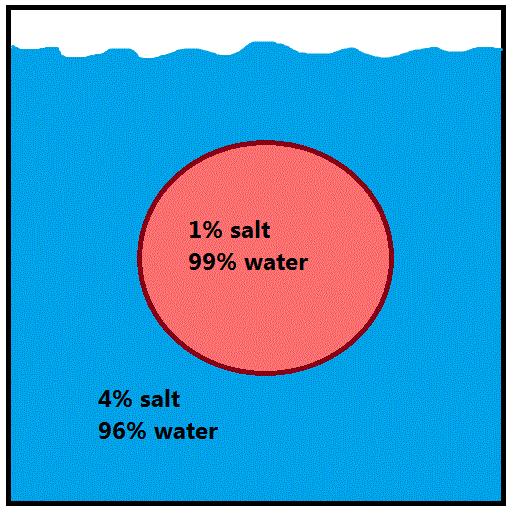
Where will the water go?

a)

Into the cell

b)

Out of the cell

c)

Equally in & out - it's isotonic

d)

There is no water

10.
Which is in a hypertonic solution? 
a)
a
b)
b
c)
c
11.

Which of the following uses energy?

a)

Diffusion

b)

Osmosis

c)

Facilitated diffusion

d)

active transport

12.

DNA and RNA are examples of __________

a)

Carbohydrates

b)

Proteins

c)

Amino Acids

d)

Nucleic Acids

13.

Which protein helps speed up chemical reactions?

a)

Enzymes

b)

Transport Protein

c)

Antibodies

d)

Collagen

14.

The building block (monomer) of proteins is...

a)

Monosaccharides

b)

Fatty Acids

c)

Amino Acids

d)

Nucleotides

15.

The molecule that binds to the enzyme is called...

a)

Substrate

b)

Enzyme

c)

Enzyme-Substrate Complex

d)

Product

16.

If you change the shape of an enzyme, will it work the same/properly?

a)

Yes

b)

No

17.

What is gel-like fluid that fills most of the cell?

a)

chloroplast

b)

cytoplasm

c)

vacuole

18.

Which of the following would be found in both prokaryotic AND eukaryotic cells?

a)

Golgi bodies

b)

ribosomes

c)

mitochondria

d)

nucleus

19.
Which organelle belongs in plant cells only?
a)
Cytoplasm
b)
Mitochondrion
c)
Large Central Vacuole
d)
Cell Membrane
20.

Reason that viruses are considered to be nonliving is because

a)

They are not made of cells

b)

They cannot reproduce on their own; need a host cell

c)

They lack machinery (structures) for metabolism (processes needed to stay alive)

d)

all of the above

21.
In which way are photosynthesis and cellular respiration different?
a)
Cellular respiration stores ATP, while photosynthesis releases ATP.
b)
Cellular respiration produces oxygen, while photosynthesis uses oxygen.
c)
Photosynthesis releases energy, while cellular respiration stores energy.
d)
Photosynthesis uses carbon dioxide, while cellular respiration produces carbon dioxide.
22.
Fermentation enables glycolysis to continue under 
a)
anaerobic conditions
b)
aerobic conditions
c)
photosynthetic conditions
d)
hydrophobic conditions
23.

Which organism go through cellular respiration?

a)

animals

b)

plants

c)

both animals and plants

d)

none

24.

Cellular Respiration occurs in what cell organelle?

a)

chloroplast

b)

cytoplasm

c)

mitochondria

d)

animal

25.

The Electron Transport Chain is a series of chemical reactions in which energy is transferred to form a large amount of what molecule?

a)

glucose

b)

oxygen

c)

pyruvic acid

d)

ATP

26.
In what step of cellular respiration is glucose broken down?
a)
Aerobic Respiration
b)
Krebs Cycle
c)
Electron Transport Chain
d)
Glycolysis
27.
What is the function of oxygen in the process of cellular respiration?
a)
to deliver hydrogen ions to the electron transport chain
b)
to pick up electrons at the end of the electron transport chain
c)
to provide oxygen for the production of carbon dioxide
d)
to give a source of energy to the Krebs cycle
28.
What phrase best describes the main role of fermentation?
a)
convert glucose into pyruvate and NADPH
b)
produce lactic acid to counteract an oxygen deficit
c)
allow glycolysis to continue making small amounts of ATP
d)
allow anaerobic production of ADP
29.
What phase is this cell in?
a)
Cytokinesis
b)
Mitosis
c)
Prophase
d)
Metaphase
30.
Which part of the Cell Cycle takes the longest?
a)
Interphase
b)
Mitosis
c)
Prophase
d)
Cytokinesis
31.

Which organelle is critical for cell division?

a)

centrioles

b)

cilia

c)

vacuoles

d)

vesicles

32.

One difference between a cancer cell and a normal cell is that

a)

cancer cells divide unconrollably

b)

normal cells divide uncontrollably

c)

cancer cells cannot make copies of DNA

d)

normal cells cannot make copies of DNA

33.

The two main purposes of the cell cycle are

a)

variation and growth

b)

adaptation and repair

c)

growth and repair

d)

variation and adaptation

34.
What phase is this cell in?
a)
Mitosis
b)
Interphase
c)
Anaphase
d)
Telophase
35.

What is the cause of sickle-cell anemia?

a)

A change to the base sequence of a hemoglobin gene

b)

Mosquitos acting as the vector for malaria

c)

Iron deficiency due to the malaria parasite

d)

Production of more white blood cells than red blood cells by bone marrow

36.

What distinguishes an allele from a gene?

a)

An allele is made of RNA

b)

An allele is shorter

c)

An allele is a variety of a gene

d)

An allele cannot be transferred during genetic modification

37.
How can the change of one base in a gene sequence completely change the protein it codes for?
a)
Protein shape is specific to the primary sequence of the amino acids it is comprised of
b)
One change of base is not enough to change the shape or effectiveness of a protein
c)
The change in the gene sequence results in the resulting enzyme being denatured at a lower temperature
d)
Proteins are comprised of polysaccharide monomers which are sensitive to changes in DNA
38.

Each gene occupies a specific position on a specific chromosome, this position is referred to as....

a)

the locus

b)

the centromere

c)

the allele

d)

the proteome

39.

Which molecules make up a eukaryotic chromosome?

a)

DNA & RNA

b)

DNA & Protein

c)

DNA, RNA, & Protein

d)

DNA, RNA, & Carbohydrate

40.

How are new alleles formed?

a)

By random mutation

b)

By pre-determined mutation

c)

During protein synthesis

d)

New alleles can never be formed

41.
What is DNA sequencing?
a)
The total of genes carried by an individual or cell
b)
Coding genes in order to identify single nucleotide polymorphisms
c)
Deciphering the functions of various parts of the human genome
d)
The process of identifying the order of the bases in DNA
42.
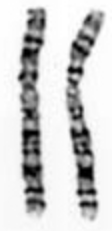
A pair of identical chromosomes shown in a karyotype, one inherited from mom, and one inherited from dad are called
a)
sister chromotids
b)
centromeres
c)
homologous chromosomes
d)
autosomes
43.
Which would be considered a somatic cell?
a)
Sperm cell
b)
Egg Cell
c)
Skin Cell
d)
All of these
44.

SELECT ALL THAT APPLY:

a)

Male

b)

Female

c)

No chromosomal abnormalities

d)

Trisomy 18

45.

Identify the process that can be used to separate fragments of DNA accoring to their size and charge.

a)

PCR

b)

Gel electrophoresis

c)

Bioinformatics

d)

Autoradiography

46.
Which best describes the process shown?
a)
mutation in which the DNA content of the gene is ltered
b)
segregation of sister chromatids
c)
condensation and segregation of the alleles
d)
crossing-over which alleles are exchanged
47.
When homologous chromosomes match up, they form a structure call a ___________.
a)
tetrad
b)
triad
c)
diploid
d)
gamete
48.
What phase is represented?
a)
metaphase 1
b)
metaphase 2
c)
anaphase 1
d)
anaphase 2
49.
What phases is shown here?
a)
Prophase II
b)
Prophase I
c)
Anaphase II
d)
Interphase I
50.

In meiosis, 1 diploid cell becomes

a)

2 diploid cells

b)

2 haploid cells

c)

4 diploid cells

d)

4 haploid cells

51.

Meiosis I separates

a)

sister chromatids

b)

homologous chromosomes

c)

sister chromosomes

d)

homologous chromatids

52.

Meiosis II separates

a)

sister chromatids

b)

homologous chromosomes

c)

sister chromosomes

d)

homologous chromatids

53.

What causes genetic variation in meiosis? [Choose two answers.]

a)

independent assortment of chromosomes

b)

crossing over of chromosomes

c)

separation of chromosomes

d)

chromosomes pulling apart

54.
If the Diploid number of Carrots is 18, the haploid number is
a)
18
b)
9
c)
27
d)
36
55.
If a somatic cell in a butterfly contains 24 chromosomes, a butterfly egg would contain
a)
3
b)
6
c)
12
d)
24
56.

Ken is blood type B and Sally is blood type A. How can they have children who are types A, B, AB, and O?

a)

Ken: IBi

Sally: IAi

b)

Ken: IBIB

Sally IAi

c)

Ken: IBi

Sally: IAIA

d)

Ken: IBIB

Sally: IAIA

57.

Males are more likely to suffer from a sex-linked disease or disorder because...

a)

males are the weaker sex

b)

males have less DNA

c)

males have 1 X chromosome, so the disorder is more likely to be expressed

d)

females are the stronger sex

58.

In humans, hemophilia is an X-linked recessive trait. If a man and a woman have a son who is affected with hemophilia, which of the following is definitely true?

a)

The mother carries an allele for hemophilia

b)

The father carries an allele for hemophilia

c)

The father is afflicted with hemophilia

d)

both parents carry an allele for hemophilia

59.

A man who has a sex-linked allele will pass it on to...

a)

all his daughters

b)

all his sons

c)

1/2 of his daughters

d)

1/2 of his sons

60.

The red and blue pair of chromosomes in the bottom row are....

a)

genetically identical

b)

carrying the same genes, but different alleles

c)

carrying completely different genes

d)

carrying the same genes and the same alleles

61.
If you were genetically modifying an animal which cell would you add a gene too?
a)
Zygote
b)
Adult stem cell
c)
Brain cell
d)
Any cell
62.
When DNA is manipulated and moved from one source to another it is known as
a)
genetic engineering
b)
electrophoresis
c)
gene therapy
d)
GMO
63.

Gel electrophoresis sorts DNA based on:

a)

fragment length

b)

fragement sequence

64.

Which sequence of RNA bases would pair with this partial strand

ATG TGA CAG

a)

ATG TGA CAG

b)

UAC ACU GUC

c)

GTA AGT GAC

d)

CAU UCA CUG

65.
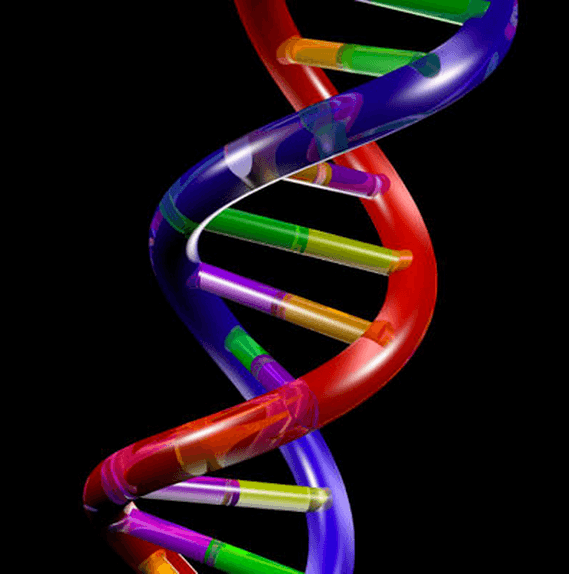
What determines the code, or information, of a DNA molecule?
a)
the shape (structure) of the nitrogen bases
b)
the order (sequence) of the nitrogen bases
c)
the color of the nitrogen bases
d)
the frequency (number) of nitrogen bases
66.
Replicate the following strand of DNA: 
AATCATGGA
a)
AATCATGGA
b)
TTAGTACCT
c)
UUAGUACCU
d)
GGATAUCUA
67.
DNA replication results in two DNA molecules,
a)
each one with two original strands
b)
each one with two new strands
c)
each one with one new strand and one original strand
d)
one with two new strands and the other with two original strands
68.
A process in which DNA has the unique ability to make an exact copy of itself.
a)
Replication
b)
Translation
c)
Transcription
69.
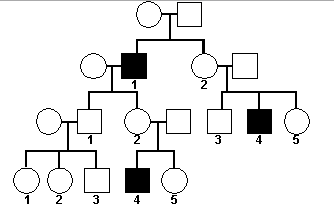
If this pedigree shows an autosomal recessive disorder, what MUST the genotype of individual II-3 be?
a)
HH
b)
Hh
c)
hh
d)
None of the above
70.
What type of heredity is shown in the pedigree?
(hint: check your notes - "modes of inheritance")
a)
Sex-Linked Dominant
b)
Sex-Linked Recessive
c)
Autosomal Dominant
d)
Autosomal Recessive 
71.
How many kids did the mother and father from the first generation have?
a)
2
b)
4
c)
5
d)
6
72.
A male beetle has the genotype Ttbb. If this beetle mates with a female with genotype TTBb, what is the chance their offspring will have the genotype TtBb?
a)
12.5%
b)
25%
c)
50%
d)
75%
73.
What is the genotype for a pea plant heterozygous for round seeds (R), and homozygous recessive for green seeds (y)?
a)
Ry
b)
RRyy
c)
RrYy
d)
Rryy
74.
What fraction of offspring from the cross AaBB x Aabb will be heterozygous for both traits?
a)
1/16
b)
1/4
c)
1/2
d)
3/16
75.

Embryonic stem cells are cultured and then implanted into a person to help cure a disease. Why is this procedure most likely considered controversial?

a)

There are associated ethical and moral issues.

b)

There is an insufficient supply of donor cells.

c)

There is an increased risk of infection.

76.

Stem cell research is a widely debated topic due to its controversial methods.

a)

True

b)

False

77.

Which is the correct order of DNA replication?

a)

3, 4, 2, 1

b)

3, 1, 4, 2

c)

2, 1, 4, 3

d)

3, 4, 1, 2

78.

What is the order for Protein Synthesis?

a)

Transcription -> Translation -> Protein

b)

Translation - > Transcription -> Protein

c)

Protein -> Transcription -> Translation

d)

Translation -> Protein -> Transcription
79.
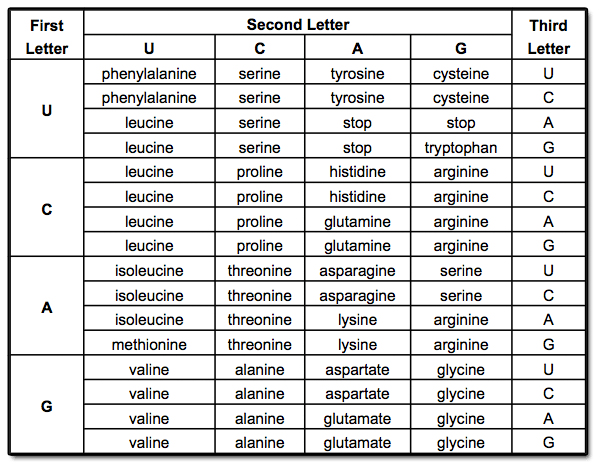
What amino acid is represented by the codon UUA?
a)
Phenylalanine
b)
Tyrosine
c)
Leucine
d)
Stop codon
80.

Mutations in ___________ can be passed from parent to offspring.

a)

somatic cells

b)

germline cells

c)

body cells

d)

autosomes

81.
Why are insertion and deletion (frameshift) mutations so harmful?
a)
They change all of the codons from the mutation on down the line, which changes the amino acid sequence
b)
They insert things that an organism doesn't need.
c)
They often delete things that organisms need.
d)
Insertion and deletions are not any more harmful than substitution mutations.
82.
What does Darwin's theory of evolution suggest?
a)
species change over time
b)
extinct species are not related to living species
c)
different species can interbreed
d)
animals that look alike are most closely related
83.

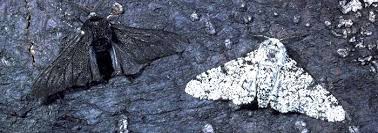
Predict which moth would increase in population.

a)

light

b)

dark

84.

Scientists compare organisms' DNA to support the theory that all species share a common _____________.

a)

separation

b)

ancestor

c)

population

d)

environment

85.

Adaptations can be:

a)

camouflage

b)

ability to survive cold weather

c)

hunting skills

d)

all of the above

86.

Which cause variations?

a)

mutations

b)

adaptations

c)

a desire to change

d)

injuries

87.

When an organism of a species has an adaptation, it will compete for resources better, survive longer and pass that adaptation on to it's offspring. This process is called _______.

a)

evolution by natural selection

b)

artificial selection

c)

inbreeding

d)

outbreeding

88.
The arrows in a food chain or web represents what?
a)
They point to the organism that is being eaten.
b)
It shows how sunlight flows within an ecosystem.
c)
They show what direction the energy is flowing between organisms. 
d)
They represent how water is transferred within a habitat.
89.
Biomass refers to
a)
Chemical Energy
b)
Light Energy
c)
Rank in the feeding heirarchy
d)
Amount of living tissue in an ecosystem
90.
What does a food web represent?
a)
All connections of energy flow throughout all organisms in a habitat.
b)
The specific ways that mutualism is carried out.
c)
A single pathway or energy flow between organisms. 
d)
How carnivores get their food. 
91.

A wolf eats a rabbit, that just ate some berries. What would you call the rabbit?

a)

Producer / Autotroph

b)

Primary Consumer / Herbivore

c)

Secondary Consumer / Omnivore

92.

If these organisms were arranged in an energy pyramid, which organism would have the least amount of total energy available?

a)

coyote

b)

insect

c)

lizard

d)

shrub

93.

ALL food chains should end with these types of organisms so that nutrients can be recycled back into a habitat…

a)

parasites

b)

predators

c)

herbivores

d)

decomposers

94.

What do we call a species that colonizes an area first?

a)

Primary species

b)

Starter species

c)

Beginning species

d)

Pioneer species

95.

How is primary succession different from secondary succession?

a)

Primary succession is faster and has pioneer species.

b)

Primary succession takes longer and starts in a new area without soil.

c)

Secondary succession has soil and starts with trees

d)

Secondary succession occurs after a disturbance and is slower that primary succession.

96.
What is the purpose of PCR?
a)
To produce millions of copies of DNA.
b)
To produce millions of copies of a specific region of DNA
c)
To add nucleotides to a DNA sequence
d)
To watch polymerase work.
97.
Which is the primary purpose of using restriction enzymes in gel electrophoresis?
a)
It allows the strands of DNA to be cut into various lengths for testing
b)
It restricts the number of base pairs that can be tested in a sample
c)
It makes the testing simpler by moving the strands into the gel faster
d)
It charges the DNA strands
98.
What is the purpose of gel electrophoresis?
a)
helps cut DNA
b)
count the genes in DNA
c)
separates DNA based on size
d)
allows for an exact replicated organism
99.

Selective breeding is where _____________ decides which traits should be passed on.

a)

nature

b)

a human

c)

traits

d)

evolution

100.

What is a population ?

a)

Disturbance has removed vegetation but left soil intact.

b)

The natural birth, growth and development of ecosystem.

c)

All organisms of a species that live in the same area.

d)

A community of interacting organisms and their environment.

101.

During which day did this population reach carrying capacity?

a)

Day 2

b)

Day 11

c)

Day 23

d)

Day 35

102.

When resources are not available a population will _____________ in size.

a)

Increase

b)

Decrease

c)

Stay the same

103.

The amount of water available limit the growth of a population?

a)

True

b)

False

c)

Unsure

104.

Parasites and diseases will ______________ the size of a population, so the are examples of limiting factors.

a)

Increase

b)

Decrease

c)

Stay the same

105.

What causes a population to reach carrying capacity?

a)

Time

b)

Number of organisms

c)

Limiting factors/resources available

106.

In the nitrogen cycle, the important work is done by ________

a)

fungi

b)

insects

c)

bacteria

d)

worms

107.

Evaporation of water from plant leaves is called _________

a)

transpiration

b)

respiration

c)

digestion

d)

oxidation

108.
Where are nitrogen-fixing bacteria found?
a)
In the soil
b)
Root nodules
c)
In dead things
d)
In the atmosphere
109.
What happens during the process of nitrogen-fixation?
a)
Nitrogen compounds turn into free nitrogen
b)
Free nitrogen turns into nitrogen compounds
110.
What is the only process that removes carbon from the atmosphere?
a)
combustion
b)
cellular respiration
c)
photosynthesis
d)
decomposition
111.

Why do living things need nitrogen?

a)

To get energy

b)

To make amino acids

c)

To make proteins

d)

To make proteins AND amino acids

112.
Which nutrient is not cycled through the atmosphere?
a)
carbon
b)
nitrogen
c)
phosphorous
d)
water
113.

What cycle are fossil fuels part of ?

a)

carbon

b)

oxygen

c)

nitrogen

d)

phosphorus

114.

What are the greatest problems facing plants, animals, and people?

a)

habitat destruction

b)

illegal hunting

c)

introducing new species that can cause problems

d)

all of the above

115.

Why do the populations of invasive species grow so quickly?

a)

Invasive Species are native to an area.

b)

Invasive species have no predators.

c)

Invasive species are prey to many animals.

d)

Invasive species keep the ecosystems in equilibrium.

116.

Human impact on the environment is often more dramatic than the impact of most other living things because humans have a greater

a)

need for water

b)

need for food

c)

ability to adapt to change

d)

ability to alter the environment

117.

What would happen in this ecosystem if the fox went extinct? Choose 2.

a)

Mouse population would increase

b)

Grasshopper population would decrease

c)

Shrew populations would decrease

d)

No impact

118.

Starting on bare rock, what is the usual ecological succession of organisms?

a)

lichens 🡪 grasses 🡪 shrubs 🡪 trees

b)

lichens 🡪 shrubs 🡪 grasses 🡪 trees

c)

grasses 🡪 shrubs 🡪 lichens 🡪 trees

d)

shrubs 🡪 grasses 🡪 lichens 🡪 trees

119.

Which experiences the least change over time?

a)

Pioneer Species

b)

Primary Succession

c)

Aquatic Succession

d)

Climax Community

120.
In the energy pyramid here, how much of the energy in the producers gets passed to the herbivores?
a)
10%
b)
20%
c)
80%
d)
90%