
 Worksheets
Yr 9 Biology revision
Total questions: 118
Worksheet time: 5hrs 25mins


Mammals are ...
Warm Blooded & Produce Milk
Cold Blooded With Feathers
Lay Eggs and Have Scales
Have Fins and Lay Eggs

Mold is most related to ...
Mushrooms
Animals
Zebras
Bears

Which cell organelle releases energy?
Mitochondria
Ribosome
Vacuole
Lysosome

Most scientists believe this is not a living organism.
Virus
Animal
Fungi
Plant

Which is linked to movement?
Locomotion
Sessile
Stagnation
Static

How plants produce food ...
Photosynthesis
Nitrogen Fixation
Decomposition
Condensation

Single Cell with membrane bound organelles
Protist
Animal
Fungus
Plant
What is binomial nomenclature?
system of 3 names
system of 2 names
the names of the kingdoms
the levels of classification
What level comes after order?
genus
kingdom
family
species
What level comes before class?
phylum
domain
order
family
All living things are made of
cells
prokaryotes
autotrophs
heterotrophs
What is a prokaryote? Choose the best description.
an organism that has nuclei in its cells
an autotroph
an organism with no membrane bound organelles.
an organism without a nucleus in its cells


All Bacteria
Prokaryote
Both
Eukaryote
DNA
Prokaryote
Both
Eukaryote
All invertebrates ____.
have a backbone
Do not have a backbone
Have hair
Have 6 legs
Arthropods have an outer covering called a(n)_________
Skin
Exoskeletons
segment body
Bones
Which group of organisms has the following features?
● three pairs of jointed legs
● three-part segmented body
● one pair of antennae
arachnids
crustaceans
myriapods
insects
What is the largest group of invertebrates?
insects
crabs
starfish
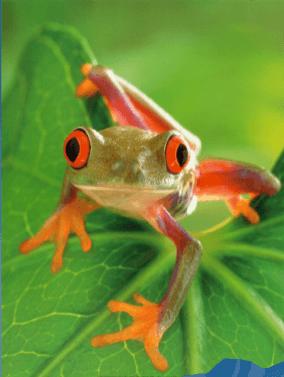
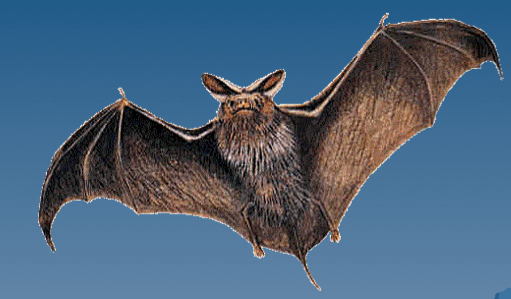
I have fur and I can fly. I feed my young on milk, and have live births. What am I?
Reptile
Bird
Mammal
Fish
Which of the following classes represents an invertebrate with 10-40 legs?
Crustacean
Arachnid
Insect
Myriapod
Which class under the phylum Arthropoda has multiple segments and each segment has jointed legs?
arachnid
crustacean
myriapod
insect
Organisms in the Kingdom Animalia are...
eukaryotic
multicellular
motile
heterotrophs
All of the above
95-98% of the animal kingdom
vertebrate
invertebrate
multicellular heterotrophs that sexually reproduce
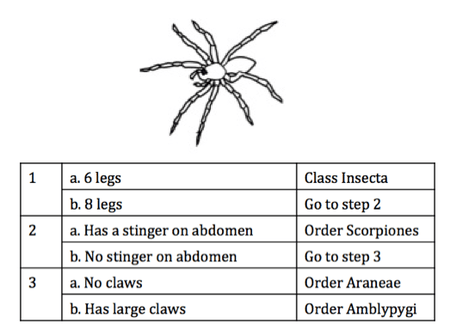

arachnids and insects?
following observations of the plant’s characteristics would be useful in determining its identity with a dichotomous key?

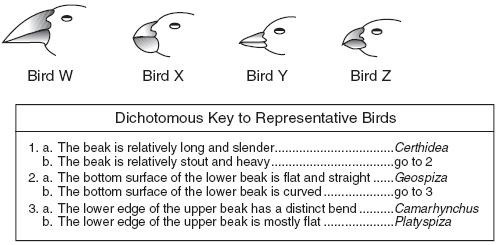


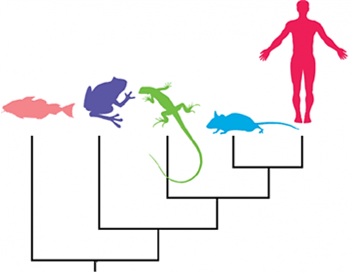
What is the human most closely related to?
Fish
mouse
Salamander
Human

Where is the alligator and T. rex's common ancestor?
Point A
Point B
Point C
Point D
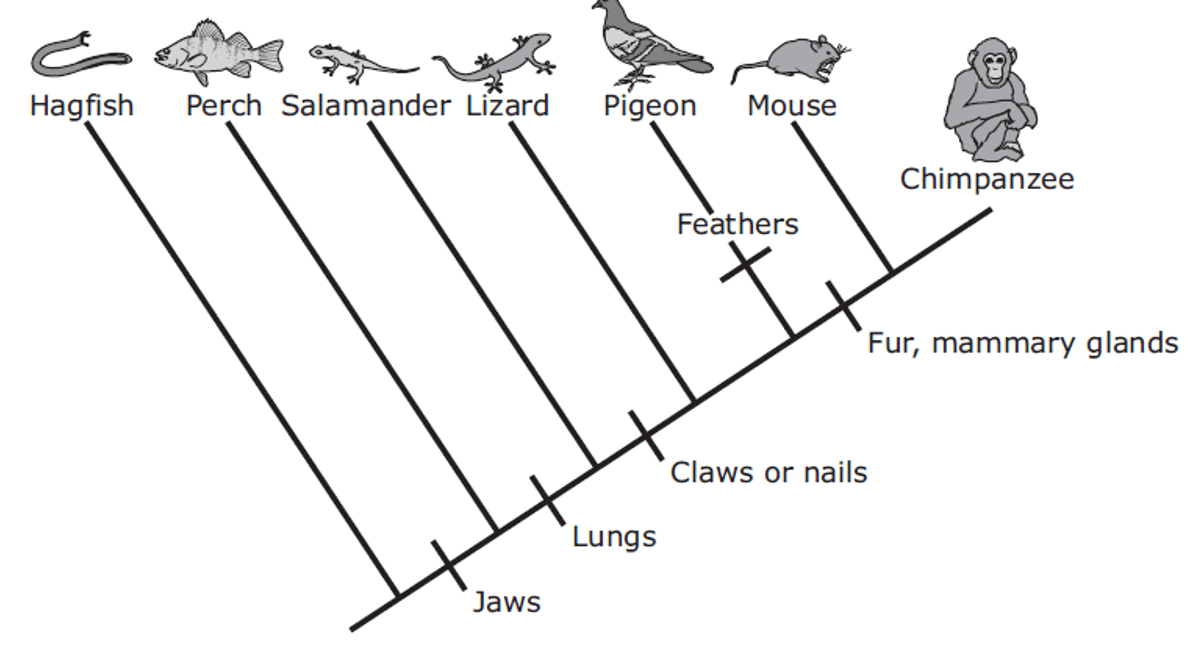
What is the purpose of a cladogram?
To map the ancestral relationships and shared traits of different organisms.
To trace the inherited traits of a single species over time.
To check the likelihood of an offspring having a particular trait.
To monitor mutations that arise among different populations.

Which letter represents the most recent common ancestor of sponges and mushrooms?
A
B
C
D
E
What type of cells are adapted to perform a specific function?
All cells
Animal cells
Plant cells
Specialised cells
Root hair cells are adapted to:
Absorb water
Transport water
Absorb oxygen
Transport oxygen


Plants that reproduce by spores
Mosses & liverworts (Bryophyta)
Ferns & Horsetaills (Pteridophyta)
Conifers (Pinophyta)
Gincos & cyads (Cycodophyta)

How is a leaf cell adapted for absorbing light efficiently?
It has a cellulose cell wall
It has a large vacuole
It has lots of chloroplasts
It has a large nucleus

Suggest the job of a cell that has lots of folds on its surface, giving it a large surface area
Absorption
Movement
Protection
Secretion
What is a tissue?
A group of different cells performing the same function
A group of similar cells performing the same function
A group of different cells performing the same function
A group of different cells performing different functions

What is an organ?
A group of similar tissues performing the same function
A group of similar tissues performing different functions
A group of different tissues performing the same function
A group of different tissues performing different functions
What it the correct order, from smallest to largest?
Cell
Organ
Tissue
Organ system
Organism
Tissue
Cell
Organ system
Organ
Organism
Cell
Tissue
Organ
Organ system
Organism
Cell
Tissue
Organ system
Organ
Organism
What is the function of red blood cells? You may choose more than one answer.
absorb water and mineral salts
transport water and mineral salts
transport oxygen
transport carbon dioxide
How are red blood cells adapted to perform their function? You may choose more than 1 option.
biconcave shape
long and narrow extension
no protoplasm
no nucleus
contain haemoglobin
When a virus attaches to a host, what does it inject into the host?
Protein coat
DNA/genetic material
Capsid
Envelope
A virus consists of:
RNA or DNA and a cell membrane
RNA or DNA and a protein coat
RNA and DNA and a protein coat
proteins, cell membrane, and RNA
What is the outside protective coating of a virus made of?
lipids
carbohydrates
protein
carbon
What reason do scientists give for saying that viruses are not living organisms?
they cannot reproduce without the aid of a host
they do not metabolize food into energy
they do not have organized cells
all of the above
none of the above


protects and supports plant cells
cell wall
cell membrane
mitochrondria
cytoplasm

Convert's the sun's energy to food for the cell
chloroplast
nucleus
endoplasmic reticulum
lysosome

storage area for the cell
vacuole
cytoplasm
chloroplast
cell wall

builds proteins for cell functions
ribosomes
mitochondria
nucleus
lysosome

command center, direct's the cell's activities
nucleus
lysosome
mitochondria
endoplasmic reticulum
mitochondria
Flowering plants can be divided into 2 categories
monocots
dicots
monosperm
dicsperm
The preformed leaf in the seed, first to emerge when seed germinates
cotyledon
monosperm
angiosperm
Plants are _________________ which means they make their own food.
heterotrophs
chemotrophs
autotrophs
liveotrophs
Which types of plants produce asexually with spores?
mosses & gymnosperms
mosses & angiosperms
angiosperms & gymnosperms
mosses & ferns


If we were to look at a bacterial cell down a microscope and observe an image size of 2.5 mm, and we are using a magnification of x400, what is the actual size of the bacteria?
100
1000
0.00625
0.05
Match the following:
Chloroplast
Site of photosynthesis
Mitochondria
Site of respiration
Cytoplasm
Site of most chemical reactions
Cell membranes
Controls substances coming in/out
Cell wall
Provides support for the cell

Reorder the following steps to using a microscope properly:
Put the sample on a slide
Add a chemical stain
Place a coverslip on the stained sample
Place the prepared slide on the stage
Look at the sample using the lowest objective lens
Which of these pictures most likely shows a plant magnified under a microscope?


How many micrometers (µm) = 1 mm?
1,000
1,000,000
10,000
100,000


To calculate actual size we use.....
image size ÷ magnification
image size x magnification
magnification ÷ image size


Josie measured the scale bar image to be 80 mm. What is the magnification of this electron micrograph?
160X
0.00625 X
0.16X
25,000X

Serena measured the image of one of the bacterial cells to be 32 mm. If the magnification of the image is 8,000X, what is the actual size of the bacterial cell?
4 μm
0.004 μm
256,000 μm
0.25 μm

If an eyepiece lens has a magnification of X10 and the objective lens has a magnification of x10
What is the total magnification of the microscope?
100
10
An experiment was done to measure the water loss when a leaf is dried out. The mass of the leaf was 2 g at the start. After a week the mass was 0.3 g. Calculate the percentage change.
1.7g
-1.7%
-85%
-170%
Calculate the percentage increase of a plant with an initial mass of 90 g and a final mass of 120 g.
30%
25%
75%
70%

